
.svg)

CBSE Class 12 is the most important academic year for students, as Board exam performance directly affects college admissions, entrance exam eligibility (JEE, NEET, CUET) and future career pathways. For the 2026-27 session, students should follow the latest CBSE curriculum and use reliable, updated study material to build strong concepts, practise extensively and revise systematically for the Board Exam 2027.
Educart brings all essential CBSE Class 12 study material for 2026-27 together in one place - the latest syllabus, NCERT books, NCERT solutions, notes, important questions, question banks, sample papers and previous year question papers.
Whether you're starting your Class 12 preparation, working through chapter-wise practice, or revising before the Boards, use the resources below to plan your preparation stream-wise and subject-wise.
CBSE Class 12 Subjects 2026-27
Class 12 subjects are organised by stream. Students should check the exact combination applicable to their school.
Science Stream
- Physics
- Chemistry
- Mathematics
- Biology
- English Core
- Computer Science / Informatics Practices
- Physical Education
Commerce Stream
- Accountancy
- Business Studies
- Economics
- English Core
- Mathematics / Applied Mathematics (optional)
- Informatics Practices
Humanities / Arts Stream
- History
- Political Science
- Geography
- Sociology
- Psychology
- English Core
- Economics (optional in some schools)
Students should check the subject-wise CBSE curriculum applicable to their chosen stream before beginning preparation.
CBSE Class 12 Syllabus 2026-27
The CBSE Class 12 syllabus 2026-27 is the foundation of Board exam preparation. It defines the chapters and topics to be covered, the course structure, prescribed textbooks and theory–practical/project weightage for each subject.
Use the syllabus to:
- Check all chapters and topics for each subject.
- Understand subject-wise course structure and unit weightage.
- Identify prescribed textbooks and reference material.
- Check theory, practical and internal assessment/project requirements.
- Plan a stream-appropriate study schedule.
- Track completed and pending topics during revision.
Tip: Since Class 12 subjects carry both theory and practical/project weightage, use the syllabus to separately track theory chapters and practical/project requirements - don't let practicals slip to the last month.
Check the CBSE Date Sheet 2027 for Class 12 board exam dates and start planning your revision schedule.
CBSE Class 12 NCERT Books 2026-27
NCERT textbooks Class 12 form the core of Class 12 preparation. They cover the prescribed concepts, derivations, examples and exercises students need to master before moving to additional practice material - this matters even more in Class 12 since many entrance exams (JEE, NEET) are also NCERT-based.
How to Use NCERT Books Effectively
- Read each chapter carefully and understand the underlying concepts.
- Work through all in-text and end-of-chapter exercises.
- Mark formulas, derivations, diagrams and definitions for quick revision.
- Make short notes for numerically or conceptually heavy chapters.
- After finishing a chapter, move to additional question practice.
- Revisit the NCERT chapter whenever you make a mistake in a sample or PYQ paper.
Best CBSE Class 12 Books 2026-27
Along with NCERT textbooks, students can use reference and practice books for deeper preparation - especially important in Class 12, where practicals and projects carry real marks weightage.
Which Class 12 Book Should You Choose?
Match the book to your preparation stage: question banks for chapter-wise and competency practice, sample/solved papers for exam simulation, exemplar books if you're also targeting JEE/NEET-level depth, and lab manuals to stay on top of practical/project deadlines through the year.
Explore All CBSE Class 12 Books 2026-27
CBSE Class 12 Notes 2026-27
CBSE Class 12 Notes are built for fast, chapter-wise revision once you've already studied the concept in depth - useful for last-minute formula, definition and diagram recall.
Use notes alongside your NCERT textbook, not as a replacement - during revision, spend the most time on the topics where you consistently lose marks.

CBSE Class 12 Important Questions 2026-27
Practising CBSE Class 12 Important Questions builds familiarity with high-weightage concepts and different question formats, especially case-based and assertion-reasoning types now common in Board papers.
Important questions help with:
- Chapter-wise revision
- Concept reinforcement
- Weak-topic identification
- Application and case-based question practice
- Faster, more structured answer writing
- Final pre-Board revision
Don't rely on important questions alone - pair them with the full syllabus, NCERT, sample papers and PYQs for complete coverage.
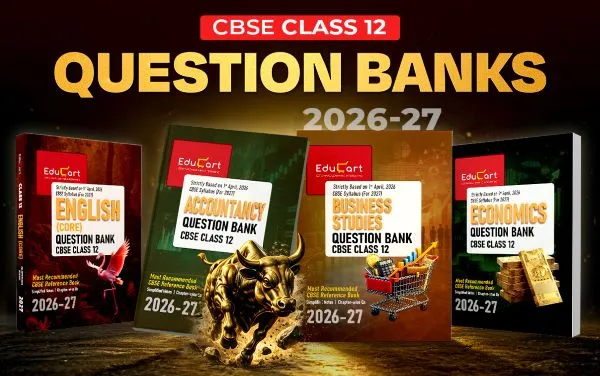
CBSE Class 12 Question Bank 2026-27
A CBSE Class 12 Question Bank covers a wider mix of question types than the textbook alone - objective, competency-based, case-based, assertion-reasoning, short and long-answer formats.
How to Use a Question Bank
- Finish the relevant chapter from NCERT first.
- Attempt a mixed set of questions without checking answers.
- Review mistakes and revisit the underlying concept.
- Flag questions for a second attempt later.
- Revisit flagged/difficult topics during final revision.
CBSE Class 12 Sample Papers 2026-27
CBSE Class 12 Sample Papers 2026-27 simulate the actual Board paper format - essential for practising time management, question-type distribution and answer-writing under exam pressure.
Sample papers help you:
- Get familiar with the exact paper pattern and marking scheme.
- Practise case-based and competency-based questions.
- Build time-management discipline.
- Identify chapters needing more revision.
- Test preparation under real exam-length conditions.
- Improve answer presentation and structure.
How to Solve a CBSE Class 12 Sample Paper
Treat each sample paper as a real exam - follow the prescribed time limit strictly, attempt the full paper without referring to solutions, then evaluate afterward. Log every mark lost and revisit that specific concept before the next attempt.
Note: Sample papers are practice tools, not a guarantee of what will appear in the actual Board exam.
CBSE Class 12 Previous Year Question Papers
Solving CBSE Class 12 Previous Year Question Papers shows students exactly how concepts have been tested across past Board exams - one of the most reliable ways to gauge exam readiness.
PYQs help you:
- Understand recurring question formats and patterns.
- Practise full papers within a fixed time limit.
- Identify frequently-tested topics.
- Build speed and accuracy under pressure.
- Get an honest read on Board-exam readiness.
How to Use Previous Year Papers
Solve PYQs after finishing the related syllabus portion. Closer to the Boards, attempt full papers under timed conditions and analyse every mistake - was it a conceptual gap, a calculation slip, an incomplete answer, or a time-management issue?
CBSE Class 12 Exam Pattern 2026-27
Understanding the CBSE Class 12 exam pattern helps students prepare for the exact mix of question types and allocate practice time accordingly. Marks distribution varies by subject, so always cross-check with the latest official CBSE curriculum document.
Class 12 papers typically test a mix of:
- Objective/MCQ-based questions
- Short-answer questions
- Long-answer questions
- Case-based and source-based questions
- Assertion-reasoning questions
- Numerical/derivation-based questions (Science stream)
- Application and competency-focused questions
Unlike most Class 10 subjects, several Class 12 subjects also carry a separate practical or project component (Physics/Chemistry/Biology practicals, Computer Science practicals, Accountancy/Business Studies project work) - these marks are assessed independently of the theory paper and should be prepared for on their own timeline.
CBSE Class 12 Board Exams 2027 - What Students Should Know
Class 12 Board results carry weight beyond the certificate itself - they factor directly into college admission cutoffs, and for many students, into eligibility and preparation overlap with entrance exams like CUET, JEE and NEET.
Students preparing for the 2027 Board Exams should track:
- Official Board examination notifications
- Date sheets
- Subject-wise curriculum updates
- Official sample papers and marking schemes
- Practical/project examination schedules
- Admit card and result updates
- Post-result facilities (rechecking, revaluation)
(Note: CBSE's two-attempt Board exam system currently applies to Class 10, not Class 12 - verify the latest official CBSE notification before publishing this section, since policy can change.)
CBSE Class 12 Preparation Tips for 2027
1. Start With the Latest Syllabus Use it as your checklist - confirm every chapter, including practical/project components, is accounted for.
2. Build Strong NCERT Concepts Read NCERT chapters thoroughly and solve every in-text and exercise question before moving to reference material.
3. Follow a Realistic, Stream-Aware Study Schedule Split time across subjects based on your stream's weightage, your strengths, and upcoming practical/project deadlines.
4. Practise Questions Regularly Mix chapter-wise, competency-based and case-based questions throughout the year, not just before exams.
5. Solve Sample Papers and PYQs Once a good portion of the syllabus is done, start full-length timed practice.
6. Analyse Your Mistakes Maintain a mistake log - recurring errors matter more than a single low score.
7. Revise in Multiple Rounds Plan at least 2–3 revision cycles using notes, formulas and flagged important questions.
8. Stay Ahead on Practicals and Projects Don't let lab work, project files or viva prep pile up in the final weeks - these carry real, non-recoverable marks.
9. Improve Time Management and Presentation Practise completing full papers within the time limit, and structure answers clearly with correct steps, diagrams or headings as required.
CBSE Class 12 Study Plan
Stage 1: Learn
- Follow the CBSE Class 12 Syllabus, stream-wise.
- Complete NCERT textbooks.
- Understand concepts, derivations and examples.
- Make short revision notes.
- Flag difficult chapters early.
Stage 2: Practise
- Solve NCERT exercises fully.
- Practise important questions.
- Use question banks for extra format variety.
- Work through case-based and competency questions.
- Complete practicals/projects alongside theory - don't defer them.
Stage 3: Test and Revise
- Solve full-length sample papers.
- Attempt previous year papers under timed conditions.
- Analyse mistakes after every attempt.
- Revise formulas, concepts and flagged topics.
- Do a final practical/viva run-through before exams.
This creates a learn → practise → test → revise cycle, same as Class 10 but with practicals and projects tracked as a parallel fourth thread.
Frequently Asked Questions
Q1. What is the CBSE Class 12 syllabus for 2026-27?
Ans. The CBSE Class 12 syllabus 2026-27 lists the prescribed subjects, chapters, topics, course structure, and theory/practical assessment details for the session. Always refer to the latest official syllabus for Board Exam 2027 prep.
Q2. Which books should I use for CBSE Class 12 preparation?
Ans. NCERT textbooks should form the base. Supplement with notes, important questions, question banks, sample papers, PYQs, and lab manuals for practicals.
Q3. Are NCERT books enough for CBSE Class 12?
Ans. NCERT is essential for building the prescribed conceptual foundation, and is also the base for entrance exams like JEE and NEET. For deeper practice, add question banks, sample papers, exemplar books and PYQs.
Q4. Where can I find CBSE Class 12 sample papers 2026-27?
Ans. Subject-wise sample papers are linked on this page. Also check the official CBSE Academic website for the latest official sample papers.
Q5. How many previous year papers should I solve for Class 12?
Ans. There's no fixed number - solve enough to become comfortable with the format, improve timing, and expose recurring weak areas.
Q6. When should I start solving Class 12 sample papers?
Ans. Start chapter-wise practice as topics are completed, then move to full-length timed sample papers once a substantial part of the syllabus is done.
Q7. How can I prepare for the CBSE Class 12 Board Exam 2027?
Ans. Start with the syllabus and NCERT, build concepts thoroughly, practise regularly across question types, stay current on practicals/projects, solve sample papers and PYQs under timed conditions, and revise in multiple rounds.
Q8. How much weightage do practicals and projects carry in Class 12?
Ans. This varies by subject - Science subjects (Physics, Chemistry, Biology, Computer Science) and some Commerce subjects (Accountancy, Business Studies) carry separate practical/project marks alongside the theory paper. Check the subject-wise syllabus for exact weightage.
Q9. How do Class 12 Board marks affect college admissions?
Ans. Many undergraduate admissions - including through CUET - factor in Class 12 Board performance alongside entrance scores, so consistent Board preparation supports both outcomes.
Q10. What are the most important resources for CBSE Class 12?
Ans. The latest syllabus, NCERT textbooks, NCERT solutions, notes, important questions, question banks, sample papers, PYQs, and lab manuals for practicals.
Q11. How can I score well in CBSE Class 12?
Ans. Follow the syllabus, master NCERT concepts, practise regularly across question formats, stay on top of practicals/projects, solve timed sample papers and PYQs, and revise multiple times with mistake analysis.
Q12. Where can I find the latest CBSE Class 12 updates?
Ans. Check the official CBSE and CBSE Academic websites for announcements, and follow Educart's Class 12 update and resource pages for study material.











.svg)

