Chemistry is about more than memorising reactions & formulas. Students need to understand key concepts, properties, and reactions of different substances, important equations and calculations. CBSE Topper Answer Sheet Class 12 Chemistry provide a holistic view of how toppers structure their answers, present chemical equations, and approach different question types in board exams.
Educart has compiled year-wise CBSE Class 12 Chemistry topper answer sheets to help students understand effective answer presentation and writing formats. These answer sheets reveal how students present and structure their answers to score high in the final board exam.
Year-Wise CBSE Topper Answer Sheet Class 12 Chemistry PDF Download
Students can access CBSE Class 12 Chemistry topper answer sheets from current to previous years (2014-2024) to see how students have attempted the board examination papers. Students can use them to learn to explain and present numerical solutions, chemical equations, and reactions in a format CBSE prioritises.

How to Write Topper-Style Answers in the CBSE Class 12 Board Exam
Topper answer sheets are not meant to show how a topper completed the entire question paper. Instead, they help students understand the approach used to tackle each type of Chemistry question.
Analysing these answer sheets enables students to structure their answers in a topper’s style. For numerical-driven questions, use the correct formula and method, substitute values, and show the result with correct SI units. Also, understand how they balance chemical equations, interpret reasoning-based answers, draw labelled diagrams, and underline keywords to write structured answers.
What Class 12 Toppers Write in a Chemistry Answer?
Topper answer sheets are the best reference to see answer presentation and writing formats CBSE examiners expect. Here are some important answer-writing practices to observe and apply in your own Chemistry paper:
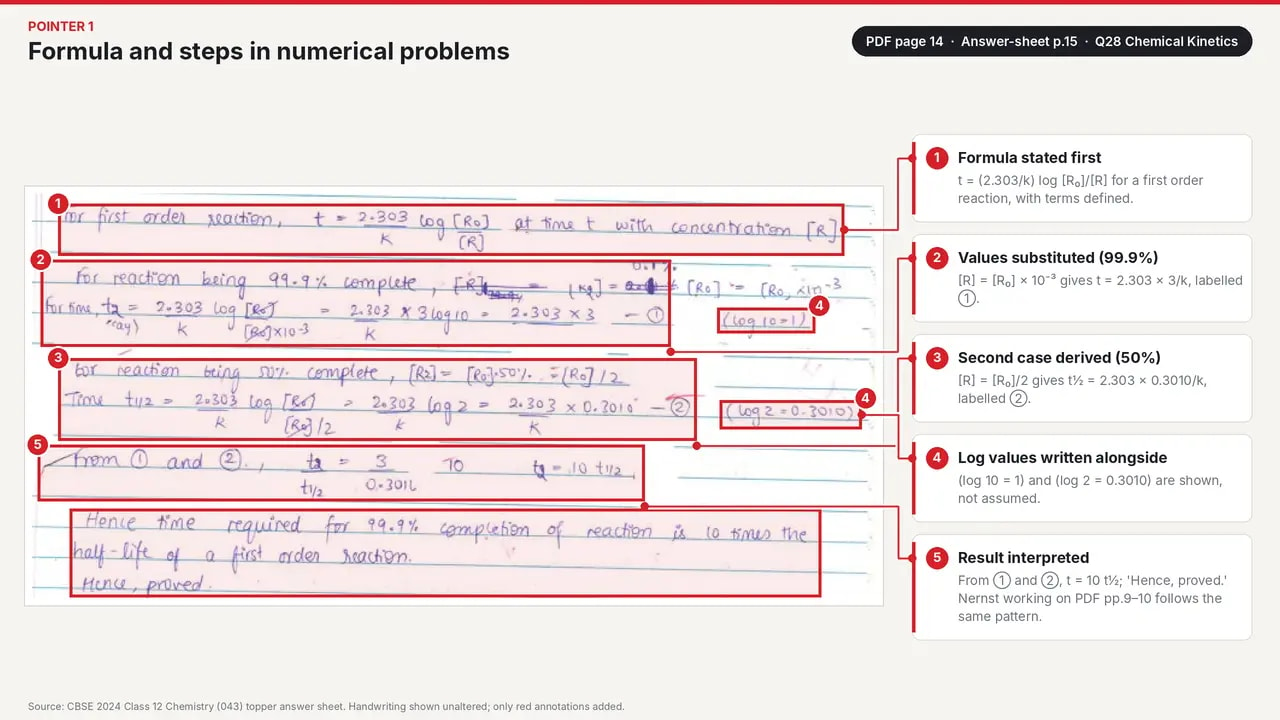
1. Show the formula and steps in numerical problems
Focus on numerical-heavy chapters, like Electrochemistry and Chemical Kinetics and practice solving them without looking at the solution. Learn the formulas, understand their applications, observe how values are substituted, practice logarithmic calculations and interpret the final results.
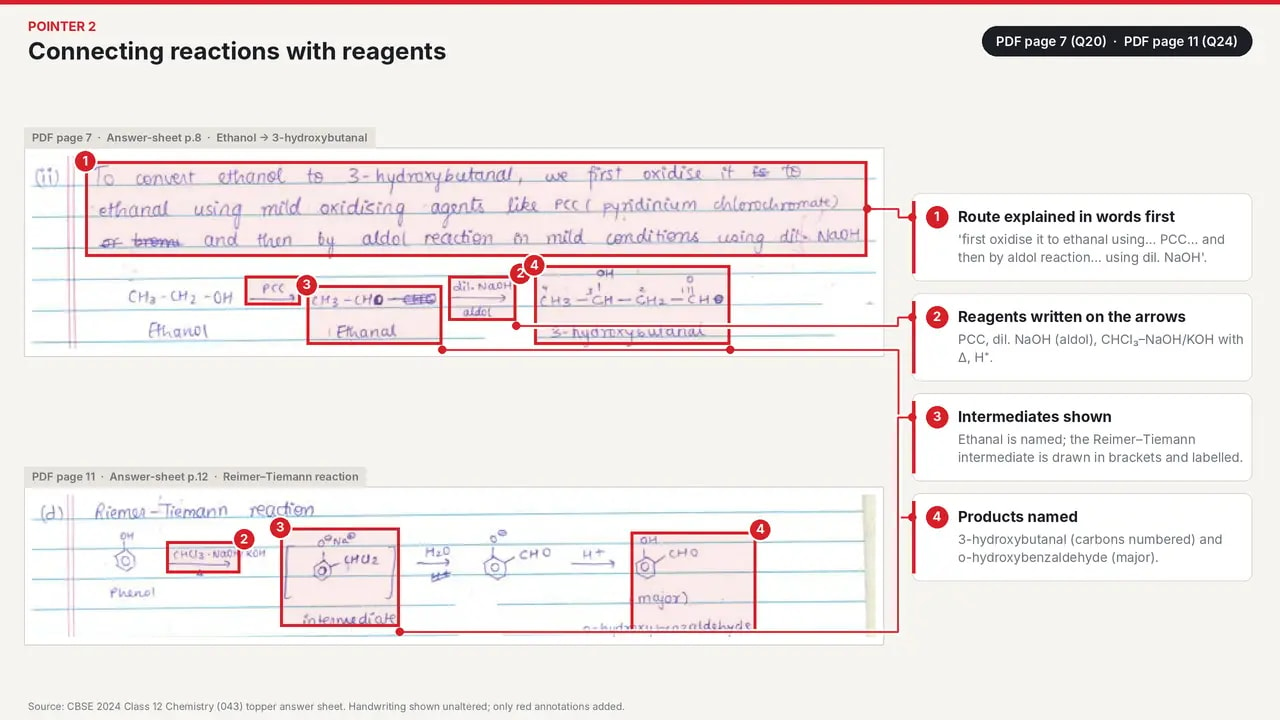
2. How reactions are connected with reagents
In Organic Chemistry, analyse how students select the right reaction conditions and reagents to convert one compound to another. When solving a conversion-based question, show intermediate compounds, mention reagents, and products in multi-step conversions.
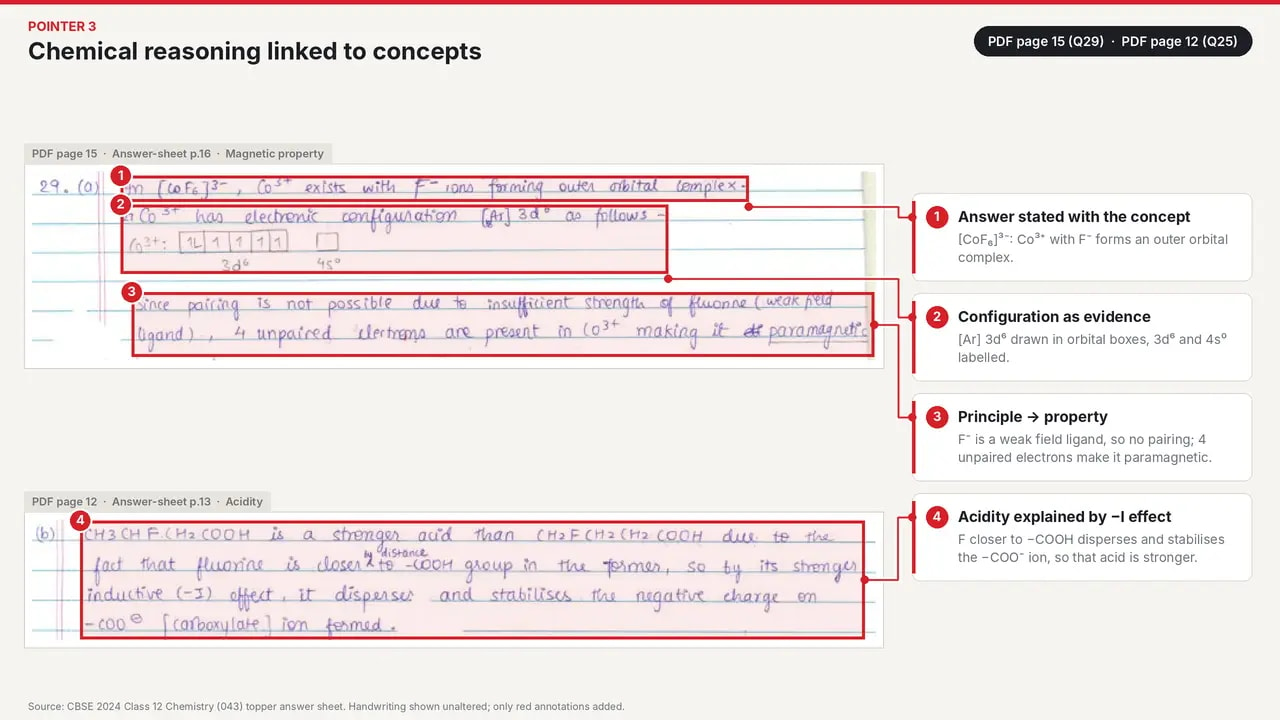
3. Explain chemical reasoning with relevant concepts
For questions involving acidity, basicity, oxidation state, magnetic properties, and reaction behaviour, connect the answer with the related chemical principles. Understand the approach toppers use to link concepts to create a meaningful explanation.
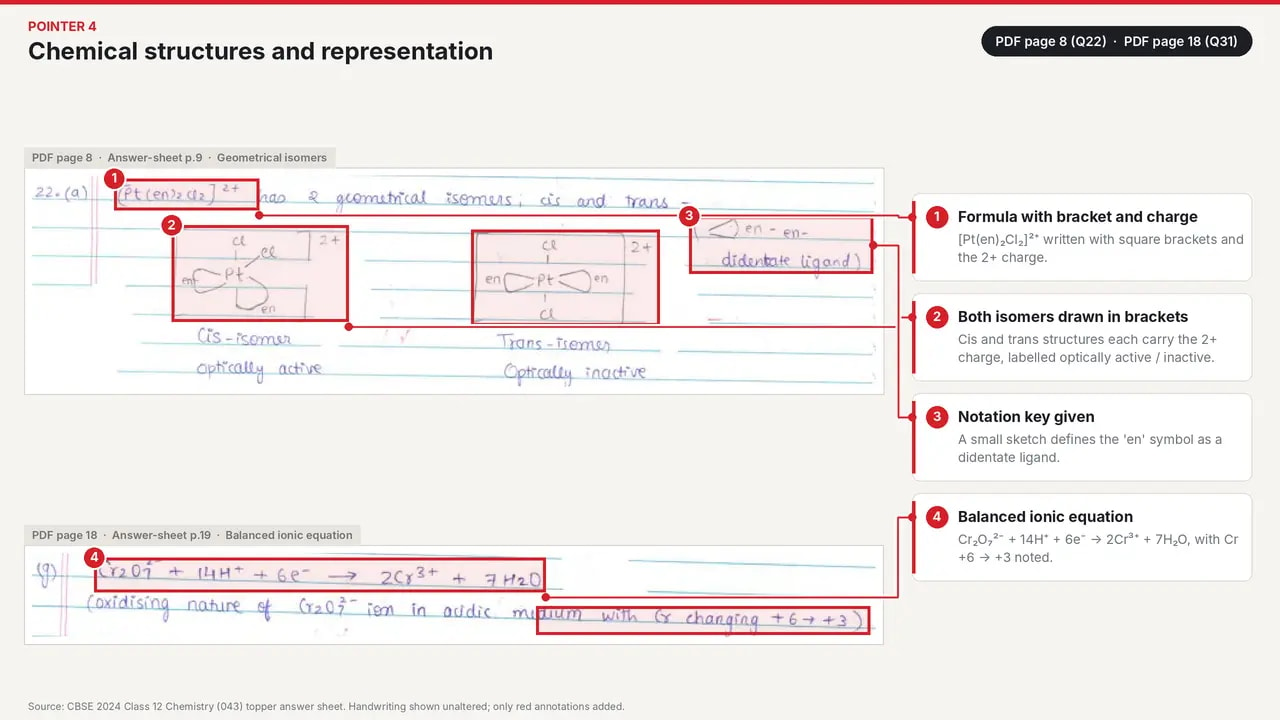
4. Understand chemical structures and representation
Learn how to represent coordination compounds, organic structures and balanced chemical equations neatly. Pay attention to the use of brackets, charges, subscripts, reaction arrows, and other chemical notation.
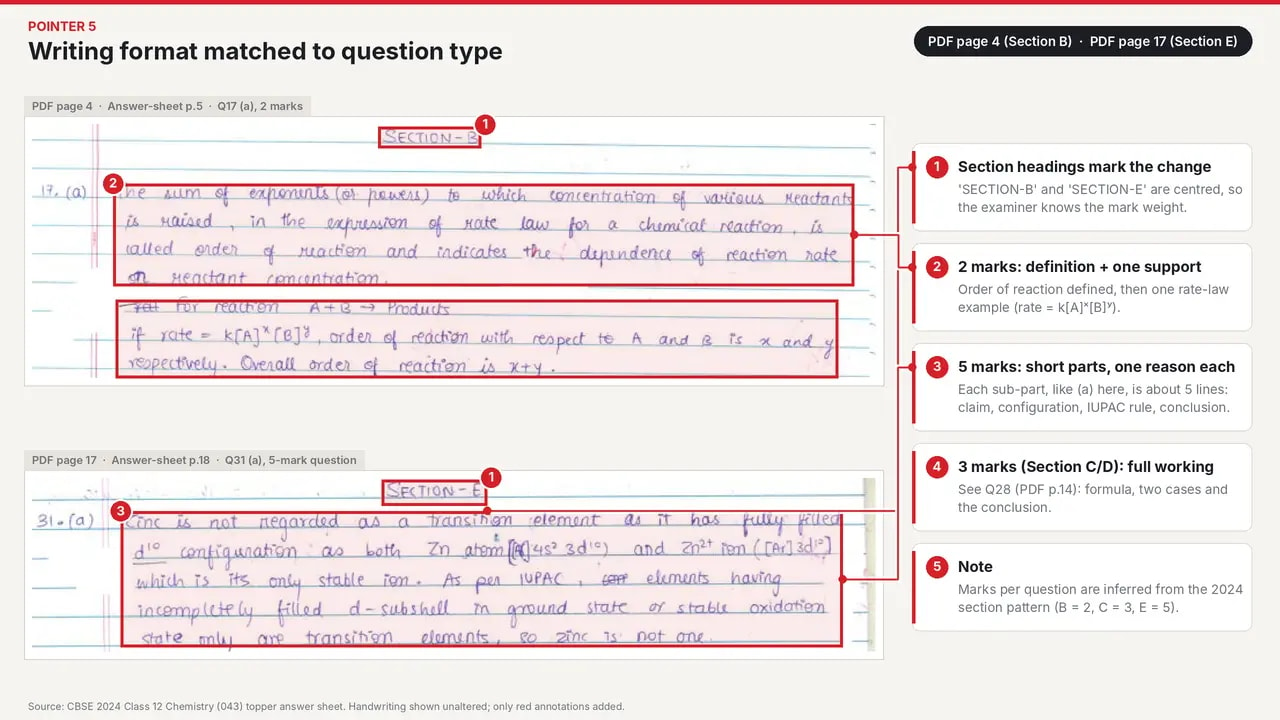
5. Align writing formats for each question type
CBSE Class 12 Chemistry topper answer sheets explain how much explanation, working, or chemical expression is needed in each 2-mark, 3-mark, and 5-mark question. This may help students divide their time effectively, keep their answers to the point, and avoid unnecessary information.
Points to Remember (Last-Minute Prep)
As the CBSE Class 12 Chemistry Board Exams approach, students should revisit important concepts and strengthen their application skills. Here are some tips to remember in last-minute preparation:
- Revise NCERT Examples: Go through important questions, solved examples and end-of-chapter exercises given in NCERT Class 12 Chemistry textbooks.
- Review Chemical Properties: important trends, reactions, oxidation states, properties of d- and f-block elements.
- Summary of Important Formulas: Review Class 12 Biology Notes to revise important formulas in solutions, electrochemistry and chemical kinetics. Practise applying them to numerical questions.
- Practice Coordination Compounds: Revise IUPAC nomenclature, bonding, isomerism and properties of coordination compounds.
- Solve a Timed Sample Paper: Attempt the latest CBSE sample paper as timed practice to understand the question paper format and the importance of time management.
- Check Writing Formats: Keep in mind balanced equations, correct chemical structure, numerical steps, and appropriate units.
Recommended Class 12 Books for 2027 Board Preparation
Explore more revision books to improve Class 12 Chemistry Board exam preparation and boost confidence. These books help you strengthen conceptual understanding, practise numerical questions and solve different question types.
Explore More Class 12 Chemistry Resources
Go through these additional Class 12 Biology study references to strengthen your preparation, understand key concepts and practice important questions expected in the CBSE board exam.
FAQs
Q1. Why do CBSE Class 12 Chemistry topper answer sheets matter for board preparation?
Ans. Topper answer sheets show high-scoring students' answers to real board questions. They help students structure and present numerical solutions, write chemical equations, explain chemical reactions and organise theoretical answers.
Q2. What can students learn from Chemistry topper answer sheets?
Ans. Focus on numerical solutions in Physical Chemistry, conversions in Organic Chemistry, and chemical reasoning and nomenclature in Inorganic Chemistry. Each category requires a different answer-writing approach, so practising them means a lot.
Q3. How to do conversions in Organic Chemistry?
Ans. Students should demonstrate the starting compound, appropriate reagent, reaction conditions and final product. If two or more steps are required, each intermediate compound must be shown in the appropriate order.
Q4. How can topper answer sheets help with Physical Chemistry numericals?
Ans. Topper sheets show how students use formulas, substitute values, show working and provide final answers. Students can read examples to identify what they are missing in their numerical presentation and to enhance their numerical skills.