The CBSE Class 9 syllabus changes 2026-27 brought major changes to the Class 9 curriculum. The new syllabus mainly shifts towards a more competency-based and multidisciplinary school curriculum.
CBSE included revised options for Mathematics and Science. It also emphasises computational thinking as well as the use of AI modules. At the same time, it also opens up vocational education and additional interdisciplinary learning for students.
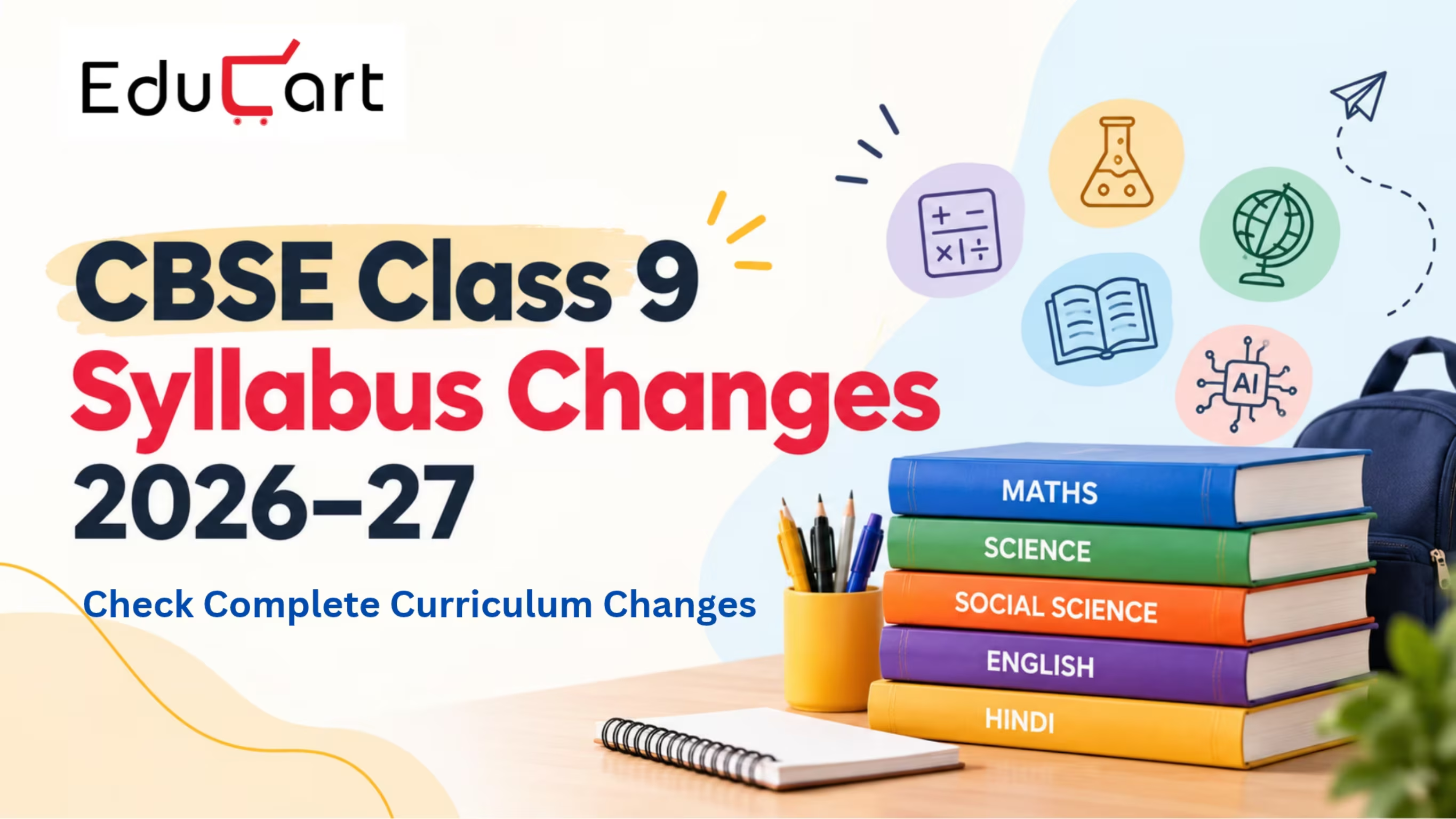
In this article, we are going to discuss the major changes in the syllabus and the curriculum of Class 9. The subject-wise changes and addition of new subjects will be discussed thoroughly. This page also underlines the changes by presenting them in a table.

Key Changes in the Latest Class 9 Curriculum 2026-27
The CBSE Class 9 syllabus changes align with the National Education Policy NEP, 2020, and the National Curriculum Framework for School Education, 2023. The changes aim to enhance conceptual learning and strengthen practical application of knowledge. In the new syllabus, a few key changes can be seen in the curriculum. The revised structure of the CBSE Class 9 syllabus changes is discussed below:
- Two levels of Science and Mathematics: The new syllabus of Class 9 introduced Advanced and Basic options for both Science and Maths.
- Addition of CT and AI: Computational Thinking and Artificial Intelligence are treated as compulsory components of the curriculum.
- Introduction of a Broader Curriculum: The scheme of education adds vocational education, individuals in society, art education, and physical education and well-being.
- Language Choice: Students have to study two Compulsory Languages (R1 and R2) along with one optional language (R3). R3 can be any native or foreign language.
- Revised Learning Approach: The new framework allows students to study through competencies, experiential learning, and interdisciplinary connections.
Subject-Wise Changes in the CBSE Class 9 Syllabus 2026–27
There can be seen various changes in the subjects of Class 9. The CBSE Class 9 syllabus changes affect all the subjects of Class 9 to align the curriculum with NCFSE, 2023. The subject-wise changes are discussed below.
Mathematics
- Addition of two pathways: Students can choose either Advanced or Basic Maths in Class 9 based on their capabilities.
- Increase in chapters: The number of chapters increased from 12 to 15. It adds topics like Arithmetic Progression, Pair of Linear Equations in Two Variables, etc.
- Changes in the Chapters: The Polynomials chapter is split into two parts for better learning.
Science
- Two Science levels: CBSE also added Advanced and Basic pathways in Science. Standard level will carry 80 marks, and it’ll be compulsory for all. The advanced level will be an optional subject for students for deep analytics/JEE/NEET baseline, which will carry an additional 25 marks.
- Practical Knowledge: The new curriculum broadens science towards scientific inquiry, evidence-based reasoning, and practical activities.
- Changes in the Chapters: The number of chapters is reduced from 12 to 11. The biology and Earth Science topics have been expanded.
Social Science (SST)
- One Book: There will be only one unified book for Geography, History, Civics, and Economics. However, the textbook is “Understanding Society: India and Beyond”, divided into two parts.
- India-focused: The topics of SST will focus more on India-centric surroundings and real-life-based contexts.
- Interdisciplinary Learning: The new curricular framework promotes connections between disciplines. Also, it encourages students to examine society, history, geography, and civic life through inquiry and real-world contexts.
Languages
- Core Component: Learning of Language is one of the core components of the curriculum. For English, the Communicative English option is discontinued. The old Hindi ‘Course A’ and ‘Course B’ have been merged. The textbook has been named “Ganga”.
- Compulsory and Optional languages: The students must study three languages (R1, R2, R3)
- R1: Any Language offered by CBSE (Compulsory)
- R2: Language other than the one offered as R1 (Compulsory)
- R3: Language other than the one offered as R1 and R2 (Optional)
- Wider Focus: The new curriculum of the syllabus of Languages focuses on a wider area. The syllabus in languages focuses on listening, speaking, reading, and writing skills to enhance proficiencies in all the areas.
Skill-based Subjects
These subjects aim to enhance students' analytical thinking and introduce them to foundational AI literacy. It will help them in further studies and research in the future.
- CT as Foundational Skill: The new Class 9 Syllabus treats Computational Thinking as one of the foundational skills.
- Aim for AI literacy: The syllabus also mentions the integration of AI literacy across all the subjects.
- CT and AI in activities: CT and AI literacy have been introduced in classroom activities such as Projects, worksheets, and so on. Also, CT & AI will be a compulsory subject from the session 2027-28.
Arts, Vocational, and Physical Education
These four subjects have been treated as compulsory subjects as per the NCERT Class 9 syllabus change.
- Art Education: Art education from Class 9 will emphasise imagination and aesthetic sensibility. It involves students' engagement with Visual Arts, Music, Theatre, and Dance.
- Education in Interdisciplinary Area: The new syllabus of Class 9 adds the textbook “Individual in Society”. It will enhance multidisciplinary learning, values, environmental consciousness, and ethical reasoning.
- Vocational Education: This subject will help students understand Work with Life Forms, Work with Machines and Materials, as well as Work in Human Services.
- Physical Education and Well-Being: The new syllabus for Class 9 focuses on holistic development. It integrates physical fitness, mental well-being, resilience, cooperation, and sportsmanship.
CBSE Class 9 Syllabus Changes 2026–27: Before vs After
The table below analyses the changes by comparing the old syllabus of Class 9 with the new syllabus of Class 9 2026-27. Go through all the points to understand the CBSE and NCERT Class 9 syllabus changes.
What are the Benefits of Revised CBSE Class 9 syllabus for students?
This CBSE Class 9 syllabus change has been made for the positive development of the students. The probable effects or the benefits of the changes are underlined below.
- Better conceptual understanding: It is a move towards making a better competency-based school curriculum. It focuses more on students’ conceptual learning rather than only memorising topics.
- More flexibility: The addition of advanced pathways in Maths and Science may allow students to select learning levels. Moreover, it will be entirely based on their needs and abilities.
- Improved Digital and Analytical skills: The emphasis on CT and AI may help students in terms of digital and analytical skills. It may also affect students' problem-solving through Computational Thinking.
- Broader learning opportunity: The CBSE syllabus change supplements Arts, Vocational, and Physical Education to the curriculum. This may enlarge the chances of students’ artistic, health, and creative growth.
- Emphasis on Holistic Development: Overall, the NCERT Class 9 syllabus change in the textbook aims at students' 360-degree development.
FAQs
Q1. What are the major changes in the CBSE Class 9 syllabus for 2026–27?
Ans. The revised curriculum introduces Mathematics and Science pathways, compulsory CT and AI modules, vocational education, interdisciplinary learning, and broader skill development.
Q2. Are Basic and Advanced Mathematics compulsory for Class 9 students?
Ans. No, students study either Mathematics or Mathematics Advanced, depending on their chosen pathway and the school’s implementation of CBSE guidelines.
Q3. Is Artificial Intelligence compulsory in the new Class 9 syllabus?
Ans. Yes, Computational Thinking and Artificial Intelligence modules are compulsory in Class 9 during and after the 2026–27 academic year, with school-based assessment.
Q4. How many languages must Class 9 students study in 2026–27?
Ans. CBSE requires two languages at R1/R2 levels; an optional third language may be taken under transitional provisions for 2026–27.
Q5. How will the new Class 9 curriculum affect examinations?
Ans. Students can expect greater emphasis on competency-based learning, practical application, and school-based assessments, alongside prescribed annual examinations.
Glimpse of the Event

Share Article