
.svg)
Class 9 New NCERT textbook (Understanding Society: India and Beyond) is the brand-new initiative by NCERT under NEP 2020 and NCF-SE 2023 to make secondary education all inclusive of competency-based learning.
CBSE Social Science for Class 9 Part 1 is not just a revised book but a complete revamp of the previous four-book (India and the Contemporary World, Contemporary India, Democratic Politics, Economics) system, along with its content.
In their place now, NCERT has released a two-part integrated volume bringing together and integrating all four subjects in class 9 SST Geography, History, Political Science, and Economics.

What's Actually New/ Changed in NCERT 9th Class SST Book?
The following features represent a significant departure from the older NCERT books:
The content is not the only thing drastically changed in the latest Understanding Society: India and Beyond textbook for Class 9 Social Science.
Class 9 SST Question Pattern Analysis (based on NCERT book)
This textbook does NOT use the standard MCQ/ VSA/ SA/ LA typology explicitly.
There are no section-wise exercise headers. All Qs appear in a single numbered list titled "Questions and Activities" at the end of each chapter. This is a significant structural departure from older NCERT books.
Earlier question types would clearly be labelled in class 10 sample papers, and be followed similarly in class 9. But now the textbook provides no direct practice scaffolded by type. Students get no sense of how a 1-mark MCQ differs in expectation from a 4-mark analytical question, and no repetitions of any one type within a chapter.
Download Class 9 Social Science NCERT Book Part 1 PDF
Download Latest Class 9 SST Syllabus for 2026-27
The question types found in the book, identified by analysis, are:
Below, we have provided how much focus on Bloom’s Taxonomy is given in the latest NCERT textbook for Class 9 SST.
The book is deliberately weighted towards L3-L4 (Apply + Analyse), which ideally must account for over 50% of Questions consistent with 2023 NCF-SE competency reforms.
Traditional recall (L1) is minimal at just 8%. This distribution closely mirrors CBSE's stated shift toward higher-order thinking in its exam design, but the typology (MCQ, SA, LA, CBQ) for practising these levels at the right depth is almost entirely absent from the textbook itself.
<red>THE CRITICAL GAP:<red>
- CBSE typically used to ask 1-mark (MCQ), 3-mark (Short Answer), 4-mark (Long Answer), and 5-mark (Case-based) questions in a structured ratio per paper.
- But Class 9 SST Part I textbook has almost no MCQs across its 9 chapters (~4 total in the entire book), no explicitly SAs and only 2-3 case-study questions in the whole book.
- For competency-based questions, which CBSE has significantly increased to 50% now, the book provides minimal graded practice.
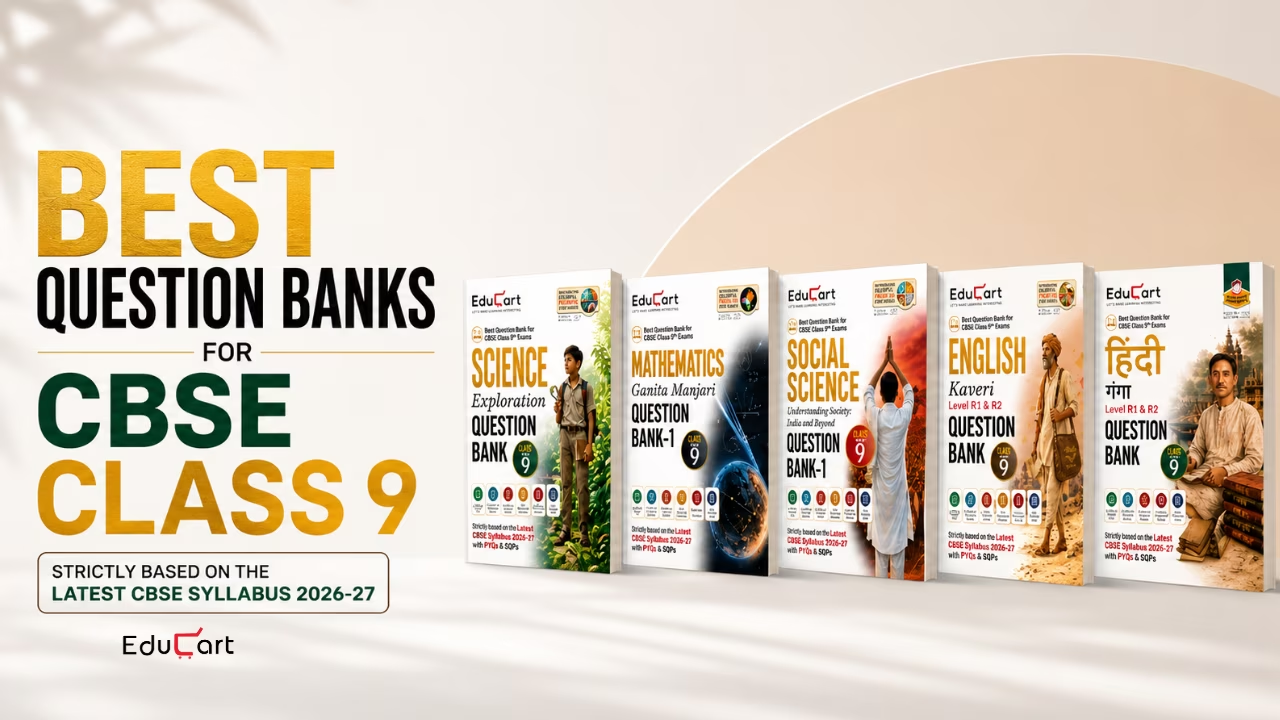
This is precisely why a dedicated Question Bank for this new textbook becomes essential. A well-designed Educart class 9th Question Banks mapped to each new pattern Question types would fill every gap the textbook leaves open with no other resources provided by CBSE/ NCERT.
Tricky Sub-topics - Something Students Need to Know!
The new textbook assumes and builds on conceptual ground covered in Grades 6-8. Many sub-topics have no recap given in the chapter, making prior knowledge essential.
Below is a compact chapter-wise map of the concepts most likely to be very new for class 9 students.
Chapter 1 - Understanding Social Science
The first chapter introduces Class 9 SST as an academic discipline and weaves in Indian knowledge traditions. It looks simple but includes several concepts that the students may not have previously known about.
- Panchamahabhutas - philosophical framing of the five elements (not periodic table elements)
- Vasudhaiva Kutumbakam and the Panchatantra tradition - Sanskrit phonetic terms
- Arthashastra as a governance text - Grade 7-8 introduced Chanakya as a "clever spy" but this book demands engagement with its actual policy content talking about topics like taxation, administration, welfare, etc.
- Itihas-Purana tradition v/s Empirical historiography - here students will learn a difference between cultural memory and documented history
Chapter 2 - Shaping of the Earth's Surface
This can be the most technically demanding Geography chapter in the book for students.
- Full plate tectonic theory - only surface-level volcanism/ earthquake content was covered in classes 6-7; further classification (continental, oceanic, mixed plates) and the three boundary types (convergent, divergent, transform) are entirely new
- Lithosphere v/s Asthenosphere - these terms were introduced in class 7 Earth interior content
- Endogenic v/s Exogenic forces - the categorisation is new
- Agents of gradation - erosion v/s deposition landforms for each agent (running water, glaciers, wind, underground water) are consistently confused
- GLOFs (Glacial Lake Outburst Floods) and avalanches - disaster terminology is new; students struggle to connect the physical process to the disaster type
Tip for Teachers: End-exercise Q.2 reads: "Relate various physiographic divisions you have studied in earlier grades with various endogenic forces responsible for their origin." This is a cross-grade synthesis question. Ch.2 does not re-teach India's physiographic divisions. Teachers may have to briefly revise the Himalayan, peninsular, and coastal physiography before assigning this question.
Chapter 3 - Atmosphere and Climate
Another technical Geography chapter that the students might need extra support with.
- 5-layer atmosphere structure - continuing on troposphere, the stratosphere (ozone), mesosphere, thermosphere, and exosphere are now introduced
- Monsoon mechanism - students already know that India has monsoons but the mechanistic explanation with terms like ITCZ shift, differential heating of land and sea, and jet streams is brand new info
- Lapse rate and temperature inversion - requires basic Physics explanation about heat transfer
- India's 4 seasons (IMD classification) - the post-monsoon and retreating monsoon seasons are routinely confused (explained using Tamil Nadu's winter rainfall example)
Tip for Teachers: The Punjab Floods 2025 Case Study (pp. 54-56) is a live current-affairs integration. It bridges physical geography and disaster management through 4 classroom discussion questions. Teachers should familiarise themselves with NDMA flood management guidelines before this lesson.
Chapter 4 - Early Humans and Beginning of Civilisation
This chapter has completely changed how we looked at Class 9 History.
- Chalcolithic stage - here is a jump from Stone Age directly to Bronze Age, missing the copper-transition period
- Radiocarbon (C-14) dating - all timelines are based on accurate radiocarbon dates (with no conceptual explanation anywhere)
- Sindhu-Sarasvati Civilisation (not "Harappan") - the dual-name is a deliberate NCF 2023 change
- Harappan script as undeciphered - Q.5 directly tests the misconception that the script has been decoded; students who believe otherwise may answer incorrectly
- Comparative Bronze Age civilisations - Q.7 asks for a 4-civilisation comparison (Mesopotamia, Egypt, China, Sindhu-Sarasvati); this requires simultaneous recall of classes 6-7 world history content
Tip for Teachers: Q.9 on the Code of Hammurabi asks students to evaluate whether it was fair to all sections of society. This is an evaluative question requiring content knowledge of Hammurabi's law categories; justice for slaves v/s freemen.
Chapter 5 - State and Society up to 1000 CE
The longest chapter at 42 pages. It covers the Vedic period through the Chola empire and is the most content-dense chapter in the book.
- Jana → Janapada → Mahajanapada → Empire evolution - the explicit political evolution chain is new (full sequence is tested in Q.1)
- Sabhā and Samiti as democratic precursors - treated as peripheral trivia in earlier grades; now linked to Chapter 6 (Democracy)
- Varṇa v/s Jāti distinction - for Q.7 asked about this topic would require students to think from a definitional and explanation point of view
- Guilds (śreṇis) as financial institutions - the source-based Q.12 (Nāhik Cave inscription) requires deep topic understanding with no prior coverage
Tip for Teachers: Q.12 (Nāhik Cave Inscription, 2nd century CE) is the book's most exam-like source-based question. It presents a primary epigraphic source and asks three sub-questions–about guilds' economic role, their trustworthiness, and donor-donee identification. Help the students practise this question type carefully.
Chapter 6 - Democracy
All topics in this chapter are also covered in a new style.
- Athens to modern democracy historical arc - Greek democracy, Magna Carta, and 17th-18th century Western developments (unfamiliar for most students)
- Sabhā and Samiti as ancient democratic roots - fresh recall from Ch.5 is required with teachers’ help
- Popular sovereignty v/s Universal Adult Franchise - Q.3 presents 4 scenarios and asks which best reflects popular sovereignty
- Directive Principles of State Policy (DPSP) - referenced in a "Think About It" box with no context in the chapter, mentioned in class 8 though
- Distinction between direct and representative democracy - complete new topic as class 8 only covers India's representative democracy
Chapter 7 - Elections
- Representation of the People Act, 1950 and 1951 - specific legislative provisions (electoral rolls, voter eligibility, delimitation) are new (unlike slightly known topics like ECI)
- Delimitation Commission - a separate body from ECI, consistently confused with it
- FPTP v/s Proportional Representation - FPTP is taught in class 8 but proportional representation is introduced in this chapter for the first time
- VVPAT, SIR (Special Intensive Revision), home voting - entirely new election machinery topics
- National v/s State/ Regional party distinction - Q.4 asks at least three structural differences; most students can name parties but cannot distinguish them structurally
Tip for Teachers: Q.14 asks students to debate "One Nation, One Election". Divide the class into two groups, one for and one against. This is a live and contested policy debate; teachers should read basic background before the class discussion. Also, Q.8 (the Ishani voting scenario) is the book's most scenario-based question and directly mirrors CBSE case-study format.
Chapter 8 - Building Blocks in Economics: The Problem of Choice
This Economics chapter is, again, part of the new initiative.
- Opportunity cost - named and formally defined here for the first time; students describe it colloquially ("you give up one thing to get another") but cannot apply it technically
- Three central economic questions (What/ How/ For Whom) - no prior formal coverage; the framework is brand new
- Market v/s Planned v/s Mixed economies - Q.5 asks why pure economic systems rarely exist in reality, which is an analytical leap most students know how to answer
Chapter 9 - The Price Puzzle: What Drives the Market (Economics)
- Law of Demand / Law of Supply - formally introduced here; class 7 covered "buyers and sellers adjust prices" informally
- Demand curve and Supply curve graphing - Q.11 and Q.12 require reading and independently drawing D-S graphs from a data table; this is the most mathematically demanding content in the book, with no prior graphing experience in economics
- Market equilibrium - entirely new concept; students struggle with the idea that equilibrium is a tendency and not a fixed or permanent state
- Substitute goods vs Complementary goods - Q.10 requires correct classification of 7 real-world pairs; students misclassify regularly (e.g., laptop and computer as complementary rather than substitutes)
- Government intervention (market failure, public goods, price ceiling/floor) - students know "government controls prices" but Q.7 asks why and with what effects that would require cause-effect-consequence reasoning
Tip for Teachers: Q.12 asks students to draw a D-S graph from a raw data table, identify equilibrium, and analyse surplus and shortage at off-equilibrium prices. This closely parallels Class 11-12 Economics Board question format. It is the single most difficult question in the book for class 9 students, encountering economics graphs for the first time.
Conclusion
With Understanding Society: India and Beyond, four subjects have become one integrated narrative. Of course that will come with a lot of alien concepts, assessment styles, and answer-writing expectations.
This is the reason why this NCERT may be incomplete to prepare class 9 students for the 2026-27 final exams. This NCERT textbook for SST is built to teach concepts the NCF-SE 2023 way. There is no labelled MCQ-SA-LA structure, which would become a NEED as per the new class 9 syllabus.
So the real question is "how do students practice what this book only introduces?" That gap is covered with this chapter-mapped, competency-level Question Bank for Class 9 SST. It stops SST from being the “toughest” subjects for class 9 students and bridges the gap.
FAQs
Q1. Will NCERT books change in 2026-27 class 9 SST?
Ans. Yes. NCERT has replaced all four earlier books (History, Geography, Political Science, and ) with a two-part integrated volume, Understanding Society: India and Beyond Part I and Part II (awaited). Almost every chapter, example, and question style has changed.
Q2. How many SST books are there in class 9 2026?
Ans. There will be two SST books for class 9 this year. Understanding Society: India and Beyond, released in two parts (Part I: 9 chapters, Part II: 7 chapters), replacing the earlier four-book system. You can download Part I book from this page.
Q3. Is class 9 new SST book released?
Ans. The book will be released officially on the NCERT website soon. You can download Part I from educational websites like Educart.
Q4. Are there any tricky topics in the 2026-27 SST syllabus?
Ans. Based on chapter analysis, the toughest additions are plate tectonics and the three boundary types (Ch.2), the 5-layer atmosphere and monsoon mechanics (Ch.3), radiocarbon dating and the Sindhu-Sarasvati naming shift (Ch.4), and demand-supply graphing (Ch.9); none of which had prior-grade groundwork.
Glimpse of the Event

Share Article


.svg)




%2520(1).avif)















.svg)

