
.svg)
NCERT released the Mathematics ncert class 9 new book pdf in alignment with the release of the draft syllabus for the academic session. The new content structure emphasizes activity-based learning, and critical thinking which moves beyond rote learning.
The updated book as per the reforms mentioned in NCF-SE 2023 and NEP 2020, encourages students to explore mathematical concepts through reasoning, patterns, and practical situations, making learning more engaging and meaningful.
Download NCERT Class 9 Maths Book PDF 2026-27 (Ganita Manjari)
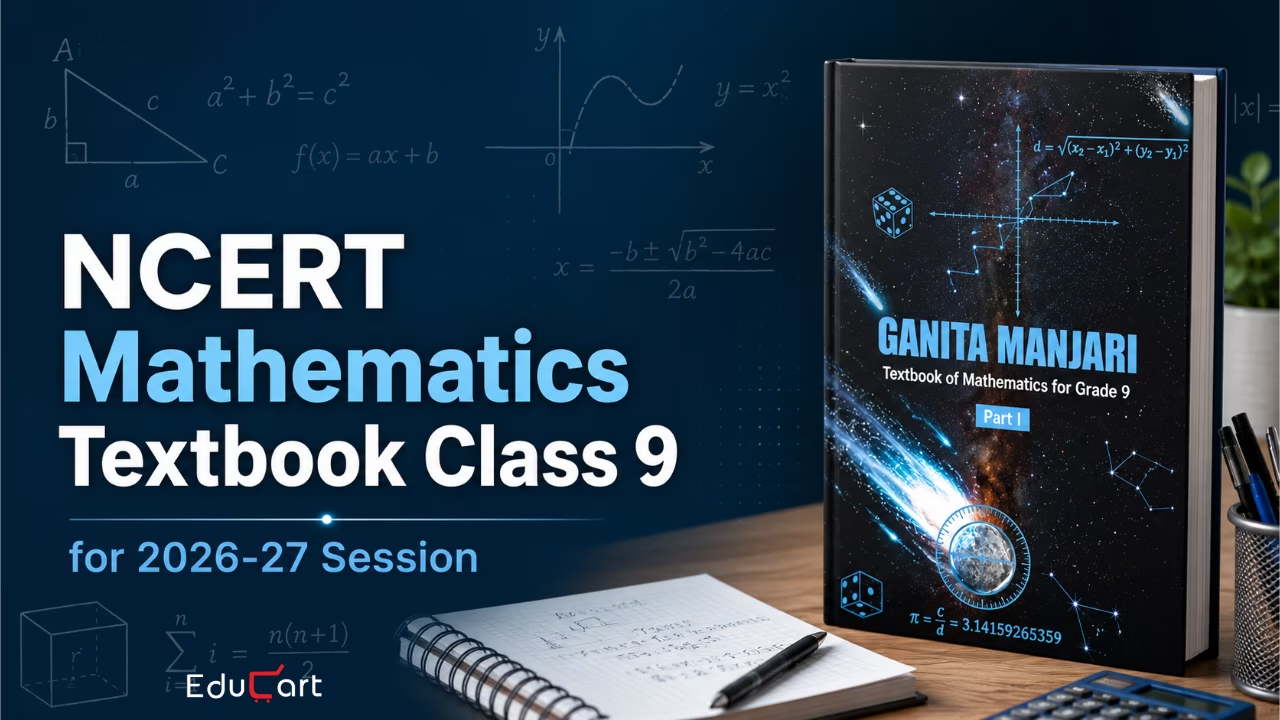
NCERT Class 9 Maths Book PDF 2026-27 Download Chapter-wise
Explore Chapter-wise NCERT Class 9 Maths Solutions
After studying the NCERT Class 9 Maths book, practice every concept with step-by-step solutions. Explore the available chapter-wise solutions below:
- Chapter 1: Orienting Yourself: The Use of Coordinates
- Chapter 2: Introduction to Linear Polynomials
- Chapter 3: The World of Numbers
- Chapter 4: Exploring Algebraic Identities
- Chapter 5: I'm Up and Down, and Round and Round
You can also explore the complete NCERT Class 9 Maths Solutions hub for all chapters.
The changes in Class 9 new NCERT Maths book and syllabus are supported by the following reasons given below:
1. Implementation of NEP 2020 and NCF - SE 2023 reforms
- The syllabus has been updated to adopt a competency-based framework that focuses on logical reasoning as students of the age 14-18 should develop the abilities like problem solving and mathematical modeling.
- It includes clear curricular goals, competencies, learning outcomes, and assessment methods to promote deeper conceptual understanding instead of rote memorization.
2. Integration of real-life applications
- It links knowledge gained through the subject with the real-world problems.
- This encourages students to apply math in everyday life, such as modeling growth patterns or optimizing designs, adaptability, and a growth mindset.
3. Preparation for high-order learning and thinking
- It promotes high-order thinking and learning for the students at the secondary stage making them think deeper and out of the box on concepts. Improve accuracy with Class 9 Maths previous year questions (PYQs with solutions).
4. Activity-based and experiential learning
- The subject promotes exploration, collaboration, and hands-on activities to make the concepts more engaging and meaningful.
NCERT Book Class 9 Maths Ganita Manjari (Old v/s New Textbook)
The table below showcases chapter-wise changes made in the Maths NCERT Class 9 new book for the academic session of 2026-27 in comparison to the previous year.
What Does This Mean for Class 9 Mathematics Teachers?
Updated Maths NCERT class 9 book PDFs bring a broad understanding of the subject for the students. Some of the additional benefits for the students are:
Adapting to the new NCERT Maths textbook might seem challenging at first but effective implementation by educators through activity-based teaching & real-life connections can make it manageable. To build deeper understanding, teachers can link the concept in maths textbooks with other subjects making it more interesting for the students.
The structure shift for better understanding of the educators can be seen here:
What Does This Mean for Students?
Updated Maths ncert class 9 book pdf bring a broad understanding of the subject for the students. Some of the additional benefits for the students are:
- Strengthening connection between mathematical ideas through real-world understanding
- Encouragement of logical reasoning and problem-solving
- High-order conceptual understanding
- Practicing exercises? The NCERT Solutions for Class 9 Maths give step-by-step answers to every question in Ganita Manjari.
Takeaway
The NCERT Class 9 Maths Book for 2026-27 moves beyond the basics to a competency-based learning approach. It includes chapters and concepts which require real-life connection, with interdisciplinary approach and competency-based learning.
In addition to that, there is a deeper focus on logical reasoning and conceptual understanding along with problem-solving and analytical thinking around the chapters. This change aims to make mathematics more relatable for the students and develop strong reasoning and practical skills for higher studies and everyday life.
FAQs
Q1. What is the focus of the new NCERT Class 9 Mathematics textbook (2026–27)?
Ans. The new textbook focuses on competency-based learning, emphasizing conceptual understanding, logical reasoning, and real-life application instead of rote memorization.
Q2. How is the new Class 9 NCERT Maths Textbook Ganita Manjari different from the previous one?
Ans. The updated version integrates topics into 8 themes and promotes interdisciplinary, activity-based learning, unlike the earlier syllabus which was divided into separate units and focused more on factual knowledge.
Q3. What type of learning approach is followed in the updated textbook?
Ans. The textbook follows an activity-based and experiential learning approach where students explore concepts through reasoning, patterns, and practical situations.
Q4. What are the major themes covered in the latest Class 9 Maths textbook?
Ans. The syllabus includes themes like coordinates, polynomials, number systems, algebraic identities, geometry, mensuration, probability, and sequences.
Q5. How does the class 9 new ncert maths book pdf 2026-27 promote interdisciplinary learning?
Ans. It connects mathematical concepts with real-life scenarios and other subjects, helping students understand how mathematics is applied beyond the classroom.
Q6. Where can I download the new NCERT Maths book class 9 PDF for 2026-27?
Ans. You can download the new NCERT Class 9 Maths book PDF 2026-27 (Ganita Manjari Part 1) for free from this page. All chapter-wise PDFs are available above, along with the full book link.












.svg)

