.svg)
Class 9 Maths textbook has been revised for the 2026‑27 session under the guidelines of the NCF‑SE 2023 framework. This transformation is not about tweaking a few chapters, but introducing an entirely new syllabus, book title, and concepts.
CBSE has discontinued the Maths Basic option - all Class 9 students now study from a single unified book, Ganita Manjari, with an optional Advanced-level paper available for those who want to attempt it. These NCERT Solutions for Class 9 Maths, aligned with the latest Class 9 CBSE syllabus 2026-27, provide students with clear, step-by-step answers to every questions of each chapter of new mathematics textbook. Students can easily download the solution PDFs by navigating to respective chpater-wise solution pages through the link provided below.
NCERT Solutions for Class 9 Maths Ganita Manjari Part 1 2026‑27: Chapter-wise PDF
The shift: The basic vs. standard papers format has been removed with one integrated exam for everyone. Probability makes a return, while additional topics include Sequences and Progressions, and Algebraic Identities as a separate section. Constructions has been eliminated. Heron's Formula is now integrated into a larger Mensuration unit, which also covers Brahmagupta's formula for cyclic quadrilaterals.
Buy NCERT Class 9 Maths Solutions Book 2026-27 Edition
NCERT Class 9 Maths 2026‑27: Unit-wise Weightage & Marks Distribution
Geometry and Mensuration are both the most affected units by part 2's delay, as Euclid's Geometry, Triangles, Quadrilaterals, Lines and Angles, and Surface Areas & Volumes are all expected there. Combined, Geometry and Algebra still constitute more than half the paper.
Note: NCERT has not yet released Part 2 of Ganita Manjari, which is expected to cover these topics)
Topic-wise List of What's Covered in NCERT Class 9 Maths Ganita Manjari Solutions
Chapter 1 - Orienting Yourself: The Use of Coordinates:
The Cartesian Plane, x and y Axes, finding positions using Ordered Pairs, and checking Collinearity or Right Angles using Coordinates.
A short, conceptually simple chapter with a 4-mark weightage. Focus on accurately reading coordinate orders, as this prevents the likelihood of errors.
Chapter 2 - Introduction to Linear Polynomials :
Polynomial types and Degree, the Remainder and Factor Theorems, and Coefficients of a Polynomial, also Linear Polynomials connected to slope and y-intercept.
Chapter 3 - Number System:
Representation of Rational and Irrational Numbers, Density of Rationals, Decimal Representation, Operations on Surds, and Proving the Irrationality of √2 and √3.
Chapter 4 - Exploring Algebraic Identities:
Eight Fundamental Identities for Polynomial Expansion, now combined with Geometric/Visual Models, along with Factorisation of Quadratic Expressions.
Understand all identities more than just memorizing them. This will help you to build the foundation for Class 10 and 11's complex algebra questions.
Chapter 5 - I’m Up and Down, and Round and Round:
This is the circles chapter. Chords, Arcs, Angles formed at the Center and Circumferences, Circle Properties, Cyclic Quadrilaterals, and Concyclic Points.
It’s one of the most crucial, demanding chapters conceptually, which scaled up this year with more advanced evidence-based outcomes.
Chapter 6 - Measuring Space: Perimeter and Area:
Heron's Formula, Circle Area and Sectors, Classical/Advanced Theorem, and Brahmagupta's Formula for the Area of a Cyclic Quadrilateral (with Heron's as a special case).
Chapter 7 - Introduction to Probability:
Experimental and Theoretical Probability, Sample Spaces, and Tree Diagrams. Reinstated this year after being removed from the old syllabus.
Chapter 8 - Exploring Sequences and Progressions:
A newly added chapter for the Class 9 curriculum—covering arithmetic and geometric progressions, their nth terms, and real-world applications such as fractals and the Tower of Hanoi puzzle.
All Class 9 students can now study from a single unified ncert class 9 maths textbook Ganita Manjari.
Class 9 Maths Ganita Manjari 2026‑27: Ch-wise Solutions
Here are some important questions and their corresponding solutions are given for each chapter. Refer to respective chapter-wise solution pages to access the complete questions and answers in detail.
Chapter 1: Orienting Yourself – The Use of Coordinates
Q1. What are the x-coordinate and y-coordinate of the point of intersection of the two axes?
Answer:
The origin is the point where the x-axis and y-axis intersect. Therefore, its coordinates are: (0, 0).
Q2. Point W has x-coordinate equal to −5. Can you predict the coordinates of point H which is on the line through W parallel to the y-axis? Which quadrants can H lie in?
Answer:
Any line parallel to the y-axis is vertical, so every point on it has the same x-coordinate.
Since x = −5 < 0:
- If y > 0, H is in Quadrant II.
- If y < 0, H is in Quadrant III.
- If y = 0, H lies on the x-axis.
Thus, the line x = −5 passes through Quadrants II and III and intersects the x-axis.
Q3. In moving from A(3, 4) to D(7, 1), what distance has been covered along the x-axis? What about the distance along the y-axis?
Answer:
Horizontal distance = |7 – 3| = 4units
Vertical distance = |4 – 1| = 3 units
Therefore, the horizontal distance is 4 units and the vertical distance is 3 units.
Q4. What are the standard widths for a room door? Look around your home and in school.
Answer:
The ideal widths of an Indian interior room door are usually about 36 inches to 48 inches (3 to 4 feet).
Chapter 2: Introduction to Linear Polynomials
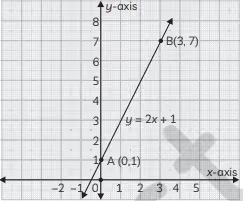
Q1. For y = 2x + 1, find the corresponding values of y for x = 1, 2, 5, 7, 9, 12, and 20.
Answer:
Substitute each x into y = 2x + 1:
For example, x = 9 gives y = 2 × 9 + 1 = 19, and
x = 20 gives y = 41. Every one of these (x, y) pairs satisfies the equation, so each point lies exactly on the line. Thus, the corresponding points are:
(1,3), (2,5), (5,11), (7,15), (9,19), (12,25), (20,41)
Q2. Differentiate between the graphs of y = 3x + 1 and y = −3x + 1.
Answer:
Both lines have the same y-intercept, (0,1)(0,1)(0,1).
- Y = 3x + 1 has slope + 3, so it rises from left to right.
- y = −3x + 1 has slope −3, so it falls from left to right.
The two lines are equally steep, have opposite slopes, and meet at (0,1).
Q3. Compare the lines y = 2x − 1, y = 2x + 1, and y = 2x + 5. (Refer to Fig 2.13 in NCERT, page no. 34)?
Answer:
All three lines have the same slope, 2, so they are parallel.
Their y-intercepts are:
(0, b): y = 2x − 1 at (0, −1), y = 2x + 1 at (0, 1), and y = 2x + 5 at (0, 5).
respectively. Changing the constant term b shifts the line vertically without changing its slope.
Q4. A positive number is 5 times another number. If 21 is added to both numbers, one of the new numbers becomes twice the other. Find the two numbers.
Answer:
Let the smaller number be x. The larger number is 5x.
After adding 21:
Smaller numberf = x + 21, larger number 5x + 21
The larger number becomes twice the smaller:
5x + 21 = 2(x + 21)
5x + 21 = 2x + 42
3x = 21
x = 7
Therefore, the two numbers are: 7 and 35.
Chapter 3: The World of Numbers
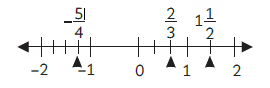
Q1. Represent 2/3, −5/4, and 1¹⁄₂ on a single number line.
Answer:
2/3 lies between 0 and 1, dividing the segment [0, 1] into 3 equal parts and taking the 2nd division point.
−5/4 = -1 1⁄4 lies between −2 and −1, at ¼ of the way from −1 towards −2.
1¹⁄₂ = 3/2 lies exactly midway between 1 and 2.
Order on the line (left to right): −5/4 < 2/3 < 3/2
Q2. Find three distinct rational numbers strictly between −1/2 and 1/4.
Answer:
Make both fractions have a denominator 4
−1/2 = −2/4 and 1/4
Rational numbers between −2/4 and 1/4 include:
−1/4, 0, 1/8, etc.
Three choices: −1/4, 0, 1/8
Q3. Try to prove the irrationality of √3 using the approach of proof by contradiction. Will the same approach work for √5, √7 or √10?
Answer:
We have to prove √3 is irrational.
Let us assume the opposite, i.e., √3 is rational.
Hence, √3 can be written in the form p/q where a and b (b ≠ 0) are co-prime (no common factor other than 1)
Hence,
√3 = a/b
√3 a= b
Squaring both sides
(√3b)2 = a2
b2/3 = a2
Hence, 3 divides a2.
As you see, both p and q are divisible by 3, which proves the fraction isn’t in lowest terms. Thus, this contradiction shows √3 is irrational.
The same logic works for √5 and √7, as they are both prime numbers. When a prime divides p², it divides p too, which builds the same contradiction as before.
For √10, the logic is different. Since 10 isn’t prime (it’s 2 × 5), the trick still works. If you say √10 = p/q, you get p² = 10q². That forces both 2 and 5 to divide p, so p and q share a factor, which messes up the whole “lowest terms” thing.
Chapter 4: Exploring Algebraic Identities
Q1. Find the following products using algebraic identities:
- (-3x + 4)2
- (2s + 7)(2s - 7)
- (s - 2t)(s2 + 2st + 4t2)
- (-3m + 4k - l)2
Answer:
- Using standard identities:
(a − b)2 = a2 −2ab + b2
(−3x + 4)2 = 9x2 − 24x + 16
9x2 − 24x + 16
- Using:
(a + b)(a − b) = a2 − b2
(2s + 7)(2s−7) = 4s2 − 49
- Using:
a3 − b3 = (a − b)(a2 + ab + b2)
(s − 2t)(s2 + 2st + 4t2) = s3 − (2t)3
= s3 − 8t3
- Apply:
(a + b + c)2 formula
= (–3m + 4k – l)2
= 9m2 + 16k2 + l2 − 24mk − 8kl + 6ml
Given a = −3m, b = 4k, c = −l
a2 + b2 + c2 = 9m2 + 16k + l2
2ab = 2(−3m)(4k) = −24mk
2bc = 2(4k)(−l) = −8kl
2ca = 2(−l)(−3m) = 6lm
Sum: 9m2 + 16k2 + l2 − 24mk − 8kl + 6lm
Q3. Find possible expressions for the length and breadth of a rectangle whose area is:
- 25a2 − 30ab + 9b2
- 36s2 − 49t2
Answer:
- Factorising:
25a2 − 30ab + 9b2
=(5a − 3b)2
Therefore, possible expressions for the length and breadth are:
5a − 3b and 5a − 3b
- Area = 36s2 − 49t2
= (6s)2 − (7t)2
= (6s + 7t)(6s − 7t)
Length = (6s + 7t)
Breadth = (6s − 7t)
Q4. A rectangular pool has area 2x2 + 7x + 3 square hastas and width (2x + 1) hastas. Find its length.
Answer:
Factorise the area:
2x2 + 7x + 3
2x2 + 6x + x + 3 (Split 7x using factors of 6 into 6 + 1)
=(2x + 1)(x + 3)
Since:
Area = Length × Breadth
and the breadth is 2x + 12x + 12x + 1, the length is: (x + 3) hastas
Chapter 5: I'm Up and Down, and Round and Round
Q1. A chord is 5 cm from the centre of a circle whose radius is 13 cm. Find the length of the chord.
Answer:
Let d = 5 cm (perpendicular distance),
r = 13 cm
Half the chord is:
2 √(r2 − d2) = 2√(132 − 52)
= 2√169 − 25
= 2√144
2 x 12 = 24 cm
Therefore:
Chord length = 24 cm
Q2. An arc of a circle subtends an angle of 70∘ at the centre. Find the angle subtended by the same arc at a point on the remaining part of the circle.
Answer:
In triangle AB, OA = OB = 12 cm (radii), so the triangle is isosceles.
The angle at the vertex
∠AOB = 60°
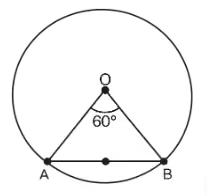
The base angles are ∠OAB = ∠OBA = (180° - 60° ) / 2 = 60°
So, all angles are 60° i.e., ⃤⃤⃤⃤⃤ OAB is equilateral
Therefore, AB = OA = OB = 12 cm
Length of chord AB = 12 cm
Q3. In a cyclic quadrilateral ABCD, ∠A = 75∘ and ∠B = 110∘ . Find ∠C and ∠D.
Answer:
Opposite angles of a cyclic quadrilateral are supplementary (sum to 180°).
∠A + ∠C = 180° = ∠C = 180° − 75° = 105°
∠B + ∠D = 180° = ∠D = 180° − 110° = 70°
Chapter 6: Measuring Space – Perimeter and Area
Q1. A circle has circumference 44 cm. Find its radius. 1
Answer:
2πr = 44
Using π = 22 / 7:
2 × 22 / 7 × r = 44
r = 44 ×7/44
r = 7 cm
Q2. If a wheel of a bicycle has a diameter of 60 cm, how far will a cyclist travel after the wheel has rotated 100 times?
Answer:
Circumference of the wheel: πd
= 22 / 7 × 60
= 1320 / 7 cm
Distance in 100 revolutions:
= 100 × 1320 / 7
= 132000 / 7
≈ 18857.14 cm
≈ 188.57 m
Q3. The parallel sides of a trapezium are 40 cm and 20 cm, and its equal non-parallel sides are each 26 cm. Find its area.
Answer:
Let parallel sides be a = 40 cm, b = 20 cm
Equal non-parallel sides = 26 cm each.
Height of trapezium:
Drop perpendicular from each end of the shorter parallel side
Horizontal distance on each side = (40 - 20) / 2 = 10 cm
Using Pythagoras: h2 + 102 = 262
h2 = 676 – 100 = 576
h = 24 cm
Area of trapezium
= 1/2 × (sum of parallel sides) × height
= 1/2 × (40 + 20) × 24
= 1/2 × 60 × 24 = 720 cm2
Chapter 7: The Mathematics of Maybe – Introduction to Probability
Q1. Fill in the blanks:
- The probability of an impossible event is ______.
- The set of all possible outcomes of a random experiment is called the ______.
- The probability of an event that is certain to happen is ______.
- Tossing a fair coin has a probability of ______ for getting heads.
Answer:
- 0
- Sample Space
- 1
- 1/2
Q2. In a survey of 50 students, 15 said they liked football. What are the frequency and relative frequency? E2
Answer: Frequency: 15
Relative frequency:
15 / 50 = 3 / 10 = 0.3
Therefore:
Relative frequency = 0.3
Q3. A child has 2 shirts (one red and one blue) and 3 types of pants ( jeans, khakis, and shorts). List all the possible combinations of outfits consisting of one shirt and one pair of pants.
Answer:
Total outfits = 2 × 3 = 6.
Below is the table showing all possible combinations
Q4. Three coins are tossed simultaneously. What is the probability of getting exactly two heads?
Answer:
The sample space has 8 equally likely outcomes:
n(S) = 8
{HHH, HHT, HTH, HTT, THH, THT, TTH, TTT}
Exactly two heads occur in:
{HHT, HTH, THH}
n(E) = 3
Therefore:
P(exactly two heads) = 3 / 8
Chapter 8: Predicting What Comes Next – Exploring Sequences and Progressions
Q1. Find the first five terms of the sequence whose nth term is:
- tn = 3n − 4
- tn = 2 - 5n
- tn = n2 − 2n + 3 for n ≥ 1
Answer:
A) tn = 3n – 4
t1 = 3(1) − 4 = −1
t2 = 3(2) − 4 = 2
t3 = 3(3) − 4 = 5
t4 = 3(4) − 4 = 8
t5 = 3(5) − 4 = 11
First five terms: −1, 2, 5, 8, 11
(B) tn = 2 − 5n
t1 = 2 – 5 = –3
t2 = 2 – 10 = –8
t3 = 2 – 15 = –13
t4 = 2 – 20 = –18
t5 = 2 – 25 = –23
First five terms: –3, –8, –13, –18, –23
(C) tn = n2 – 2n + 3:
t1 = 1 – 2 + 3 = 2
t2 = 4 – 4 + 3 = 3
t3 = 9 – 6 + 3 = 6
t4 = 16 – 8 + 3 = 11
t5 = 25 – 10 + 3 = 18
First five terms: 2, 3, 6, 11, 18
Q2. Find the 10th and 26th terms of the AP: 3,8,13,18,…
Answer:
Here:
a = 3, d = 5
Using:
nth term: an = a + (n − 1)d
10th term: a10 = 3 + (10 − 1) × 5
= 3 + 45 = 48
26th term: a26 = 3 + (26 − 1) × 5
= 3 + 125 = 128
Q3. Find the 31st term of an AP whose 11th term is 38 and 16th term is 73.
Answer:
For an AP: tn = a + (n − 1)d
Given:
a + 10d = 38
a + 15d = 73
Subtracting (i) from (ii):
5d = 35
d = 7
Then:
a = 38 − 70 = −32
t31 = a + 30d
= −32 + 30 (7)
= t31 = 178
Things to Follow for Scoring Well in Maths Exams
The CBSE scoring system prioritizes steps over final answers for awarding marks. It means if your final answer is incorrect but the working is correct, you still earn partial marks, and a correct answer with incorrect working earns nothing. Like:
What to do for each type of question:
- Proof questions (Geometry): State the theorem you're using at each step. Don't assume the examiner will fill in the gaps.
- Numerical questions (Mensuration, Statistics): Write formula → substitute values → calculate. Never skip to the answer directly.
- Graph questions (Linear Equations, Coordinate Geometry): Label axes, mark points clearly, and draw a neat line. Presentation matters here.
- Algebra questions (Polynomials): Show factorisation steps even when you can do them mentally.

Other Class 9 Maths Resources
Class 9 Maths Chapter-wise Notes
Class 9 Maths Important Questions
Frequently Asked Questions
1. Are these NCERT solutions for Class 9 Maths Ganita Manjari revised for the latest syllabus?
Ans. Yes. Educart provides students with the current CBSE-prescribed Mathematics Solutions for Class 9 covering step-by-step textbook solutions, practice exercises, and quick chapter summaries.
2. What's updated and removed this year?
Ans. Several chapters are included, like Sequences and Progressions and Exploring Algebraic Identities as an individual topic, along with Probability (reinstated). At the same time, several are removed, such as Constructions.
3. Does the new textbook still involve a Maths Basic and Maths Standard option?
Ans. CBSE has discontinued the Maths Basic option - all Class 9 students now take the Standard paper, with an optional Advanced-level paper (25 marks) available for those who choose to attempt it.
4. Which unit is important and carries the most weightage?
Ans. Geometry still shines as the highest-weightage unit with 25 marks. The marks distribution is as follows: Geometry (25 marks), Algebra (20 marks), Mensuration (14 marks), Statistics and Probability (10 marks), Number System (7 marks), and Coordinate Geometry (4 marks).
5. Has the syllabus load decreased this year?
Ans. No. CBSE hasn’t changed the total marks for a paper - it still carries 80 marks for theory and 20 for internal evaluation. While they reorganized the content and expanded in certain areas, like Sequences and Progressions, but not reduce the syllabus.











.svg)

