
.svg)
Class 9 Science now comes as an integrated book - combining Physics, Chemistry, Biology, and a new edition Earth Science for the 2026-27 curriculum. This year, NCERT has updated their syllabus for all subjects under the NCF‑SE 2023 and NEP 2020 frameworks. Several chapters are introduced, several have been dropped, and the mark distribution approach has also changed.
These NCERT Solutions for Class 9 2026-27 cover all chapters given in the NCERT Science Exploration textbook of the current CBSE-notified syllabus with answers written to match exactly what examiners expect.
NCERT Solutions Class 9 Science : Chapter-wise PDF
What's changed: Matter in Our Surroundings, Is Matter Around Us Pure, Gravitation, and Improvement in Food Resources are no longer standalone chapters. Reproduction, Diversity, Exploring Mixtures and their Separation, and Earth as a System have been added.
Buy NCERT Class 9 Science Exploration Solutions 2026-27 Edition
Note: Diversity in Living Organisms, Natural Resources, and Why Do We Fall Ill have been removed from the Class 9 science syllabus as per CBSE's rationalisation. These chapters are not included in these solutions.

Class 9 Science - Unit-wise Weightage
World of Living unit now carries the highest weight with 27 marks, just surpassing Matter at 25 marks. Motion, Force, Work and Sound together hold 23 marks and remain the most numerically heavy unit. Meanwhile, Earth as a System is a newly added, low-weightage unit that carries 5 marks. Most students will ignore this, but it offers easy marks due to its compact nature.
Topic Coverage in Class 9 Science Textbook
1. Exploring - Entering the World of Secondary Science: Introduction to the scope of science at the secondary level, the spirit of inquiry, and the importance of scientific thinking in everyday life.
2. Cell - The Building Block of Life: Discovery of cells, plant vs. animal cells, prokaryotic vs. eukaryotic cells, structure and function of cell organelles, osmosis, and more.
It’s a high-frequency chapter - labeled diagrams of cells and osmosis-related questions appear almost every year.
3. Tissues in Action: Plant tissues (meristematic, permanent) and animal tissues (epithelial, muscular, nervous), also the musculoskeletal system.
Tabular comparison questions between tissue types are common. Practise structured comparison tables.
4. Describing Motion Around Us: Displacement, velocity, motion graphs, acceleration, uniform circular motion, kinematic equations of motion.
Numericals from this chapter are predictable and formula-driven. The three equations of motion are asked repeatedly in exams. Practise deriving and applying equations of motion is a must.
5. Exploring Mixtures and their Separation: Homogeneous vs. heterogeneous mixtures, solutions/suspensions/colloids, concentration calculations, and separation techniques.
A few topics in this chapter are new this year, which were not emphasized before. Focus on numericals, not just definitions.
6. How Forces Affect Motion: Newton's three laws of motion, balanced/unbalanced forces, friction.
Law-based theories and numericals appear regularly in exams. Always demonstrate the law before applying it in answers.
7. Work, Energy, and Simple Machines: Work done by constant force, kinetic/potential energy, conservation of energy, power, and newly added simple machines and mechanical advantage.
As the simple machines concept is new, practise the mechanical advantage formula (M.A. = Load/Effort) alongside the numerical questions of the work-energy chapter.
8. Journey Inside the Atom: Atomic models (Thomson's, Rutherford's, and Bohr's), electron distribution in cells, subatomic particles, valency, atomic number, isotopes/isobars.
Both theory and diagram questions appear in the exams. Practise all three models and their limitations.
9. Atomic Foundations of Matter: Law of constant proportion, law of conservation of mass, Dalton's atomic theory, ions and ionic compounds, molecules of elements, chemical formulae.
The mole concept and formula writing are key topics essential for Class 10-11 Chemistry.
10. Sound Waves - Characteristics and Applications: Production and propagation of sound, characteristics of sound waves, reflection of sound/echo/echolocation, human perception of sound, and propagation of different media.
Mostly theory and short-answer questions. Occasionally, you may encounter numericals based on the speed of sound.
11. Reproduction - How Life Continues: Asexual/sexual reproduction, flower structure, gamete formation, fertilization, human (male/female) reproductive systems, the menstrual cycle, and reproductive health.
Entirely a new chapter in the 2026-27 Class 9 science textbook—expect diagram-based questions on floral and human reproductive systems.
12. Patterns in Life - Diversity and Classification: Five-kingdom classification, binomial nomenclature, viruses, major divisions of plants and animals, and binomial nomenclature.
13. Earth as a System - Energy, Matter and Life : Earth as an interconnected system, solar energy, electromagnetic spectrum, biogeochemical cycles, and human impact on earth’s cycle.
Class 9 Science: Ch-wise Questions and Answers 2026-27
NCERT Class 9 Science Solutions Exploration Chapter 1
Q1. Think of a prediction you or your family made recently (for example, the outcome of a cricket match). Was it based on evidence and reasoning, or mainly on guesswork? How can scientific thinking improve such predictions?
Ans.
Last week, my brother predicted that it would rain in the evening because the sky had become very cloudy, the wind was cooler than usual, and humidity was high. His prediction was based on observation and reasoning rather than pure guesswork. Scientific thinking can improve such predictions by using more reliable information, such as player statistics, past performance, weather conditions, pitch reports, and team combinations. Predictions based on evidence and analysis are usually more accurate than those based only on personal opinion or emotions.
Q2. Describe one situation where an approximate answer is good enough, and one where you would need a very exact value.
Ans.
Situation where an approximate answer is good enough:
When estimating the number of students attending a school event, an approximate count is usually sufficient for making general arrangements such as seating or refreshments. Situation where a very exact value is needed: When measuring the dose of a medicine for a patient, a very exact value is required to ensure safety and effectiveness.
NCERT Solutions Class 9 Science Exploration Chapter 2
Differentiate between the following pairs of terms based on the clues given in parentheses:
(A) Cell membrane and cell wall (Permeability)
(B) RER and SER (Structure)
(C) Chloroplasts and chromoplasts (Pigments)
[Refer to Q1, Revise, Reflect, Refine, Page 3]
Answer:
(A) Cell membrane: Selectively permeable, i.e., it controls the entry and exit of substances, allowing only specific molecules to pass through.
Cell wall: Freely permeable, i.e., it allows most substances (water, gases, small molecules) to pass through without restriction.
(B) Rough Endoplasmic Reticulum (RER): It has ribosomes attached to its surface, giving it a rough appearance; mainly involved in protein synthesis.
Smooth Endoplasmic Reticulum (SER): Lacks ribosomes on its surface, appears smooth; mainly involved in lipid synthesis and detoxification of the body.
(C) Chloroplasts: Contain green pigment, i.e., chlorophyll, essential for photosynthesis.
Chromoplasts: Contain non-green pigments, responsible for red, yellow, and orange colors in fruits and flowers.
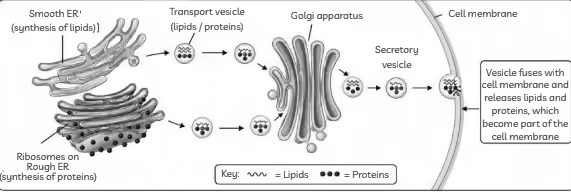
Q2. The cell membrane of a cell is made up of proteins and lipids. Which cell organelles help in the synthesis of cell membrane? Write the path of these compounds from their site of synthesis to the cell membrane and show this through a labelled diagram.
[Refer to Q14, Revise, Reflect, Refine, Page 4]
Answer: The cell membrane is mainly composed of proteins and lipids (phospholipids). Carbohydrates and steroids (such as cholesterol) are also present in minute quantities.
Organelles involved in synthesis:
Ribosomes: Ribosomes (free in the cytoplasm or attached to the RER) are the sites of protein synthesis. The proteins destined for the cell membrane are synthesised on ribosomes attached to the Rough Endoplasmic Reticulum (RER).
Rough Endoplasmic Reticulum (RER): Membrane proteins are synthesised by ribosomes on the RER surface and are then processed and transported within the RER membrane or lumen.
Smooth Endoplasmic Reticulum (SER): Lipids (phospholipids) and steroids (hormones) required for the cell membrane bilayer are synthesised in the SER.
Golgi Apparatus: The Golgi apparatus receives proteins and lipids from the ER via vesicles. It modifies, sorts, and packages them into vesicles for delivery to the cell membrane.
Pathway from synthesis to cell membrane:
NCERT Solutions Class 9 Science Exploration Chapter 3
Question 1: Meristematic tissues divide repeatedly. What property of their cells allows them to do this?
(a) They have thick walls for protection.
(b) They contain large vacuoles that store nutrients.
(c) They have thin walls, dense cytoplasm and large prominent nucleus.
(d) They are functionally differentiated cells.
Answer:
(c) They have thin walls, dense cytoplasm and large, prominent nucleus.
Explanation: Meristematic cells are structurally adapted for continuous and rapid cell division. Their thin cell walls allow easy growth and division, while the dense cytoplasm provides active metabolic support required for cell division. The large, prominent nucleus controls repeated division and helps in the replication of genetic material before cell division. Vacuoles are either absent or very small, allowing more space for the nucleus and cytoplasm.
Question 2: If a plant is unable to transport food from leaves to roots which tissue is malfunctioning?
(a) Xylem
(b) Phloem
(c) Epidermis
(d) Sclerenchyma
Answer:
(b) Phloem
Explanation: Phloem is the complex permanent tissue responsible for transporting food prepared in the leaves to different parts of the plant, including the roots. This process is called translocation. Sieve tubes carry food, while companion cells help sieve tubes in this transport. Therefore, if food cannot be transported from leaves to roots, the phloem tissue is malfunctioning. Xylem transports water and minerals, while epidermis and sclerenchyma perform protective and
NCERT Solutions Class 9 Science Exploration Chapter 4
Question 1: My father went to a shop from home which is located at a distance of 250 m on a straight road. On reaching there, he discovered that he forgot to carry a cloth bag. He came home to take it, went to the shop again, bought provisions and came back home. How much was the total distance travelled by him? What was his displacement from Home?
[Refer to Q1, Revise, Reflect, Refine, Page 20]
Answer:
Distance between home and shop = 250 m
Distance travelled by father:
• From home to the shop = 250 m
• From shop to home = 250 m
• From home to the shop again = 250 m
• From shop to the home after shopping = 250 m
Total distance travelled:
= 250 + 250 + 250 + 250
= 1000 m or 1 km
Displacement is the shortest distance between the initial and final positions. Since father started from home and finally returned home, his initial and final positions are the same. Therefore, the displacement from home is 0 m.
Question 2: A bus is travelling at 36 km h–1 when the driver sees an obstacle 30 m ahead. The driver takes 0.5 seconds to react before pressing the brake. Once the brake is applied, the velocity of the bus reduces with constant acceleration of 2.5 m s–2. Will the bus be able to stop before reaching the obstacle?
[Refer to Q10, Revise, Reflect, Refine, Page 21]
Answer:
Initial velocity of the bus,
u = 36 km h-1
u = 36 * 1000 / 3600
= 10 ms-1
Distance of obstacle from the bus = 30 m
Reaction time of driver, t = 0.5 s
Retardation after applying brake, a = –2.5 ms–2
During the reaction time, the driver does not apply brakes, so the bus continues to move with the same velocity.
Distance travelled during reaction time,
s1 = vt
s1 = 10 × 0.5
s1 = 5 m
Now, distance left before reaching the obstacle,
30 – 5 = 25 m
Then, stopping distance after brakes are applied.
v2 = u2 + 2as
Since the bus stops,
v = 0
0 = (10)2 + 2(–2.5)s
0 = 100 – 5s
5s = 100
s = 20 m
Thus, the bus requires 20 m to stop after applying brakes.
Total distance travelled before stopping,
= 5 + 20
= 25 m
Since the obstacle is 30 m ahead, the bus stops 5 m before the obstacle. Therefore, the bus will be able to stop before reaching the obstacle.
NCERT Solutions Class 9 Science Exploration Chapter 5
Question 1: Which of the following mixtures are correctly classified as homogeneous (Hm) and heterogeneous (Ht)? Choose the correct option.
(a) Air — Hm, Milk — Ht, Sugar solution — Hm, Smoke — Hm
(b) Brass — Ht, Fog — Ht, Vinegar — Ht, Muddy water — Hm
(c) Copper sulfate solution — Hm, Salt solution — Hm, Milk — Hm, Bronze — Hm
(d) Muddy water—Ht,Milk—Ht,Blood—Ht, Brass — Hm
[Refer to Q1, Revise, Reflect, Refine, Page 30]
Answer:
(d) Muddy water — Ht, Milk — Ht, Blood — Ht, Brass — Hm
Explanation: A homogeneous mixture has a uniform composition throughout, while a heterogeneous mixture does not. Muddy water is a suspension in which mud particles remain suspended and settle over time, while milk and blood are colloids with fine particles dispersed in a liquid medium. Hence, muddy water, milk, and blood are all heterogeneous mixtures. Brass, on the other hand, is homogeneous, as it is an alloy of copper and zinc with a uniform composition throughout.
Question 2: Your mother gives you a bottle of orange juice concentrate to mix with water and serve it to your visiting friends. She asks you to mix two tablespoons of the concentrate with water in a glass tumbler. If each tablespoon measures 15 mL and you make 150 mL of juice per person, what is the % v/v of orange juice concentrate in the mixture you prepared?
[Refer to Q8, Pause and Ponder, Page No. 29]
Answer:
Given:
Volume of one tablespoon = 15 mL
Volume of two tablespoons = 2 × 15 = 30 mL
Total volume of prepared juice = 150 mL
% v/v = Volume of solute / Volume of solution × 100
= 30 / 150 * 100 = 20%
Therefore, the orange juice concentrate in the prepared mixture is 20% v/v.
NCERT Solutions Class 9 Science Exploration Chapter 6
Question 1: For a ball moving on a smooth frictionless surface, choose the appropriate option that will make the following statements physically correct.
(A) If no net force is applied on the ball, the velocity of the ball will remain the same/ increase/decrease.
(B) If a net force is applied on the ball in the direction of its motion, the magnitude of the velocity of the ball will remain the same/increase/decrease.
(C) If a net force is applied on the ball in a direction opposite to the direction of its motion, the magnitude of the velocity of the ball will remain the same/increase/ decrease.
[Refer to Q2, Revise, Reflect, Refine, Page 40]
Answer:
(A) If no net force is applied on the ball, the velocity of the ball will remain the same. (According to Newton’s first law, if net force is zero, there is no change in velocity.)
(B) If a net force is applied on the ball in the direction of its motion, the magnitude of the velocity of the ball will increase. (The acceleration is in the direction of motion, so the speed increases.)
(C) If a net force is applied opposite to the direction of motion, the magnitude of the velocity of the ball will decrease. (A force opposite to the motion produces retardation, so the speed decreases.)
Question 2: An ace footballer converted a penalty shot by kicking the football with a speed of 108 km h–1. The estimated force they imparted was 800 N. The mass of the football was 0.4 kg. Calculate the time of contact between their foot and the ball.
[Refer to Q12, Revise, Reflect, Refine, Page 41]
Answer:
Given,
Mass of bullet, m = 50 g = 0.05 kg
Initial velocity, u = 100 ms–1
Final velocity, v = 0 ms–1
Distance travelled inside the block
s = 50 cm = 0.5 m
Using the equation
v2 = u2 + 2as
02 = (100)2 + 2 × a × 0.5
0 = 10000 + a
a = –10000 ms–2
Now, using Newton’s second law,
F = ma
F = 0.05 × (–10000)
F = –500 N
The negative sign shows that the force acts opposite to the direction of motion. Therefore, the stopping force acting on the bullet is 500 N.
NCERT Solutions Class 9 Science Exploration Chapter 7
Question 1: Which factors determine the energy required to raise a flag from the ground to the top of a tall flagpole using a pulley? Does raising the flag slowly or quickly change the amount of work done? If the speed at which the flag is raised is doubled, how does the power requirement change? Explain your answers.
[Refer to Q7, Revise, Reflect, Refine, Page 48]
Answer:
The energy required to raise a flag to the top of a flagpole depends on the mass of the flag (m), the height of the flagpole (h), and the acceleration due to gravity (g).
The work done in raising the flag is equal to the
gain in its potential energy.
Work done = Potential energy gained = mgh
Thus, a heavier flag or a taller flagpole requires more energy.
Raising the flag slowly or quickly does not change the amount of work done because the flag is lifted through the same height against gravity in both cases. Therefore, the gain in potential energy remains the same. However, the power required depends on the time taken.
Power = Work done / Time taken
If the flag is raised more quickly, the same amount of work is done in less time, so more power is required. If the speed of raising the flag is doubled, the time taken becomes half. Since power is inversely proportional to time, the power required becomes double.
Question 2: For each of the following situations, identify
the energy transformation that takes place:
(A) a truck moving uphill
(B) unwinding of a watch spring
(C) photosynthesis in green leaves
(D) water flowing from a dam
(E) burning of a matchstick
(F) explosion of a fire cracker
(G) speaking into a microphone
(H) a glowing electric bulb
(I) a solar panel.
[Refer to Q4, Revise, Reflect, Refine, Page 47]
Answer:
(A) Chemical energy → Mechanical energy → Potential energy
(B) Potential energy → Mechanical energy
(C) Light energy → Chemical energy
(D) Potential energy → Kinetic energy
(E) Chemical energy → Heat energy and light energy
(F) Chemical energy → Heat energy, light energy and sound energy
(G) Sound energy → Electrical energy
(H) Electrical energy → Light energy and heat energy
(I) Light energy → Electrical energy
NCERT Solutions Class 9 Science Exploration Chapter 8
Question 1: Choose the correct options and explain the reason for the correct and incorrect options in the context of Ernest Rutherford’s gold foil experiment:
(A) The experiment clearly showed the existence of neutrons in the nucleus.
(B) The results disproved the plum pudding model and led to the idea of a nucleus at the centre of the atom.
(C) The large deflection of a few alpha particles indicated that most of the mass of the atom and positive charge are packed into a tiny centre.
(D) The way alpha particles were deflected showed that electrons move around the nucleus.
[Refer to Q1, Revise, Reflect, Refine, Page 57]
Answer:
(A) Incorrect
Reason: Rutherford’s gold foil experiment did not show the existence of neutrons. Neutrons were discovered later by James Chadwick. Rutherford’s experiment mainly showed the presence of a small, dense, positively charged nucleus.
(B) Correct
Reason: Most alpha particles passed straight through the gold foil, but a few were deflected. This disproved Thomson’s plum pudding model, which suggested that positive charge was spread throughout the atom. Rutherford proposed that positive charge is concentrated in a small central region called the nucleus.
(C) Correct
Reason: A very small number of alpha particles were deflected through large angles or even bounced back. This showed that most of the atom’s mass and positive charge are concentrated in a tiny, dense centre called the nucleus.
(D) Incorrect
Reason: The experiment did not directly show that electrons move around the nucleus. Rutherford proposed this arrangement in his atomic model, but the deflection of alpha particles mainly gave evidence for the nucleus, not for the exact motion of electrons.
NCERT Solutions Class 9 Science Exploration Chapter 9
Question 1: If a species has 11 protons, 12 neutrons and 10 electrons then:
(A) what is its atomic number and mass number?
(B) is it neutral, a cation or an anion? Explain.
(C) write its electronic configuration.
(D) name the species.
[Refer to Q12, Revise, Reflect, Refine, Page 68]
Answer:
Given that the species has 11 protons, 12 neutrons and 10 electrons.
(A) The atomic number is equal to the number of protons. Therefore, the atomic number is 11.
Mass number = Number of protons + Number of neutrons
= 11 + 12 = 23
So, the mass number is 23.
(B) The number of protons (11) is greater than the number of electrons (10).
Positive charge = +11
Negative charge = −10
Net charge = +11 − 10 = +1
Hence, the species has a positive charge of +1. Thus, it is a cation.
(C) According to the Bohr-Burry scheme:
Maximum number of electrons in a shell = 2n2
For K-shell, n = 1
So, K-shell can hold maximum 2 electrons.
For L-shell, n = 2
So, L-shell can hold maximum 2 × (2)2 = 8 electrons.
Therefore, the electronic configuration of given species is 2, 8.
(D) The species is sodium ion (Na+) because the atomic number 11 corresponds to sodium.
NCERT Solutions Class 9 Science Exploration Chapter 10
Question 1: In a room, the reflected sound reaches the ear 0.05 s after its production. Will it produce an echo or reverberation? Justify your answer.
[Refer to Q4, Revise, Reflect, Refine, Page 77]
Answer:
The reflected sound will produce a reverberation, not an echo. This is because for an echo to be heard, the time gap between the original sound and the reflected sound must be at least 0.1 s, so that the brain can distinguish them as two separate sounds. Here, the reflected sound reaches the ear in only 0.05 s, which is less than 0.1 s, so the original and reflected sounds merge together, and the sound appears to persist for a short time after the source has stopped; this phenomenon is called reverberation.
Question 2: The speed of sound in air is about 331 ms–1 at 0 oC and nearly 344 ms–1 at 22 oC. Roughly how much extra time will the sound of thunder take to travel a distance of 1720 m, if the air temperature changes from 22oC to 0 oC? Assume that all other conditions remain unchanged.
[Refer to Q12, Revise, Reflect, Refine, Page 78]
Answer:
Given that:
Distance travelled by sound = 1720 m
Speed of sound at 22 oC = 344 ms-1
Speed of sound at 0 oC = 331 ms-1
Time taken at 22 oC:
t1 = 1720 / 344 = 5s
Time taken at 0 oC:
t2 = 1720
331 » 5.2 s
Extra time taken:
t – t1 = 5.2 – 5 = 0.2 s
Hence, the sound of thunder will take approximately 0.2 s extra to travel 1720 m when the air temperature changes from 22 °C to 0 °C.
NCERT Solutions for Class 9 Science Exploration Chapter 11
Question 1: Arrange the following stages of sexual reproduction in plants in the correct order:
(A) Pollen germination on stigma
(B) Fertilisation
(C) Pollination
(D) Formation of zygote
[Refer to Q2, Revise, Reflect, Refine, Page 3]
Answer:
The correct order is:
(C) Pollination -> (A) Pollen germination on stigma -> (B) Fertilisation -> (D) Formation of zygote
Pollen grains are first transferred from the anther to the stigma. This process is called pollination. Once the pollen grain lands on the stigma, it germinates and forms a pollen tube, which grows down through the style towards the ovule. This step is called pollen germination on the stigma. Fertilisation occurs when the male gamete reaches the ovule through the pollen tube and fuses with the egg cell. This fusion results in the formation of a zygote, which is the last step in the given sequence.
Question 2: Explain why the menstrual cycle stops during pregnancy.
[Refer to Q5, Revise, Reflect, Refine, Page 84]
Answer:
The menstrual cycle stops during pregnancy because the fertilised egg implants in the thickened lining of the uterus and starts developing into an embryo. The uterine lining, which is rich in blood vessels, is maintained to support the developing embryo, and later the placenta helps provide nourishment to theembryo/foetus.
Under normal conditions, if fertilisation does not occur, the thickened uterine lining is no longer maintained. It breaks down and is shed through the vagina along with blood and mucus as menstrual flow. However, during pregnancy, hormonal changes, mainly involving progesterone and estrogen, maintain the uterine lining and prevent its shedding. These hormones also prevent further ovulation. Therefore, menstruation stops during pregnancy and resumes only after childbirth, though the timing may vary.
NCERT Class 9 Science (Exploration) Solutions Chapter 12
Question 1: How can changes in climate affect the biodiversity?
[Refer to Q14, Revise, Reflect, Refine, Page 89]
Answer:
Changes in climate can affect biodiversity by changing temperature, rainfall, humidity and seasonal patterns in different habitats. When these conditions change, many organisms may not get suitable food, water, shelter or breeding conditions. Some species may migrate to new areas, some may adapt slowly, while sensitive species may decline or become extinct. Climate change can also disturb food chains, flowering and pollination patterns, and the balance between predators and prey. Thus, changes in climate can reduce biodiversity and disturb the stability of ecosystems.
Question 2: Viruses contain genetic material like living organisms but lack cellular organisation. Which features prevent them from fitting into the five kingdom system? What does this tell us about the limitations of classification systems?
[Refer to Q10, Revise, Reflect, Refine, Page 90]
Answer:
Features that prevent viruses from fitting into the five kingdom system:
(1) Acellular nature: The five-kingdom system classifies organisms on the basis of cell type (prokaryotic or eukaryotic), cell structure, and level of cellular organisation. Viruses possess none of these and thus cannot be placed in any kingdom.
(2) No independent metabolism: Viruses cannot perform metabolic activities such as respiration, nutrition, or growth outside a host. All five kingdoms comprise organisms with independent metabolic capabilities.
(3) Inability to reproduce independently: Viruses require a host cell’s machinery to replicate. No kingdom includes organisms that are entirely dependent on other cells for reproduction in this manner.
(4) No response to stimuli or homeostasis: Viruses do not respond to the environment or maintain internal balance, which are fundamental characteristics of all classified organisms.
Limitations of classification systems revealed by viruses:
Classification systems are human‐made frameworks based on selected traits, but no single system can fully capture life’s diversity. Organisms like viruses, which show both living and non‐living features, expose these limits. Such systems are practical tools, not absolute truths, and must be revised as new knowledge emerges, showing that biological classification is imperfect and subject to change.
NCERT Solutions for Class 9 Science Exploration Chapter 13
Question 1: Discuss how human activities increase the concentration of greenhouse gases in the atmosphere. What would you do as an individual to reduce the emission of greenhouse gas?
[Refer to Q10, Pause and Ponder, Page 97]
Answer:
Human activities increase the concentration of greenhouse gases (such as carbon dioxide, methane, nitrous oxide and chlorofluorocarbons) in the atmosphere. Burning of fossil fuels like coal, petrol and diesel in vehicles, industries and power plants releases large amounts of carbon dioxide. Deforestation increases CO2 because fewer trees remain to absorb it during photosynthesis. Agricultural activities, cattle rearing, paddy fields and landfills release methane, while excessive use of nitrogen fertilisers releases nitrous oxide. Refrigerators, air conditioners and some industrial processes may also release harmful synthetic gases.
As an individual, I would reduce greenhouse gas emissions by using public transport, cycling or walking for short distances, saving electricity, switching off lights and fans when not needed, using energy-efficient appliances, reducing waste, reusing and recycling materials, avoiding food wastage, planting and protecting trees, and supporting clean sources of energy. These small actions can help reduce greenhouse gas emissions and slow down global warming.
Question 2: Which of the following is primarily responsible for warming of the Earth?
(a) Solar radiation is immediately absorbed by carbon dioxide, which then releases it as heat.
(b) The atmosphere’s tiny particles absorb incoming solar radiation, which directly heats the Earth.
(c) The Earth’s surface absorbs solar radiation, which is then re-radiated and trapped by greenhouse gases.
(d) The Earth’s environment is heated only by the solar radiation reflected by the clouds.
[Refer to Q2, Revise, Reflect, Refine, Page 97]
Answer:
(c) The Earth’s surface absorbs solar radiation, which is then re-radiated and trapped by greenhouse gases.
Explanation: Solar radiation reaches the Earth’s surface after passing through the atmosphere. The Earth’s surface absorbs this radiation and re-radiates it in the form of infrared (heat) radiation. Greenhouse gases such as carbon dioxide (CO2), methane (CH4), and water vapour absorb this outgoing infrared radiation, preventing it from escaping into space. This process, known as the greenhouse effect, is primarily responsible for keeping the Earth warm enough to support life.
How to Score Well in Class 9 Science Exams?
The science exam carries 80 marks for external and 20 for internal. The paper contains a mix of MCQs, short answers, and long answers. Students often write paragraph-style answers for questions even when they demand structured points. The answer should be written in the format aligned to the marks allocated. Educart’s NCERT Solutions for Class 9 Science are designed in a way that helps them get higher marks in school exams.
1. Physics: Theory and Numericals
- Always start with the formula
- Substitute values along with their correct units
- Calculate and state the final answer with proper units
- Marks are awarded for each step, so writing final answers without steps can cost you partial marks.
2. Biology and Chemistry theory questions:
- 1-mark answers: Concise, clear point-based answer without explanation.
- 3-mark answers: Carries three distinct points. Make sure not to have three sentences repeating the same idea.
- 5-mark answers: Structure your answer with a brief intro, key points, and a conclusion/diagram if relevant.
3. Diagrams:
- Cell Structure (Ch 2)
- Atomic Models (Ch 8)
- Flower Structure (Ch 11)
- Biochemical Cycles (Ch 13)
These are the diagram-intensive chapters and appear regularly in exams.
Note: Always label the diagram neatly and accurately—even a perfectly drawn but unlabeled diagram will lose marks.
Other Class 9 Science Resources
Class 9 Science Syllabus
Class 9 Science Chapter-wise Notes
Class 9 Science Important Questions
Class 9 Science Practice Papers
Class 9 Science Previous Year Papers
NCERT Exemplar Class 9 Science
NCERT Class 9 Science Textbook
Frequently Asked Questions
1. Do these NCERT Solutions for Class 9 Science align with the 2026‑27 syllabus?
Yes, the NCERT Class 9 Science Solutions is built on the current CBSE-prescribed curriculum (Subject Code 086). This combines Physics, Chemistry, Biology, and Earth Science into one new integrated textbook, “Exploration.”
2. What are the key changes that have been implemented this year?
NCERT has introduced notable changes in Class 9 syllabus this year. Several chapters have been removed, including Gravitation, Matter in Our Surroundings, Improvement in Food Resources, and Is Matter Around Us Pure. At the same time, new concepts have been added, like reproduction, diversity, exploring mixtures and their separation, and the Earth as a system.
3. Which unit holds the highest marks?
World of Living carries the highest weightage at 27 marks, just ahead of Matter at 25 marks. And Motion/Force/Work/Sound carries 23 marks, and new Earth as a System unit carries the least weightage at 5 marks.
4. Are these NCERT Class 9 Science Solutions free to download?
Yes, Educart provides Class 9 Science NCERT Solutions in accessible PDF format for free. Students can download these solutions seamlessly at no cost.
5. Are these NCERT Solutions for Class 9 Science useful for NEET preparation?
Yes. Cell, Tissues, Diversity, Reproduction, Atoms and Molecules, and Structure of an Atom are also important concepts for competitive exams, like NEET and Olympiad, and higher classes, like Class 9 and 12.












.svg)

