
.svg)
The chapter Lines and Angles forms the foundation of geometry in Class 9. It explains how angles are formed when lines intersect and when a transversal cuts parallel lines. Check the complete CBSE Syllabus for Class 9 for all subjects in one place
These relationships are essential for solving geometrical problems and for understanding proofs in later chapters like Triangles and Quadrilaterals.

Basic Terms and Definitions
- Line: A line is a collection of points that extends endlessly in both directions. It has no thickness but only length. A line is usually denoted by a small letter (like l, m, n) or by two points on it (like AB̅).
- Line Segment: A line segment is a part of a line which has two fixed endpoints. For example, the line segment AB̅ has endpoints A and B.
- Ray: A ray is a part of a line that has one endpoint and extends endlessly in one direction.
- Collinear Points: If three or more points lie on the same straight line, they are called collinear points.
- Angle: An angle is formed when two rays meet at a common endpoint. The common endpoint is called the vertex of the angle and the rays are called the arms of the angle.
Types of Angles
Angles are classified on the basis of their measures.
- Acute Angle: An angle less than 90°.

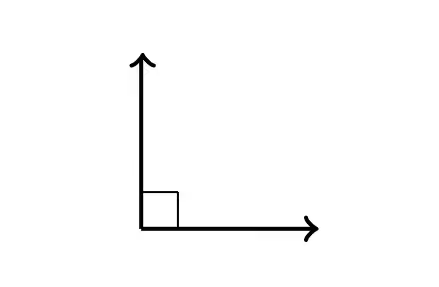
- Right Angle: An angle equal to 90°.
- Obtuse Angle: An angle greater than 90° but less than 180°.

- Straight Angle: An angle equal to 180°.

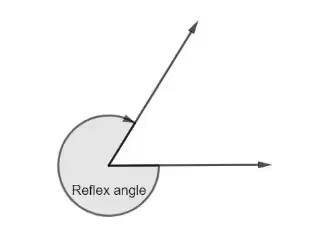
- Reflex Angle: An angle greater than 180° but less than 360°.
- Complete Angle: An angle equal to 360°.

Pair of Angles
Whenever two lines intersect or a transversal cuts two lines, several pairs of angles are formed. These pairs have special names and properties.
- Complementary Angles: Two angles are said to be complementary if the sum of their measures is 90°. For example, 60° and 30°.

- Supplementary Angles: Two angles are supplementary if the sum of their measures is 180°. For example, 130° and 50°.

- Adjacent Angles: Two angles are adjacent if they have a common arm, a common vertex and do not overlap. For example, a and b are adjacent angles below.

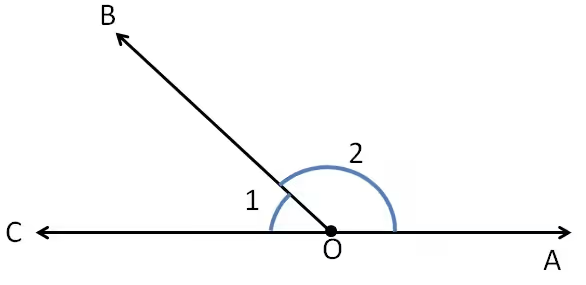
- Linear Pair of Angles: When two adjacent angles form a straight line, they are called a linear pair. The sum of the angles in a linear pair is always 180°.
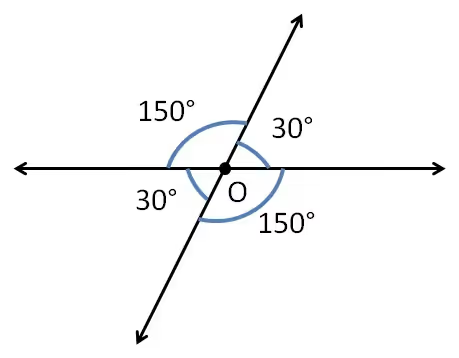
- Vertically Opposite Angles: When two lines intersect each other, they form two pairs of opposite angles. These are called vertically opposite angles and they are always equal.
Intersecting Lines and Properties
When two lines intersect, they form four angles. These angles satisfy certain properties:
- Four angles are formed.
- Vertically opposite angles are equal.
- Adjacent angles form a linear pair and are supplementary.
Theorem 6.1: If two lines intersect each other, then the vertically opposite angles are equal.
Proof Idea: When two lines intersect, adjacent angles form a linear pair and are supplementary. By applying this, we can prove opposite angles are equal.
Proof: Let AB and CD be two lines intersecting at O.

They lead to two pairs of vertically opposite angles, namely, (i) ∠ AOC and ∠ BOD (ii) ∠ AOD and ∠ BOC.
We need to prove that ∠ AOC = ∠ BOD and ∠ AOD = ∠ BOC.
Now, ray OA stands on line CD. Therefore, ∠ AOC + ∠ AOD = 180° (1)
And ∠ AOD + ∠ BOD = 180° (2)
From (1) and (2), we can write ∠ AOC + ∠ AOD = ∠ AOD + ∠ BOD
This implies that ∠ AOC = ∠ BOD
Similarly, it can be proved that ∠AOD = ∠BOC
Parallel Lines and Transversal
When two lines are parallel and a third line cuts them, the third line is called a transversal. The transversal forms eight angles with the parallel lines.

These angles are grouped as follows:
- Corresponding Angles: If a transversal intersects two parallel lines, the angles that occupy the same relative position are called corresponding angles. They are equal.
- Alternate Interior Angles: Angles formed on opposite sides of the transversal but inside the two lines are called alternate interior angles. They are equal.
- Alternate Exterior Angles: Angles formed on opposite sides of the transversal but outside the two lines are called alternate exterior angles. They are equal.
- Consecutive Interior Angles (Co-interior Angles): The pair of angles formed on the same side of the transversal and inside the two lines are called consecutive interior angles. Their sum is 180°.
Properties:
- If a transversal intersects two parallel lines, then
- Corresponding angles are equal.
- Alternate interior angles are equal.
- Consecutive interior angles are supplementary.
- The converse is also true: If any one of the above properties holds, then the lines are parallel.
Some Important Theorems
Theorem 6.2: If a transversal intersects two parallel lines, then each pair of corresponding angles is equal.
Theorem 6.3: If a transversal intersects two parallel lines, then each pair of alternate interior angles is equal.
Theorem 6.4: If a transversal intersects two parallel lines, then each pair of consecutive interior angles is supplementary.
Theorem 6.5 (Converse): If a transversal makes a pair of corresponding angles equal, then the two lines are parallel.
Theorem 6.6 (Converse): If a transversal makes a pair of alternate interior angles equal, then the two lines are parallel.
Theorem 6.7 (Converse): If a transversal makes a pair of consecutive interior angles supplementary, then the two lines are parallel.
Angle Sum Property of a Triangle
The sum of the three interior angles of a triangle is 180°. This is proved by drawing a line parallel to one side of the triangle and using alternate interior angles formed by a transversal.
This property is often proved using the concept of parallel lines and a transversal.
Common Mistakes Students Make
- Confusing corresponding angles with alternate angles.
- Forgetting that co-interior angles are supplementary (not equal).
- Not writing reason statements properly in proofs.
- Mixing up theorem and its converse.
Conclusion
The chapter Lines and Angles builds the logical base of geometry. By understanding angle relationships and properties of parallel lines, students develop the ability to solve geometrical proofs systematically.
Mastery of these concepts makes later chapters like Triangles, Quadrilaterals and Circles much easier.
FAQs
Q1. What is a linear pair?
Ans. A linear pair consists of two adjacent angles whose non-common arms form a straight line. Their sum is 180°.
Q2. Why are vertically opposite angles equal?
Ans. Because each is supplementary to the same adjacent angle, making them equal.
Q3. When are two lines parallel?
Ans. Two lines are parallel if corresponding angles are equal, alternate interior angles are equal, or co-interior angles are supplementary.
Q4. What is a transversal?
Ans. A transversal is a line that intersects two or more lines at distinct points.
Q5. State the angle sum property of a triangle.
Ans. The sum of the three interior angles of a triangle is 180°.












.svg)

