
.svg)
This chapter focuses on understanding areas through reasoning, not memorisation. It explains how figures that look different can have equal areas if their base and height are the same. Stay updated with changes in the latest CBSE Class 9 syllabus.
The key results in this chapter are:
- Parallelograms on the same base and between the same parallels are equal in area.
- Triangles on the same base and between the same parallels are equal in area.
- The area of a triangle is half the area of a parallelogram on the same base and height.
These results are proved logically using parallel lines and properties of triangles.

Understanding Area
Area is the region enclosed inside a shape. Here, you learn to compare areas using reasoning instead of direct measurement. A key idea is that the area of a shape depends on its base and height, not on the lengths of the slanted sides.
For example, two parallelograms may look different because their sides tilt differently, but if they share the same base and lie between the same parallels, they have equal areas.
Important Idea: Area depends only on base × perpendicular height, not on slanting sides.
Parallelograms on the Same Base and Between the Same Parallels
This is one of the most important results in NCERT. If two parallelograms have–the same base (i.e., they sit on the same line segment) and their opposite sides lie on the same parallel line then their areas are equal, even if their shapes seem different.
Why Does This Happen?
Think of a parallelogram as made from a rectangle but tilted. When you tilt the sides, the base stays the same and the height (distance between parallels) stays the same. Since area = base × height, the area remains unchanged.
The two parallelograms share the same base and have the same height, so their areas are equal.
Simple Example
If parallelograms ABCD and ABEF stand on the same base AB and both have their opposite sides on the same parallel line, then ⇒ ar(ABCD) = ar(ABEF).
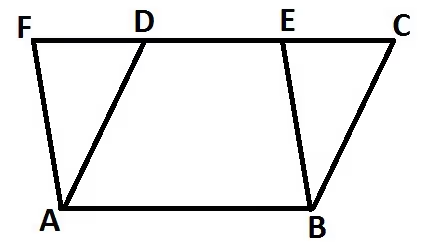
This is a fundamental theorem used repeatedly later.
Triangles on the Same Base and Between the Same Parallels
Just like parallelograms, triangles on the same base and between the same parallels also have equal areas.
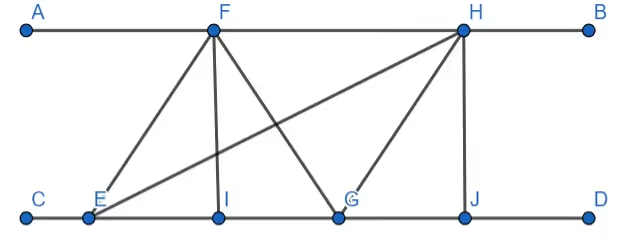
Why?
A triangle’s area = 1/2 × base × height. If the base is common and the height (distance between the vertex and the base) is the same, then all such triangles have equal area.
Visualising the Idea
Imagine sliding the top vertex along a line parallel to the base. The triangle changes shape, it becomes long or short, sharp or wide, but the height stays the same.
Since height is unchanged, area remains unchanged.
Relationship Between the Area of a Parallelogram and a Triangle
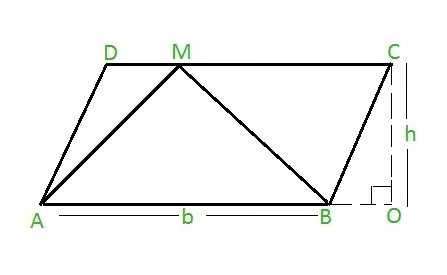
This is another key idea: A parallelogram can always be divided into two congruent triangles by drawing a diagonal.
Therefore, Area of a triangle = 1/2 × Area of the parallelogram
This gives the commonly used formula ⇒ Area of triangle = 1/2 × base × height
Proving the Equal-Area Concepts
These results are based on the idea that area depends only on the base and the perpendicular height, not on the shape’s slant or position.
1. Parallelograms on the Same Base and Between the Same Parallels : When two parallelograms lie between the same parallels, their heights are equal. Because bases are the same, the area must be equal.
2. Triangles on the Same Base and Between the Same Parallels : Again, the base is the same and the perpendicular distance from the third vertex to the base is the same. So the area is equal.
3. Triangle vs Parallelogram Relationship : A diagonal divides a parallelogram into two equal-area triangles. So each triangle has half the area.
Conclusion
This chapter builds logical understanding of area by connecting it with base and height. It shows that shape may change visually, but area remains the same if base and height remain unchanged. These results are foundational for coordinate geometry and higher geometry concepts.
FAQs
Q1. What does “between the same parallels” mean?
Ans. It means the figures lie between two parallel lines, so the perpendicular distance (height) between them is equal.
Q2. Are all parallelograms with the same base equal in area?
Ans. No. They must also lie between the same parallels.
Q3. Why is the area of a triangle half of a parallelogram?
Ans. Because a diagonal divides a parallelogram into two triangles of equal area.
Q4. Can two triangles look different but have equal area?
Ans. Yes, if they have the same base and height.
Q5. Why does slanting a parallelogram not change its area?
Ans. Because slanting does not change base or perpendicular height.












.svg)

