.svg)
In line with the reforms proposed under the National Education Policy 2020, NCERT has released the draft syllabus for Grade 9 (Secondary Stage Phase I) - Part III, prepared according to the NCF-SE 2023.
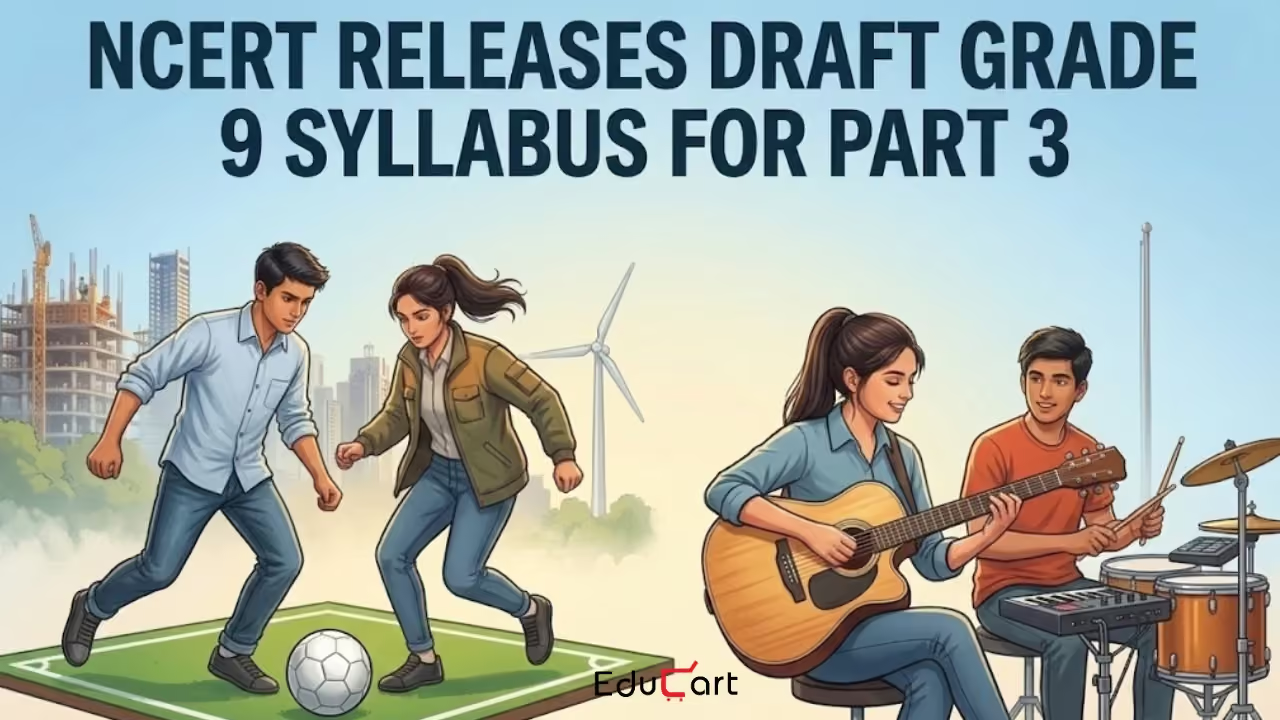
The proposed curriculum is expected to guide the academic session for 2026-27 and introduces a significant change in the learning of the students by focusing on vocational exposure, creative development, physical well-being, and social awareness alongside technical academic subjects.

Curriculum Structured Into Three Parts
As per the updated syllabus, the curriculum is divided into three parts, where Part I is for the languages, Part II is for the knowledge of technical subjects and the final part i.e., Part III is dedicated to vocational education
Part III focusing on four key learning areas:
- Vocational Education
- Arts Education
- Physical Education and Well-being
- Individuals in Society
The curriculum for this part is curated with the aim to ensure that students develop practical skills, creativity and social understanding, rather than focusing only on theoretical classroom learning.
NCERT Class 9 Language Subject Syllabus (Part I)
NCERT Class 9 Technical Subject Syllabus (Part II)
Shift Towards Competency-based Learning
The part III of the syllabus brings in a broader move away from rote memorisation to competency-based learning.
The framework emphasizes:
- Conceptual understanding
- Analytical and critical thinking
- Inquiry-based learning
- Real-world application of knowledge
Assessments are expected to focus more on problem-solving, reasoning, interpretation, and communication skills, aligning classroom learning with real-life situations.
Vocational Education Linked to Local Livelihoods
The draft syllabus places emphasis on vocational exposure for Grade 9 students, introducing skill-based modules connected to local livelihoods and emerging industries such as agriculture, healthcare support, retail, tourism, IT basics, beauty and wellness, and automotive repair.
Vocational education is organised into three categories of work:
- Work with Life Forms: activities involving plants, animals, agriculture, and environmental care.
- Work with Machines and Materials: skills related to designing, building, repairing, or manufacturing products.
- Work in Human Services: areas involving interaction with people, such as hospitality, healthcare support, and community services.
Note: Students in Grades 9 and 10 will explore six vocational areas through hands-on learning, with 220 hours allocated to vocational education across the two grades.
Experiential Learning at the Core
As the curriculum majorly focuses on hands-on-activity, it places strong emphasis on activities like:
- Project-based learning
- Field observations
- Practical work
- Community engagement
- Real-life problem-solving tasks
By engaging in these activities, authentic work experience is established where students complete tasks that produce real outcomes rather than only classroom simulations.
Focus on Holistic Learning
The NCERT Grade 9 updated syllabus expands the role of Arts Education and Physical Education and well-being to ensure complete i.e., holistic development. Focus on arts brings out creative expressions and cultural awareness, whereas physical education emphasizes fitness, and healthy lifestyles, with assessment based largely on participation and personal progress.
It also integrates cross-cutting themes such as:
- Indian knowledge systems
- Cultural rootedness
- Inclusion and diversity
- Educational technology
- Legal literacy
- Financial literacy
- Electoral literacy
The goal is to connect school education with India’s cultural context while addressing contemporary social and global challenges.
What’s in The Future
To support the revised curriculum, the NCERT is currently developing new textbooks aligned with the updated framework and they are expected to be released by March 2026.
The ultimate goal of this reform is to help students explore every skill that they entail and open up varied career options for them. The update in the syllabus by NCERT will help students develop life skills, gain early exposure to career pathways, and build ethical and civic responsibility, preparing them to become future-ready citizens.
Glimpse of the Event

Share Article


.svg)




%2520(1).avif)















.svg)

