The first chapter of the Science textbook, “Exploration”, is Exploring: Entering the World of Secondary Science. It introduces students to the fascinating world of science and its different branches.
This page provides important notes in PDF with a short and simple summary format for the first chapter. It will help students gain clarity of concepts and revision during final exam preparation.
Download Exploring: Entering the World of Secondary Science Class 9 Notes PDF
Students studying in Class 9 may download the PDF of Class 9 Science Ch. 1 notes via the download button. In the PDF, you will get detailed notes for all important topics in the chapter. The notes describe every concept in detail with proper explanation according to the latest CBSE Class 9 Science Syllabus. The notes are going to be very useful for self-study of complicated concepts, clarifying doubts and revision before exams
Download Exploring: Entering the World of Secondary Science notes

Class 9 Science Chapter 1 Notes at a Glance
Chapter 1, Exploring: Entering the World of Secondary Science focuses on some primary science concepts. It includes different scientific models, language, symbols, scientific laws, theories and principles, scientific predictions and testing, reasoning, the nature of science and science as a human activity.
The detailed breakdown of the main topics of Class 9 Science Ch. 1 notes has been mentioned below in the table.
After revising each chapter, students can practise CBSE Class 9 Science important questions to test their understanding.
1.1. How Science Explores the World
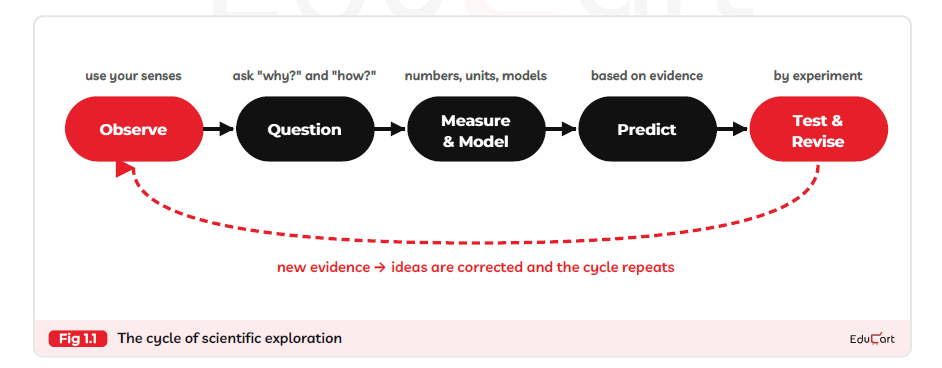
Science explores the natural world using observation, questioning, measurement and experimentation. Exploring: Entering the World of Secondary Science explains how scientists prepare models, identify different patterns and test ideas using evidence and reasoning.
1.1.1. Observation, Questioning and Scientific Exploration
Various scientists observe different natural events, ask relevant questions and conduct experiments to understand the natural order. They collect different evidence, measure quantities, test explanations and revise their ideas when new observations challenge existing conclusions. For detailed explanations of textbook exercises, students can refer to NCERT Solutions for Class 9 Science.
1.1.2. Scientific Models and Simplification
Scientific models represent real objects and processes through simplified explanations. Scientists determine appropriate features and ignore less significant details to study complex systems. They improve models by including additional elements when greater accuracy becomes necessary.
1.1.3. Precise Language, Symbols and Standard Units (SI Units)
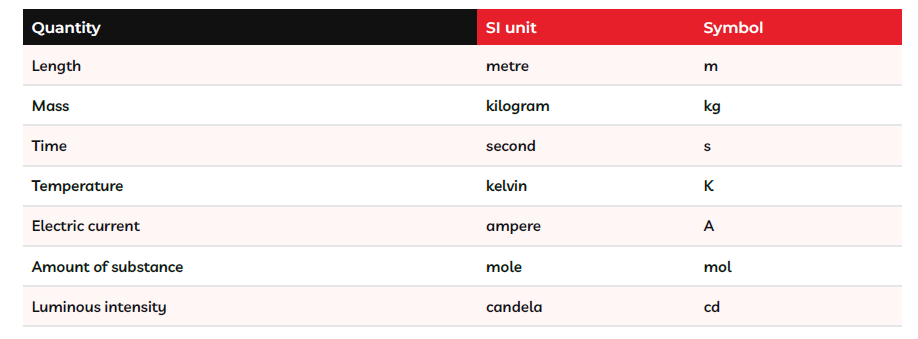
Science uses correct terminology, symbols and standard SI units to communicate information clearly. Scientists represent physical quantities using symbols such as mass (m), velocity (v) and force (F), whereas SI units ensure consistent measurements worldwide.
1.1.4. Mathematics as the Language of Science
Mathematics implies relationships among scientific quantities through equations and numerical calculations. Scientists use mathematical reasoning to research motion, chemical reactions, population growth and energy changes. Equations support and explain observations and make scientific predictions. To improve their exam preparation, students can also attempt Class 9 Science practice papers
1.2. Scientific Laws, Theories and Principles
CBSE Class 9 Science Ch. 1 notes explain how scientific laws, theories and principles organise and arrange scientific knowledge and experiences. These concepts describe natural patterns and explain observed phenomena. They also provide broad ideas for understanding different scientific situations.
1.2.1. Meaning and Characteristics of Scientific Laws
Scientific laws describe usual patterns and relationships of nature. They develop laws through frequent observations and experimental evidence. These laws use mathematical expressions to represent relationships between physical quantities in the behaviour of nature.
1.2.2. Scientific Theories and Evidence-Based Explanations
Scientific theories give evidence-based explanations for natural events or phenomena and observed patterns. They develop theories through careful testing, repeated observations and close examination. These explanations continue to improve when new scientific evidence becomes available.
1.2.3. Principles and Their Applications
The scientific principles provide guiding ideas which are broad in nature and apply to diverse situations. They help describe different natural processes and relationships through standard scientific understanding and explanations. The principle of conservation of energy describes energy changes during activities.
1.2.4. Differences Between Laws, Theories and Principles
Scientific laws outline patterns in nature, whereas theories of science explain why those patterns appear. Principles provide wide guiding ideas for understanding various situations. Each concept serves a distinct purpose in structuring knowledge in Science.
1.3. Scientific Predictions, Evidence and Critical Thinking
Science employs established laws, theories and models to make predictions about natural events. Exploring: Entering the World of Secondary Science notes explain how scientists examine predictions, test evidence and review claims through critical thinking and experiments.
1.3.1. Scientific Predictions Based on Evidence and Reasoning
Scientific predictions explain anticipated outcomes using existing evidence, measurements and logical reasoning. Scientists apply established laws, theories and models to forecast future events. These predictions help explain probable outcomes under different conditions.
1.3.2. Testing Predictions Through Measurements and Observations
Scientists examine predictions by collecting measurable data and comparing observations with expected outcomes. They examine factors for instance humidity, temperature and wind speed to evaluate predictions. Unexpected findings help determine errors in assumptions or scientific models.
1.3.3. Evaluating Myths and Unverified Claims Scientifically
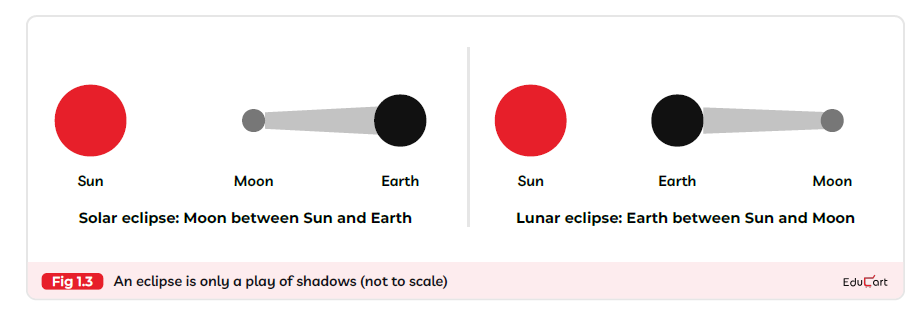
Scientific thinking supports evaluating general beliefs and unproven claims using evidence and measurable observations. Scientists continuously investigate possible explanations, identify supporting mechanisms and examine claims. For example, eclipse-related food myths lack scientific evidence.
1.3.4. Limitations of Scientific Models and Theories
Scientific models and theories also possess limitations, as they might not explain every condition or observation in nature. Scientists review existing explanations when new evidence develops, or measurements become more precise. These limitations uphold the constant development of science for further studies.
1.4. Estimation and Interconnected Branches of Science
CBSE Class 9 Science Ch. 1 notes also describe scientific estimation as a scientific skill and explain the connections between diverse branches of science. These concepts assist students in applying scientific reasoning to everyday problems and real-life situations in the environment.
1.4.1. Meaning and Importance of Estimation
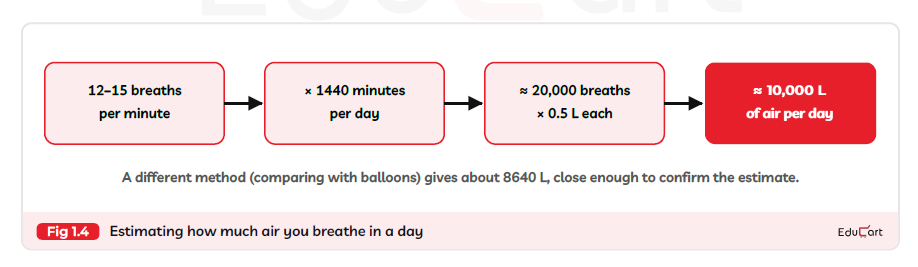
Scientific estimation involves calculating approximate values through facts and logical reasoning. Scientists often use estimation to develop numerical intuition, detect calculation errors and evaluate whether results are reasonable or not. It also helps early-stage scientific problem-solving.
1.4.2. Approximate Values and Reasonable Estimates
Approximate values deliver useful answers whenever exact measurements are not essential. Scientists compare estimated results with familiar quantities to check their reasonableness. As an example, a person breathes approximately 10,000 litres of air per day.
1.4.3. Major Branches of Science: Physics, Chemistry, Biology and Earth Science
Science comprises four major branches. Those are Physics, Chemistry, Biology and Earth Science. Physics analyses matter and motion, Chemistry examines substances and their properties, whereas Biology researches living organisms, and Earth Science looks into Earth's structure and processes.
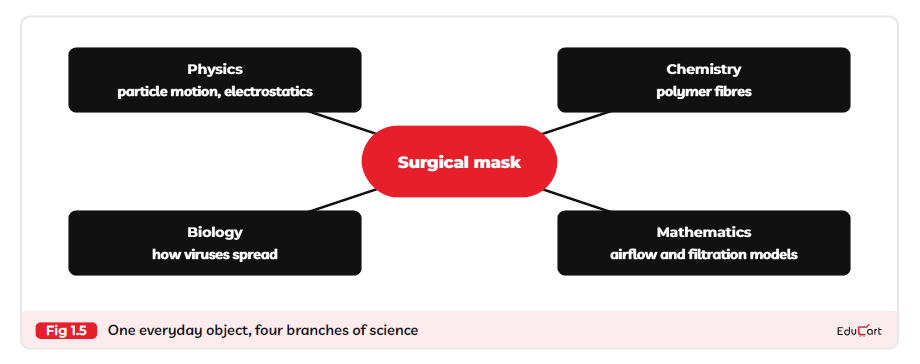
1.4.4. Interdisciplinary Connections in Science and Real-Life Applications
Various branches of science work together to solve complex problems related to real life as well as the environment. For instance, the study of climate change, medicine development or sustainable technology involves knowledge of Physics, Chemistry, Biology, Earth Science and Mathematics. These interdisciplinary connections among the branches help advance scientific understanding and practical applications in the real world.
Important Terms and Their Meanings
The chapter Exploring: Entering the World of Secondary Science carries various important terminologies. Remembering these terminology will help students later to understand questions to provide a proper answer in the exams. The important terminologies are:
Important Things to Remember from Exploring: Entering the World of Secondary Science Class 9
Some key concepts students must remember from Chapter 1, Class 9: Exploring: Entering the World of Secondary Science Class 9 are:
- Scientific Models: Scientific models are simplified representations that keep important features and overlook unnecessary details.
- Scientific Exploration: The concept of scientific exploration follows observation, questioning, measurement, modelling, prediction, testing and revision related to natural phenomena.
- SI Units: The chapter includes seven base units. It includes metre, kilogram, second, kelvin, ampere, mole and candela.
- Mathematics: Mathematical equations express relationships between scientific quantities, such as Distance = Speed × Time.
- Laws, Theories and Principles: Laws help describe, theories explain, and principles provide large guiding ideas of scientific concepts.
- Predictions and Estimation: Both use scientific reasoning; predictions rely on evidence, while estimates provide approximate values.
- Meghnad Saha: Meghnad Saha described the relationship between a star's colour and temperature using scientific modelling.
Recommended Study Materials For CBSE Class 9 Science
Read more articles related to resources for the Class 9 Science final exam.
Recommended Study Materials for CBSE Class 9 Notes
Students are advised to explore Educart's question banks and sample papers for effective exam preparation. These books provide extra practise material aside from Class 9 Science Chapter 6 notes for better scores in results.
Frequently Asked Questions
Q1. Where can students download Class 9 Science Chapter 1 notes PDF?
Ans. Students can download the free PDF of Exploring: Entering the World of Secondary Science notes using the download button provided on this page.
Q2. What topics are covered in Exploring: Entering the World of Secondary Science notes?
Ans. The notes cover scientific exploration, models, SI units, mathematics, scientific laws, theories, principles, predictions, critical thinking, estimation and branches of science.
Q3. Do Class 9 Science Chapter 1 notes include important definitions and terminology?
Ans. Yes. The notes explain important terms such as scientific models, assumptions, simplification, scientific observations, predictions, accuracy and scientific investigation.
Q4. How are the Class 9 Science Chapter 1 notes organised?
Ans. The notes follow the NCERT chapter sections, with topic-wise explanations, subtopics, important definitions and key concepts for quick revision.
Q5. How can students use Chapter 1 Science notes for final exam preparation?
Ans. Students can use these notes to revise important concepts, understand scientific terminology, clarify doubts and review key points before attempting chapter-related questions.