
.svg)


The Earth is home to an enormous variety of living organisms, ranging from microscopic bacteria to complex plants and animals. This vast variety is called biodiversity. To understand and study this diversity systematically, scientists classify organisms into groups based on similarities and differences.
Classification not only makes study easier but also helps us understand evolutionary relationships among organisms. In the Diversity in Living Organisms chapter, you will learn about the five-kingdom classification system, the basis of grouping organisms, and how plants and animals are further classified. Get complete overview from CBSE Class 9 Science syllabus

Introduction to Diversity
Life on Earth exists in an astonishing variety of forms. From microscopic bacteria to giant whales, living organisms differ greatly in size, shape, habitat, and function. This variety is referred to as biodiversity.
The Earth is home to millions of species, yet only about 1.7 to 1.8 million species have been identified and named. Understanding this vast diversity and organizing it meaningfully is one of the main goals of biological classification.
Early humans classified organisms based on their usefulness, such as edible plants and animals or those that posed danger. However, with the development of science, a more systematic and scientific method of classification became necessary to study organisms and understand their relationships and evolution.
What is Classification?
Classification is the process of grouping organisms based on similarities and differences in their characteristics. It helps scientists to study organisms systematically and understand how they are related. Moreover, classification makes the study of the vast number of organisms manageable and meaningful.
For example, despite the huge diversity, all organisms can be placed into specific groups such as animals, plants, fungi, bacteria, etc. These groups are formed based on shared characteristics like cell structure, mode of nutrition, level of organization, and reproductive strategies.
Why Do We Need Classification?
Classification serves several purposes in biology. Firstly, it simplifies the study of the vast number of living organisms by grouping them based on similar traits. Secondly, it helps in understanding the evolutionary relationships between organisms.
Classification also provides insight into the shared ancestry and common features of different species. Most importantly, it helps in predicting characteristics of newly discovered organisms based on their group.
Basis of Classification
Over time, scientists have developed various criteria for classification. The important features considered in modern classification include:
- Whether the organism is made up of prokaryotic or eukaryotic cells
- Whether the organism is unicellular or multicellular
- Whether the organism can prepare its own food (autotroph) or depends on others for food (heterotroph)
- The level of body organization, such as tissues, organs, or organ systems
- Mode of reproduction, such as sexual or asexual
These features provide a framework to categorize life forms into distinct groups.
Hierarchy of Classification
Living organisms are classified step by step into categories called taxa. Species is the smallest unit of classification. The hierarchy is:
Kingdom → Phylum/Division → Class → Order → Family → Genus → Species
The Five Kingdom Classification
The most widely accepted system of classification was proposed by Robert Whittaker in 1969. He classified living organisms into five major kingdoms:

- Monera
- Protista
- Fungi
- Plantae
- Animalia
Each kingdom is described based on specific features.
Kingdom Monera
Organisms in the kingdom Monera are unicellular and prokaryotic, meaning their cells do not have a well-defined nucleus or membrane-bound organelles. These organisms include bacteria and cyanobacteria (blue-green algae).
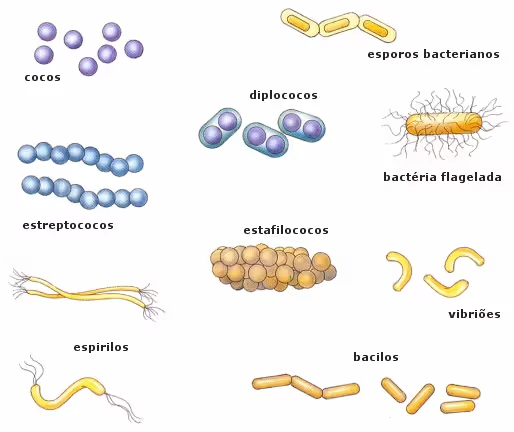
Some monerans can perform photosynthesis, while others are heterotrophic. Bacteria are found in almost all habitats, soil, water, air, and even inside the bodies of plants and animals.
Despite their small size, they play essential roles in decomposition, nitrogen fixation, and even in industrial processes.
Kingdom Protista
Protists are unicellular eukaryotic organisms, meaning they have a nucleus enclosed within a membrane. They show greater cellular complexity compared to monerans. Some examples include Amoeba, Paramecium, and Euglena.
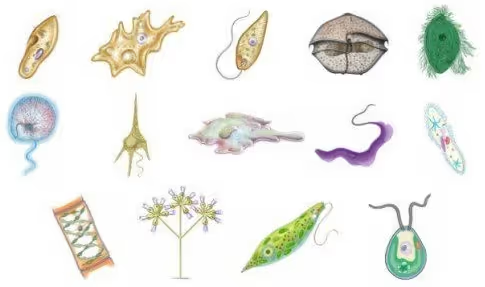
Some protists like Euglena have both plant-like and animal-like features. They can perform photosynthesis when sunlight is available and act as heterotrophs in the absence of light. These organisms are mostly aquatic and move with the help of cilia or flagella.
Kingdom Fungi
Fungi are mostly multicellular (except for unicellular yeast) and eukaryotic. They do not perform photosynthesis; instead, they are heterotrophs and absorb nutrients from dead or decaying organic matter, which makes them saprophytes.
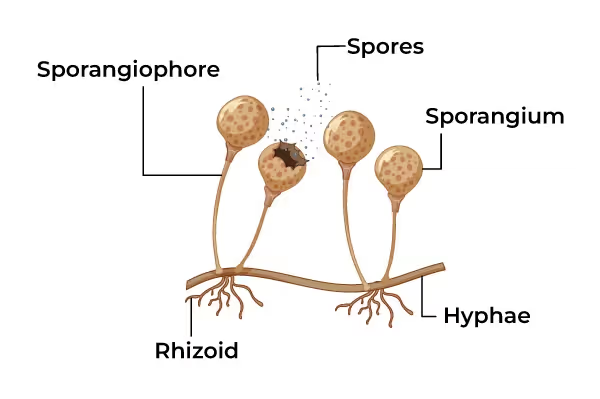
Fungal bodies are made up of thread-like structures called hyphae, and a group of hyphae forms a mycelium. Reproduction occurs through spores. Examples include Rhizopus (bread mold), Mushroom, and Yeast.
Kingdom Plantae
This kingdom includes multicellular, eukaryotic autotrophs. These organisms perform photosynthesis using chlorophyll present in chloroplasts. Plants have a rigid cell wall made of cellulose.
Based on the presence or absence of specific features such as vascular tissues, seeds, and flowers, plants are further divided into smaller groups.
The major plant groups include:
- Thallophyta (e.g., algae like Spirogyra)
- Bryophyta (e.g., mosses)
- Pteridophyta (e.g., ferns)
- Gymnosperms (e.g., pine)
- Angiosperms (e.g., mango, rose)
Kingdom Animalia
Animals are multicellular, eukaryotic, heterotrophic organisms. They do not have a cell wall and are capable of movement at some stage in their life. Most animals have complex body organization with specialized tissues, organs, and organ systems.
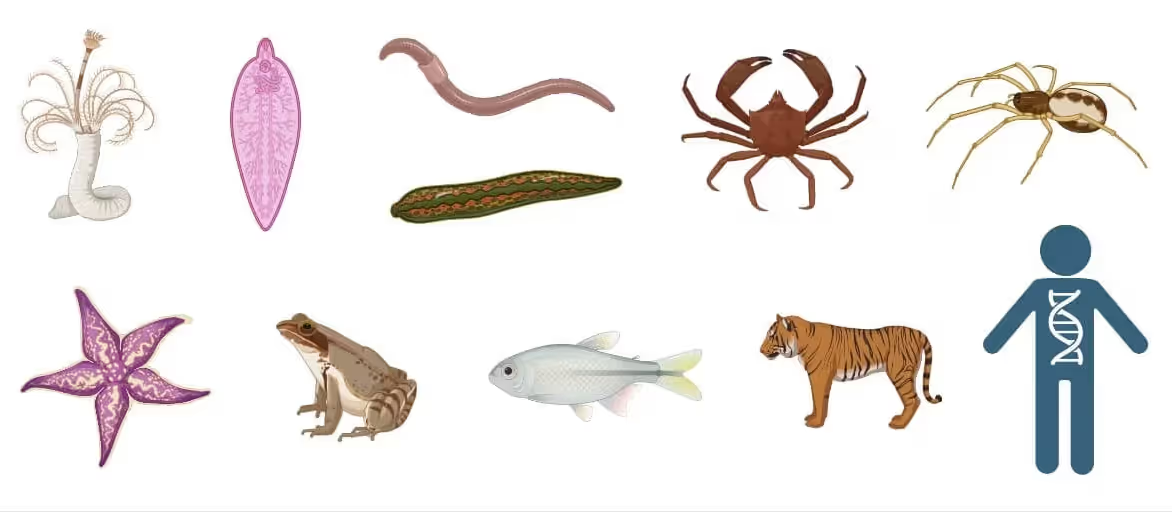
Animals are classified based on:
- Body symmetry (e.g., bilateral, radial)
- Presence of body cavity (coelom)
- Levels of organization (cellular, tissue, organ, organ system)
- Presence or absence of backbone (vertebrates and invertebrates)
Classification of Plants
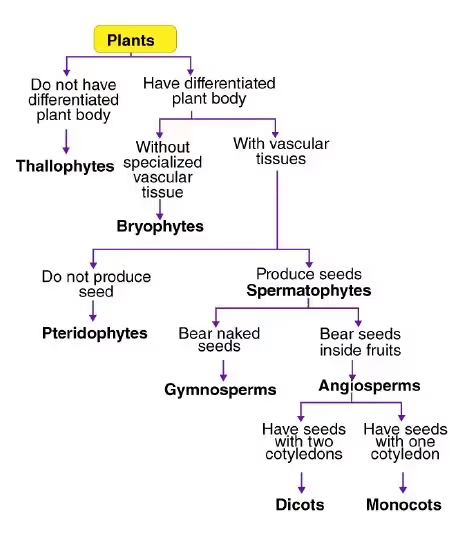
Within the kingdom Plantae, plants are classified into different divisions:
- Thallophyta
These are the simplest plants that have no roots, stems, or leaves. They are mostly aquatic. Example: Algae.
- Bryophyta
These plants grow in moist and shady places and have structures similar to roots, stems, and leaves, but without vascular tissues. Example: Moss.
- Pteridophyta
These are the first vascular plants and have true roots, stems, and leaves. They reproduce through spores. Example: Ferns.
- Gymnosperms
These plants have seeds, but they are naked seeds (not enclosed in fruits). They have needle-like leaves and are usually evergreen. Example: Pine, Cycads.
- Angiosperms
These are flowering plants that produce seeds enclosed in fruits. They are further divided into:
- Monocots - one seed leaf (e.g., rice, wheat)
- Dicots - two seed leaves (e.g., mango, sunflower)
Classification of Animals
Animals are divided into invertebrates (without backbone) and vertebrates (with backbone).
Invertebrates include:
- Porifera: Simplest animals with pores, e.g., Sponges
- Coelenterata (Cnidaria): Have a hollow body cavity, e.g., Hydra, Jellyfish
- Platyhelminthes: Flatworms, e.g., Tapeworm
- Nematoda: Roundworms, e.g., Ascaris
- Annelida: Segmented worms, e.g., Earthworm
- Arthropoda: Largest group with jointed legs, e.g., Insects, spiders
- Mollusca: Soft-bodied animals, e.g., Snails, octopus
- Echinodermata: Spiny-skinned animals with radial symmetry, e.g., Starfish
Vertebrates include:
- Pisces: Fishes, aquatic, gills, scales, e.g., Shark, Rohu
- Amphibia: Can live on land and water, moist skin, e.g., Frog
- Reptilia: Dry scaly skin, cold-blooded, e.g., Snake, lizard
- Aves: Birds, warm-blooded, feathers, e.g., Parrot, crow
- Mammalia: Warm-blooded, have hair, give birth to young ones, e.g., Humans, cows
Nomenclature and Scientific Naming
To avoid confusion caused by local names, scientists use a standard system of naming organisms called binomial nomenclature, introduced by Carl Linnaeus. Each organism is given a two-part scientific name:
- The first word is the genus
- The second word is the species
For example, Homo sapiens refers to humans where Homo is the genus and sapiens is the species.
The rules of binomial nomenclature are:
- The name should be in Latin
- The genus name starts with a capital letter, species with a small letter
- It should be italicized when printed or underlined when handwritten
Conclusion
Now that you've explored the amazing variety of life on Earth, you can see how all living things, big or small, have their own special features. From simple bacteria to complex animals and plants, every organism has a role in nature.
Understanding how scientists group these organisms helps us make sense of this vast diversity. It also helps us appreciate how living things are connected and how they’ve adapted to survive in different environments.
You now have a clearer picture of how classification works and why it’s so important in science. The next time you see a plant, animal, or insect, you’ll know there’s a lot more to it than meets the eye!
FAQs
Q1. Why is classification necessary?
Ans. It helps organise organisms systematically and understand evolutionary relationships.
Q2. Why are viruses not included in five kingdoms?
Ans. Because viruses are non-cellular and show characteristics of both living and non-living things.
Q3. Why are bryophytes called amphibians of the plant kingdom?
Ans. Because they live on land but require water for reproduction.
Q4. What is the main difference between gymnosperms and angiosperms?
Ans. Gymnosperms have naked seeds, while angiosperms have seeds enclosed in fruits.
Q5. What is binomial nomenclature and why is it important?
Ans. It is a universal scientific naming system that avoids confusion caused by local names.












.svg)

