
.svg)
Understanding Atoms and Molecules is the first major step in learning chemistry. This chapter explains what the smallest particles of matter are, how they behave, and how they combine to form everything around us.
It introduces you to fundamental ideas like the Laws of Chemical Combination, the meaning of atomic mass and molecular mass, the mole concept, and how to write chemical formulae using valency. Some basic terms related to atoms, such as atomicity and relative masses, are also introduced. The chapter Atoms and Molecules is an important part of the CBSE Class 9 Science Syllabus, where students learn about the basic building blocks of matter and the laws of chemical combinations.
These notes will help you revise quickly and clearly, whether you are preparing for exams, class tests, or simply want an easy explanation to strengthen your basics.
Class 9 Atoms and Molecules Notes
The chapter Atoms and Molecules introduces the basic building blocks of matter. It explains fundamental laws like the Law of Conservation of Mass and Law of Definite Proportions. The concept of atoms, molecules, atomic mass, molecular mass, valency, and writing chemical formulae are discussed in detail.
It also covers the mole concept and introduces isotopes, isobars, and atomicity. These concepts form the foundation of chemistry and help understand the composition and behavior of substances in a chemical reaction.
Let's go through detailed notes to understand each concept clearly.

Introduction to Atoms and Molecules
All matter around us is made of small particles known as atoms and molecules.
An atom is the smallest particle of an element that can take part in a chemical reaction and retains the properties of that element. Atoms are extremely small and cannot be seen with the naked eye or even a microscope.
A molecule is formed when two or more atoms combine chemically. Molecules can be of the same kind of atoms (like O₂, H₂) or of different kinds of atoms (like H₂O, CO₂).
Molecules are the smallest units of compounds that can exist independently and exhibit the properties of the compound. These concepts about atoms, molecules, and the laws of chemical combination are explained in detail in the Class 9 Science NCERT Book, along with examples and practice questions.
Law of Conservation of Mass
Antoine Lavoisier gave the Law of Conservation of Mass.
According to this law, mass is neither created nor destroyed in a chemical reaction.
This means that the total mass of the products formed in a chemical reaction is equal to the total mass of the reactants involved.
For example, if hydrogen and oxygen react to form water, the combined mass of hydrogen and oxygen before the reaction will be the same as the mass of water formed after the reaction.
For example, 2 g of hydrogen reacts with 71 g of chlorine to form 73 g of hydrogen chloride.
H₂ + Cl₂ → 2HCl
This law laid the foundation for understanding chemical changes and maintaining balance in chemical equations.
Law of Definite Proportions
Joseph Proust proposed this law and is also known as the Law of Constant Proportions.
It states that a given compound always contains the same elements combined together in a fixed proportion by mass.
This means no matter where a sample of the compound is obtained from or how it is prepared, it will always have the same composition by mass.
Example:
Water (H₂O) always has 2 parts of hydrogen and 16 parts of oxygen by mass (Ratio 1:8), regardless of source.
Atomic Mass
Atomic mass is the relative mass of an atom of an element as compared to 1/12th the mass of a carbon-12 atom, usually expressed in atomic mass units (amu or u).
1 atomic mass unit = 1/12th the mass of one atom of carbon-12 isotope.
Each element has a characteristic atomic mass. For example, hydrogen has an atomic mass of approximately 1 u, oxygen is 16 u, and carbon is 12 u.
Atomic mass helps in comparing the masses of different atoms and in calculating the mass of molecules.
Examples:
- Hydrogen = 1 u
- Oxygen = 16 u
- Carbon = 12 u
Molecular Mass
Molecular mass is the sum of the atomic masses of all the atoms present in a molecule of a substance. It is also expressed in unified mass units (u).
For example, the molecular mass of water (H₂O) is calculated by adding the atomic mass of two hydrogen atoms (2 × 1 u) and one oxygen atom (16 u), which equals 18 u.
H₂O = (2 × 1) + (1 × 16) = 18 u
Molecular mass helps in understanding the relative weight of different molecules and is useful in stoichiometric calculations during chemical reactions.
Mole Concept
The mole is a standard scientific unit for measuring large quantities of very small entities like atoms or molecules.
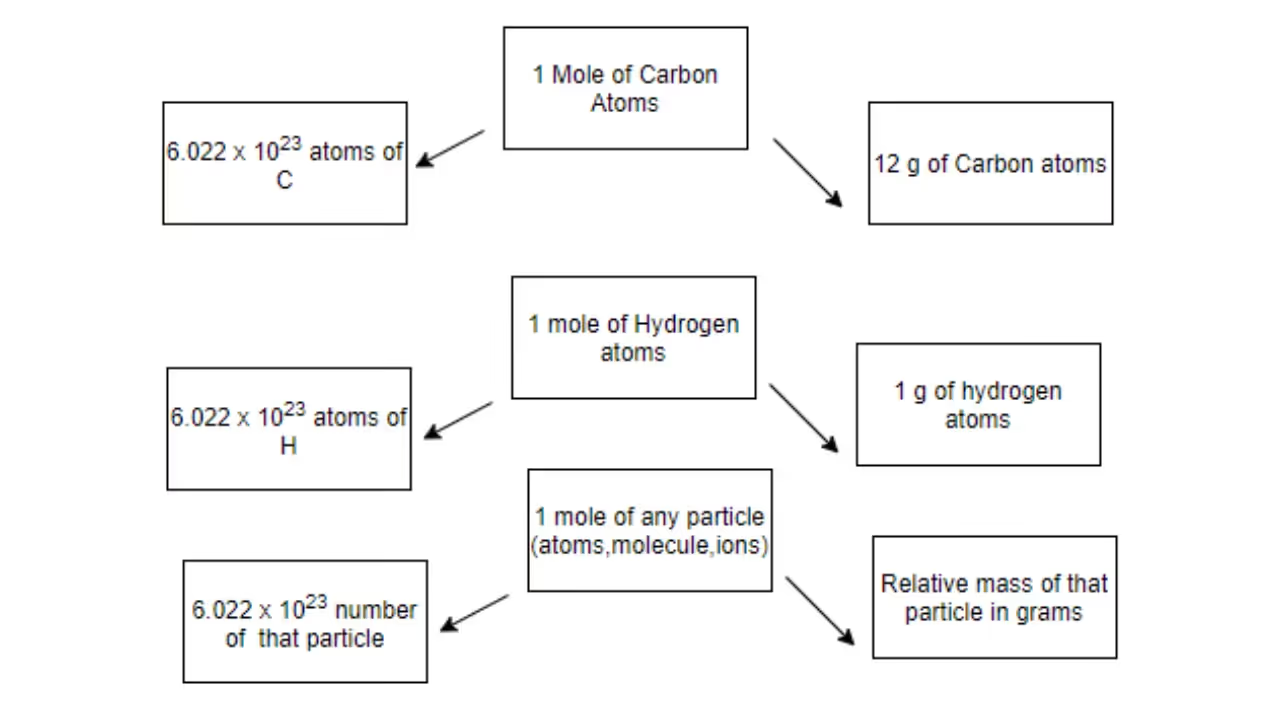
A mole is the amount of substance that contains 6.022 × 10²³ particles (Avogadro’s number).
- 1 mole of an element has a mass numerically equal to its atomic mass in grams
- 1 mole of molecules = Molecular mass in grams
Students should also practice Class 9 Science Important Questions from this chapter to strengthen their understanding of the mole concept and chemical formulas.
Examples:
- 1 mole of H = 1 g = 6.022 × 10²³ atoms
- 1 mole of H₂O = 18 g = 6.022 × 10²³ molecules
Formula:
Number of moles = Given mass / Molar mass
Writing Chemical Formula
Chemical formulas represent the composition of molecules and compounds using symbols and numbers. To write a chemical formula, we need to know the valency of each element. The chemical formula is written by balancing the valencies of the combining elements.
Steps:
- Write symbols of elements.
- Write their valencies.
- Cross-multiply to balance.
Examples:
- Water: H (valency 1), O (valency 2) → H₂O
- Ammonia: N (3), H (1) → NH₃
- Calcium chloride: Ca (2), Cl (1) → CaCl₂
Concept of Valency
Valency is the combining capacity of an element. It is defined as the number of electrons an atom can gain, lose, or share to complete its outer shell and attain stability. Valency helps determine how atoms combine with each other to form molecules and compounds. It also helps in writing correct chemical formulas.
Examples:
- Hydrogen = 1
- Oxygen = 2
- Nitrogen = 3
- Carbon = 4
- Sodium = 1
Atomicity
Atomicity refers to the number of atoms present in a molecule of an element. It can vary from one element to another.
Elements like helium, neon, and argon have atomicity of 1 and are called monoatomic.
Oxygen, hydrogen, and nitrogen have atomicity of 2 and are called diatomic.
Some elements like ozone (O₃) and phosphorus (P₄) have atomicities of 3 and 4 respectively.
Examples:
- Monoatomic: He, Ne, Ar
- Diatomic: O₂, H₂, N₂
- Triatomic: O₃
- Polyatomic: P₄, S₈
Conclusion
We hope these notes have helped you understand the chapter Atoms and Molecules in a simple and clear way. This chapter is very important because it explains the basic ideas of chemistry that you will use again and again in higher classes.
If you revise these notes regularly, you’ll be able to remember all the important points during your exams and tests. These notes are made to save your time and give you the best summary of the chapter without any confusion.
So whether you are preparing for school exams or just want a quick revision, these notes are your perfect study partner.
FAQs
Q1. What does Dalton’s Atomic Theory say?
Ans. Dalton’s Atomic Theory states that all matter is made of tiny, indivisible atoms. These atoms combine in fixed, simple whole-number ratios to form compounds, and atoms of the same element have similar mass and properties.
Q2. What is the difference between atoms and molecules?
Ans. An atom is the smallest unit of an element, such as H or O. A molecule is formed when two or more atoms chemically bond together, such as H₂ or CO₂.
Q3. What is meant by atomic mass?
Ans. Atomic mass is the average mass of an element’s atoms compared to 1/12th the mass of a carbon-12 atom. It helps compare how heavy one atom is relative to another.
Q4. What is a mole in chemistry?
Ans. A mole is a unit used to measure the amount of a substance. One mole contains 6.022 × 10²³ particles, such as atoms, molecules, or ions.
Q5. What is the chemical formula of a compound?
Ans. A chemical formula shows the types of atoms present in a compound and their ratio. For example, CO₂ represents one carbon atom combined with two oxygen atoms.
Q6. Where can students revise Class 9 Science chapters along with Atoms and Molecules?
Ans. Students can revise this topic and other chapters using Class 9 Science Chapter-wise Notes, which provide simplified explanations, formulas, and key concepts for quick revision.
Q7. How can students check answers to NCERT questions from the Atoms and Molecules chapter?
Ans. Students can refer to Class 9 Science NCERT Solutions, which provide step-by-step answers and explanations for all textbook questions.












.svg)

