
.svg)
Surface Areas and Volumes Class 9 Notes help you understand how to calculate the outer covering and inner capacity of 3D objects like tanks, cones, balls and boxes. This chapter from NCERT focuses on formulas for cuboid, cube, cylinder, cone, sphere and hemisphere.
These concepts are widely used in real-life problems involving storage, painting and construction. Let’s understand each solid clearly with formulas and diagrams. Make sure to revise from Maths Syllabus Class 9 regularly.
Surface area tells us the total area that covers the outside of a solid object. Volume tells us the space occupied by a solid object.
Students can also explore Class 9 Maths Chapter-wise Notes to revise other important chapters of the syllabus in a simple and structured way.
What is the Surface Area?
The space occupied by 2-D flat surfaces is called the area. It is measured in square units. The area occupied by a 3-dimensional object by its outer surface is called the surface area. It is also measured in square units.
Generally, area can be of two types–total surface area and curved surface area/ lateral surface area.
- Total Surface Area: refers to the area including the base(s) and the curved part
- Curved Surface Area/ Lateral Surface Area: refers to the area of only the curved part of the shape excluding its base(s)
What is Volume?
The amount of space, measured in cubic units, that an object or substance occupies is called volume. 2-D doesn’t have volume but has area only.

Cuboid
A cuboid is a three-dimensional solid figure bounded by six rectangular faces, with opposite faces equal. It has 12 edges and 8 vertices.
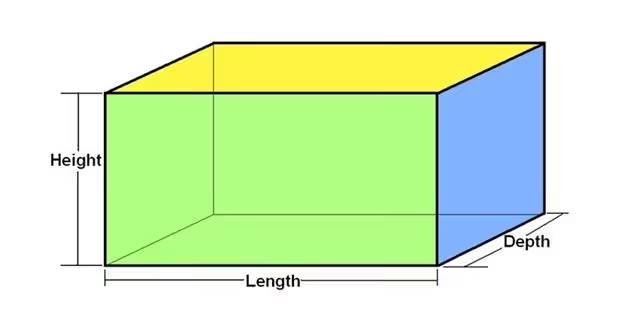
Let the length = l, breadth = b and height = h.
(i) Total Surface Area (TSA) of Cuboid
Each cuboid has 6 rectangular faces:
- 2 faces of area = l × b
- 2 faces of area = b × h
- 2 faces of area = l × h
TSA = 2(lb + bh + hl)
(ii) Lateral Surface Area (LSA) of Cuboid
Excluding the top and bottom, only 4 side faces remain:
LSA = 2h(l + b)
(iii) Volume of Cuboid
The volume of a cuboid = base area × height.
V = lbh
Cube
A cube is a special cuboid where all edges are equal, i.e., l=b=h=al = b = h = a. It has 6 equal square faces.
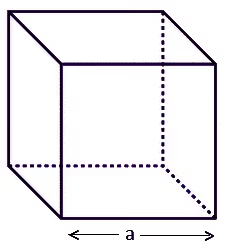
(i) Total Surface Area (TSA) of Cube
TSA = 6a2
(ii) Lateral Surface Area (LSA) of Cube
LSA = 4a2
(iii) Volume of Cube
V = a3
Right Circular Cylinder
A right circular cylinder is a solid having two identical circular bases connected by a curved surface and the line joining the centers of the bases is perpendicular to them.
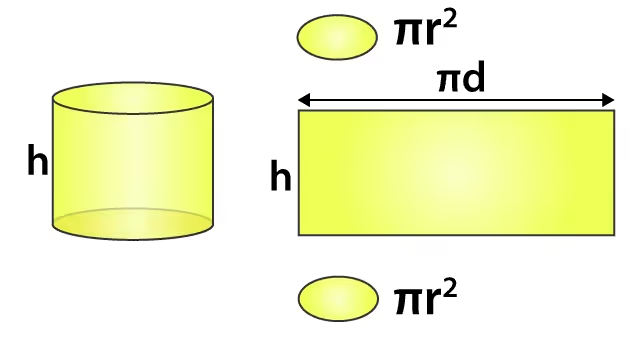
Let radius = r, height = h.
(i) Curved Surface Area (CSA) of Cylinder
If the curved surface is unfolded, it becomes a rectangle of length 2πr and height h.
CSA = 2πrh
(ii) Total Surface Area (TSA) of Cylinder
Includes curved surface + 2 circular bases:
TSA = 2πrh + 2πr2
(iii) Volume of Cylinder
V = πr2h
Right Circular Cone
A cone is a solid with a circular base and a curved surface that tapers smoothly to a point called the vertex.
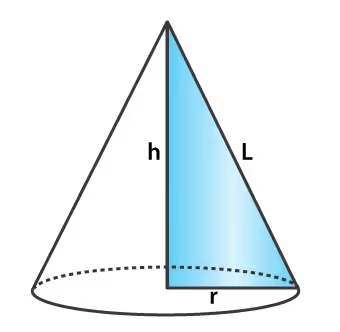
Let radius = r, height = h, slant height = l.
(i) Relation between Height and Slant Height
By Pythagoras theorem:
l2 = h2 + r2
(ii) Curved Surface Area (CSA) of Cone
CSA = πrl
(iii) Total Surface Area (TSA) of Cone
TSA = πrl + πr2
(iv) Volume of Cone
V = 1/3 πr2h
Sphere
A sphere is a perfectly round 3D solid in which every point on the surface is equidistant from the center. The distance from the center to any point on the sphere is called its radius (r).
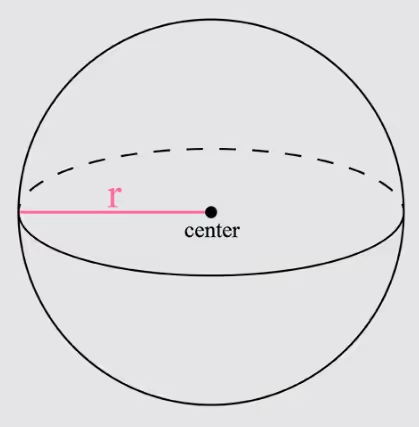
(i) Surface Area of Sphere
TSA = CSA = 4πr2
(ii) Volume of Sphere
V = 4/3 πr2
Hemisphere
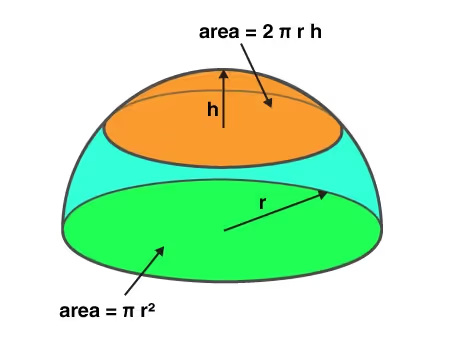
(i) Curved Surface Area of Sphere
CSA = 2πr2
(i) Total Surface Area of Sphere
TSA = 3πr2
(ii) Volume of Sphere
V = 2/3 πr2
Combination of Solids
Many real-life objects are combinations of two or more solids. For example:
- A toy made of hemisphere + cone
- A capsule (cylinder + hemispheres)
Steps:
- Divide into known solids
- Apply individual formulas
- Add or subtract accordingly
Volume v/s Capacity
- Volume is the measure of space occupied by a solid (inside space).
- Capacity refers to the amount of liquid or material a container can hold.
- Both are measured in cubic units (e.g., cm³, m³, litres).
Note: 1 litre = 1000 cm3 and 1 m3 = 1000 litres
Conclusion
Surface areas and volumes are fundamental concepts in geometry with wide practical applications. When we know the formulas for cuboids, cubes, cylinders, cones and spheres, it becomes easy to calculate the paint required for objects, the storage capacity of containers and the space occupied by different solids. For step-by-step solutions to textbook questions based on these formulas, students can also refer to Class 9 Maths NCERT Solutions.
This chapter not only helps us in solving mathematical problems but also strengthens our spatial reasoning skills and the ability to relate mathematics to real-life situations.
FAQs
Q1. What is the difference between curved surface area and total surface area?
Ans. Curved surface area includes only the curved part of a solid, while total surface area includes the curved surface area along with the base areas of the solid. These concepts are explained clearly in the Class 9 Maths NCERT Book with diagrams and examples.
Q2. What is the formula for the volume of a cone?
Ans. The volume of a cone is calculated using the formula
V = 1/3 πr²h, where r is the radius of the base and h is the height of the cone.
Q3. What is the surface area of a hemisphere?
Ans. The surface area formulas for a hemisphere are:
- Curved Surface Area = 2πr²
- Total Surface Area = 3πr²
These formulas are used to calculate the surface area of a hemispherical solid.
Q4. How do you solve combination of solids problems?
Ans. To solve combination of solids problems, first divide the figure into basic solids such as cylinder, cone, or hemisphere. Then apply the respective formulas for each solid and add or subtract the areas or volumes as required.
Q5. What is the relation between volume and capacity?
Ans. Volume is the total space occupied by a solid, while capacity refers to the amount of liquid a container can hold. The standard conversion is 1 litre = 1000 cm³.
Q6. Where can students download Class 9 Surface Areas and Volumes notes for quick revision?
Ans. Students can download Class 9 Surface Areas and Volumes notes from reliable educational platforms like Educart. These notes provide formulas, solved examples, and key concepts to help students revise the chapter effectively before exams.
Q7. How can students practice important problems from the Surface Areas and Volumes chapter?
Ans. Students can strengthen their preparation by solving Class 9 Maths Important Questions, which include exam-oriented problems based on surface area and volume formulas.












.svg)

