
.svg)
Quadrilaterals form an important part of geometry in Class 9. In this chapter, students study different types of quadrilaterals, their properties, important theorems and conditions to prove whether a figure is a parallelogram.
Understanding this chapter from class 9 maths syllabus clearly is important because many proof-based questions and reasoning problems in exams are asked from here.

Definition of a Quadrilateral
A quadrilateral is a polygon having four sides, four angles and four vertices.
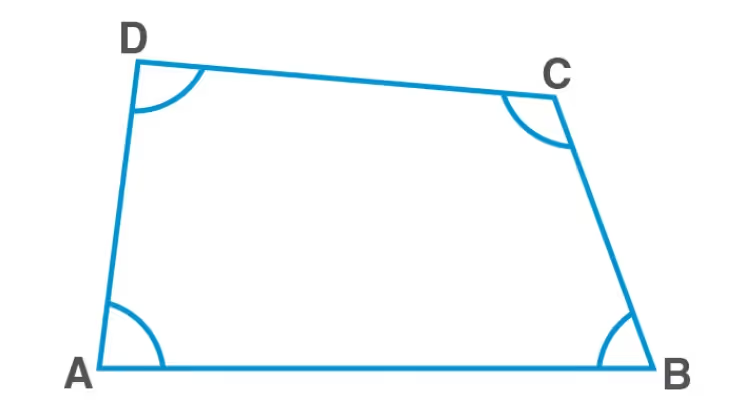
- The sum of the four angles of any quadrilateral is always 360°.
- Quadrilaterals can be classified into various types depending on the nature of their sides and angles.
Angle Sum Property: ∠A + ∠B + ∠C + ∠D = 360°
Types of Quadrilaterals
Quadrilaterals are classified based on sides, angles and diagonals.
1. Trapezium
A quadrilateral in which one pair of opposite sides is parallel is called a trapezium.
Properties:
- One pair of opposite sides parallel
- Adjacent angles between parallel sides are supplementary (sum = 180°)
- In an isosceles trapezium, non-parallel sides are equal
2. Parallelogram
A quadrilateral in which both pairs of opposite sides are parallel is called a parallelogram.
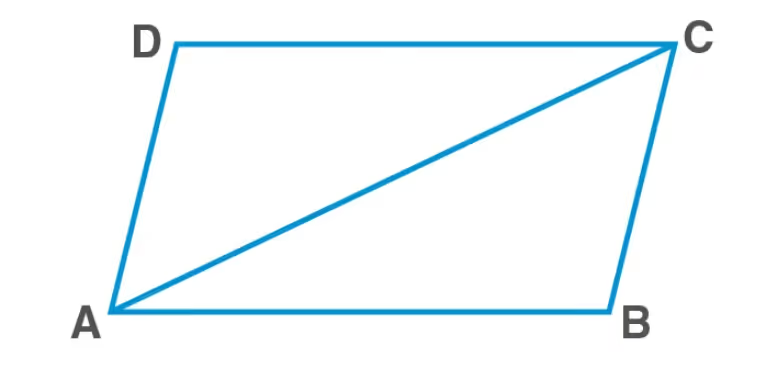
Derivation:
In ΔABC and ΔCDA
AC = AC [Common / transversal]
∠BCA = ∠DAC [alternate angles]
∠BAC = ∠DCA [alternate angles]
ΔABC ≅ ΔCDA [ASA rule]
Hence, AB = DC and AD = BC [C.P.C.T]
Properties:
- Opposite sides are equal and parallel.
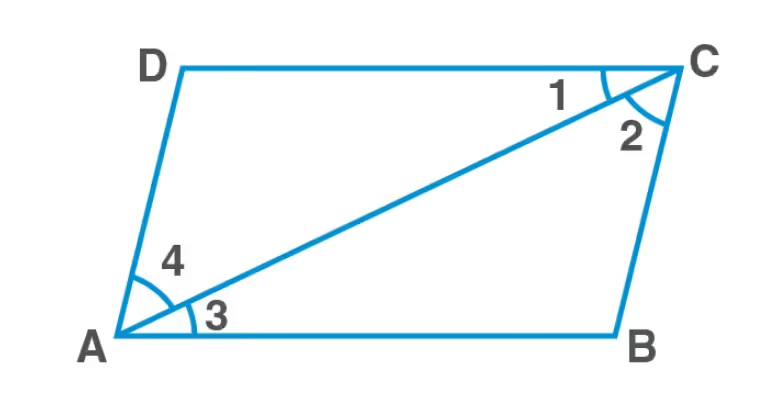
In parallelogram ABCD,
AB‖CD; and AC is the transversal; hence, ∠1 = ∠3….(1) (alternate interior angles)
BC‖DA; and AC is the transversal; hence, ∠2 = ∠4….(2) (alternate interior angles)
Adding (1) and (2)
∠1 + ∠2 = ∠3 + ∠4
∠BAD = ∠BCD and similarly, ∠ADC = ∠ABC
- The diagonals bisect each other.
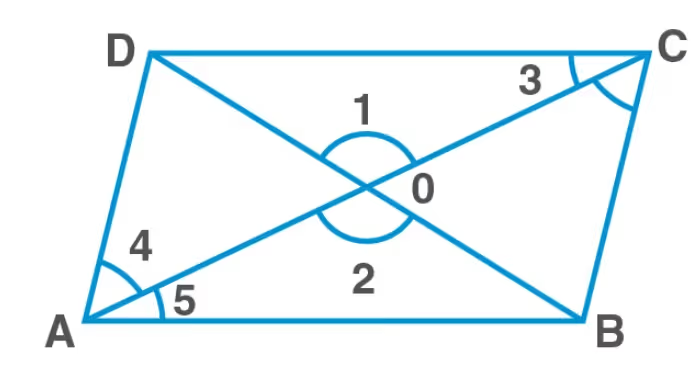
In ΔAOB and ΔCOD, ∠3 = ∠5 [alternate interior angles], ∠1 = ∠2 [vertically opposite angles], and AB = CD [opp. sides of parallelogram]
ΔAOB ≅ ΔCOD [AAS rule]
OB = OD and OA = OC [C.P.C.T]
Hence, proved. Conversely, if the diagonals of a quadrilateral bisect each other, then it is a parallelogram.
- Each diagonal divides the parallelogram into two congruent triangles.
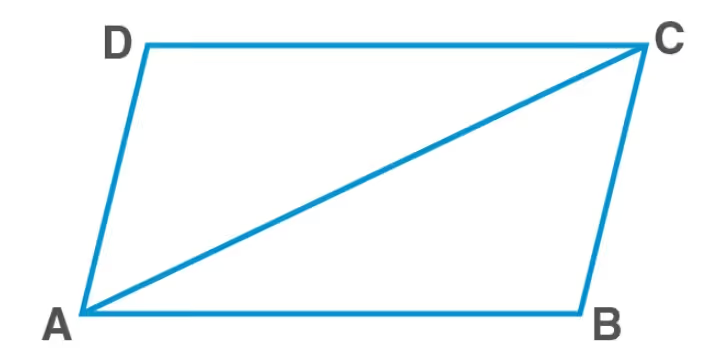
In ΔABC and ΔCDA,
AB = CD [Opposite sides of parallelogram]
BC = AD [Opposite sides of parallelogram]
AC = AC [Common side]
ΔABC ≅ ΔCDA [by SSS rule]
Hence, proved.
Important Results of Parallelogram
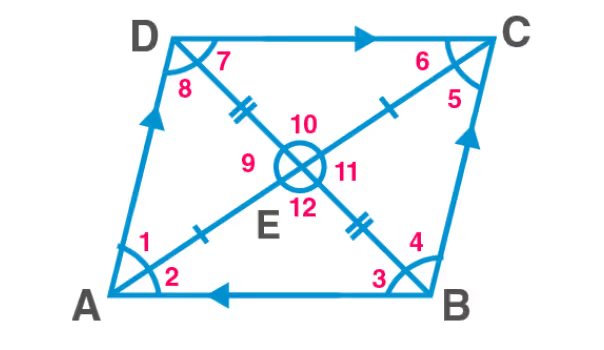
- Opposite sides of a parallelogram are parallel and equal.
AB || CD, AD || BC, AB = CD, AD = BC
- Opposite angles of a parallelogram are equal adjacent angles are supplementary.
∠A = ∠C, ∠B = ∠D; ∠A + ∠B = 180°, ∠B + ∠C = 180°, ∠C + ∠D = 180°, ∠D + ∠A = 180°
- A diagonal of parallelogram divides it into two congruent triangles.
ΔABC ≅ ΔCDA [With respect to AC as diagonal]
ΔADB ≅ ΔCBD [With respect to BD as diagonal]
- The diagonals of a parallelogram bisect each other.
AE = CE, BE = DE
∠1 = ∠5 (alternate interior angles)
∠2 = ∠6 (alternate interior angles)
∠3 = ∠7 (alternate interior angles)
∠4 = ∠8 (alternate interior angles)
∠9 = ∠11 (vertically opp. angles)
∠10 = ∠12 (vertically opp. angles)
3. Rhombus
A parallelogram in which all four sides are equal is called a rhombus.
Properties:
- All sides are equal.
- Opposite angles are equal.
- Diagonals bisect each other at right angles.
- Each diagonal bisects the opposite angle.
Proof: Diagonals bisect each other at right angles.
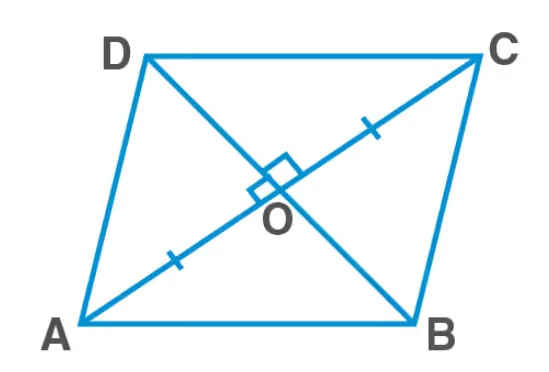
In ΔAOD and ΔCOD,
OA = OC [Diagonals of parallelogram bisect each other]
OD = OD [Common side]
AD = CD [Adjacent sides of a rhombus]
ΔAOD ≅ ΔCOD [SSS rule]
∠AOD = ∠DOC [C.P.C.T]
∠AOD + ∠DOC = 180° [∵ AOC is a straight line]
Hence, ∠AOD = ∠DOC = 90°
4. Rectangle
A parallelogram in which all angles are right angles (90°) is called a rectangle.
Properties:
- Opposite sides are equal and parallel
- All angles are 90°
- Diagonals are equal and bisect each other
Proof: Diagonals are equal and bisect each other.
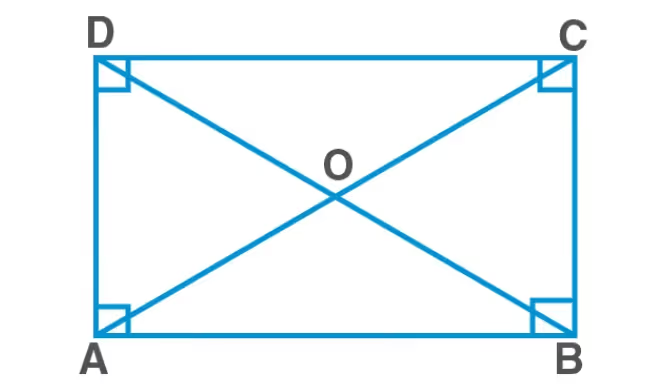
In ΔABC and ΔBAD,
AB = BA [Common side]
BC = AD [Opposite sides of a rectangle]
∠ABC = ∠BAD [Each = 90° ∵ ABCD is a Rectangle]
ΔABC ≅ ΔBAD [SAS rule]
∴ AC = BD [C.P.C.T]
Consider ΔOAD and ΔOCB,
AD = CB [Opposite sides of a rectangle]
∠OAD = ∠OCB [∵ AD || BC and transversal AC intersects them]
∠ODA = ∠OBC [∵ AD || BC and transversal BD intersects them]
ΔOAD ≅ ΔOCB [ASA rule]
∴ OA = OC [C.P.C.T]
Similarly we can prove OB = OD
5. Square
A rectangle with all four sides equal is called a square.
Properties:
- All sides are equal.
- All angles are 90°.
- Diagonals are equal, bisect each other at right angles and bisect opposite angles.
Proof: Diagonals are equal, bisect each other at right angles and bisect opposite angles.
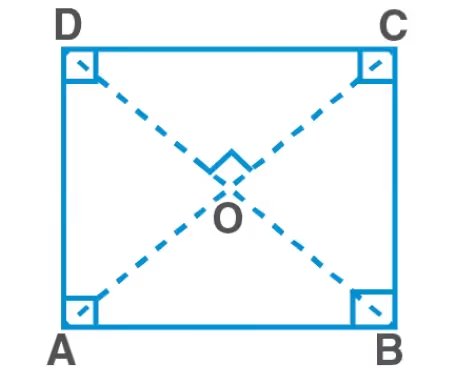
In ΔABC and ΔBAD,
AB = BA [Common side]
BC = AD [Opposite sides of a Square]
∠ABC = ∠BAD [Each = 90° ∵ ABCD is a Square]
ΔABC ≅ ΔBAD [SAS rule]
∴ AC = BD [C.P.C.T]
Consider ΔOAD and ΔOCB,
AD = CB [Opposite sides of a Square]
∠OAD = ∠OCB [∵ AD || BC and transversal AC intersects them]
∠ODA = ∠OBC [∵ AD || BC and transversal BD intersects them]
ΔOAD ≅ ΔOCB [ASA rule]
∴ OA = OC [C.P.C.T]
Similarly we can prove OB = OD
In ΔOBA and ΔODA,
OB = OD [proved above]
BA = DA [Sides of a Square]
OA = OA [ Common side]
ΔOBA ≅ ΔODA, [ SSS rule]
∴ ∠AOB = ∠AOD [ C.P.C.T]
But, ∠AOB + ∠AOD = 180° [ Linear pair]
∴ ∠AOB = ∠AOD = 90°
6. Kite
A quadrilateral in which two pairs of adjacent sides are equal is called a kite.
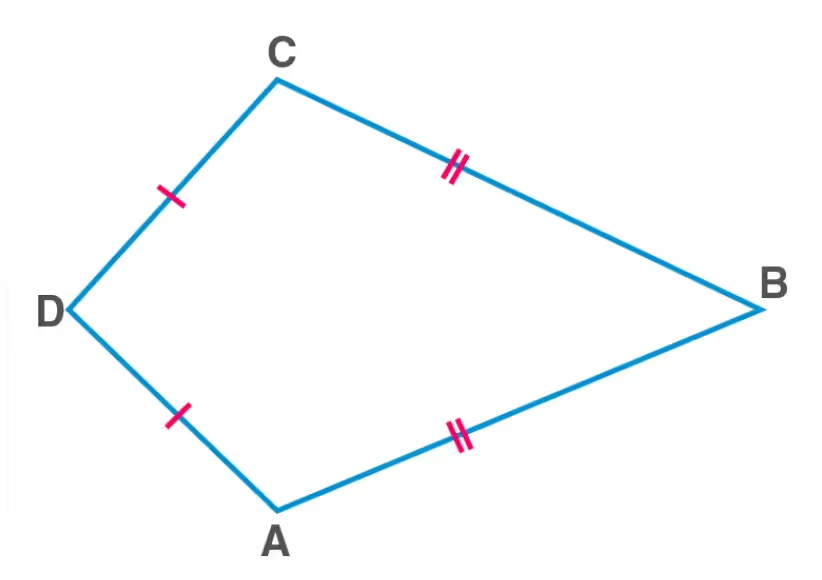
Properties:
- Two pairs of adjacent sides are equal.
- One pair of opposite angles (between unequal sides) is equal.
- Diagonals intersect at right angles.
- One diagonal bisects the other.
Angle Sum Property of Quadrilateral
The sum of the four angles of a quadrilateral is always 360°.
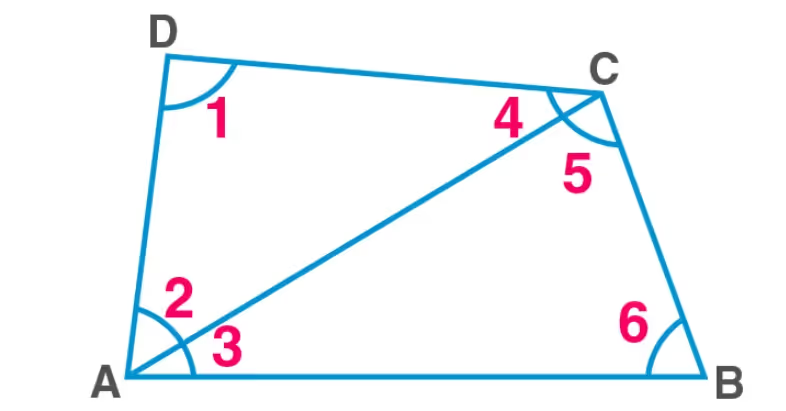
Proof:
Angle sum property = Sum of angles in a quadrilateral is 360°
In △ADC,
∠1 + ∠2 + ∠4 = 180° (Angle sum property of triangle)…………….(1)
In △ABC,
∠3 + ∠5 + ∠6 = 180° (Angle sum property of triangle)………………(2)
(1) + (2):
∠1 + ∠2 + ∠3 + ∠4 + ∠5 + ∠6 = 360°
I.e, ∠A + ∠B + ∠C + ∠D = 360°
Hence proved
Conditions for a Quadrilateral to be a Parallelogram
A quadrilateral will be a parallelogram if:
- Both pairs of opposite sides are equal.
- Both pairs of opposite angles are equal.
- Diagonals bisect each other.
- One pair of opposite sides is both equal and parallel.
If any one of these conditions holds true, then the quadrilateral is a parallelogram.
For detailed solutions to textbook problems based on these concepts, students can also refer to Class 9 Maths NCERT Solutions.
Midpoint Theorem
The line segment joining the midpoints of two sides of a triangle is parallel to the third side and equal to half of it.
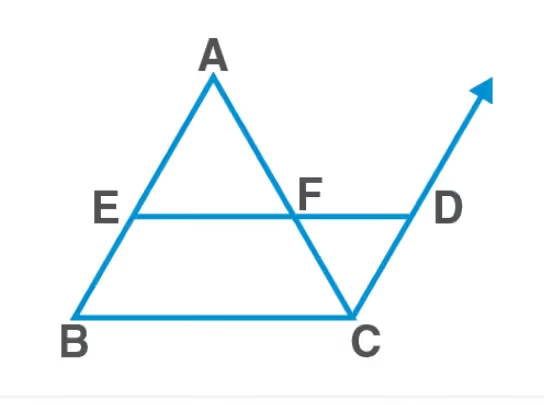
In ΔABC, E is the midpoint of AB; F is the midpoint of AC
Construction: Produce EF to D such that EF = DF.
In ΔAEF and ΔCDF,
AF = CF [ F is the midpoint of AC]
∠AFE = ∠CFD [ V.O.A]
EF = DF [ Construction]
∴ ΔAEF ≅ ΔCDF [SAS rule]
Hence,
∠EAF = ∠DCF….(1)
DC = EA = EB [ E is the midpoint of AB]
DC‖EA‖AB [Since, (1), alternate interior angles]
DC‖EB
So EBCD is a parallelogram
Therefore, BC = ED and BC‖ED
Since, ED = EF + FD = 2EF = BC [ ∵ EF = FD]
We have,EF = 12BC and EF || BC
Hence proved.
Summary
- A quadrilateral has four sides, four vertices and four angles.
- The sum of all interior angles of a quadrilateral is always 360°.
- Special quadrilaterals include trapezium, parallelogram, rectangle, rhombus, square and kite.
- Parallelograms have unique properties of parallel sides, equal opposite sides and angles and bisecting diagonals.
- Different quadrilaterals are classified based on side lengths, angles and diagonals.
Conclusion
Quadrilaterals may look tough at the beginning, but with the right guidance, they become one of the easiest and most interesting topics in Class 9 mathematics.
These notes have been written in simple words and short explanations, so that even stressed students can learn without feeling burdened.
So, whenever you revise, keep these notes beside you and practice regularly. With the help of this guide, you will not only perform well in exams but also start enjoying mathematics more.
FAQs
Q1. State the properties of a parallelogram.
Ans. In a parallelogram, the opposite sides are parallel and equal, the opposite angles are equal, and the diagonals bisect each other. These properties are explained with diagrams in the Class 9 Maths NCERT Book, which helps students understand quadrilaterals clearly.
Q2. What is the property of diagonals in a kite?
Ans. In a kite, one diagonal bisects the other at right angles. This property is often used while solving geometry problems related to quadrilaterals.
Q3. What is a trapezium?
Ans. A trapezium is a quadrilateral in which one pair of opposite sides is parallel. It is one of the important types of quadrilaterals studied in Class 9 geometry.
Q4. State the properties of a rectangle.
Ans. In a rectangle, the opposite sides are equal and parallel, each interior angle is 90°, and the diagonals are equal and bisect each other.
Q5. What is the mid-point theorem related to quadrilaterals?
Ans. The mid-point theorem states that the line joining the midpoints of two sides of a triangle is parallel to the third side and equal to half of it. This theorem is frequently applied in solving problems related to quadrilaterals and other geometric figures.
Q6. From where can students access Class 9 Quadrilaterals notes for quick exam preparation?
Ans. Students can access Class 9 Quadrilaterals notes from reliable educational platforms like Educart, where the chapter is explained with diagrams, properties, and solved examples to help students revise effectively.
Q7. How can students practice exam-oriented questions from the Quadrilaterals chapter?
Ans. Students can improve their preparation by solving Class 9 Maths Important Questions, which include commonly asked exam questions based on properties and theorems of quadrilaterals.












.svg)

