
.svg)
Polynomials Class 9 Notes explain one of the most important algebra chapters in CBSE Class 9 Maths Syllabus. In this chapter, you learn about terms, coefficients, degree of polynomials, zeroes, Remainder Theorem, Factor Theorem and algebraic identities.
These concepts form the foundation for Class 10 algebra and higher mathematics. Let’s understand polynomials clearly with definitions, formulas and exam-focused examples.
Let us now dive into the detailed notes of this chapter to understand each topic clearly.

What is a Polynomial?
A polynomial is a mathematical expression that consists of variables, constants and exponents combined using addition, subtraction and multiplication. The powers of the variables must be whole numbers and coefficients must be real numbers.
General form of a polynomial in one variable x:
p(x) = a0xn + a1xn-1 + a2xn−2 +…+an; where:
- a0,a1,……,an are real numbers
- n is a non-negative integer
Important Conditions:
- Powers must be whole numbers
- No variable in denominator
- No negative exponents
Examples of polynomials:
- 5
- x2 + 3x − 7
- 7a2b + 2ab + 3
Not polynomials:
- 3 / x + 2 (variable in the denominator)
- x−2 +4x (negative exponent)
Terms and Coefficients
- Each part of a polynomial separated by + or − is called a term. For example,
In x2 − 4x + 7, the terms are ⇒ x2, −4x and 7
- The numerical part of a term (along with any constants multiplying the variable) is called the coefficient. For example:
In 9x2 + x − 5, coefficient of x2 is 9, coefficient of x is 1, and constant term is -5
Types of Polynomials
- Monomial: A polynomial with one term, example: 6x, −3a2
- Binomial: A polynomial with two terms, example: x + 4
- Trinomial: A polynomial with three terms, example: x2 + 2x + 1
Constant Polynomials
Polynomials that consist only of a constant number and no variable. For example: 12, −5
A zero polynomial is the constant 0.
Note: Polynomials like x-1 + 3 are not valid, as the exponent is not a whole number.
Degree of a Polynomial
The highest power of the variable in the polynomial is called its degree. For example:
- x4 + 2x2 + 1 ⇒ Degree = 4
- 9a2 - 6a + 3 ⇒ Degree = 2
- 8 (constant polynomial) ⇒ Degree = 0
- Zero polynomial (0) ⇒ Degree is not defined
Zeroes of a Polynomial
A zero (or root) of a polynomial is a value of the variable that makes the polynomial equal to 0. For example:
Let p(x) = x2 - 9; putting x = 3 ⇒ p(3) = 9 - 9 = 0
So, x = 3 is a zero of the polynomial.
Relationship b/w Zeroes and Coefficients
For quadratic polynomial ⇒ ax2 + bx + c. If α and β are zeroes:
- Sum of zeroes = −b/a
- Product of zeroes = c/a
Geometrical Meaning of Zeroes
The zero of a polynomial is the x-coordinate where its graph intersects the x-axis. If the graph touches the x-axis at one point → one zero, but if it cuts at two points → two zeroes.
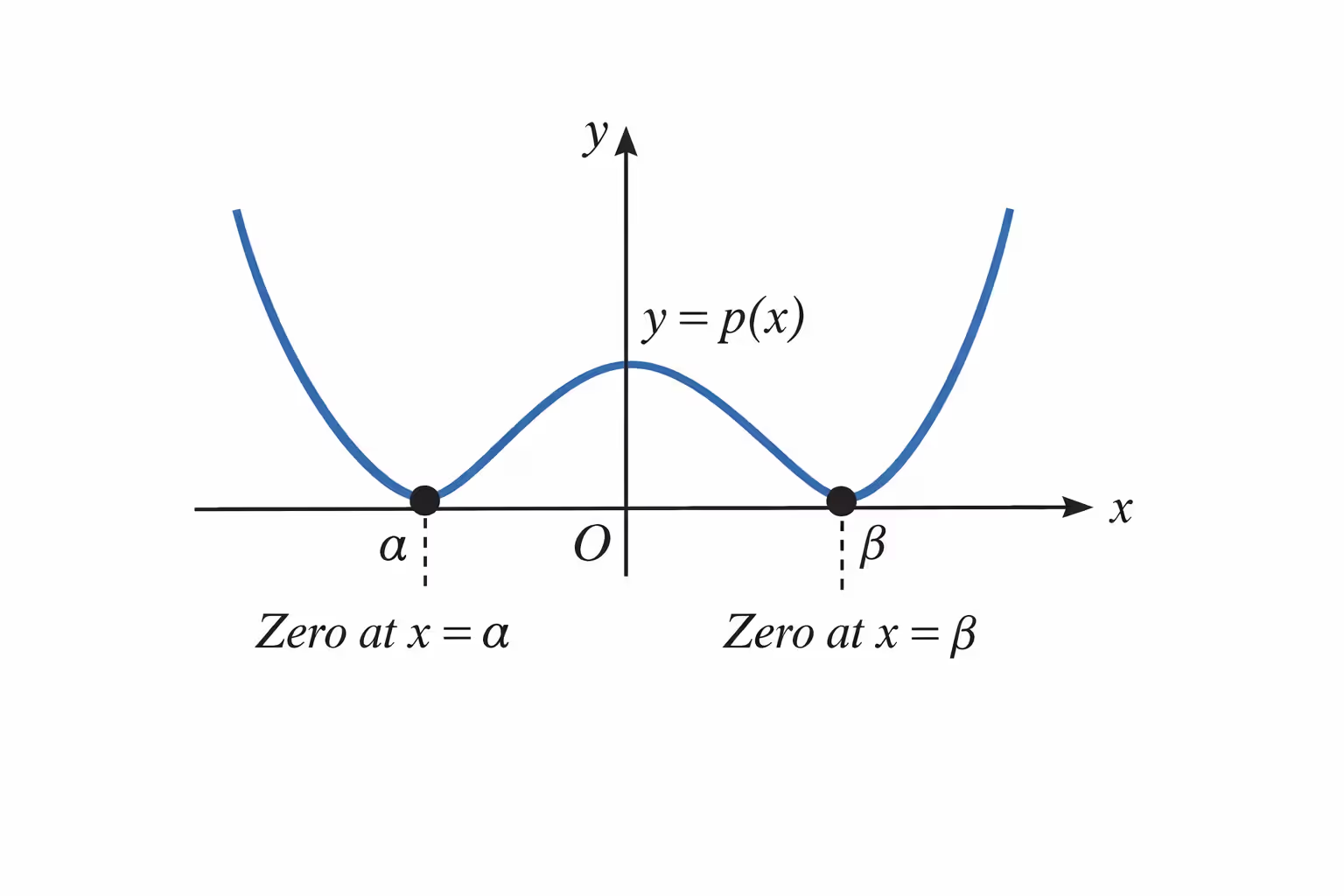
Graph showing zeroes of polynomial
Remainder Theorem
If a polynomial p(x) is divided by x−a, the remainder is p(a). This only applies when the degree of p(x) is greater than or equal to 1. For example:
If p(x) = x2 – 4x + 5, find the remainder when divided by x − 2
Here, p(2) = (2)2 – 4(2) + 5 = 4 – 8 + 5 = 1, so remainder = 1.
Factor Theorem
If p(c) = 0, then x−c is a factor of the polynomial p(x). For example:
Let p(x) = x2 – 2x – 3, check if x = 3 is a factor.
Here, p(3) = 9 - 6 - 3 = 0, so x−3 is a factor.
Factorisation of Polynomials
This is the process of expressing a polynomial as the product of polynomials of lower degree. For example:
x2 + 5x + 6, find two numbers whose sum = 5 and product = 6
(x + 2)(x + 3)
Important Algebraic Identities
These identities help in simplifying and factorising algebraic expressions:
- (a + b)2 = a2 + 2ab + b2
- (a - b)2 = a2 - 2ab + b2
- (a + b)(a - b) = a2 - b2
- (a + b)3 = a3 + b3 + 3ab(a + b)
- (a - b)3 = a3 - b3 - 3ab(a - b)
- (x + y + z)2 = x2 + y2 + z2 + 2xy + 2yz + 2zx
Conclusion
Now that you have the right notes and a clear path to follow, there's no need to be afraid of maths anymore. With regular practice and the right understanding, you can overcome any difficulty in the subject.
These notes are all you need to prepare well for your exams and tests. Remember, Class 9 maths builds the foundation for higher-level topics and once you understand it properly, everything ahead becomes easier.
So stay focused, believe in yourself and make the most of these simplified notes. Maths is no longer a challenge when you have the best support by your side!
FAQs
Q1. What is the degree of a polynomial?
Ans. The highest power of the variable in a polynomial is called its degree.
Q2. What is a zero of a polynomial?
Ans. A zero of a polynomial is a value of the variable where the polynomial becomes zero. It is found by solving p(x) = 0 or by observing where the graph intersects the x-axis. For example: For p(x) = x – 3, zero = 3.
Q3. What is the Remainder Theorem?
Ans. If a polynomial p(x) is divided by (x – a), then the remainder is p(a).
Q4. What is the Factor Theorem?
Ans. If p(a) = 0, then (x – a) is a factor of the polynomial p(x).
Q5. What is the relationship between zeroes and coefficients?
Ans. For ax2 + bx + ca, sum of zeros = −b/a and product of zeros = c/a.












.svg)

