
.svg)
Heron’s Formula Class 9 Notes help you calculate the area of a triangle when only the three sides are given. In many exam questions, height is not provided; and that’s where this formula becomes extremely useful.
This chapter from CBSE Syllabus Class 9 Maths teaches a powerful method to find areas using just side lengths. Let’s understand the concept clearly with formulas, diagrams and solved examples.

Types of Triangles
Triangles can be classified in two ways–based on sides and based on angles.
1. Based on Sides
- Equilateral Triangle: All three sides are equal in length and all three angles measure 60°
- Isosceles Triangle: Two sides are equal and the angles opposite to equal sides are also equal
- Scalene Triangle: All three sides are unequal and all three angles are different
2. Based on Angles
- Acute-angled Triangle: All three interior angles are less than 90°
- Right-angled Triangle: One of the angles is exactly 90°
- Obtuse-angled Triangle: One of the angles is greater than 90°
Area of a Triangle
The area of a triangle can be calculated using the standard formula:
Area = 1/2 x base x height, in cases where height is given.
In cases where height is not directly given, we use Pythagoras’ theorem or Heron’s formula.
Area of an Equilateral Triangle
Let the side of an equilateral triangle be a. By drawing a perpendicular from a vertex to the opposite side, the height is obtained using Pythagoras’ theorem ⇒ h = √3/2 × a
Thus, Area = 1/2 × a × h = 1/2 × a × √3/2 × a = √3/4 × a2
Area of Equilateral Triangle = √3/4 a2
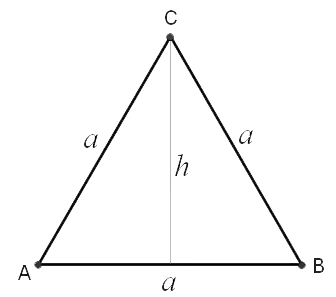
Equilateral triangle with height drawn Class 9
Heron’s Formula
When the sides of a triangle are known but height is not, Heron’s formula is very useful.
For a triangle with sides a, b, c:
- Semi-perimeter ⇒ s = (a + b + c) / 2
- Area ⇒ √[ s (s − a)(s − b)(s − c)]
This formula is especially helpful in finding the area of a scalene triangle.
Detailed explanations and practice exercises for Heron’s formula can also be found in the Class 9 Maths NCERT Book, where students apply the formula to different types of triangles.
Important Condition Before Applying
The sides must satisfy Triangle Inequality Theorem ⇒
- a + b > c
- b + c > a
- c + a > b
Otherwise, a triangle cannot be formed.
Solved Examples
- Find the area of a triangle with sides 13 cm, 14 cm and 15 cm.
Step 1 ⇒ s = (13 + 14 + 15) / 2 ⇒ s = 42 / 2 ⇒ s = 21
Step 2 ⇒ Area = √[21 (21 − 13)(21 − 14)(21 − 15)] = √[21 × 8 × 7 × 6] = √7056
⇒ Area = 84 cm2
Students can check step-by-step solutions for similar questions in Class 9 Maths NCERT Solutions, which help in understanding how to apply Heron’s formula correctly.
Conclusion
Triangles form the foundation of geometry and knowing their properties makes learning other shapes easier. By studying different types of triangles, we learn how sides and angles work together.
These techniques help us understand shapes in real life, like parks, fields or even building designs. By practicing step by step, even tricky problems, such as finding the area of a quadrilateral by splitting it into triangles, become simple.
The key is to stay calm, understand each step and solve the problem logically. Once you get the hang of it, triangles can be both easy and interesting. They are not scary, they are just puzzles waiting to be solved!
FAQs
Q1. What is Heron’s formula in Class 9 Maths?
Ans. Heron’s formula is used to find the area of a triangle when the lengths of all three sides are known.
Area=s(s−a)(s−b)(s−c)\text{Area} = \sqrt{s(s-a)(s-b)(s-c)}Area=s(s−a)(s−b)(s−c)
where s is the semi-perimeter of the triangle.
Q2. How do you calculate the semi-perimeter of a triangle?
Ans. The semi-perimeter is half the sum of the three sides of the triangle.
s=a+b+c2s = \frac{a+b+c}{2}s=2a+b+c
It is used as an important step when applying Heron’s formula.
Q3. Can Heron’s formula be used for equilateral triangles?
Ans. Yes. Heron’s formula works for any type of triangle, including equilateral, isosceles, and scalene triangles, as long as the lengths of all three sides are known.
Q4. What must be checked before applying Heron’s formula?
Ans. Before applying Heron’s formula, the triangle inequality condition must be satisfied. The sum of any two sides of a triangle must be greater than the third side.
Q5. How is Heron’s formula used in quadrilaterals?
Ans. A quadrilateral can be divided into two triangles using a diagonal. Heron’s formula is then applied to each triangle separately, and the two areas are added to get the total area.
Q6. Where can students revise Heron’s Formula along with other Class 9 Maths chapters?
Ans. Students can revise this topic along with other chapters using Class 9 Maths Chapter-wise Notes, which provide clear explanations, formulas, and solved examples for quick revision.
Q7. How can students practice important exam questions from the Heron’s Formula chapter?
Ans. Students can improve their preparation by solving Class 9 Maths Important Questions, which include numerical problems and application-based questions frequently asked in exams.












.svg)

