.svg)
The introduction of a modern and faster evaluation system named “On-Screen Marking (OSM)” was supposed to be remembered as a revolution in CBSE Class 12 boards result history. Instead, it turned into one of the biggest controversies surrounding the CBSE board in 2026.
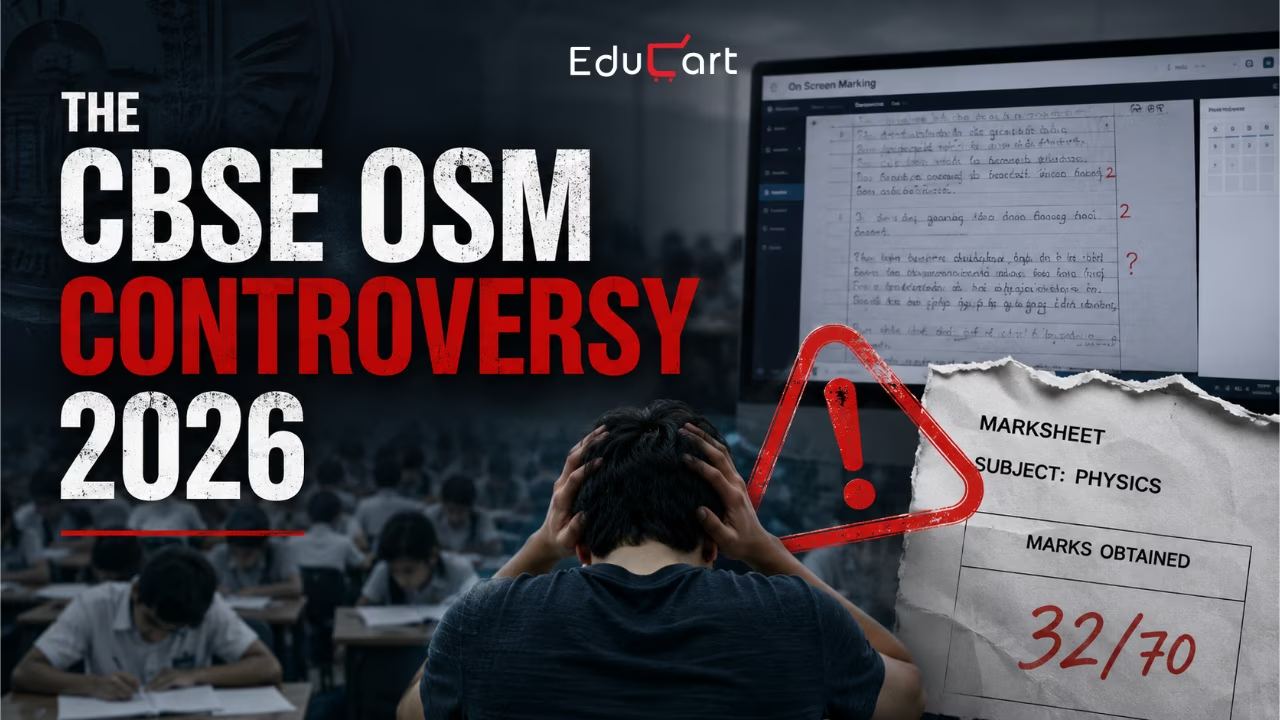
On 9 February 2026, CBSE introduced the On-screen Marking evaluation method for Class 12 boards 2026. Students were immediately skeptical and expressed their concerns on Reddit and Twitter. (Read more)
But this didn’t stop CBSE from going further with their new mode of assessment. And what happened in the end was devastating. Not only students' and parents’ trust was broken in the system, they shifted from confident to contemplating their future with this board.
Let’s see step-by-step where this issue actually started and where it has taken the education system today.

What is OSM?
On-Screen Marking (OSM), is a digital evaluation process in which physical answer sheets are scanned and uploaded online and the examiners check them digitally. As Class 12 is the career deciding grade, and requires marksheets timely to apply for higher studies, OSM was first introduced for them.
This system was introduced by CBSE to make checking faster, reduce manual errors and standardize evaluation across the country.
When you think of it, the idea sounds efficient and futuristic. But after the declaration of the result for Class 12 boards for 2026, students across India began alarming complaints.
How Did the OSM Controversy Start?
I think the real controversy began when students started requesting scanned copies of their answer sheets after getting unexpectedly low marks. Many students felt that there was a huge difference between their performance and the marks they have received.
The issue became bigger and started coming into limelight when a student named Vedant claimed that the answer sheet uploaded for Physics under his roll number was not his own. His complaint quickly went viral on social media.
The issue became even more serious when CBSE later acknowledged an error and provided the correct answer sheet. This incident deeply shook the students across the country because it raised huge concerns about the reliability of OSM and of CBSE as a system.
The controversy mainly intensified due to:
- Wrong answer sheets allegedly being uploaded
- Students receiving unexpectedly low marks
- Fear of evaluation mismatches
- Lack of confidence in the digital checking process
- Concerns about how many similar cases might exist
- Blurred, missing or folded pages
Security Concerns Raised by Students
I believe when the OSM system was first launched, some students warned CBSE about the technical glitches in the system but no attention was paid to the heads up.
The OSM controversy grew bigger when student whistleblowers started raising concerns about the system’s security and transparency. One student also said that he tried reaching out to the issue before everything started.
Nisarga Adhikary (19 Years Old - Ethical Hacker)
Nisarg Adhikary, a 19 year old ethical hacker, claimed that he discovered the major flaws in the OSM platform in February 2026 and reported the same to CERT-In. According to reports, he warned that users with basic technical knowledge could impersonate examiners, bypass OTP security, change passwords and even alter marks.
Additionally, he said, “The access control is broken.”
Sarthak Sidhant (18 Years Old - Researcher)
Researcher Sarthak Sidhant also claimed that the OSM system contained vulnerabilities like master password, OTP bypass, and unsecured cloud storage. He and Adhikary stated that parts of the system could be breached within minutes.
These allegations increased public concern about how securely students marks and data were being handled
Vedant Srivastava (17 Years Old - Affected Student)
Vedant’s claim was the main turning point when he shared on X (formerly Twitter) that the Physics answer sheet uploaded under his roll number was not his own. His post took over the internet in a very short span of time. He faced online abuse for simply speaking out.
Students strongly connect with Vedant’s story.
Why Such A Reaction from Students?
As board examination marks in India are deeply connected to the student’s future and those being affected can actually bring a turmoil in the life of those facing it. Had I been in their position, I would have reacted similarly.
These marks affect:
- College admissions
- Scholarships
- Entrance opportunities
- Career choices
- Student confidence
Because of these very reasons, class 12 board results are life-changing. And then news comes about the board changing the evaluation system altogether, a response like this was to be expected.
Many students said that their future should not depend on technical mistakes, scanning errors, or system confusion.
How does it Affect the Nation?
Complaints are still rising, legal petitions are still being filed–all to look for more transparency and promote investigation into this new OSM process.
Now that the matter has reached Delhi High Court with concerns related to irregularities in the evaluation system were raised - this controversy has stopped being a social media discussion to a serious national issue.
Now the OSM debate has shifted from student frustration to Qs about accountability and institutional responsibility from CBSE.
What Has Been Requested from the Delhi High Court?
The National Students’ Union of India has filed a PIL in the Delhi High Court demanding:
- an independent inquiry into OSM discrepancies,
- manual rechecking of the answer sheets containing issues, and
- an extension of the verification process.
The petition argued that students affected by scanning errors and mismatches could not be treated the same as students whose papers were evaluated properly.
Involvement of Ministry of Education & Parliament
The controversy has also reached the Parliament, claiming that CERT-In had raised concerns about vulnerabilities in the evaluation system between February and May 2026.
And finally what happens? Education Minister Dharmendra Pradhan publicly acknowledges that irregularities had been witnessed during the first large-scale use of OSM and assured students that concerns would be addressed.
CERT-In’s Role in the Controversy
The controversy also raised serious questions about CERT-In, India’s cybersecurity agency. Reports suggested that CERT-In had found security vulnerabilities in one of the portals and reportedly concluded it not fit for use. Even after this, the system was still used for the evaluation process affecting lakhs of students.
Cert-In also had to face the consequences as they failed to provide timely remediation before the system went live.
I think this became one of the most worrying parts of the controversy because students began questioning as to why the warnings were ignored.
Vendor Coempt EduTeck
The vendor linked to the OSM system, Coempt EduTeck, also came under investigation. Student researcher Sarthak Sidhant reported that tender rules were changed during the selection process. He also pointed out that the company earlier has been linked to the Telangana intermediate result controversy in 2019.
Following this, the court was requested to look into the company and investigate its role in the irregularities.
Why Was All This So Important?
The issue was impossible to ignore as it affected students on a massive scale. The scale of complaints was huge.
According to reports:
- more than 1.27 lakh applications were filed,
- involving nearly 3.87 lakh scanned answer sheets.
These numbers, the post-result reaction - what started as social media complaints eventually turned into a national debate involving courts, government institutions, and cybersecurity concerns.
Final Thoughts
To summarize, the issue was never about the technology, but about trust. When students were willing to accept a new digital evaluation system, the board should have delivered accuracy, transparency and accountability in return.
Whether the number of affected students was small or large, every student deserves the assurance #1 the answer sheet being evaluated is genuinely theirs; #2 every page should be checked properly and finally, #3 the marks awarded truly reflect their performance.
FAQs
Q1. What role did CERT-In play in the OSM controversy?
Ans. CERT-In claimed that the OSM platform had issues related to security, access controls, and authentication, raising concerns about the safety and integrity of the evaluation process.
Q2. Are all CBSE Class 12 results affected by the OSM controversy?
Ans. No. The controversy involves reported complaints from a section of students. It does not imply that every student's result contains errors.
Q3. Will CBSE continue using OSM in future board examinations?
Ans. As of now, there is no official announcement for discontinuing the CBSE 2026 OSM system. As investigation is still going on, improvements and policy decisions will follow after the conclusion only.
Q4. What did students demand from CBSE in the OSM controversy?
Ans. Students demanded full transparency, investigation and fixing of irregularities, manual rechecking of affected answer sheets, and an extension of review deadlines. Also, stronger safeguards are expected from this year if this method is to be continued.
Q5. How many students have raised concerns regarding OSM-related issues?
Ans. According to reports, over 3.87 lakh answer sheets were scanned, out of which 1.27 lakh applications were submitted for review-related processes.
Glimpse of the Event

Share Article


.svg)





%2520(1).avif)



















.svg)

