
.svg)
On 29th June, Educart successfully conducted a Teacher's Training Workshop at Sharda World School, Agra. The workshop revolved around the theme ‘Competency-based Assessment’. The workshop was led by Ms. Gayatri Vaswani, an ISTM Certified Trainer and CBSE Resource Person.
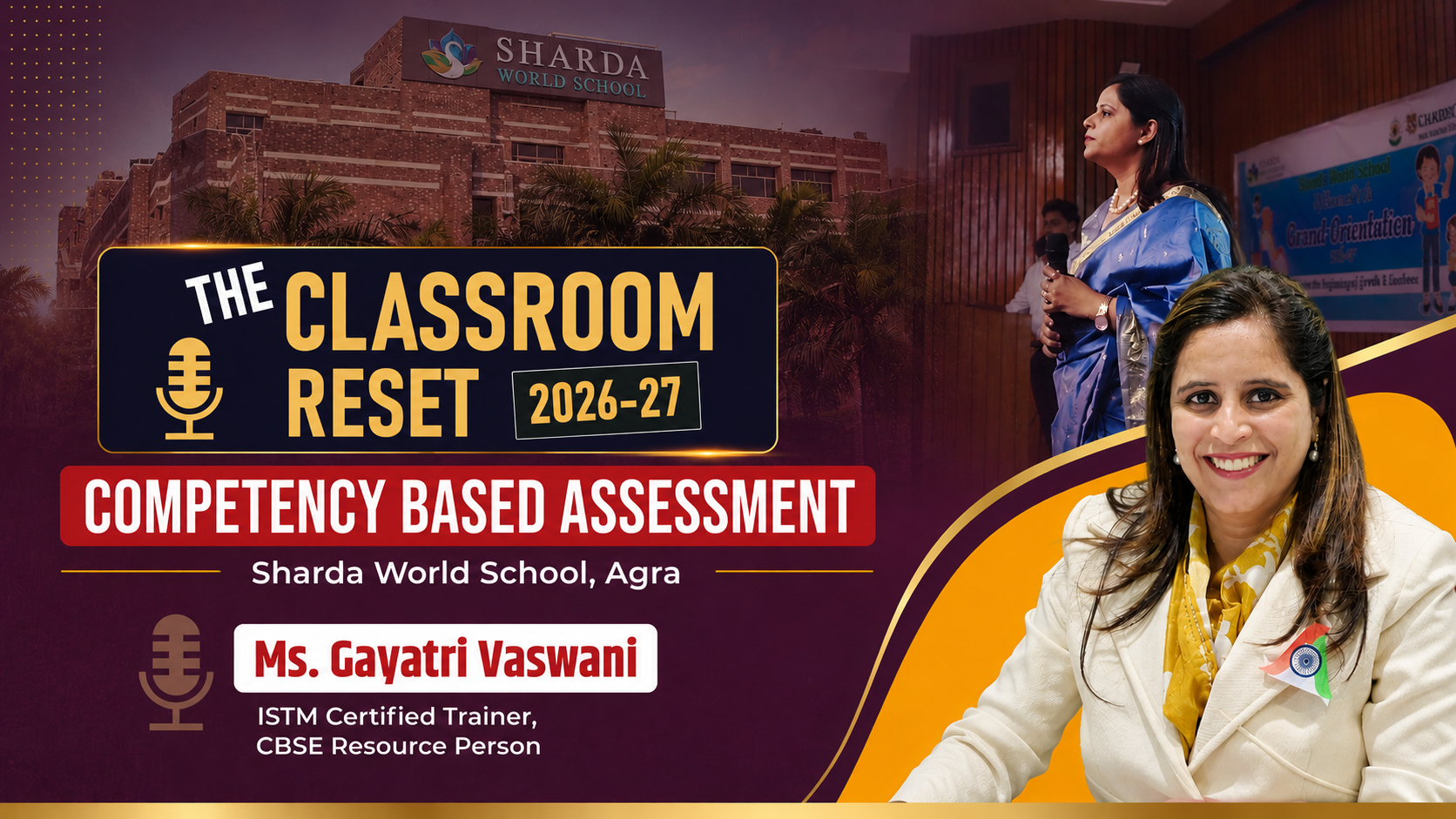
The workshop aimed to bring together educators with a common objective which was to strengthen classroom assessment practices with the evolving needs of competency-based education.
Workshop At a Glance
- Topic: Competency-Based Assessment
- Organised by: Educart
- Type of Event: Teacher’s Training Workshop
- Speaker: Ms. Gayatri Vaswani
- Participation Fee: Free
- Duration: 2 Hours
- Discussion Led by: Rohan
Understanding the Shift Towards Competency-based Assessment
With schools increasingly adopting competency-focused teaching practices, assessments are no longer limited to testing students’ memory and recall. The workshop showed how meaningful assessments can evaluate students' conceptual understanding, critical thinking, problem-solving abilities, and real-life application of knowledge.
Ms. Gayatri Vaswani explained how teachers can gradually transition from early examination patterns to competency-based assessment methods that encourages deeper learning and active student participation.
Practical Strategies for Assessment Designing
One of the important highlights of the session was how practical it was. The session was not limited to any theory, and teachers also got the chance to explore actionable strategies that could be directly used in their classrooms.
The workshop covered:
- Designing competency-based learning outcomes aligned with classroom objectives
- Creating assessment tasks that encourage higher-order thinking
- Developing effective rubrics to assess student performance fairly and consistently
- Framing questions that checks understanding, application, analysis, and reasoning instead of rote learning
These discussions helped teachers understand how well-designed assessments can become valuable tools for learning rather than just measuring performance.
Collaborative Learning with Engaging Activities
The workshop maintained a highly engaging and collaborative environment throughout the session. The way in which the workshop was being conducted, clearly justified topic on which it was based as teachers were actively participating in:
- Hands-on assessment design activities
- Group discussions on classroom assessment challenges
- Real-world assessment examples and case-based exercises
- Collaborative sharing of classroom experiences and best practices
These activities motivated educators to exchange ideas, reflect on their current practices, and explore interesting and new ways to make assessments more student-centric.
Building Assessment Literacy Among Educators
One of the major takeaways from the workshop was the growing importance of an understanding about assessment literacy in today's classrooms. Through interactive discussions and practical examples, teachers gained valuable insights into designing assessments that measure learning and also support overall development of the students.
Participants learned how to:
- Design assessments that promote conceptual understanding while focusing on students’ growth
- Provide meaningful, constructive feedback that encourages continuous improvement
- Create learner-centred assessment experiences aligned with competency-based education
- Apply practical competency-based assessment strategies in their everyday classroom teaching
- Align classroom assessments with revised educational standards
A Meaningful Learning Experience for the Educators
With all the excitement throughout the session, the workshop came to an end. Participants appreciated Ms. Gayatri for an engaging session with interesting insights. Teachers also appreciated the practical relevance and interactive format in which the workshop was conducted.
The combination of expert guidance, and real-life classroom examples made the session full of learning and wholesome. Educart remains committed to supporting teachers through professional development initiatives that provide them with effective teaching and assessment practices.
FAQs
Q1. What is competency-based assessment in classroom teaching?
Ans. While using competency-based assessment practices to track students’ performance, teachers need to focus on what they’re applying rather than just the facts they’re learning. It focuses on skills like critical thinking, reasoning, problem-solving, and real-life application.
Q2. Why is now CBSE focusing on competency-based questions for all classes?
Ans. CBSE is gradually increasing competency-based Qs in all classes to encourage conceptual learning over rote memorisation. How this affects classroom teaching is discussed in the webinar covered in this article.
Q3. How can teachers create competency-based questions?
Ans. Focus on one learning outcome and then frame questions based on real-life situations supporting that outcome. Use case studies, data interpretation, or problem-solving prompts to answer analytical questions instead of direct ones.
Q4. What are some activities to support CBE in classes?
Ans. These activities may help students explore interesting and new ways to recall learned concepts and perform in the class:
- Hands-on assessment design activities
- Group discussions on classroom assessment challenges
- Real-world assessment examples and case-based exercises
- Collaborative sharing of classroom experiences and best practices
Q5. What are higher-order thinking (HOTS) questions?
Ans. HOTS questions are one type of competency-based questions that require the students to analyse, evaluate, critically think, and/or reason to solve problems.
Glimpse of the Event

Share Article


.svg)
.avif)




%2520(1).avif)









.avif)







.svg)

