.svg)
The Central Board of Secondary Education (CBSE) has announced a significant reform for Class 12. On 9 February 2026, CBSE introduced on-screen marking for evaluation of Class 12th board answer sheets from 2026 for the examinations beginning from 17 February 2026.
![Article Image Template.png [apng-to-avif output image]](https://www.educart.co/img-cache/https%3A%2F%2Fcdn.prod.website-files.com%2F5f5cf4627107791c0412287b%2F698f1e3a1607bea88c49dcf4_ezgif-33fe70179a2dfc3b.avif)
This move will impact nearly 46 lakh students across India and 26 countries, making it one of the biggest evaluation reforms in recent years.
On 16 March, CBSE issued new advisories for maintaining the integrity of the OSM Evaluation Process. The advisories were issued concerning the sharing of misleading information related to OSM on social media. To ensure the evaluation process runs smoothly this year and in the future, CBSE advised complete cooperation of the stakeholders following these advisories.
What is On-Screen Marking (OSM)?
On-Screen Marking is a digital evaluation system where answer sheets are scanned and then entered into the system to be assessed by examiners and marked instead of evaluating physical copies.
The students will follow the pen-paper format to write their examinations. The major change is in the after exam process when answer sheets are digitized and uploaded to a secure evaluation system. Teachers log in using their OASIS IDs and mark the answers online.
With OSM, the need for transportation of huge bundles to the marking center and the requirement manual is completely cut down.
Why is CBSE Making This Change?
As the Class 12th result is crucial and plays a major role in admission decisions by universities and institutions, this step is taken by CBSE to ensure accuracy and a smooth evaluation system.
With OSM, the Board expects elimination of totalling errors, faster evaluation and declaration of results, and an environmentally sustainable process.
What Changes for CBSE Class 12 Students?
For class 12 students appearing for 2025-26 board exams, this change will turn out to be beneficial as the process of the release of results is likely to process faster as the evaluation system will reduce the logistic delays.
Accuracy in marking will be improved due to the digitized system of totalling. This would eventually minimize the requirement of re-verification of the answer sheets.
But there are mixed reviews among them:
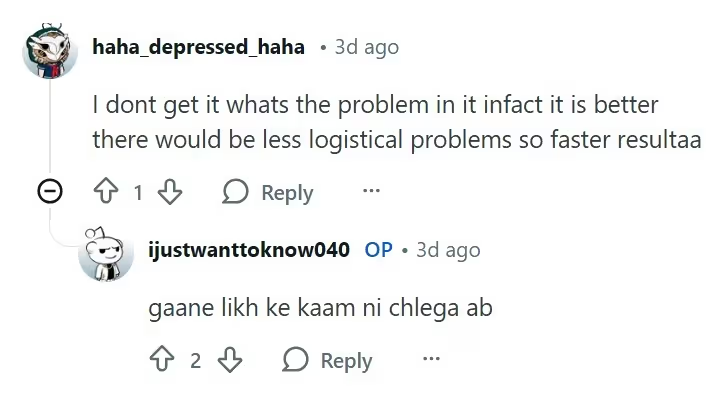
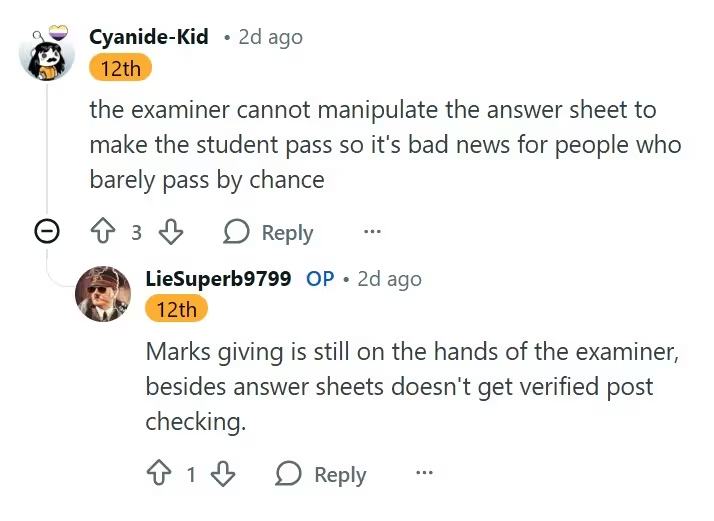
Some students even started sharing memes on Reddit.
Some Tips for Students
The important thing students should focus on now is that, as the answer sheets will be scanned and then entered into the system for teachers to evaluate, it is important to pay extra attention to them.
1. Writing rule
- Pen Choice: Use only blue or black ballpoint pens. Avoid pens which have a chance of ink spread as that can create a mess.
- No Scribbling: If you make a mistake, draw a single neat line through it.
2. Optimize your layout for the screen
- Respect your margins: Avoid writing outside the margin.
- Double space: Leave at least two lines between different answers. On a screen, a bit of “white space” makes your paper much easier to navigate.
- Darker diagrams: If you use a pencil for diagrams, ensure it is dark (HB or 2B). Light sketches often vanish or look blurry once scanned. Label your diagrams using a pen for maximum visibility.
3. Clean answer sheet
- Avoid whitener: Correction fluid can peel off or create a glare under the high-intensity scanner lights. A simple strike-through is safer and cleaner.
- Secure attachment: If using supplementary sheets, tie them securely but avoid “bunching” the paper at the corners, which prevents a flat scan.
Final Tip: Imagine the teacher is reading your paper on a tablet or laptop. The clearer you make it, the faster they can find your correct points and award you the marks.
Infrastructure Requirement in Schools
Since the process is new for everyone and the time space is very short for teachers to gain clarity about the process, CBSE instructed affiliated schools to prepare technical infrastructure as soon as possible. This would help teachers conduct multiple dry runs and get familiar with the process.
Schools must ensure:
- A computer lab with Public Static IP
- Systems with Windows 8 or above and minimum 4 GB RAM
- Updated browsers and Adobe Reader
- Reliable internet connectivity (minimum 2 Mbps)
- Uninterrupted power supply
How CBSE Will Support the Transition?
To make the implementation smooth, CBSE has planned structured support measures. Teachers will be allowed to log in and familiarise themselves with the system before live evaluation begins.
The board will also conduct dry runs, organize training programmes, release instructional videos, and establish a call centre to resolve technical issues. Detailed instructions for each stage will be issued separately.
Mass Mock Evaluation
CBSE made mass mock evaluation compulsory for all teachers of Class XI and XII on 26th February, 2026. This step was taken quickly to ensure smooth login, load testing of the system, and complete familiarity with digital evaluation before actual checking begins.
How will this first mock help ?
- Teachers will log in with the credentials given to them which they have to save for the actual evaluation.
- Improvements will be done in the platform based on feedback received from the teachers making it user-friendly
- Provision of first-hand experience to the teacher
- Provisions for the principal include:
- Correction of the wrong data in OASIS by the principal
- Monitoring who has logged in and evaluated
- Provide correct login credentials to the teachers
Region-wise Schedule
Note: All teachers must log in only during their slot from school
What teachers must do:
- Log in only during their region’s allotted time from school. Do not continue working after time ends (for proper load testing)
- Evaluate one answer book
- Note any issues/difficulties and immediately report to your Principal
What principals must do:
- Ensure 100% teacher participation
- Compile issues received from teachers and mail the consolidated report to [email protected]
Important note:
26 Feb 2026 was chosen because only 2.92 lakh candidates are appearing for exams that day, and exam start/end timings have been excluded to avoid any disturbance.
Class 10 v/s Class 12: What’s the Difference?
Both 10th and 12th are board classes but the change is applied on Class 12th evaluation and for Class 10th, the evaluation will take place manually only. This phased approach allows the Board to stabilize the system before expanding it further.
Conclusion
The introduction of On-Screen Marking reflects the broader digital transformation happening in Indian Education and marks an important milestone for CBSE. The system promises faster results, improved accuracy, and greater transparency without a change in the student exam hall experience.
For students, the focus remains clear: write neatly, follow proper formatting, and prepare well. The evaluation system may be digital, but academic clarity and strong conceptual understanding remain the real keys to success.
Glimpse of the Event

Share Article


.svg)




%2520(1).avif)



















.svg)

