
.svg)
Motion describes the movement of objects in our daily life. When an object changes its position with time, it is called motion. This chapter from cbse class 9 science syllabus explains motion using graphs and equations, which helps in understanding how objects move in real situations.
These Motion Class 9 notes are important and made to explain each topic in a simple and clear way. All important definitions, formulas, and points are given in a proper order so students can study without confusion. The notes are useful for quick revision before exams and tests.
Class 9 Physics Motion Notes
Motion deals with the movement of objects with time. This chapter covers distance, displacement, speed, velocity, acceleration, and motion graphs in an easy-to-understand manner. Students can download these notes of motion class 9 in PDF format for quick revision and exam preparation.

What is Motion?
Motion in Physics Class 9 chapter explains the movement you see around you every single day. Motion helps you understand concepts like distance and displacement, speed and velocity and why acceleration matters when speed changes.
When any object is in moving condition we can say that object is in motion. The object will change its position with time .
If an object does not change its position, We will say that the object is in rest condition.
Example: A moving bus is an example of motion because of its moving nature.
A parked car in a certain place is an example of the object being at rest due to its stationary or non movement condition.
Types of Motion
There are the following types of motions:
- Translatory Motion- Particles move from one point in space to another. This motion can occur either along a straight line or along a curved path.
Example- A car traveling along a straight road
- Rotatory Motion-The particles of the body describe concentric circles about the axis of rotation.
Example- Earth's Rotation: The Earth rotates around its axis, causing day and night.
- Vibratory Motion-Particles oscillate back and forth around a fixed point.
Example- A pendulum swings back and forth around its equilibrium position.
a) Distance & Displacement
Distance refers to the total length of the actual path covered by an object during motion, irrespective of the direction of movement. It depends only on how much ground is covered.
Displacement is the shortest straight-line distance between the initial and final positions of an object, measured in a specific direction. It shows the overall change in position.
- Distance is a scalar quantity (it has only magnitude).
- Displacement is a vector quantity (it has both magnitude and direction).
- Distance is always positive and can be zero.
- Displacement can be positive, negative or zero.
- Distance is always greater than or equal to displacement.
- Displacement always includes direction.
Example:
If you walk 8 m towards the west and then 3 m towards the east:
- Total distance = 8 + 3 = 11 m
- Displacement = 8 − 3 = 5 m towards the west
The SI unit of both distance and displacement is metre (m) (kilometre is also commonly used).
b) Uniform and Non-Uniform Motion
This concept helps us understand whether an object moves at a constant speed or changes its speed during motion.
Uniform Motion: A body is said to be in uniform motion when it covers equal distances in equal intervals of time, no matter how small the time interval is. In this type of motion, the speed of the object remains constant.
Examples:
- The Earth revolves around the Sun (approximately uniform motion).
- A car moving at a constant speed of 60 km/h on a straight road.
- A fan rotating at a constant speed.
Non-Uniform Motion: A body is said to be in non-uniform motion when it covers unequal distances in equal intervals of time. Here, the speed or direction (or both) of the object changes with time.
Examples:
- A person running and slowing down due to fatigue.
- A car moving in city traffic where its speed keeps changing.
- A ball falling freely under gravity.
Point to Remember: Uniform motion means constant speed, while non-uniform motion involves changing speed or direction.
Speed
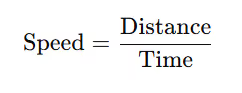
Speed tells us how fast an object moves. It is defined as the rate at which an object covers distance with respect to time. Speed does not consider the direction of motion, which is why it only shows the magnitude of motion.
Formula of Speed:
- Speed is a scalar quantity.
- The SI unit of speed is metre per second (m/s).
- Other commonly used units are kilometre per hour (km/h).
a) Uniform Speed: An object is said to have uniform speed when it covers equal distances in equal intervals of time and its speed remains constant throughout the motion.
b) Non-Uniform Speed: An object has non-uniform speed when it covers unequal distances in equal intervals of time or equal distances in unequal intervals of time, meaning the speed keeps changing.
Velocity
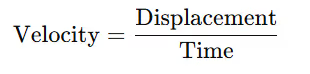
Velocity is defined as the rate of change of displacement with respect to time. It is a vector quantity, which means it has both magnitude (speed) and direction. In simple terms, velocity tells us how fast an object is moving and in which direction.
- Displacement: Velocity depends on displacement, which is the shortest distance between the initial and final positions of an object along with its direction.
- Time: Velocity shows how quickly this displacement takes place in a given time interval.
Formula of Velocity:
a) Uniform Velocity: An object is said to have uniform velocity when it moves in a straight line with constant speed and constant direction.
b) Non-Uniform Velocity: An object has non-uniform velocity when its velocity changes with time, either due to a change in speed, direction or both.
Acceleration
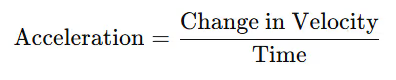
Acceleration is defined as the rate at which the velocity of a moving object changes with time. This change may occur due to a variation in the object’s speed, direction of motion or both.
Formula of Acceleration:
- The SI unit of acceleration is m/s².
i) Types of Acceleration
- Positive Acceleration: When the velocity of an object increases with time.
- Negative Acceleration (Retardation): When the velocity of an object decreases with time.
- Zero Acceleration: When there is no change in velocity, i.e., the object is either at rest or moving with uniform velocity.
ii) Uniform and Non-Uniform Acceleration
a) Uniform Acceleration: If the change in velocity in equal intervals of time remains the same, the object is said to have uniform acceleration.
b) Non-Uniform Acceleration: If the change in velocity in equal intervals of time is different, the object is said to have non-uniform (variable) acceleration.
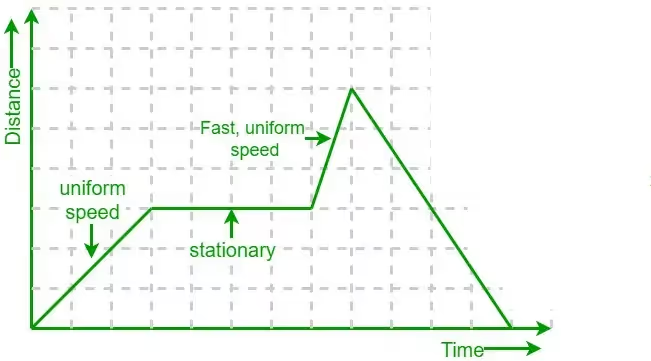
Graphical Representation of Motion
1. Distance - Time graph
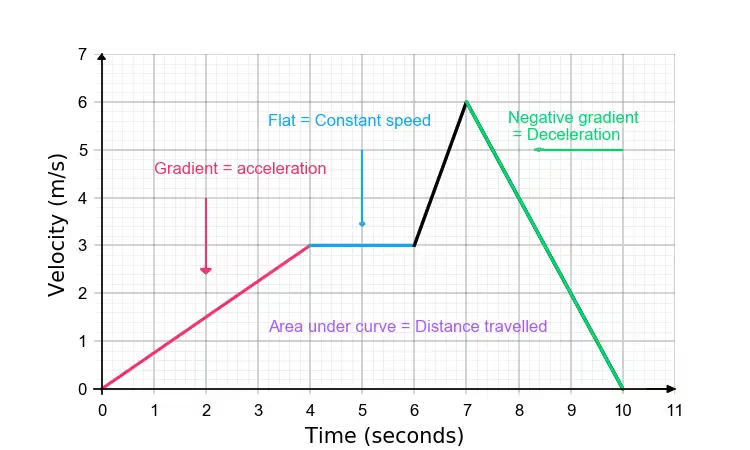
2. Velocity-time graph
i) Equations of Motion
When motion is uniform or uniformly accelerated:
- v=u+at
- S=ut=1/2at2
- v2 = u2 + 2as
Where:
- s = displacement
- u = initial velocity
- v = final velocity
- a = acceleration
- t = time
With this formula you can solve multiple numericals. You can find displacement, time, velocity,acceleration etc.
ii) Numerical Questions
Let us solve some numericals:
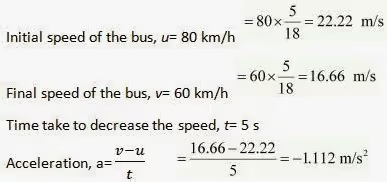
1. A bus decreases its speed from 80 km/h to 60 km/h in 5 s. Find the acceleration of the bus.
2. A bus starting from rest moves with a uniform acceleration of 0.1 m/s2 for 2 minutes. Find (a) the speed acquired, (b) the distance travelled.
Answer: Initial speed of the bus, u= 0 m/s
Acceleration, a = 0.1 m/s2
Time taken, t = 2 minutes = 120 s
(a) v= u + at
v= 0 + 0×1 × 120
v= 12 ms-1
(b) According to the third equation of motion, v2 - u2= 2as
s is the distance covered by the bus
(12)2 - (0)2= 2(0.1) s
s = 720 m
Speed acquired by the bus is 12 m/s.
Distance travelled by the bus is 720 m.
3. A trolley, while going down an inclined plane, has an acceleration of 2 cm/s2. What will be its velocity 3 s after the start?
Answer: Initial Velocity of the trolley, u= 0 cm/s
Acceleration, a= 2 cm/s2
Time, t= 3 s
It is known that final velocity, v= u + at = 0 + 2*3 cm/s
Therefore, the velocity of train after 3 seconds is 6 cm/s
4. A racing car has a uniform acceleration of 4 m/s2. What distance will it cover in 10 s after start?
Answer: Initial Velocity of the car, u=0 m/s
Acceleration, a= 4 m/s2
Time, t= 10 s
We know Distance, s= ut + (1/2)at2
Therefore, Distance covered by car in 10 second= 0 × 10 + (1/2) × 4 × 102
= 0 + (1/2) × 4× 10 × 10 m
= (1/2)× 400 m
= 200 m
In conclusion, these are quick and effective revision notes for the chapter Motion. If you go through these notes carefully, you can revise the entire chapter within a few minutes without even opening the textbook.
Regular revision of these notes will keep concepts clear and formulas fresh in your mind. By using them during exam time, students can revise faster, save valuable time and feel more confident while solving numerical and theory-based questions.












.svg)

