
.svg)
Feeling stressed before your physics exam? You’re not alone. Chapters like Gravitation from CBSE Syllabus Class 9 Science might feel heavy because of the formulas, confusing concepts and numericals but these notes are for the purpose to reduce worry and increase understanding.
Here, in this gravitation chapter-wise summary you will get a better understanding of everything like free fall, acceleration due to gravity, mass and weight, motion under gravity, buoyancy, Archimedes’ principle, thrust and pressure, and relative density; right from why an object falls, to why weight changes and how gravity works.
This chapter summary provides clear concepts, explanations, important formulas, revision notes and FAQs. Take a deep breath, relax, and let’s revise this chapter step by step - just like a good coaching class before exams. Students can also explore Class 9 Science Chapter-wise Notes to revise all chapters of the syllabus with short explanations and diagrams.

Introduction to Gravitation
Gravitation is a force of attraction that acts between any two objects in the universe. Whether it's a falling apple or planets orbiting the sun, the force of gravity is responsible.
It is a universal phenomenon, meaning it works everywhere and affects all matter. The most familiar example is Earth’s gravity, which pulls everything toward its center, keeping us grounded.
Gravitational Force
The force with which two objects attract each other due to their masses is called gravitational force. This force is present between all objects, but it becomes noticeable only when at least one of the objects has a large mass, like the Earth. Gravity is the force that gives weight to objects and causes them to fall when dropped.
Universal Law of Gravitation
The Universal Law of Gravitation describes the force of attraction that exists between all objects in the universe.
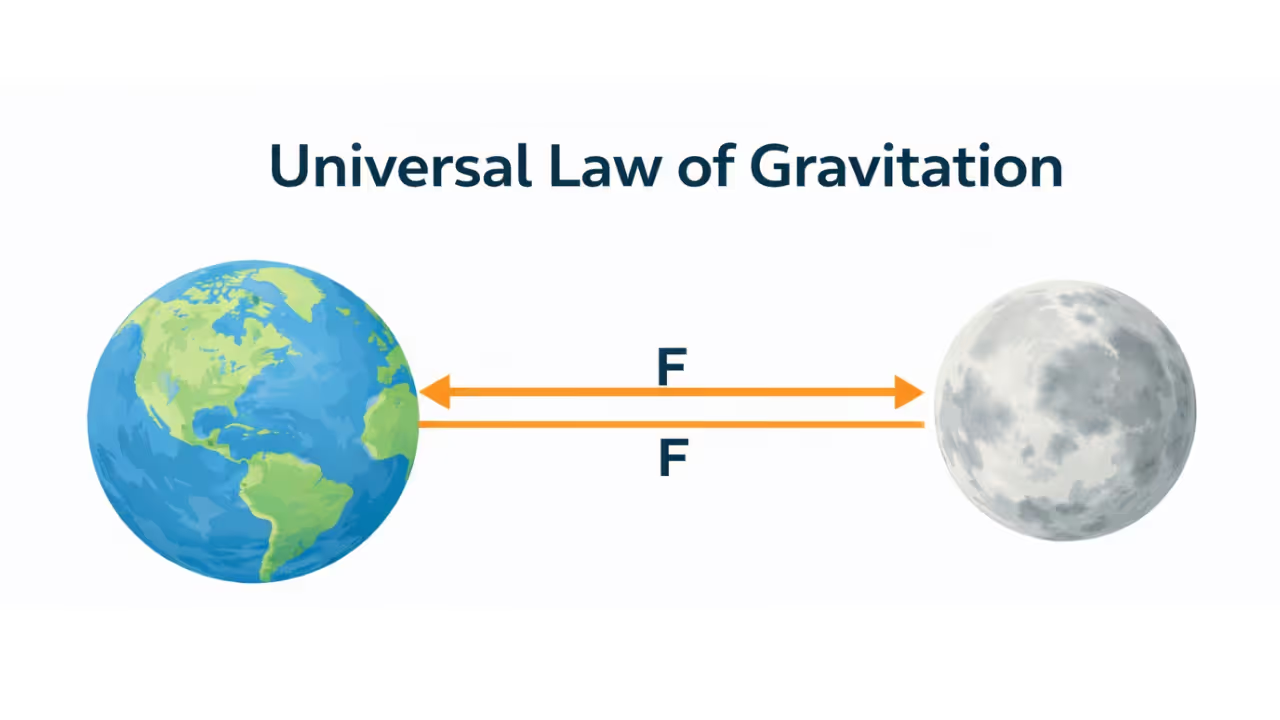
Stated by Sir Isaac Newton, the law says:
“Every object in the universe attracts every other object with a force which is directly proportional to the product of their masses and inversely proportional to the square of the distance between them.”
Mathematically:
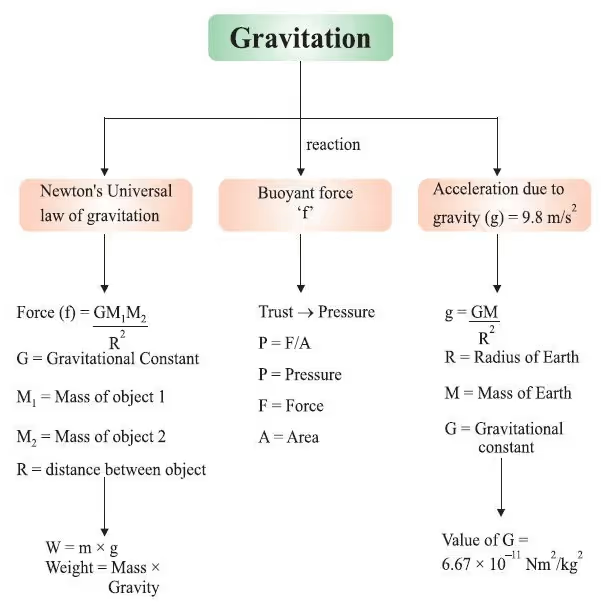
F = G m1 ⋅ m2 / r2,, where:
- F = gravitational force
- m1, m2 = masses of two objects
- r = distance between centers of the two objects
- G = universal gravitational constant
Universal Gravitational Constant (G)
The constant G in the law of gravitation is known as the universal gravitational constant. Its value is the same throughout the universe and is equal to 6.674×10⁻¹¹ Nm2/kg2.
It provides a measure of the strength of the gravitational force between two bodies with unit masses placed one meter apart. Though its value is very small, it plays a crucial role in calculating gravitational forces between planets and stars.
- Explains the force that binds us to Earth.
- Accounts for the motion of planets around the sun.
- Responsible for tides due to the moon’s attraction.
- Holds galaxies and planetary systems together.
Free Fall
When an object falls under the sole influence of gravity, neglecting air resistance, it is said to be in free fall.
During free fall, all objects fall with the same acceleration, regardless of their mass. This acceleration is known as acceleration due to gravity (g). To better understand acceleration concepts, students can also revise Class 9 Motion Notes.
Acceleration Due to Gravity (g)
g = G M /R2
Where:
- M = mass of the Earth
- R = radius of the Earth
Standard value:
g = 9.8 m/s2
Note: g is not constant. It varies slightly depending on height and location.
Motion of Objects under Gravity
Using equations of motion:
- v = u + gt
- s = ut +1/2at2
- v2 = u2 + 2gs
If an object is thrown upward, g becomes –9.8 m/s² and is called deceleration.
Mass and Weight
Mass is the amount of matter in a body and remains constant everywhere. It is a scalar quantity measured in kilograms (kg). Weight, on the other hand, is the force with which Earth attracts the body. It is given by the formula
W = mg
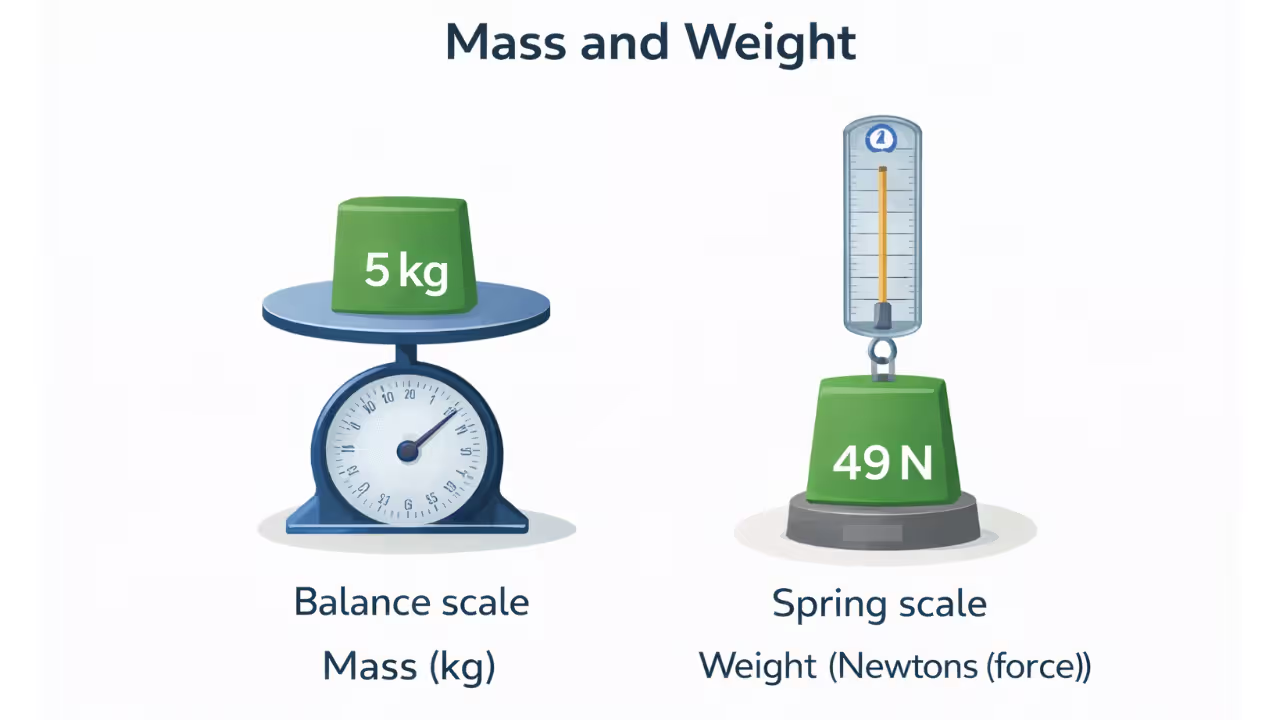
where m is mass and g is the acceleration due to gravity. Weight is a vector quantity and is measured in newtons (N). Unlike mass, weight varies with the value of g at different locations.
Weight of an Object on the Moon
The moon has less mass and a smaller radius than Earth. As a result, its gravitational pull is weaker, about one-sixth that of Earth. This means an object will weigh only one-sixth of its Earth weight on the moon. However, the mass of the object remains unchanged. This is why astronauts on the moon can jump higher than on Earth.
Thrust and Pressure
Thrust is the force exerted perpendicular to a surface. When thrust is applied over a surface, it results in pressure. Pressure is defined as the thrust per unit area and is calculated as
P = F / A
where F is the thrust and A is the area. Pressure increases when the same force is applied to a smaller area. This principle is used in sharp objects like knives to make cutting easier.
Units:
- SI unit of thrust = Newton (N)
- SI unit of pressure = Pascal (Pa)
Note: For the same force, pressure is more if area is less (e.g., knife edge).
Pressure in Fluids
Fluids, such as liquids and gases, exert pressure in all directions. This pressure increases with depth in a liquid because of the weight of the fluid above. For example, a diver feels more pressure deeper underwater, and the walls of a dam are made thicker at the bottom to withstand this pressure. For detailed answers to textbook questions, students should also practice Class 9 Science NCERT Solutions.
Buoyancy
When an object is immersed in fluid, it experiences an upward force known as buoyant force.
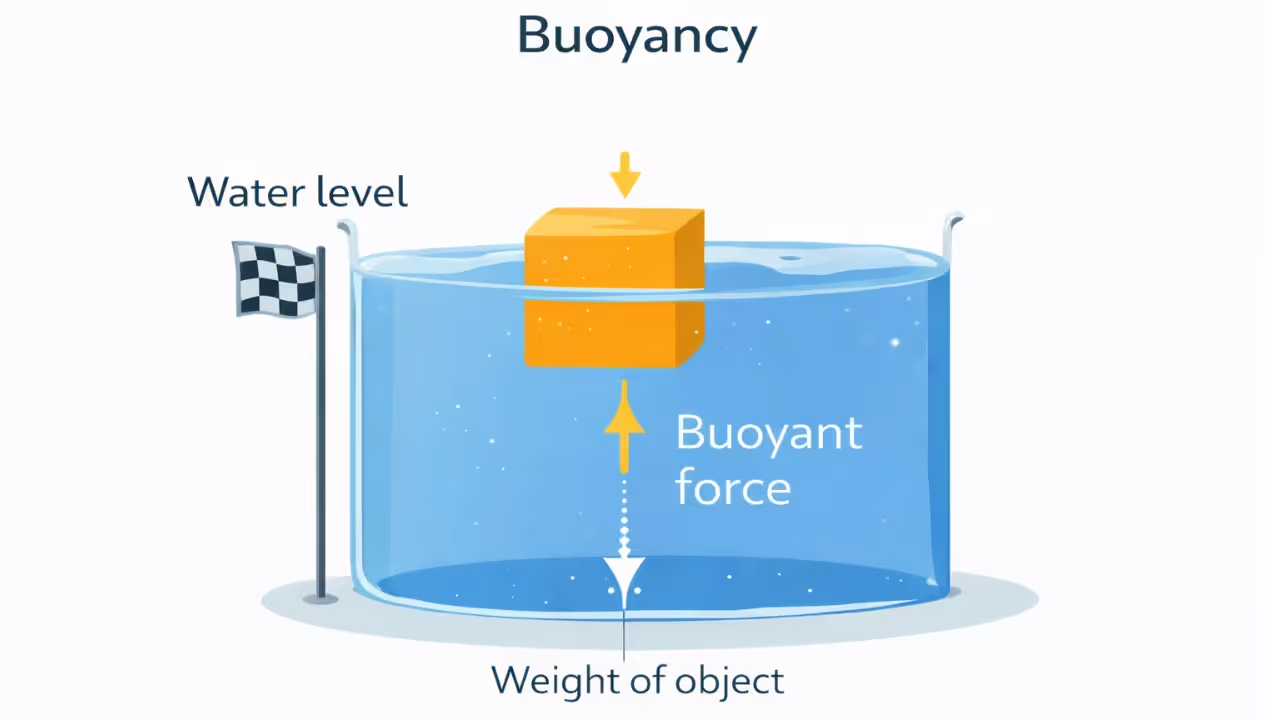
This upward push is called buoyancy and is caused due to the difference in pressure at different depths of the fluid. Buoyancy makes objects appear lighter in water and can cause them to float if the upward force exceeds their weight.
Factors Affecting Buoyant Force
- Volume of the object immersed.
- Density of the fluid.
The magnitude of the buoyant force depends on two factors:
- The volume of the object submerged in the fluid
- The density of fluid
Larger the volume and higher the fluid density, greater is the buoyant force. This is why it is easier to float in salty water (denser) than in fresh water.
Why Do Objects Float or Sink?
- If the buoyant force ≥ weight, object floats
- If the buoyant force < weight, object sinks
Density
Density is defined as mass per unit volume. It is calculated using the formula
Density = Mass/Volume
Its SI unit is kg/m3. A substance with higher density will sink in a fluid of lower density. The density of water is 1000 kg/m3, which is often used as a reference for comparison.
Relative Density
Relative density is the ratio of the density of a substance to the density of water. It is a dimensionless quantity, meaning it has no unit.
Relative Density = Density of substance / Density of water
A relative density greater than 1 means the object is denser than water and will sink, while less than 1 means it will float.
Students can practice exam-oriented questions from Class 9 Science Gravitation Important Questions to strengthen their understanding.
Archimedes’ Principle
“When a body is partially or wholly immersed in a fluid, it experiences an upward force equal to the weight of the fluid displaced by it.”
Applications:
- Designing ships and submarines
- Measuring relative density
- Hydrometers and lactometers
Conclusion
If this topic once felt confusing, it should feel much lighter now. Revise the formulas, understand the logic, and don’t panic before exams. Read it calmly, revise once more before tests, and share it with a friend if it helps.
FAQs
Q1. State the universal law of gravitation.
Ans. Every object attracts every other object with a force directly proportional to the product of their masses and inversely proportional to the square of the distance between them.
Q2. What is free fall?
Ans. The motion of a body when only the gravitational force of Earth acts on it is called free fall.
Q3. What is the acceleration due to gravity (g)?
Ans. It is the acceleration produced in a body due to Earth’s gravity, and its average value is 9.8 m/s² near the Earth’s surface.
Q4. Does the value of ‘g’ remain the same everywhere on Earth?
Ans. No, the value of g varies slightly depending on height, depth, and latitude, but its approximate value near Earth’s surface is 9.8 m/s².
Q5. What is the difference between mass and weight?
Ans. Mass is the amount of matter present in a body and remains constant everywhere. Weight is the force exerted by gravity on that body and may vary depending on the gravitational field.
Q6. Where can I download the latest Class 9 Science Gravitation notes PDF?
Ans. Students can download the latest Class 9 Science Gravitation notes PDF from trusted educational platforms like Educart. These notes follow the latest CBSE syllabus and include important concepts, formulas, diagrams, and exam-oriented questions for quick revision.
Q7. Are these Class 9 Gravitation notes based on the latest CBSE syllabus?
Ans. Yes, these Gravitation notes are prepared according to the latest CBSE Class 9 Science syllabus and cover all key topics such as the universal law of gravitation, free fall, acceleration due to gravity, buoyancy, pressure in fluids, and Archimedes’ principle.
Q8. What are the important topics in the Class 9 Gravitation chapter?
Ans. The important topics in this chapter include:
- Universal Law of Gravitation
- Free Fall
- Acceleration due to Gravity
- Mass and Weight
- Thrust and Pressure
- Buoyancy
- Archimedes’ Principle
- Density and Relative Density
These topics are frequently asked in school exams.
Q9. How can students revise the Gravitation chapter quickly before exams?
Ans. Students can revise the Gravitation chapter by focusing on key formulas, definitions, diagrams, and important concepts. Practicing numerical questions and solving important questions can help improve understanding and exam performance.
Q10. Where can I find chapter-wise Class 9 Science notes for all chapters?
Ans. Students can find chapter-wise Class 9 Science notes for all chapters such as Motion, Force and Laws of Motion, Gravitation, and Work & Energy on educational platforms that provide CBSE-aligned study materials and downloadable PDFs for easy revision.












.svg)

