
.svg)
If ideas like oscillating electric fields, Maxwell’s equations or the electromagnetic spectrum feel confusing right now, don’t worry. Let's go through this chapter of electromagnetic waves and help you make it stronger and interesting.
These Electromagnetic Waves Class 12 Notes are written according to Class 12 Physics Syllabus, explained in simple language and designed for quick revision and strong conceptual clarity.
Electromagnetic Waves Summary
Electromagnetic waves are waves formed due to mutually perpendicular oscillating electric and magnetic fields, which are also perpendicular to the direction of propagation of the wave.
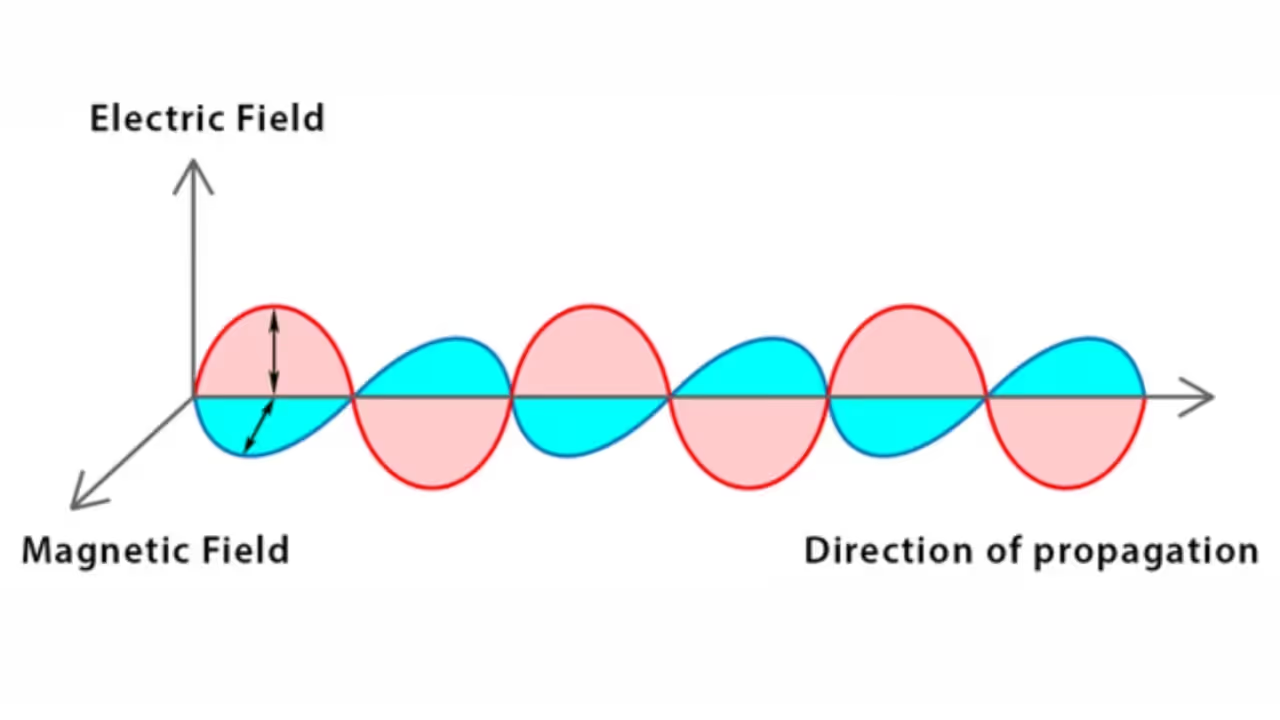
Unlike mechanical waves (sound waves), electromagnetic waves do not require a material medium and can travel through vacuum. Light from the Sun reaching Earth is the best real-life example.
This single property makes electromagnetic waves unique and extremely important in physics.

Maxwell’s Contribution
James Clerk Maxwell, in the 19th century, unified electricity and magnetism through his famous Maxwell’s equations. From these equations, he predicted that:
- A changing electric field produces a magnetic field
- A changing magnetic field produces an electric field
- These changing fields sustain each other and travel through space as a wave
This theoretical prediction later got experimental confirmation by Hertz, proving the existence of electromagnetic waves.
Hertz’ Experiment
In 1887, Heinrich Hertz experimentally produced and detected electromagnetic waves.
He used:
- A spark gap transmitter to produce EM waves
- A metallic loop with a small gap to detect them
The detector produced sparks when EM waves reached it, confirming Maxwell’s prediction.
Displacement Current
Maxwell introduced the concept of displacement current to explain how changing electric fields can produce magnetic fields even in vacuum. He modified Ampere’s law by adding a new term called displacement current.
Displacement current is not due to actual flow of charges. It arises due to changing electric fields. This completed the symmetry between electricity and magnetism and led to the prediction of electromagnetic waves.
Nature of Electromagnetic Waves
According to NCERT, electromagnetic waves have the following key characteristics:
1. Transverse Nature
Electromagnetic waves are transverse waves.
- Electric field oscillates in one plane
- Magnetic field oscillates in a plane perpendicular to it
- Both are perpendicular to the direction of propagation
This is why polarization is possible only in electromagnetic waves.
2. No Medium Required
EM waves can travel:
- In vacuum
- In air
- In transparent materials
This explains how sunlight reaches Earth through empty space.
3. Speed of Electromagnetic Waves
In vacuum, all electromagnetic waves travel with the same speed ⇒ c = 3 x 10⁸ m/s. This speed is independent of frequency and wavelength. In a medium ⇒ v = c/n; where n is the refractive index of the medium.
Relationship Between Electric and Magnetic Fields
In an electromagnetic wave ⇒ E/B = c; where:
- E = Electric field amplitude
- B = Magnetic field amplitude
This relationship is directly derived from Maxwell’s equations and is frequently asked in theory questions.
Energy and Momentum
Electromagnetic waves carry–Energy and Momentum. This explains phenomena like radiation pressure, where light can exert force (used in solar sails).
Energy flow is given by Poynting vector, which indicates:
- Direction of energy propagation
- Rate of energy transfer per unit area
Electromagnetic Spectrum
The electromagnetic spectrum is the complete range of electromagnetic waves arranged in order of increasing frequency or decreasing wavelength.
Order of Electromagnetic Spectrum
Radio Waves → Microwaves → Infrared → Visible Light → Ultraviolet → X-Rays → Gamma Rays
Detailed Classification with Uses
Let us see the uses of each waves in detail:
1. Radio Waves
- Longest wavelength
- Lowest frequency
- Produced by oscillating electric circuits
- Used in radio, TV broadcasting, mobile communication
2. Microwaves
- Shorter wavelength than radio waves
- Produced by special vacuum tubes
- Used in radar, satellite communication, microwave ovens
3. Infrared Rays (IR)
- Emitted by hot bodies
- Invisible to human eyes
- Used in night vision, remote controls, thermal imaging
4. Visible Light
- Only part visible to human eye
- Range: Violet (short wavelength) to Red (long wavelength)
- Responsible for vision and optical phenomena
5. Ultraviolet Rays (UV)
- Higher frequency than visible light
- Causes fluorescence
- Used in sterilization, water purification
- Excess exposure causes skin damage
6. X-Rays
- Very high energy waves
- Produced when fast electrons strike heavy metal targets
- Used in medical imaging, fracture detection
7. Gamma Rays
- Shortest wavelength
- Highest energy
- Produced in nuclear reactions
- Used in cancer treatment (radiotherapy)
Conclusion
Electromagnetic Waves may be one of the shortest chapters in Class 12 Physics, but its importance is massive. From sunlight and mobile phones to medical imaging and satellite communication, this chapter explains how the modern world works.
With clear concepts, NCERT-based explanations and smart revision, this chapter can easily become your highest-scoring unit. These Electromagnetic Waves Class 12 Notes are designed to help you revise faster, understand better and write perfect exam answers.
FAQs
Q1. Do electromagnetic waves require a medium?
Ans. No. They can travel through vacuum.
Q2. Who predicted electromagnetic waves?
Ans. James Clerk Maxwell predicted electromagnetic waves.
Q3. Why do electromagnetic waves not require a medium?
Ans. They are self-sustaining waves of electric and magnetic fields, so they can travel through vacuum.
Q4. Which electromagnetic waves have the highest energy?
Ans. Gamma rays have the highest frequency and therefore the highest energy.
Q5. Which EM waves are used in communication?
Ans. Radio waves and microwaves are the EM waves that are used in communication.












.svg)

