.svg)
For hundreds of students NEET (National Eligibility cum Entrance Test) is not just an entrance exam but a hope to contribute towards people’s health from the ground level. It represents years of preparation, sacrifices, and dream of becoming a doctor.
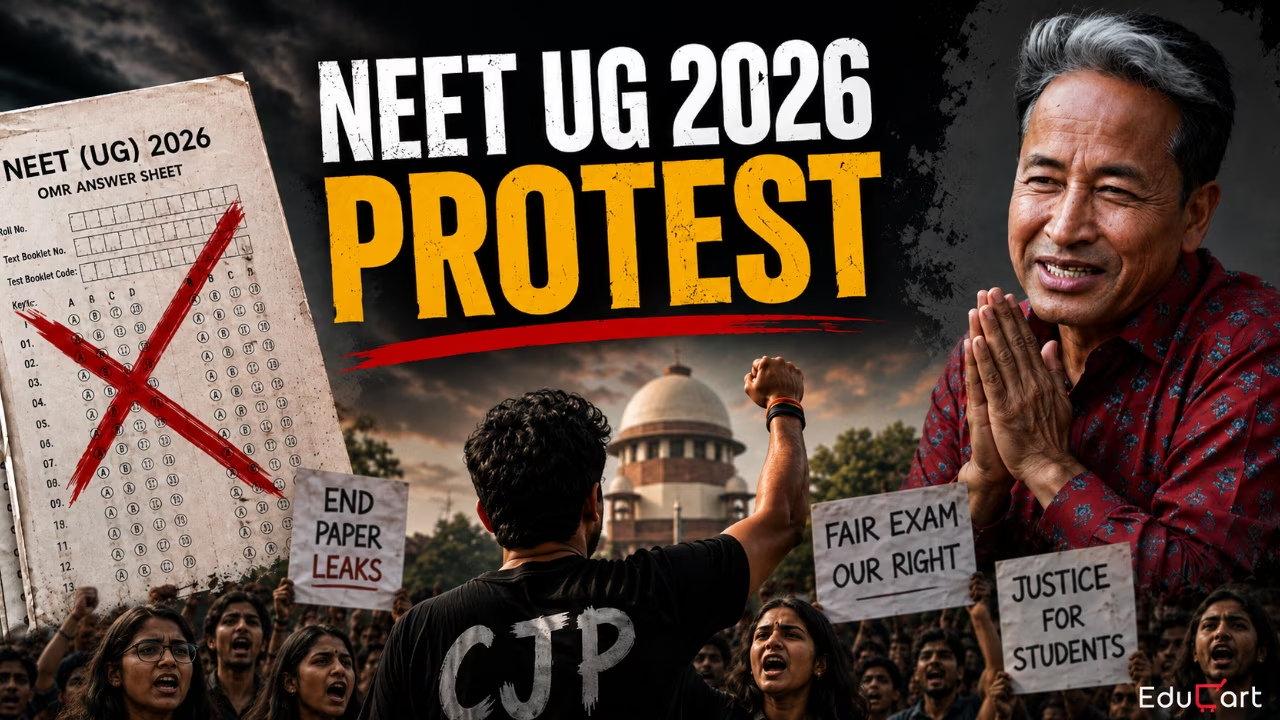
Although the NEET UG exam has leaked multiple times starting from 2021, and 2024. But this year 2026 has been marked as the year with the biggest NEET controversy. NEET UG 2026 became one of the most controversial examinations in India’s recent history.
This article explains everything that happened, from the beginning of the controversy to the final victory and why the issue continues to matter for everyone, especially people from the age group of 16-30.
What Started the NEET UG 2026 Controversy?
NEET UG 2026 was scheduled for 3 May 2026. The test was supposed to be conducted across many cities for more than 22.79 lakh registered candidates in pen-paper mode.
This was expected to be the final stage of the preparation cycle for the students, after which they could take a breather and relax after almost a year of preparation. Instead, the examination became the starting point of an uncertain controversy.
On 12 May 2026, the authorities cancelled the exam and announced a possible leak of the paper. This led students disheartened as the cancellation also meant that candidates who appeared in the first exam, now have to sit for the Re-Neet UG 2026.
This cancellation affected more than two million aspirants and became the first major source of anger amongst the students. Everything led to affect students to such a level, that some of them decided to end their lives and this started the controversy.
What Were the NEET Aspirants Really Feeling?
Students were not prepared for a re-examination setback and their anger was directed towards the circumstances that caused the cancellation
Students argued that:
- Honest candidates were being forced to take the examination again
- Months of preparation had been disrupted
- Families had to bear additional travel and stay expenses
- Students faced the pressure and uncertainty yet again
- The people responsible for securing the paper had not been publicly held accountable
- Previous examination controversies had not resulted in proper structural changes
- A re-examination addressed the immediate admission problem but not the larger system failure
For students, the concern was not ‘When will the Re-exam be held?’ anymore. Their concerns were about their trust in the system which felt shattered after this. The questions became ‘Why did such a serious failure happen, and who will ensure that it will never happen again’?
The Rise of the “Cockroach Movement”
NTA announced on 12 May that the Re-Neet UG 2026 Examination will be conducted on 21 June with stricter security measures. These measures included tighter control over question-paper transportation, extra surveillance and biometric verification.
The conduction of the paper was expected to be smooth as per the promises but the on ground situation showed something else.
Everything collectively led to the rise of the youth-led Cockroach Janta Party widely known as CJP where Abhijeet Dipke emerged as one of the prominent faces.
The movement began as an online and satirical response to a mark in which unemployed young people were compared to ‘cockroaches’. The CJP people accepted this term as a symbol of survival and what began as a satire soon transformed into an organised protest movement.
The CJP used humour, political comedy and student-focused social media communication to discuss issues including:
- Examination paper leaks
- Lack of institutional accountability
- Youth unemployment
- Coaching and examination pressure
- Student suicides
- The disconnect between young people and policymakers
The sit-in protest at Jantar Mantar officially began on 20 June with Abhijeet Dipke, fellow CJP members and Sonam Wangchuk. The campaign started gaining millions of followers, becoming one the most visible youth-led social movement in the country.
The protest started for NEET UG also started representing wider dissatisfaction among the students.
The Protest Spread and Turned Nation-wide
Slowly, the protest started spreading and people across India and abroad started showing support. Cities like Kolkata, Indore, Lucknow, Mumbai and other state capitals showed support by organising peaceful marches, candlelight gatherings and online campaigns.
The movement gained support from:
- NEET aspirants
- Students preparing for government recruitment examinations
- University students
- Young working professionals
- Parents
- Teachers and education activists
- Civil society organisations
- Supporters living outside Delhi who sent food and other supplies
At the central protest site, Jantar Mantar, volunteers organised meals, medical support and other required necessities and there started a steady flow of food along with donations from the supporters. Protesters used placards, songs, satire, speeches and social media videos to communicate their demands.
The atmosphere was mixed with anger and humour. The movement’s use of memes and unconventional slogans helped it attract young people who may not have participated in traditional political protests.
Sonam Wangchuk’s 26-Day Hunger Strike
The movement received national attention when education and environmental activist Sonam Wangchuk sat on a hunger strike in support of the protesting students. His participation moved the protest from just the examination issue to complete accountability of the government on varied matters.
- Wangchuk began his hunger strike on 28 June 2026 in support of NEET UG 2026 protesters
- His key demands included accountability for the alleged paper leak and the resignation of the Union Education Minister
- Doctors, political leaders, and supporters repeatedly urged him to end the fast due to health risks
- The hunger strike continued for a total of 26 days
What Were the Main Demands of the Protestors?
The demands of the movement evolved over time but 3 major demands that stayed throughout the protest were:
- Resignation of the Union Education Minister - The protesters demanded the resignation of Union Education Minister Dharmendra Pradhan, arguing that his accountability was necessary for a failure of this scale. As the protest continued, this demand became non-negotiable for ending the protest.
- A fair transparent retest - This demand asked the government that the Re-neet being conducted should be conducted fairly with all the security measures being taken.
- Reforms in NTA - This demand asked for a structural reform in the system to prevent future failures like such.
The NEET UG 2026 Re-Examination & Result Controversy
The NEET UG 2026 re-examination was conducted on 21 June 2026 after the original exam was cancelled due to alleged paper leak concerns. To ensure more security and restore confidence in the examination process, the NTA introduced improved measures:
- Biometric verification of candidates
- Stricter identity authentication at examination centres
- Exception-handling protocols for irregular cases
- Increased surveillance and monitoring at test venues
- Strong control over question paper distribution and handling
The re-examination was supposed to solve the issues related to the original examination. Instead another conspiracy started related to the result of the re-examination.
The NTA declared the NEET UG 2026 re-examination results on 16 July 2026.
After the results, some social media posts claimed mismatches in OMR sheets and scores. The NTA clarified that:
- Many OMR images were fake, edited, or AI-generated
- Claims did not match official records
As a result, the protest continued even after the re-exam, and the result, shifting its focus to systemic reform and justice.
The “Sansad Chalo” Parliament March
The protest reached its emotional and the highest motivational phase during the Sansad Chalo march from Jantar Mantar towards the parliament. What had begun as a peaceful student-led movement driven by hope, frustration, and a deep desire for fairness had now become a powerful expression of collective determination.
Thousands of young aspirants, parents, teachers and people in support participated carrying books, and handwritten placards walked together with complete discipline and enthusiasm.
Police set up barricades, but tensions rose as protesters tried to push forward demanding to be heard at the highest level.
Towards the end, both sides presented incidents of violence:
- Protesters claimed it was a crackdown on a largely peaceful march, highlighting the courage and discipline with which students had gathered to demand accountability.
- Police stated that some protesters engaged in stone-pelting and attempts to break barricades
New Demands After the Police Action
After the Sansad Chalo March on 20 July, the videos and photos of the injured protestors by the police spread across social media. This questioned the use of force against students seeking accountability.
The action done by police generated three new demands:
- An independent investigation into the clashes
- Withdrawal or review of cases against peaceful protesters
- Accountability for officers found to have used excessive force
Protest Continued After the March & Government Negotiated
Despite the violence of 20 July March, protesters returned to the streets on 21st of July. Thousands of them gathered in the favour that the movement will continue until the Education Minister resigns and the government provides a plan for clear reform.
- As the pressure increased, the government called the representative of CJP for direct talks about the issue and related demands.
- Health Minister J.P. Nadda was among the senior leaders who met protest representatives. The early meetings did not immediately produce an agreement.
On 24 July, protest leaders said that the government had asked for time until the following afternoon to respond to the resignation demand. The negotiation process involved multiple rounds of discussion covering:
- The Education Minister’s position
- Examination reform
- Compensation for affected families
- Treatment of protesters
- Legal action arising from the demonstrations
- Future dialogue with student representatives
Dharmendra Pradhan Resigns
On 25 July, 2026, Dharmendra Pradhan resigned as the Union Education Minister. The resignation marked the most significant win in the protest for NEET UG 2026 controversy.
For the protestors, the resignation represented political accountability. It was indeed a victory for the protestors and the students fighting against the failures in the education system.
End of the Protest At Jantar Mantar
Following the news of Dharmedra Pradhan’s resignation, on 25 July, CJP representatives announced that the government had accepted all their demands, and asked the supporters to peacefully end the protest.
Movement spokesperson Ashutosh Ranka told the protestors that their struggle and patience had succeeded. The movement concluded with celebrations as an expression of relief.
The CJP stated that it would continue pursuing:
- Justice in the paper-leak investigation
- Examination-system reforms
- Compensation and support for affected families
- Accountability for alleged police excesses
- Broader concerns affecting students and young people
The movement therefore described 25 July as a major victory, but not necessarily the end of its public campaign.
What Did the Government Agree On?
The broader written terms on which the government and protestors agreed on were:
- The resignation of the Education Minister
- Stronger laws and procedures against paper leaks
- Faster trials in examination-leak cases
- Conversation on examination reforms
- Concerns relating to protesters and police action
- Support or compensation connected with affected families
- Restoration of public facilities and normal conditions around the protest area
A special Fast Track Court was set up to begin hearing the NEET UG 2026 paper-leak case under the Public Examination (Prevention of Unfair Means) Act, 2024.
Role of Social Media In the NEET Protest
It was because of social media that the students and everybody else were able to connect with the protest, emotionally and mentally. Unlike the older students protests which majorly relied on traditional media, and campus unions, the NEET movement developed its course online.
The CJP, independent journalists, and online media platforms used ways to keep the movement completely active online:
- Short videos
- Memes
- Satirical posts
- Livestreams
- Protest updates
- Student testimonies
- Volunteer coordination
This communication style helped the movement reach supporters who were not physically present in Delhi.
It also allowed young protesters to frame the issue in their own language rather than depending entirely on television debates or party spokespersons.
Students Suicides and Mental-Health Concerns
What started the fire to protest was the involved reports of the students deaths by suicides during the period of uncertainty. Protestors and affected families argued that the cancellation, fear of lost academic year, repeated preparation pressure and lack of clear information caused major distress.
The controversy highlighted serious mental health issues:
- Extreme examination pressure
- Fear of disappointing families
- Financial investment in coaching
- Uncertainty over admission
- Social isolation during preparation
- Lack of accessible counselling
- The emotional impact of institutional failure
The demand for compensation was therefore joined with a broader message to the educational authorities to keep students' mental health as the primary concern.
Moreover, students experiencing stress should seek immediate support from a trusted family member, teacher, counsellor or qualified mental-health professional.
The Legal Actions Against the Paper Leak
Several legal processes developed around the NEET controversy.
Why the NEET Protest Matters?
The NEET UG 2026 protest matters beyond one examination as India’s examination system affects millions of students every year.
These competitive exams are the deciding factors and determine a student’s education or employment opportunities.
When an examination is leaked:
- Honest preparation loses value
- Wealthy or connected candidates may gain unfair advantages
- Families lose money
- Students lose time
- Public institutions lose credibility
- Young people become more vulnerable to misinformation and exploitation
A secure examination system is therefore not simply an administrative requirement. It is a question of equality.
FAQs
Q1. What was the Cockroach Janta Party (CJP) and how was it connected to the protest?
Ans. The Cockroach Janta Party (CJP) emerged as a youth-led movement that transformed online satire into a nationwide campaign demanding examination reforms, institutional accountability and justice for NEET aspirants.
Q2. What caused the NEET UG 2026 protest?
Ans. The protest began after the NEET UG 2026 examination was cancelled due to an alleged paper leak. The cancellation, followed by a re-examination, sparked concerns over fairness, accountability and the credibility of India's examination system.
Q3. What were the main demands of the NEET UG 2026 protesters?
Ans. The protesters primarily demanded:
- Resignation of the Union Education Minister
- A fair and transparent re-examination
- Structural reforms within the National Testing Agency (NTA)
Q4. What role did Sonam Wangchuk play in the movement?
Ans. Education and environmental activist Sonam Wangchuk joined the protest by undertaking a 26-day hunger strike, drawing nationwide attention to the students' demands for accountability and examination reforms.
Q5. What happened during the 'Sansad Chalo' march?
Ans. Thousands of students, parents and supporters marched from Jantar Mantar towards Parliament, demanding accountability. The march witnessed tensions between protesters and police, leading to fresh demands for an independent investigation into the clashes.
Q6. How did social media influence the NEET UG 2026 protest?
Ans. Social media played a central role by spreading protest updates, student testimonies, memes, livestreams and campaign messages, helping the movement gain nationwide support and engage young people.
Q7. Why does the NEET UG 2026 protest matter beyond one examination?
Ans. The movement highlighted broader concerns about fairness, transparency and accountability in India's examination system. It shows the importance of secure examinations in protecting equal opportunities for millions of students.
Glimpse of the Event

Share Article


.svg)




%2520(1).avif)
.avif)
.png)





















.svg)

