
.svg)
Class 9 Constitutional Design explains how democratic constitutions are framed and why they are essential for governing a country. This chapter focuses on why a constitution is needed, how it is made, the role of the Constituent Assembly, the Preamble, and institutional design.
It also focuses on two case studies to show how equality, rights and institutional balance are built into a democracy:
- South Africa’s transition from apartheid
- India’s Constitution-making process

Begin your learning journey with the Latest Class 9 SST Syllabus walkthrough.
Introduction to Constitution
A Constitution is the supreme law of a country. It lays down the basic rules and principles according to which a country is governed.
Every democratic country needs a constitution because:
- It defines how the government will be formed.
- It distributes power among different institutions.
- It limits the powers of the government.
- It protects the rights of citizens.
In this chapter, we study two important examples of constitutional design:
- The making of the Constitution in South Africa after apartheid.
- The framing of the Constitution in India by the Constituent Assembly.
Democratic Constitution in South Africa
South Africa presents a powerful example of how a country can transition from a system of racial domination to a democratic constitution.
- Under apartheid, the white minority ruled and severely discriminated against the black majority.
- Blacks were denied basic human rights, segregated in public places and were not allowed to vote.
- Leaders like Nelson Mandela and the African National Congress (ANC) led a prolonged struggle to end apartheid.
- Nelson Mandela was released in 1990, marking the start of negotiations for a new constitution.
- The ruling government and ANC negotiated despite deep differences, agreeing to compromise for a future based on equality and justice.
- The new constitution, adopted in 1996, is one of the most democratic in the world.
The most remarkable aspect of South Africa’s transition was the spirit of reconciliation.
After spending 28 years in prison, Nelson Mandela chose forgiveness over revenge. Instead of punishing the white minority, he worked towards unity and equality.
The Constitution of 1996:
- Guaranteed equal rights to all citizens
- Protected minority rights
- Created independent institutions
- Became a symbol of democratic compromise
This example shows that a constitution is not just a legal document; it is a tool for nation-building and reconciliation.
Why Do We Need a Constitution?
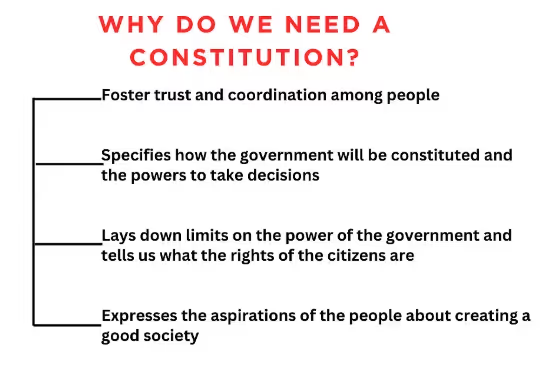
A constitution performs several essential functions in a democracy.
- First, it lays down the fundamental rules and principles according to which a country is governed.
- Second, it defines the nature of a country’s political system, whether it is parliamentary, federal or presidential.
- Third, it specifies the rights and duties of citizens and protects their freedoms through enforceable laws.
- Finally, it limits the powers of the government by clearly defining the roles of different organs of the state.
A constitution also expresses the aspirations of the people and reflects the values of the society it governs. In newly independent nations or countries emerging from conflict, drafting a constitution is important to rebuilding trust and establishing a stable political order.
It ensures that all groups, particularly minorities and marginalized sections, have a say in governance and that power is not concentrated in the hands of a few.
Making of the Indian Constitution
The Constituent Assembly of India was formed in 1946 under the Cabinet Mission Plan.
- Members were indirectly elected by provincial assemblies
- It originally had 389 members; after Partition, it had 299 members
- It was chaired by Dr. Rajendra Prasad
- Dr. B. R. Ambedkar was Chairman of the Drafting Committee
The Assembly debated every provision carefully and transparently.
- Time taken: 2 years, 11 months and 18 days
- Adopted on: 26 November 1949
- Came into effect on: 26 January 1950
The Constitution reflected democratic values and the diversity of India.
Philosophy of the Constitution
The Preamble of the Indian Constitution embodies its philosophy and core values. It declares India to be a Sovereign, Socialist, Secular, Democratic, Republic.
These terms convey that India is an independent nation, committed to social justice, religious freedom, democracy and the rule of law. The Preamble also promises to secure to all its citizens justice, liberty, equality and fraternity.
These principles reflect the vision of the freedom fighters and the Constituent Assembly. The ideas in the Constitution are inspired by various sources like:
- French Revolution (liberty, equality, fraternity)
- US Constitution (rights)
- British parliamentary system
The values enshrined in the Preamble guide the interpretation of all other parts of the Constitution and serve as a constant reminder of the country’s goals.
Before drafting began, Jawaharlal Nehru moved the Objective Resolution in 1946.
This resolution laid down the philosophy of the Constitution and later became the basis of the Preamble.
It emphasised:
- Sovereignty of the people
- Justice and equality
- Federal structure
- Protection of minorities
Key Features of the Indian Constitution
The Indian Constitution is the longest written constitution in the world. It has several distinctive features. It provides for a parliamentary form of government, a federal structure and an independent judiciary. It also ensures a separation of powers among the legislature, executive and judiciary.
One of the most important parts of the Constitution is the Fundamental Rights, which guarantees civil liberties to all citizens, including the right to equality, freedom and protection against exploitation.
The Constitution also includes Directive Principles of State Policy, which are guidelines for the government to ensure social and economic justice. Additionally, it contains Fundamental Duties, which remind citizens of their responsibilities.
The Indian Constitution is both rigid and flexible. It can be amended when necessary but only through a detailed and deliberate process, ensuring stability while allowing change.
Institutional Design (Rewritten – NCERT Accurate)
Institutional design refers to the way the Constitution creates and structures key institutions of governance. The Indian Constitution establishes:
- Legislature: makes laws (Parliament and State Legislatures)
- Executive: implements laws (President, Prime Minister, Council of Ministers)
- Judiciary: interprets laws and protects the Constitution (Supreme Court, High Courts)
These institutions are separate but interdependent. This system ensures:
- Checks and balances
- Prevention of misuse of power
- Protection of democracy
The Constitution carefully distributes power between–Centre and States (Federalism) and different organs of government.
Note: This prevents concentration of power in one institution.
FAQs
Q1. What do we mean by “constitutional design”?
Ans. Constitutional design is about making rules for how a country will be governed, protecting rights and dividing powers among institutions.
Q2. Why did South Africa need a new constitution?
Ans. South Africa needed a new constitution after ending apartheid to ensure equality, freedom and justice for all citizens.
Q3. Why is the Indian Constitution called the longest written constitution?
Ans. Because it has detailed rules covering rights, duties, powers and the functioning of the government to handle India’s diversity.
Q4. What role did Dr. B.R. Ambedkar play in India’s Constitution?
Ans. Dr. Ambedkar was the Chairman of the Drafting Committee. He is known as the “Father of the Indian Constitution” for guiding its making.
Q5. Why is the Indian Constitution important for us?
Ans. It protects our rights, ensures equality, sets rules for leaders and keeps democracy strong and fair.












.svg)

