
.svg)
If the chapter Sound has been confusing or stressful, you can relax now. This chapter from cbse syllabus class 9 science introduces wave-based concepts and scientific terms, which may feel difficult at first, but once explained step by step, it becomes very easy to understand.
These NCERT-aligned notes explain every concept in simple language with clear examples and formulas exactly as required for exams. Whether you’re revising before a test or learning the chapter for the first time, this guide will help you build confidence and score better.
Sound Chapter Class 9 Notes
In this chapter, you will learn about vibrating objects and how it travels through a medium in the form of longitudinal waves. You will learn about key concepts like frequency, amplitude, time period and wavelength.
The chapter also covers reflection of sound, echo, reverberation, range of hearing, ultrasound, SONAR, and the structure of the human ear. Let us now understand each concept clearly.

What is Sound?
Sound is a form of energy that produces the sensation of hearing. It is produced by vibrating objects and travels in the form of waves.
We cannot see sound, but we can hear it and observe its effects. Sound requires a material medium such as air, water, or solids to travel. It cannot travel through a vacuum because there are no particles to carry vibrations.
Sound is a form of energy that enables us to hear things around us. It is produced by vibrating objects and travels in waves.
How is Sound Produced?
Sound is produced when an object vibrates. A vibration means a quick back-and-forth movement of an object.
Example: Tuning Fork
- When you strike a tuning fork, its two arms start vibrating.
- These vibrating arms push the air particles around them.
- The air particles also begin to vibrate and pass this energy to nearby particles.
- This chain of movement creates a sound wave that travels through the air and finally reaches our ears.
Sound Production in Humans
In humans, sound is produced when air from the lungs passes through the vocal cords. The vocal cords vibrate, and this vibration produces sound. Difference in sounds is because of change in tension and length of the vocal cords.
Propagation of Sound
Sound does not travel instantly from one place to another. It moves through a medium by the vibration of particles.
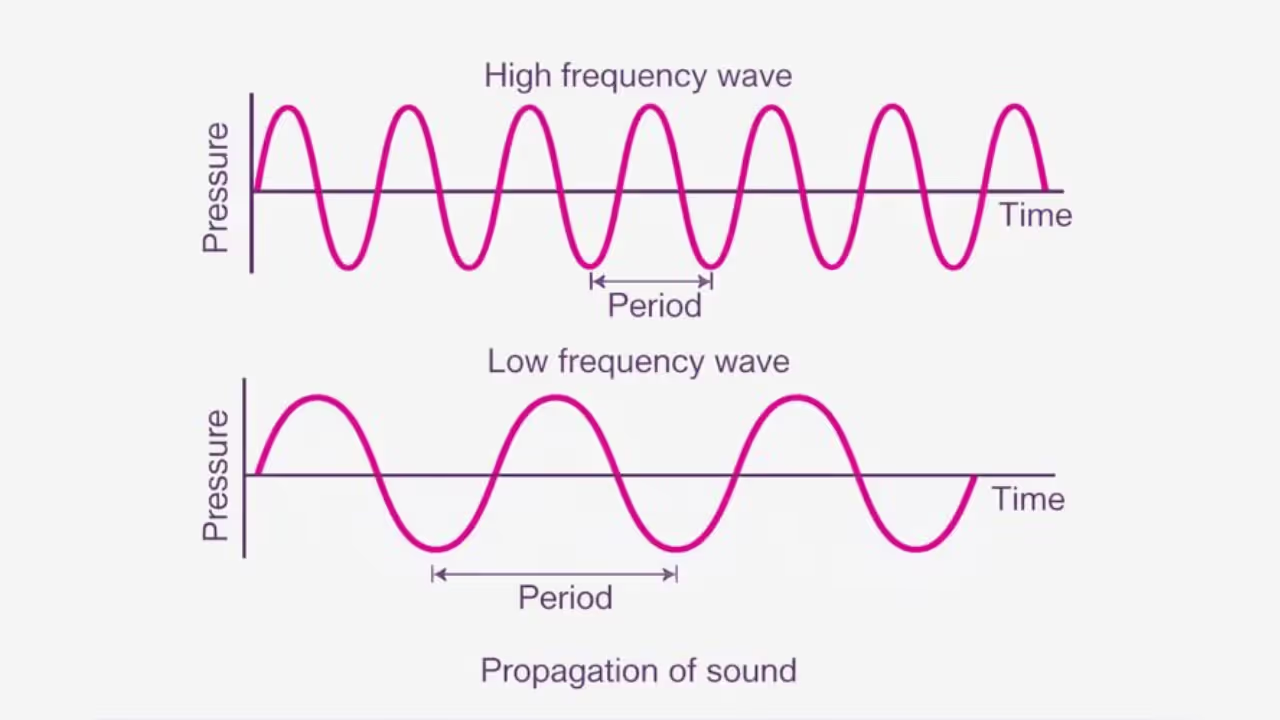
How Sound Travels
When an object vibrates, it pushes the particles of the medium (air, water, or solid). This creates two regions:
- Compression: where particles are close together (high pressure)
- Rarefaction: where particles are far apart (low pressure)
These compressions and rarefactions move forward as a wave and carry sound energy from one place to another.
Q. What type of Wave is a Sound Wave?
In sound waves, the particles move parallel to the direction of the wave. Such waves are called longitudinal waves.
Q. Why Sound Cannot Travel in Vacuum?
Sound needs particles to travel. In a vacuum, there are no particles to vibrate, so sound cannot travel in vacuum.
Characteristics of Sound
Sound has several important characteristics.
- Loudness: Depends on amplitude. Greater amplitude = louder sound.
- Pitch: Depends on frequency. High frequency = high pitch (e.g., woman’s voice), low frequency = low pitch (e.g., man’s voice).
- Quality (Timbre): Helps us distinguish different sounds even if loudness and pitch are the same.
Speed of Sound
The speed of sound depends on the medium through which it travels. It is fastest in solids, slower in liquids and slowest in gases.
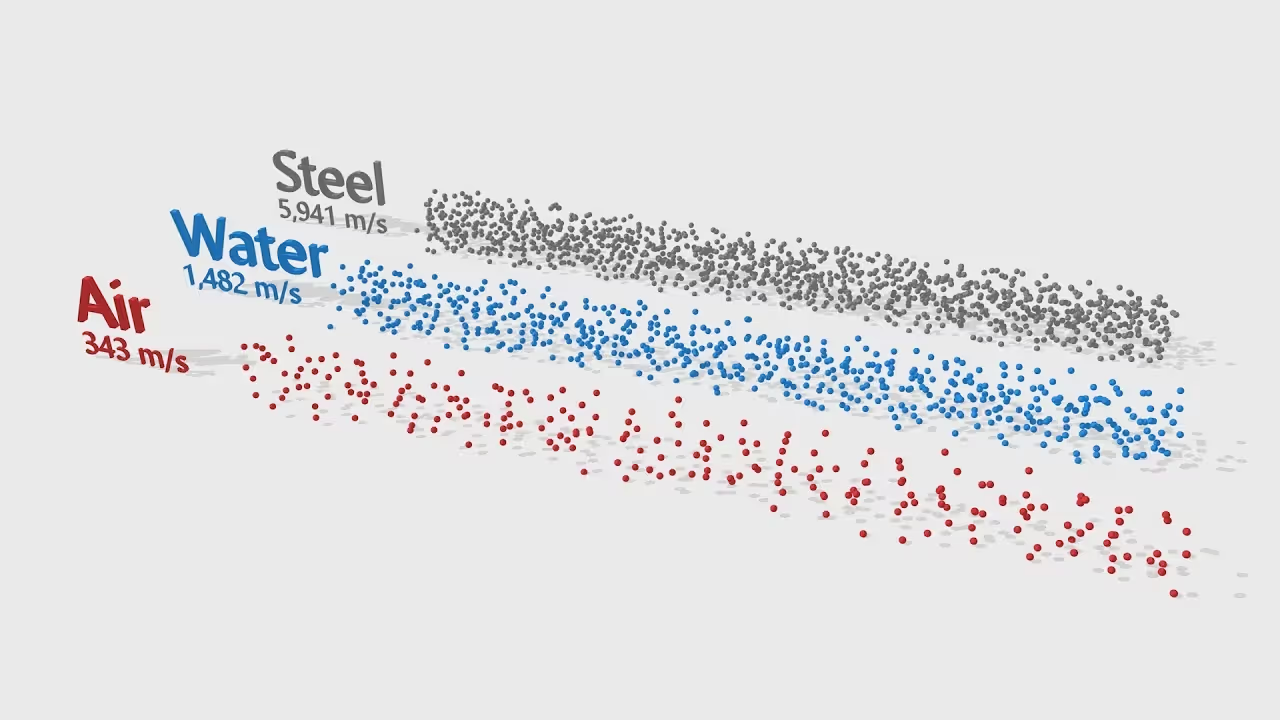
Speed of sound in:
- air = 343 m/s
- water = 1482 m/s
- solids like iron = 5960 m/s
Notes: Temperature also affects speed. Sound travels faster in warm air than in cold air. This is because particles move faster at higher temperatures, allowing vibrations to pass through more quickly. Sound travels fastest in solids, slower in liquids and slowest in gases.
Reflection of Sound
Just like light, sound also reflects when it hits a surface.
The laws of reflection for sound are the same as those for light: the angle of incidence is equal to the angle of reflection. This reflection is used in real life in designing auditoriums and concert halls to improve sound quality.
- Echo: Echo is the reflected sound that is heard after a short delay. It can be heard if the distance between the source and the reflecting surface is more than 17.2 meters and the sound returns in more than 0.1 seconds.
- Reverberation: It is when sound reflects many times in a closed space, making it last longer. Materials like carpets and curtains can reduce unwanted echoes. It is unwanted, so walls and ceilings are treated with sound-absorbing materials.
Range of Hearing
Humans can hear sounds only within a certain frequency range, known as the audible range, which is between 20 Hz and 20,000 Hz.
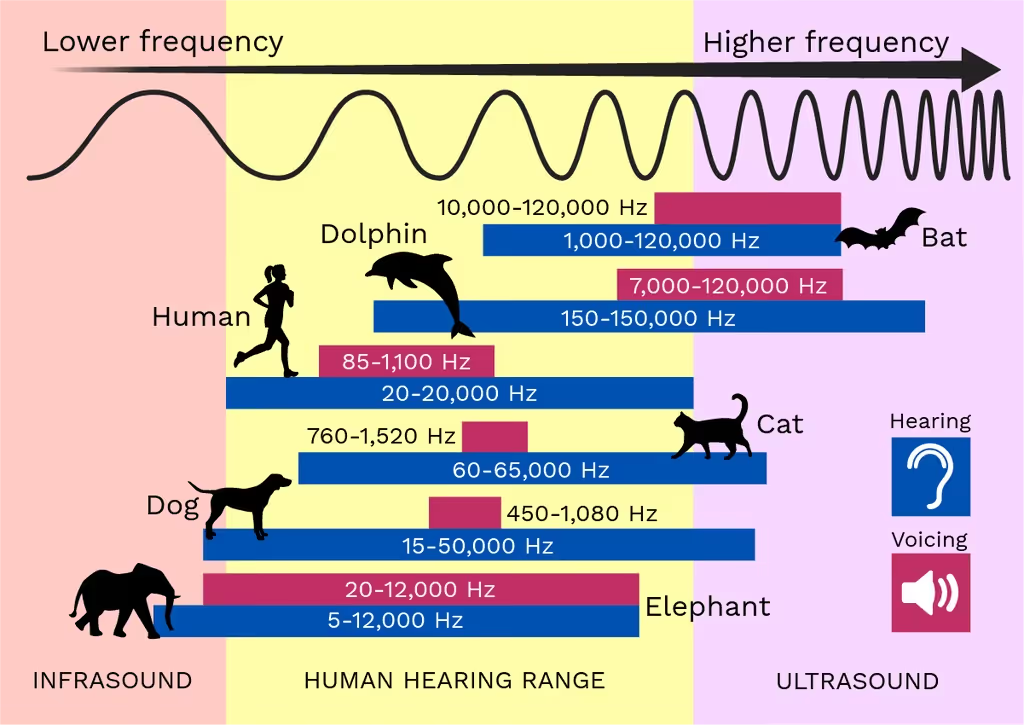
Sounds below 20 Hz are called infrasonic sounds and those above 20,000 Hz are called ultrasonic sounds.
Some animals like elephants can hear infrasonic sounds, while bats and dogs can hear ultrasonic sounds. Humans use devices to detect ultrasonic sounds for various purposes.
Uses of Ultrasound
Ultrasound has many useful applications in both medical and industrial fields.
- Used in sonography to view internal organs or a developing fetus
- Used to clean delicate objects like electronic parts or jewelry
- Used in industrial flaw detection (cracks in machines, pipes)
SONAR (Sound Navigation and Ranging)
SONAR is a technique that uses ultrasound to detect underwater objects. It works by sending out ultrasonic waves into water.
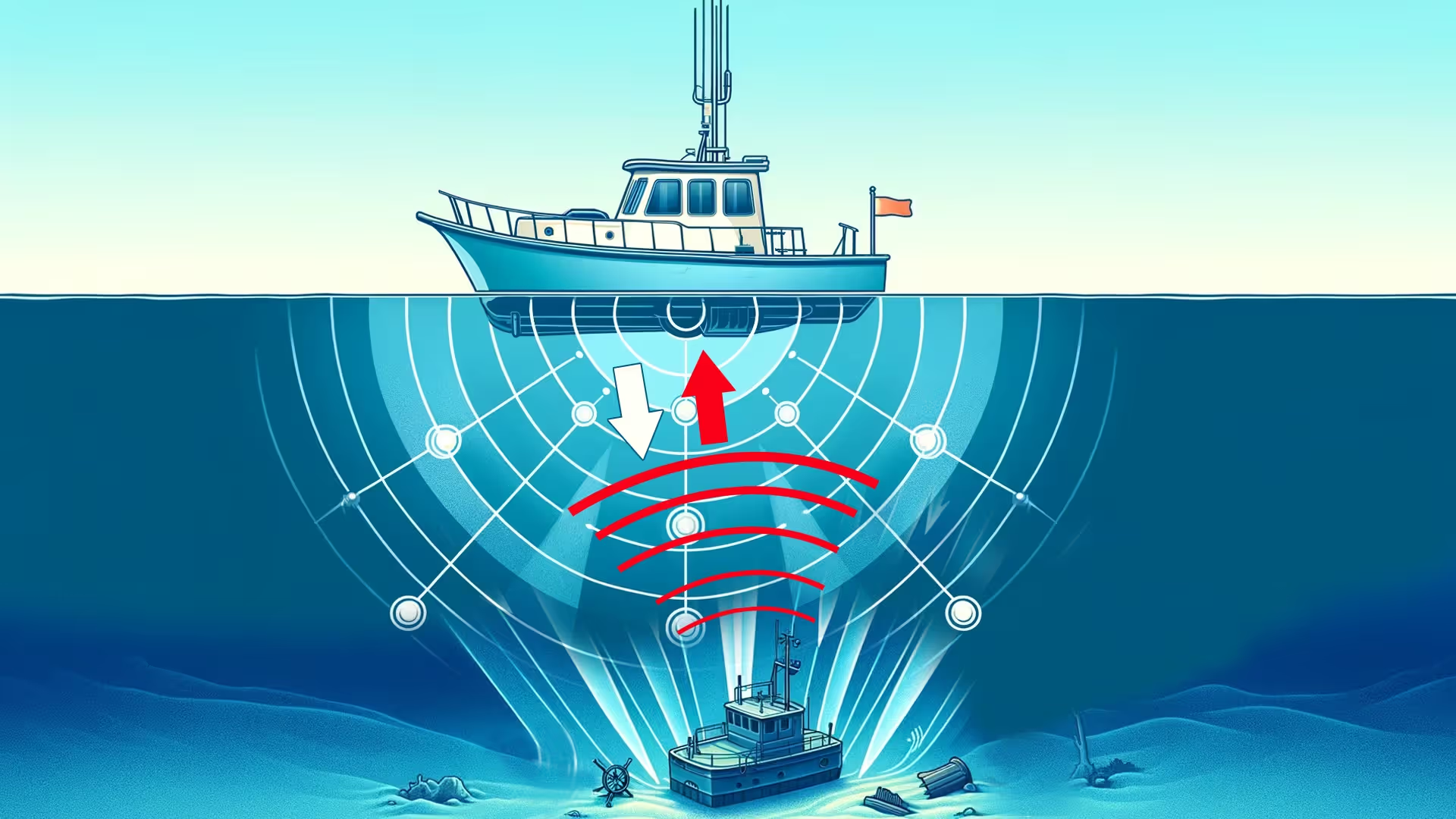
These waves hit an object and bounce back as echoes. By measuring the time taken for the echo to return, the distance of the object can be calculated using the formula:
Distance = (Speed × Time) / 2.
(Time is divided by 2 because sound travels to the object and back)
SONAR is used in submarines, ships and even by oceanographers to map the sea floor and detect fish or other obstacles under water.
Key Formulas to Remember:
- Speed of Sound (v) = Frequency (f) × Wavelength (λ)
- Time Period (T) = 1 / Frequency (f)
- Distance in SONAR = (Speed × Time) / 2
FAQs
Q1. What type of wave is sound?
Ans. Sound is a mechanical longitudinal wave where particles vibrate back and forth in the direction of wave travel.
Q2. What are compressions and rarefactions?
Ans. Compressions are the regions of high pressure where particles are close and rarefactions are regions of low pressure where particles are far apart.
Q3. What is the speed of sound in air?
Ans. At room temperature, the speed of sound in air is about 343 m/s.
Q4. What is the range of human hearing?
Ans. Humans can hear sounds between 20 Hz to 20,000 Hz.
Q5. What are ultrasonic and infrasonic sounds?
Ans. Ultrasonic sound is above 20,000 Hz (used in SONAR, medical scanning) and infrasonic sound is below 20 Hz (used by some animals for communication).












.svg)

