
.svg)
In this chapter, you will learn about balanced and unbalanced forces, Newton’s three laws of motion, momentum, and the law of conservation of momentum using simple examples and everyday situations.
These Forces And Laws Of Motion Notes from cbse class 9 science syllabus are written in clear, simple language and focus on helping you understand the concepts, not just memorize them. Each section of the chapter is broken down into short and easy explanations with key examples to help you grasp the topic better.

What Are Balanced & Unbalanced Forces?
Forces acting on an object can be classified as balanced or unbalanced based on their effect on the object’s motion.
Balanced Forces: When two or more forces act on a body and cancel each other out, the body does not move.
Effect: No change in the state of motion (no acceleration).
Example: A book resting on a table. The force of gravity is balanced by the normal force of the table.
Unbalanced Forces: When the forces acting on a body are not equal and opposite, they cause a change in the state of motion.
Effect: The object moves or changes speed/direction.
Example: Pushing a stationary car and making it move.
What is Newton’s First Law of Motion?
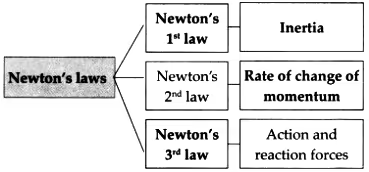
The law of motion, introduced by Galileo and later explained by Newton, states that an object remains at rest or continues moving with uniform velocity unless acted upon by an external force. This property is called inertia (tendency of an object to resist change in the state of motion or rest).
Types of Inertia:
- Inertia of Rest: Body stays at rest.
Example: A coin stays on a card when the card is flicked away quickly.
- Inertia of Motion: Body continues in motion.
Example: A passenger moves forward when a bus suddenly stops.
- Inertia of Direction: Body continues in the same direction.
Example: Sparks fly off a rotating wheel tangentially.
More mass = more inertia
What is Newton’s Second Law of Motion ?
The rate of change of momentum of an object is directly proportional to the applied force and takes place in the direction of the force.
Formula:
F = ma
Where:
- F = Force (in Newtons)
- m = Mass (in kg)
- a = Acceleration (in m/s²)
Momentum
Momentum (p) = mv
It is the product of mass and velocity.
- Unit: kg·m/s
- Vector quantity (has both magnitude and direction)
Derivation of F = ma
We know that, Force = change in momentum with change of time
Let initial momentum = mu
Final momentum = mv
∴ Change in momentum = mv - mu = m(v - u)
Rate of change of momentum = m(v−u) / t = m [(v−u) / t] = ma
∴ F = ma
Greater the force, greater the acceleration.
What is Newton’s Third Law of Motion ?
For every action, there is an equal and opposite reaction. These forces act on different objects, not on the same object.
Examples:
- A swimmer pushes water backward (action), and water pushes the swimmer forward (reaction).
- The gun recoils backward when a bullet is fired.
- A balloon flies in the opposite direction when the air rushes out.
Students can also refer to Class 9 Science NCERT Solutions to understand step-by-step answers to textbook questions related to Newton’s laws of motion.
What is The Law of Conservation of Momentum?
The total momentum of two objects before and after collision remains the same, provided no external force acts on them.
Formula
If two bodies collide:
- Initial total momentum = m1u1+m2u2
- Final total momentum = m1v1+m2v2
Then:
m1u1 + m2u2 = m1v1 + m2v2
To strengthen their understanding of numericals, students should practice Class 9 Science Important Questions based on force, inertia, and momentum.
Applications
This law is applied in many real-life situations where objects interact or collide.
• Recoil of a gun:
- Recoil of a gun - When a gun is fired, the bullet moves forward with high momentum. To conserve momentum, the gun moves backward (recoils) with an equal and opposite momentum.
- Rocket propulsion - A rocket moves forward by ejecting gases backward at high speed. The backward momentum of the gases is balanced by the forward momentum of the rocket.
- Collision between billiard balls - When one billiard ball strikes another, momentum is transferred from one ball to the other, but the total momentum of the system remains conserved.
These notes simplify important concepts from the Class 9 Science NCERT Book for better understanding.
Concept Clarification
Now these important conceptual pointers are vital to have a gold on the chapter well.
- Force is a push or pull that can change motion or shape. It is measured in Newton (N).
- Mass is measured in Kilogram (kg)
- Inertia is the resistance to change in motion
- Acceleration is the rate of change of velocity. It is measured in metres per second squared (m/s²)
- Momentum is the quantity of motion of a body. It is measured in kilogram metre per second (kg·m/s)
- External Force is a force applied from outside the system
Conclusion
That’s a wrap on this chapter. Force and Laws of Motion becomes easy once you understand the logic behind each law instead of memorising formulas. Hope this helped you revise better and feel more confident before exams. Share it with a friend if it helps
FAQs
Q1. What do we mean by inertia?
Ans. Inertia is the tendency of a body to resist changes in its state of rest or motion. This concept is explained in detail in the Class 9 Science NCERT Book, where different types of inertia such as inertia of rest, motion, and direction are discussed.
Q2. What is Newton’s Second Law of Motion?
Ans. Newton’s Second Law of Motion states that the force acting on a body is equal to the product of its mass and acceleration. Mathematically, it is expressed as F = ma. Students can practice related numerical problems using Class 9 Science Important Questions.
Q3. What is Newton’s Third Law of Motion?
Ans. Newton’s Third Law of Motion states that for every action, there is an equal and opposite reaction. This law explains many real-life situations such as walking, swimming, and the movement of rockets.
Q4. Why are seat belts important in vehicles?
Ans. Seat belts are important because they prevent passengers from moving forward suddenly due to inertia when a vehicle stops abruptly. This helps reduce injuries during sudden braking or accidents.
Q5. What is momentum?
Ans. Momentum is the product of the mass and velocity of a body and is represented by the formula p = mv. Understanding momentum is important for solving numerical problems in the chapter.
Q6. Where can I download the latest Class 9 Science Forces and Laws of Motion notes PDF?
Ans. Students can download the latest Class 9 Science Forces and Laws of Motion notes PDF from educational platforms like Educart. These notes follow the latest CBSE syllabus and include definitions, formulas, diagrams, and important questions for quick revision.
Q7. Are these Class 9 Forces and Laws of Motion notes based on the latest CBSE syllabus?
Ans. Yes, these notes are prepared according to the latest CBSE Class 9 Science Syllabus and cover all important topics such as inertia, momentum, and Newton’s three laws of motion.
Q8. How can students prepare the Forces and Laws of Motion chapter for exams?
Ans. Students can prepare this chapter by revising key concepts, learning formulas, and solving practice questions. It is also helpful to attempt Class 9 Science Question Bank and Previous Year Questions and practice Class 9 Science Practice Papers.
Q9. Where can I find notes for other Class 9 Science chapters?
Ans. Students can explore Class 9 Science Chapter-wise Notes to revise other chapters such as Motion, Gravitation, and Work & Energy in a simplified format.












.svg)

