
.svg)
Linear Inequalities extend the idea of linear equations by introducing comparison instead of equality. In real life, quantities are often restricted within limits; such as minimum marks, maximum capacity, budget limits or time constraints. These restrictions are mathematically represented using inequalities.

Inequalities and Their Symbols
An inequality is a statement involving two algebraic expressions connected by one of the following signs:
- Less than (<)
- Greater than (>)
- Less than or equal to (≤)
- Greater than or equal to (≥)
Example:
- x > 3, means x takes all values greater than 3.
- 2x + 5 ≤ 11, means all values of xx which satisfy this condition.
Properties of Inequalities
Inequalities follow rules similar to equations, but with special care when multiplying or dividing by a negative number.
1. Addition/ Subtraction Rule
- If a < b, then a + c < b + c
- If a > b, then a - c > b - c
2. Multiplication/ Division Rule
- If a < b and c > 0, then ac < bc
- If a < b and c < 0, then ac > bc (inequality sign reverses)
Example:
- If 2x < 6, dividing by 2 (positive), we get x < 3.
- If − 2x < 6, dividing by − 2 (negative), we get x > –3.
Linear Inequalities in One Variable
A linear inequality in one variable is an inequality which involves a linear expression in a single variable.
General form, where a, b are real numbers and a ≠ 0.
- ax + b < 0
- ax + b ≤ 0
- ax + b > 0
- ax + b ≥ 0
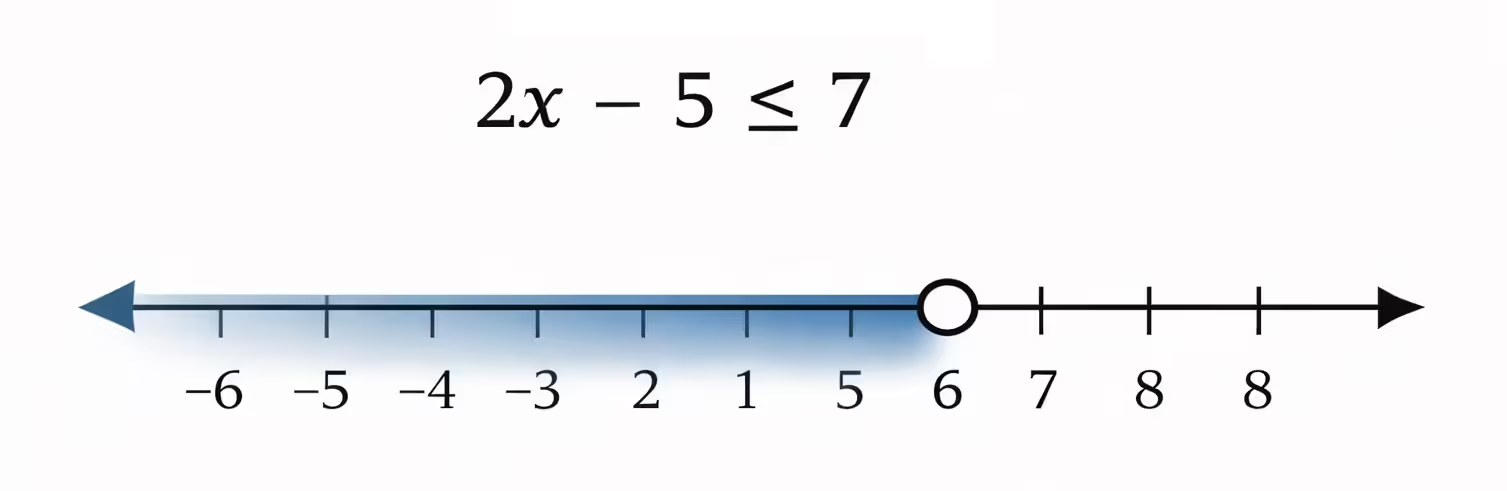
Example: Solve 2x − 5 ≤ 7
⇒ 2x ≤ 12
⇒ x ≤ 6
Thus, the solution set is all real numbers less than or equal to 6.
Solutions of Linear Inequalities in One Variable
The solution set of an inequality is the collection of all real numbers which satisfy the given inequality.
- For x > 2, the solution is (2,∞).
- For x ≤ − 1, the solution is ( − ∞, − 1].
These can also be represented on a number line.
- Open circle for strict inequality (<, >).
- Closed circle for inclusive inequality (≤, ≥).
Linear Inequalities in Two Variables
A linear inequality in two variables is an inequality which involves a linear expression in two variables. The solution is a region in the Cartesian plane.
General form, where a, b, c are real numbers and at least one of a,ba, b is non-zero.
- ax + by + c < 0
- ax + by + c ≤ 0
- ax + by + c > 0
- ax + by + c ≥ 0
Example: 2x + 3y ≤ 6
Graphical Representation
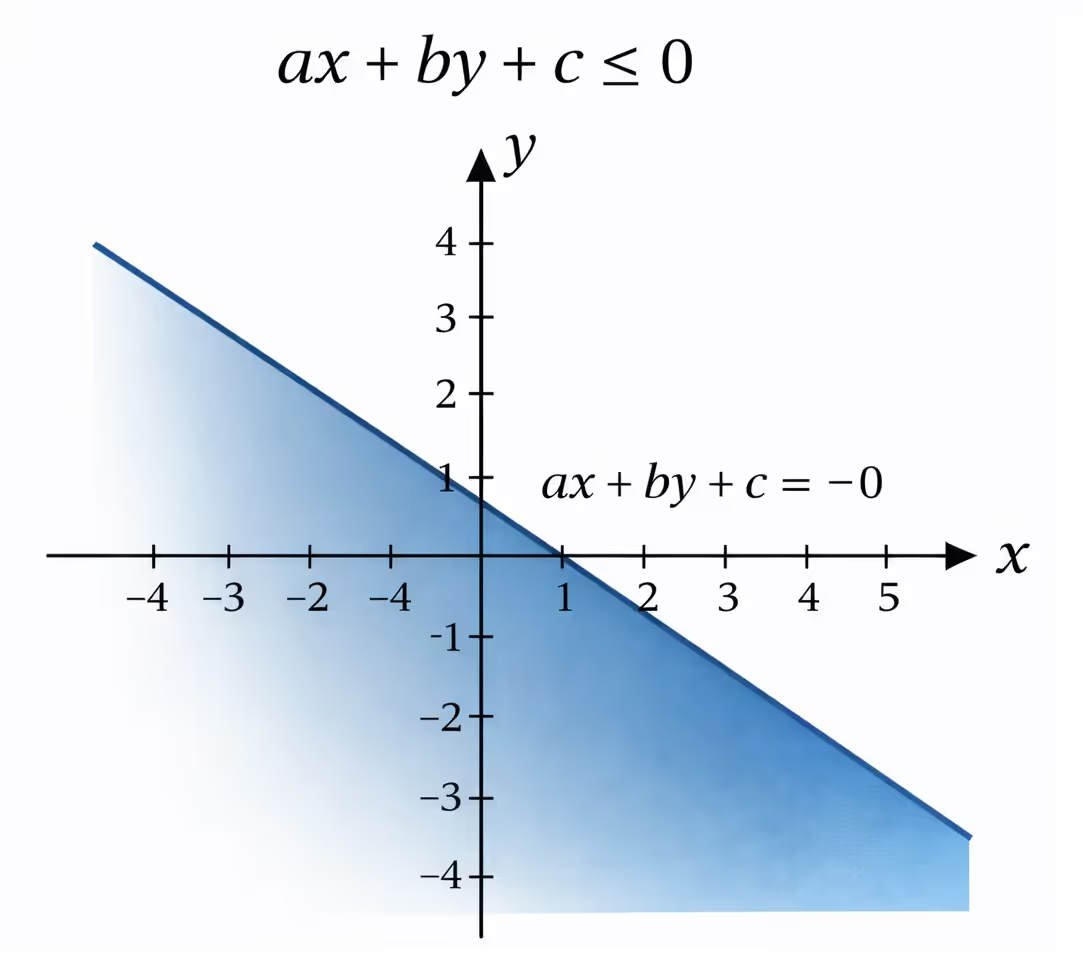
To represent ax + by + c ≤ 0 on the Cartesian plane:
- Write the related equation ax + by + c = 0. This represents a straight line.
- Plot the line:
- If the inequality is strict (< or >), draw a dashed line.
- If the inequality is inclusive (≤ or ≥), draw a solid line.
- Select a test point (usually origin (0,0)) to check which side of the line satisfies the inequality.
- Shade the region representing the solution.
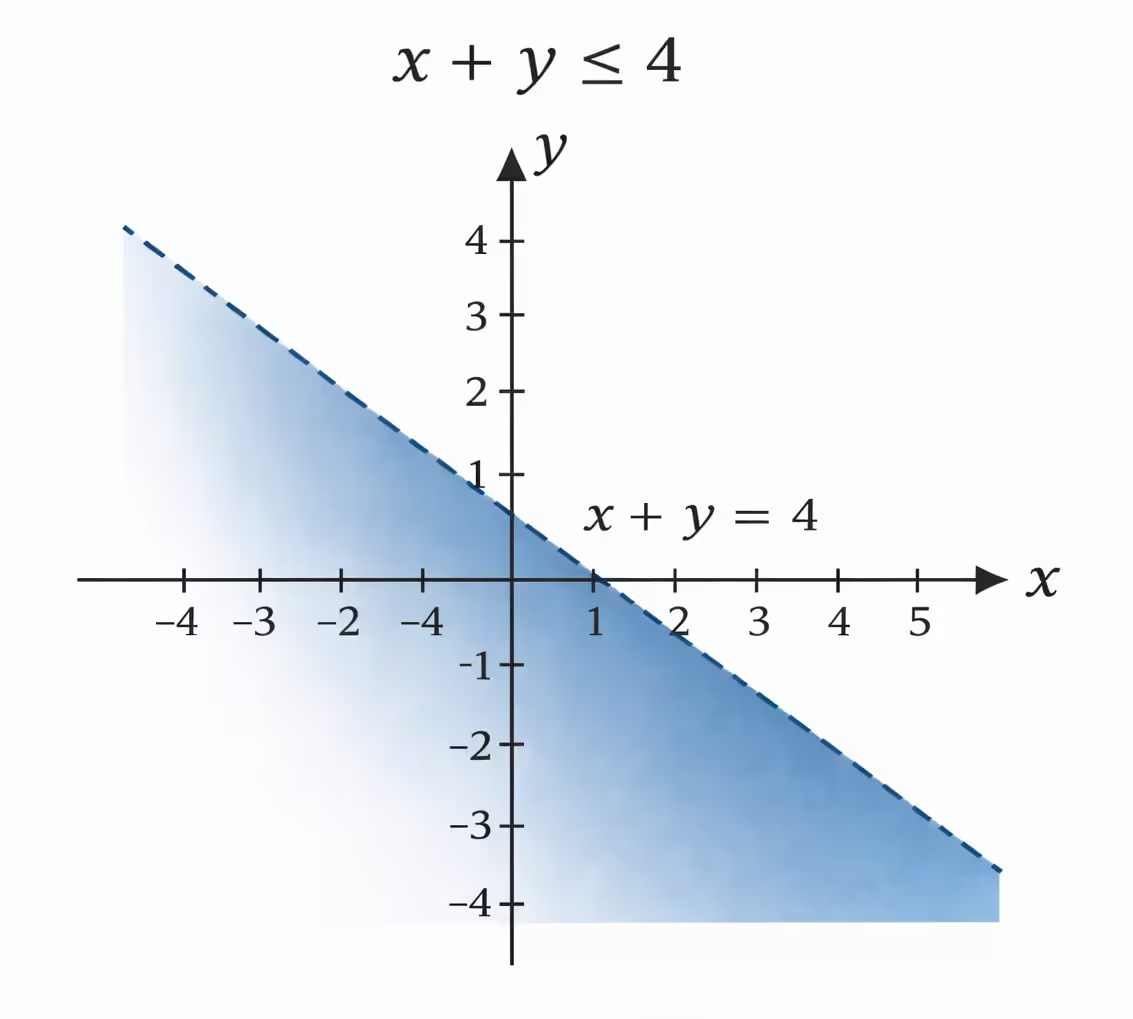
Example: For x + y ≤ 4, draw the line x + y = 4. Substituting (0,0), we get 0 + 0 ≤ 4, which is true, so the region including the origin is shaded.
Solution of a System of Linear Inequalities in Two Variables
Many practical problems involve more than one condition. The solution set of such problems is the intersection region common to all inequalities.
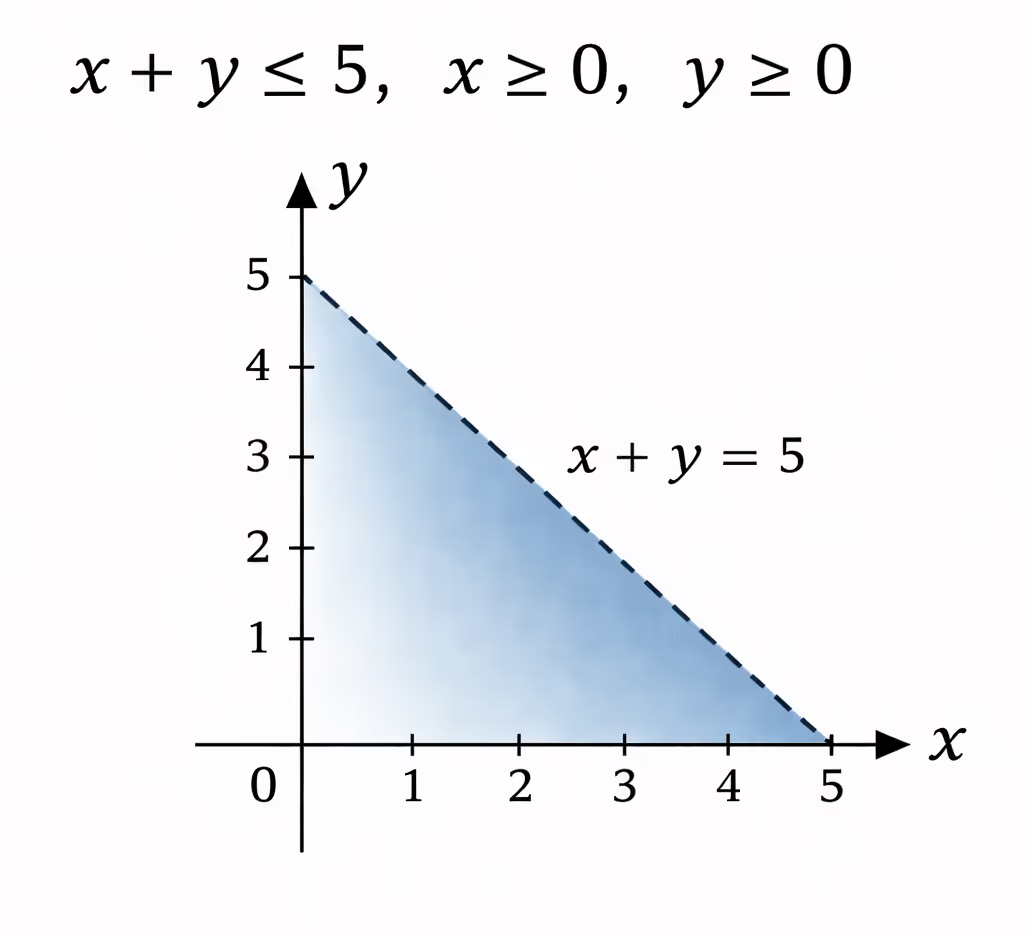
Example: Solve x + y ≤ 5, x ≥ 0, y ≥ 0
- Draw line x + y = 5.
- Take the region below it (since ≤).
- Restrict to the first quadrant (since x, y ≥ 0).
- The shaded triangular region is the solution set.
Applications of Linear Inequalities
Linear inequalities are mathematical models used to solve real-world problems involving constraints, limits, and optimization, rather than exact equalities. They are used for:
- Budget constraints
- Production limits
- Time management
- Resource allocation
- Capacity restrictions
Conclusion
Linear Inequalities help represent restrictions and ranges mathematically. While one-variable inequalities give interval solutions on number lines, two-variable inequalities represent regions on graphs.
FAQs
Q1. What is the difference between equation and inequality?
Ans. An equation shows equality (=), while an inequality shows comparison (<, >, ≤, ≥).
Q2. When does inequality sign reverse?
Ans. It reverses only when both sides are multiplied or divided by a negative number.
Q3. Why do we use dashed lines in graphs?
Ans. Dashed lines represent strict inequalities (< or >), meaning boundary line is not included.
Q4. What is the solution of a linear inequality in two variables?
Ans. It is a region of the plane containing all ordered pairs satisfying the inequality.
Q5. What is a feasible region?
Ans. The common region satisfying all inequalities in a system is called the feasible region.












.svg)

