
.svg)
The Common University Entrance Test (CUET) 2026 is being conducted by the National Testing Agency (NTA) for admission to undergraduate programs across participating universities in India.
The examination is conducted in Computer-Based Test (CBT) mode across 306 cities in India and 15 international locations. The National Testing Agency administers the exam annually, making it one of the most important UG entrance examinations in the country.
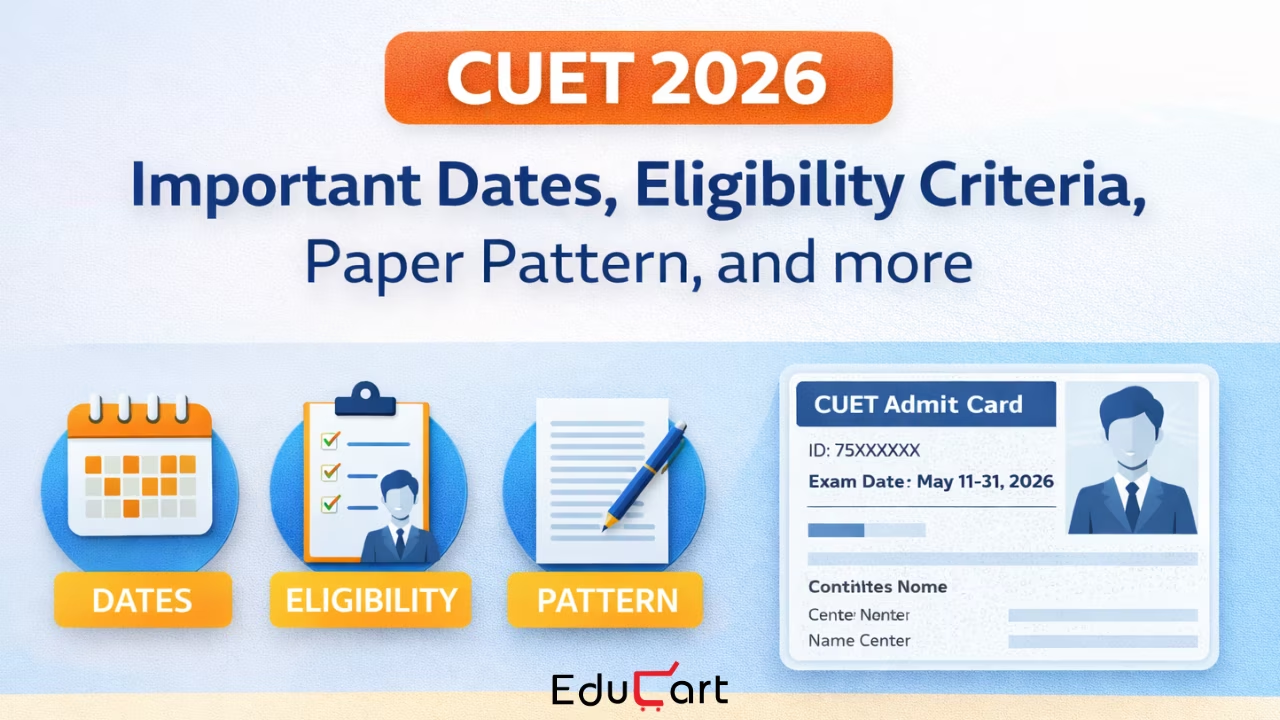
All latest CUET 2026 updates are given below, including exam dates, eligibility requirements, exam pattern, and preparation strategies.
CUET 2026 Examination Schedule - Important Information
Candidates are advised to regularly monitor cuet.nta.nic.in for confirmed dates and any updates.
Important Changes in CUET 2026
The University Grants Commission has implemented several modifications for the 2026 examination cycle to increase flexibility and streamline the process.
- Subject Selection Flexibility: Students are no longer restricted to choosing subjects based on their Class 12 syllabus. Candidates may select any subject combination regardless of their previous academic specialization.
- Streamlined Subject Options: The total number of available subjects has been reduced from 63 to 37. <red>Subjects such as Entrepreneurship, Teaching Aptitude, and Legal Studies have been discontinued.<red> Admissions for programs related to these subjects will now be based on General Aptitude Test scores.
- Uniform Test Duration: All subject papers now follow a standardized 60-minute format.
- All Questions Compulsory: All 50 questions in every paper are now mandatory. The earlier system of attempting 40 out of 50 has been removed.
- Exclusive CBT Mode: The examination will be conducted solely through computer-based testing. No paper-based or OMR option is available.
- Maximum 5 Subjects: Candidates can select a maximum of 5 subjects in total, with at least one being a language paper.
What are the Eligibility Criteria for CUET 2026?
Students need to know and understand the eligibility criteria for CUET before Here is a consolidated list of all the terms:
1. Academic Qualifications: Candidates must have successfully completed their Class 12 examination or equivalent from a recognized educational board. Students currently appearing for Class 12 in 2026 are also eligible to apply.
The examination accepts candidates from all academic streams - Science, Commerce, and Humanities. However, individual universities may require specific subject combinations or minimum marks for particular programs.
2. Age Specifications: NTA has not imposed any age restriction for CUET 2026. However, specific universities may enforce their own age criteria for certain courses.
3. Nationality Criteria: Indian nationals are eligible to apply. Additionally, Non-Resident Indians (NRIs), Overseas Citizens of India (OCIs), and Persons of Indian Origin (PIOs) may also register.
4. Minimum Percentage Requirements: CUET itself does not mandate a minimum percentage. However, most participating universities require at least 50% marks in Class 12 (45% for SC/ ST/ OBC candidates). Verify specific criteria with your target university.
5. Reservation Policy: The examination follows Government of India reservation norms:
- OBC-NCL: 27% reservation
- Scheduled Caste (SC): 15% reservation
- Scheduled Tribe (ST): 7.5% reservation
- Economically Weaker Section (EWS): 10% reservation
- Persons with Disabilities (PwD): 5% reservation


Examination Fee Structure
<red>The registration window is now CLOSED.<red>
Given below is the official fee structure for CUET 2026. Payment was accepted through credit/ debit cards, net banking, and UPI.
CUET 2026 Examination Structure
i) Section I: Languages
Candidates must select one language from 13 available options: English, Hindi, Bengali, Assamese, Odia, Punjabi, Marathi, Gujarati, Malayalam, Tamil, Telugu, Kannada, and Urdu.
- Total Questions: 50 (all compulsory)
- Time Allotted: 60 minutes
ii) Section II: Domain-Specific Subjects
Candidates may choose up to 4 domain subjects from 23 available options including Physics, Chemistry, Biology, Mathematics, Accountancy, Business Studies, Economics, History, Geography, Political Science, Psychology, Sociology, and others.
- Total Questions per Subject: 50 (all compulsory)
- Time Allotted per Subject: 60 minutes
iii) Section III: General Aptitude Test (GAT)
This section assesses General Knowledge, Current Affairs, Quantitative Aptitude, Logical Reasoning, and Analytical Ability. The math component is based on the Class 8 level curriculum.
- Total Questions: 50 (all compulsory)
- Time Allotted: 60 minutes
iv) Marking Scheme
- Correct Response: +5 marks
- Incorrect Response: −1 mark (negative marking applicable)
- Unanswered Questions: 0 marks
- Disputed Questions: Full marks awarded if question is dropped or all options are deemed correct
CUET 2026 Syllabus Overview
Here’s just an overview for your knowledge. For a full subject-wise topics list you may visit CUET UG syllabus 2026.
1. Language Section
Tests reading comprehension, vocabulary, and grammar at Class 12 level:
- Comprehension of factual, literary, and narrative passages
- Vocabulary (synonyms, antonyms, word meanings)
- Sentence formation and grammar
2. Domain Subject Syllabus
Totally based on NCERT Class 12 Syllabus:
- Physics: Electrostatics, Current Electricity, Magnetism, Optics, Modern Physics
- Chemistry: Physical, Organic, and Inorganic Chemistry
- Mathematics: Calculus, Algebra, Vectors, Probability
- Accountancy: Financial statements, Partnership accounts, Company accounts
- History: Themes in Indian History (Parts I, II, and III)
3. General Aptitude Test (GAT) Syllabus:
- General Knowledge and Current Affairs (October 2025 onwards)
- Mental and Analytical Ability
- Quantitative Aptitude (up to Class 8 level)
- Logical and Analytical Reasoning
Admit Card and Test Center Information
The CUET 2026 admit card will be released in the first week of May 2026, approx. 3-4 days before the exam. Before that, NTA will release an Exam City Intimation Slip in the first week of April 2026.
- To Download: Visit cuet.nta.nic.in, enter your application number and date of birth, then download and print your admit card.
- What It Contains: Candidate details, photograph, exam date and shift, test center address, and examination instructions.
- Required on Exam Day: Printed admit card and valid photo ID (Aadhaar, Passport, Driving License, School ID, or PAN Card). Arrive one hour before reporting time.
- Test Locations: CUET 2026 will be held across 306 cities in India and 15 international locations.
Post-Examination Process
1. Provisional Answer Key: NTA releases the provisional answer key within 2–3 weeks of the exam. Candidates can challenge it by:
- Logging into the official portal during the challenge window
- Selecting the question(s) to be challenged
- Providing supporting documentation
- Paying the non-refundable challenge fee per question
If a challenge is accepted, the fee is refunded. The final answer key reflects all accepted modifications.
2. Result Declaration: CUET 2026 results are expected in late June/ early July 2026. To check your result:
- Visit NTA official site
- Click on the result link
- Enter your application number and date of birth
- Download your scorecard
Important Reminders
1. Registration is Closed: The CUET UG 2026 application window closed on February 26, 2026. No further extension will be provided. Registered candidates should verify their details at cuet.nta.nic.in.
2. Maintain Application Records: Keep copies of your application confirmation, fee payment receipt, and all NTA correspondence. Print multiple copies of your admit card when it releases.
3. Beware of Misinformation: Only trust NTA’s site for official updates.
4. Technical Preparedness: Practice on NTA's official CBT mock test interface. Get comfortable with on-screen reading and navigation before exam day.
5. Health and Well-being: With roughly 7 weeks to the exam, maintain a study routine with adequate sleep, regular breaks, a healthy diet, and stress management.
Preparation Strategy for CUET 2026
- NCERT is Everything: Domain subject questions are almost entirely NCERT Class 12 based. Cover every chapter, no skipping.
- All 50 Questions Are Compulsory: Unlike previous years, there is no choice. Prepare all topics in each subject thoroughly.
- General Aptitude Test: Focus on current affairs from October 2025 onwards, revise Class 6-8 math, and practice logical reasoning daily.
- Language Skills: Practice reading comprehension passages and build vocabulary systematically using newspapers and previous year papers.
- Mock Tests: Attempt full-length CUET mock tests under timed conditions weekly. Analyze weak areas and improve time management.
- Revision: Create short notes with formulas, key dates, and important concepts. Plan at least two full revision cycles before May.
- Exam Strategy: With all 50 questions compulsory and only 60 minutes per paper, time management is most important. Never leave questions unanswered.
Frequently Asked Questions
1. Is CUET UG 2026 registration still open?
Ans. No, the registrations closed on February 26, 2026. No further extension has been announced. Students who missed the deadline cannot apply for this cycle.
2. What are the confirmed CUET UG 2026 exam dates?
Ans. NTA has officially announced dates for CUET 2026 as May 11-31, 2026 in CBT mode only. The subject-wise datesheet is expected by the end of March or early April 2026.
3. When will the CUET UG 2026 admit card be released?
Ans. In the first week of May 2026. Before that, an Exam City Intimation Slip will be released in the first week of April 2026. Keep checking cuet.nta.nic.in.
4. Are all 50 questions compulsory in CUET UG 2026?
Ans. Yes. All 50 questions in every paper are now mandatory. The earlier format of attempting 40 out of 50 no longer applies.
5. What is the marking scheme for CUET UG 2026?
Ans. The marking scheme for CUET UG 2026 is +5 marks for every correct answer, −1 mark for every incorrect answer, and 0 marks for unattempted questions.
6. How many subjects can I choose in CUET UG 2026?
Ans. A maximum of 5 subjects in total, at least one language from Section I, up to 4 domain subjects from Section II, and optionally the General Aptitude Test.
7. What subjects have been removed in CUET 2026?
Ans. The deleted subjects for CUET 2026 are Entrepreneurship, Teaching Aptitude, Legal Studies, and others have been discontinued. Total papers reduced from 63 to 37.
8. What is the CUET UG 2026 application fee?
Ans. The CUET 2026 admission fee is ₹1,000 (General), ₹900 (OBC-NCL/ EWS), ₹800 (SC/ ST/ PwD/ Others), and ₹4,500 (International centers).
9. Is there any age limit for CUET UG 2026?
Ans. No, the NTA has not set any age limit. Individual universities may have their own criteria for specific programs.
10. How many universities accept CUET UG 2026 scores?
Ans. There are approx. 240 universities who accept CUET UG scores - central, state, deemed, and private including DU, BHU, JNU, and Jamia Millia Islamia.
11. What should I do if I made an error in my CUET 2026 application?
Ans. The correction window (February 9-11, 2026) is now closed. For urgent discrepancies, contact NTA at their helpline numbers or mail them at their official ID.
12. What must I carry to the exam center?
Ans. Things students should carry positively at the exam center are: Printed admit card, valid photo ID (Aadhaar, Passport, PAN Card, Driving License, or School ID), and a passport-size photograph matching your admit card. Arrive one hour before your shift's reporting time.
13. What is the CUET 2026 syllabus based on?
Ans. Domain subjects follow NCERT Class 12 Syllabus. The Language section tests comprehension, vocabulary, and grammar. The GAT covers current affairs from October 2025 onwards, logical reasoning, and Class 8 level quantitative aptitude.
14. What is the difference between CUET UG and CUET PG?
Ans. CUET UG is for undergraduate admissions (Class 12 pass-outs); CUET PG is for postgraduate admissions after graduation. Both are by NTA but have separate portals, schedules, and patterns. CUET PG 2026 exams will be held in March 2026.
Glimpse of the Event
Share Article


.svg)


%20(1).avif)
.avif)









.svg)

