.svg)
How National Education Policy (NEP) will Transform Indian Education System
On December 30th 2022, the New Education Policy (NEP), which aspires to embrace education from pre-school to secondary school, was approved by the Union cabinet in July 2020. NEP-2020, is a comprehensive framework that covers all levels of education from elementary to higher education in the country. It replaced the education policy made in 1986.
National Education Policy 2020
The National Education Policy 2020 is the first education policy of the 21st century which aims to create a new system which is aligned with the goals of 21st century and SDG4.
Global Education Development Agenda (Goal 4) seeks an inclusive and equitable quality education and promotes lifelong learning opportunities for all by 2030.
It emphasises the creative development of each individual including vocational and technical education. However, it also ensures that not only cognitive capacities but all these skills will also include:
- Foundational capacities of literacy and numeracy
- Higher-order cognitive capacities, such as critical thinking and problem solving
- Social, ethical, and emotional capacities and dispositions
The teacher should be in the centre of the fundamental reforms in the education system. The new education policy helps in re-establishing teachers at all levels, because they truly shape the future of our next generations. In the given table below, check all the basic details regarding NEP 2020.
Vision of National Education Policy
The National Education Policy envision a education system which is:
- rooted in Indian ethos that contributes directly to transforming India;
- sustainable into an equitable and vibrant knowledge society and provide high-quality education to all;
- envisaging curriculum and pedagogy of our institutions must develop among the students a deep sense of respect towards the Fundamental Duties and Constitutional values;
- bonding with one’s country, and a conscious awareness of one’s roles and responsibilities in a changing world; and
- instilling a deep-rooted pride in being Indian among the learners, not only in thought, but also in spirit, intellect, and deeds, as well as to develop knowledge, skills, values, and dispositions that support responsible commitment to human rights, sustainable development and living, and global well-being, thereby reflecting a truly global citizen.
Difference Between Existing and New Academic Structure
After 34 years the education policy was launched in 2020. Many changes were brought in pedagogies and curriculum. The major changes were around 23, and some of the them are given below:
- Education in early childhood care
- Education for ST, SC, OBC
- Technical and management Education
- Sports, physical education and youth
- Management of education
- Teacher and training
.avif)
The focus of the education policy is to prepare students as a quality product not as a factory output. This will be totally based on experiential learning, students can choose different fields to study in a particular field or do some research work. Check all the differences between National Policy of Education (NPE) 1986 and National Education Policy (NEP) 2020.
Difference between National Policy of Education (NPE) (1986) and National Education Policy (NEP) (2020)
New Changes in National Education Policy (NEP 2023)
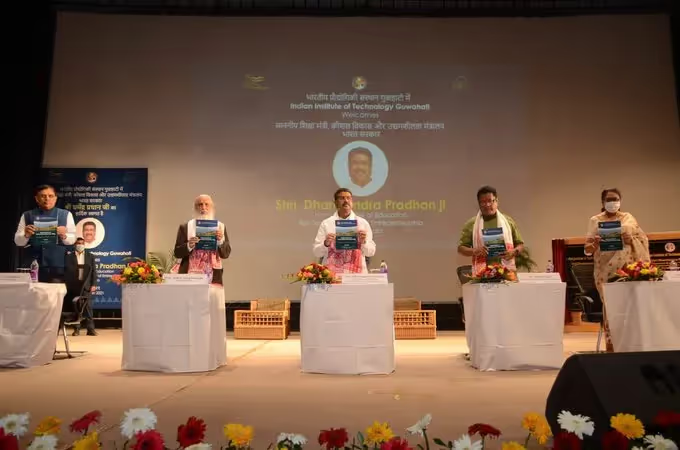
In a program jointly organised by Indian Council of Historical Research (ICHR) and RSS-affiliated Akhil Bharatiya Itihas Sankalan Yojana, the Union Education Minister Dharmendra Pradhan announced that from January 26th, 2023 (also Vasant Panchami), the new “corrected’ syllabus of history will be implemented across all schools.
It will be very helpful to increase the use of our mother tongue rather than English. When NEP 2020 was introduced, schools started following it on a smaller level and with time, it has worked out well.
On December 28th, Parliament recommended four sacred texts (Vedas) and Bhagavad Gita to be a part of corrected history under NEP 2020. They also suggested that the contribution of many unsung heroes, especially from the North-East, should also be incorporated equally in NCERT textbooks.
National Education Policy Outcomes
The expected outcomes from NEP are to:
- Universalisation of access from ECCE to Secondary education.
- Ensure equity and inclusion in schools as well as in classrooms
- Improve quality and achievement of Learning Outcomes through using Foundational Literacy & Numeracy
(FLN) - Focused on 21st century skills in teaching, learning and assessment.
- Common standards for public and private schools.
Structure of National Education Policy
New Transforming Curricular & Pedagogical Structure of School Education (5+3+3+4):3 years in Anganwadi/pre-school and 12 years in school is explained below. The current existing academic structure 10+2 are now revised to 5+3+3+4.
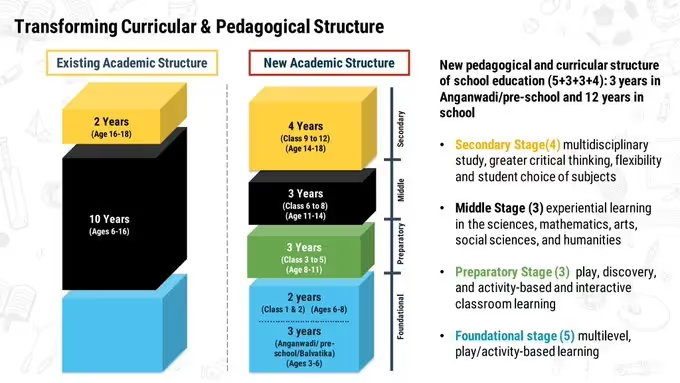
According to the New pedagogical and curricular structure of school education (5+3+3+4)
- Foundational Stage
The starting 5 years are divided into two parts. This stage is called the Foundational stage. In starting years (age 3 to 6 years), children spend time in Anganwadi/ Pre-school/ Balvatika. At (Age of 6-8) children spend their time in Grade 1 & 2.
- Preparatory Stage
The next stage is the Preparatory stage. This stage is for 3 years. Under this stage children are now cover grade 3 to 5 and their age should be 6 to 11.
In this stage, the different pedagogy which a teacher can use in the teaching learning process are play-way method, discovery, activity based and interactive classroom learning.
- Middle Stage
Coming on to the next stage is the Middle stage . Which is also for 3 years. In this students are now at grade 6 to 8 and their age group should be 11 to 14. During this stage, educators should follow the following pedagogy in their teaching learning process.
Experiential learning in the Sciences, Mathematics, Social Science and Humanities.
- Secondary Stage
The last is the Secondary stage. This stage is for 4 years which cover grade 9 to 12. At this point the students must be 14 to 18 years of age.
The correct pedagogy for this stage is teaching with multidisciplinary studies, critical thinking, flexibility and students choice of subject.
Conclusion
The NEP 2020 is a revolutionary policy, which aims to transform India into a vibrant knowledge society and global knowledge superpower by making both school and college education more holistic, flexible, multi-disciplinary, suited to 21st century needs and aimed at bringing out the unique capabilities of each student.

Glimpse of the Event

Share Article


.svg)




%2520(1).avif)
























.svg)

