
.svg)

The chapter Introduction to Trigonometry is one of the most significant and high-weightage topics in Class 10 Mathematics Syllabus. It introduces you to the study of relationships between the angles and sides of a right-angled triangle.
This chapter focuses on defining trigonometric ratios of acute angles, understanding their relationships, and using them to solve various types of questions. The Introduction to Trigonometry Important Questions for Class 10 Mathematics help you:
- Understand trigonometric ratios, identities, and complementary angles.
- Practice simplification and evaluation of trigonometric expressions.
- Gain confidence to solve exam-based problems quickly and accurately
IMPORTANT QUESTIONS CLASS 10
(Most Important Questions of this Chapter from our 📕)
In the table below, we have provided the links to downloadable Important Questions for Class 10 Maths Trigonometry with Solutions PDFs. Now you can download them without requiring a login.
Class 10 Ch8 Introduction to Trigonometry Important Questions Maths 2026
1. If cos y = 0, then what is the value of ½ cos y/2?
- 0
- ½
- 1/√2
- 1/2√2
Soln. d) 1/2√2
Explanation:
cos y = 0
let y= π/2 + kπ where k is an integer
Substitute y= π/2 + kπ in ½ cos y/2
= ½ cos (π/2 + kπ)/2
= ½ cos (π/4) + (kπ/2)
put k=0
= ½ cos (π/4) + ((0)π/2)
= ½ cos (π/4)
= ½ . 1/√2
=1/2√2
2. Show that sinθ = cos (90-θ ) is true using the definition of trigonometric ratios.
.avif)
Soln. ∠PQR = 90°
∠QRP = 90°- θ
the sum of angles in a triangle is 180 and one angle is 90°
sin θ = PQ/PR
sin θ = ⅘
cos(90°- θ) = QP/PR
cos(90°- θ) = ⅘
(In the right triangle, the side opposite to θ is the same as the side adjacent to 90°−θ. Therefore, sin(θ)=cos(90°−θ).
Hence, sin(θ)=cos(90°−θ) is true
3. In the triangles shown below, ∠Q = ∠T.
.avif)
Write an expression each for cos Q and sin T.
Soln. In △PQR
The side adjacent to ∠Q is r, and the hypotenuse is p.
cosQ=r/p
In △TUS:
sinT=t/s
4. A unit circle is shown below with centre O. A tangent AB is drawn to the circle at point M such that ∠MOB = β.
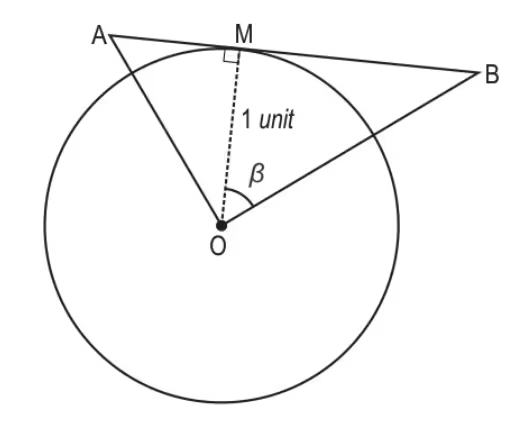
(Note: The figure is not to scale.)
If OA ⊥ OB, write the expressions that represent the lengths of
i) OB
ii) OA
iii) AB
Soln.
i) OB
The unit circle has a radius of 1 unit, centered at O.
AB is a tangent at point M.
∠MOB=β
OA is perpendicular to OB
Length of OB:
In the right triangle △OMB:
- The hypotenuse is OB.
- The radius OM=1 is the adjacent side.
cosβ = OM/OB
OB = 1/cosβ
ii) OA
In the right triangle △OMA
The hypotenuse is OAOAOA.
The radius OM=1 is the opposite side.
Length of OA:
sinβ = OM/OA
OA = 1/sinβ
iii) AB
In the right triangle △OAB
∠AOB=90°
By the Pythagorean theorem:
AB2=OA2+OB2
Substituting OA=1/sinβ and OB = 1/cosβ
AB2=(1/sinβ)2+(1/cosβ)2
AB2=(1/sin2β)+(1/cos2β)
AB2=(sin2β+cos2β)/(sin2β.cos2β)
Using the Pythagorean identity (sin2β+cos2β)= 1
AB2=1/(sin2β.cos2β)
AB=1/(sinβ.cosβ)
AB=2/(sin2β)
5. In the figure below, 5sin P = 4.
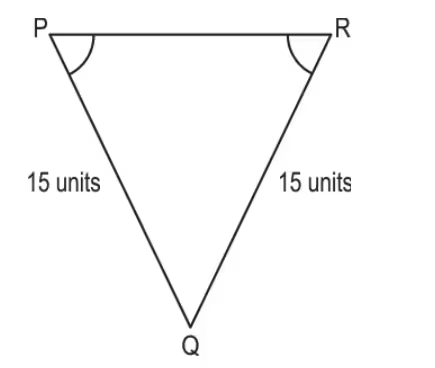
(Note: The figure is not to scale.)
What is the length of PR? Draw a diagram and show your steps.
Soln. In △PQR
PQ=QR=15 units.
We need to find the length of PR.
5sinP=4
sinP= ⅘
In △PQR, the Law of Cosines states:
PR2=PQ2+QR2−2⋅PQ⋅QR⋅cosP.
Substitute PQ=QR=15
PR2=152+152−2⋅15⋅15⋅cosP.
Use the Pythagorean identity:
sin2P+cos2P=1.
Substitute sinP= ⅘
(4./5)2+cos2P=1.
(16/25) +cos2P=1.
cos2P = 1- (16/25)
cos2P = 9/25)
cosP = ± 3/5
Since P is acute,
PR2=152+152−2⋅15⋅15⋅± ⅗
PR2=(225+225−2⋅15⋅15⋅3)/5
.PR2=180
.PR=6√5
6. Shown below is a cuboid. Its length is / units, breadth b units and height h units.
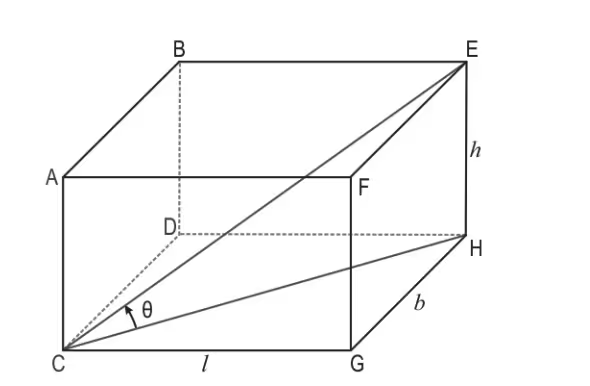
i) Express cos θ in terms of I, b, and h.
ii) If the figure was a cube, what would be the value of cos θ ?
Show your work.
Soln.
Given:
The cuboid has:
- Length l,
- Breadth b,
- Height h, and θ is the angle between the diagonal AC and the base diagonal CG.
i) Express cos θ in terms of I, b, and h.
Calculate the length of CG:CG is the diagonal of the rectangular base ABCD.
CG = √l2 + b2
Calculate the length of AC:AC is the space diagonal of the cuboid
CG = √l2 + b2+h2
cos θ = CG/ AC
cos θ = (√l2 + b2+h2)/( √l2 + b2)
ii) If the figure was a cube, what would be the value of cos θ
Substitute the value of l, b, and h
cos θ =(√l2 + b2)/ (√l2 + b2+h2)
In cube, every side is equal l=b=h
cos θ =(√l2 +l2)/ (√l2 + l2+l2)
cos θ =(√2l2/ (√3l2
cos θ =(√2 l/ (√3) l
cos θ =(√2 / (√3)
after rationalising
cos θ =√6 / 3
7. The teacher asked the students to correctly complete the following sentence about the rhombus.
"A rhombus has a side length of I units and one of its angles is equal to 0. The ratio of the lengths of the two diagonals is dependent on
Ashima: only I.
Bilal: only θ.
Chris: both l and θ.
Duleep: neither l nor θ.
Who answered the question correctly? Show your work and give valid reasons.
Given that a rhombus has a side length of l units and one of its angles is equal to θ. We have to find the dependency of the ratio of the lengths of the two diagonals.
First, we draw a rhombus ABCD whose side length is l units, diagonals AC and BD intersect at E, and ∠ABC=θ as shown below-
We know that in a rhombus, all sides are equal and diagonals bisect each other at 90°, and diagonals bisect the angles of a rhombus. i.e.
∠BEC=∠CED=∠AED=∠AEB=90°,
AE=CE, BE=DE, and
∠ABD=∠CBD, ∠BCA=∠DCA, ∠BAC=∠DAC, ∠ADB=∠CDB
So, ∠ABD=∠CBD=θ/2 or ∠ABE=∠CBE=θ/2
The tangent (tan) of an angle in a right-angled triangle is defined as the ratio between the lengths of opposite side of the angle to its adjacent side.
Now, in right-angled ∆BEC-
tanθ/2=CE/BE=(1/2AC)/(1/2BD)=AC/BD
As we can see that the ratio of the diagonals depends only on θ.
Hence, Bilal answered correctly.
8. A 90 cm wide door opens on one side of the room at a maximum angle of 90°. Due to shortage of space, a 40 cm by 80 cm table is kept behind the door along the wall such that it obstructs its path.
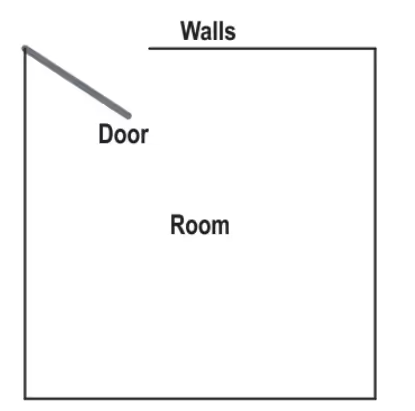
(Note: The figure is not to scale.)
At what distance from the hinge should the table be kept such that the door opens for a maximum angle of 60°. Show your work.
(Note: Use √2 = 1.41, √3 = 1.73)
Soln. Given that a 90 cm wide door opens on one side of the room at a maximum angle of 90°. Due to shortage of space, a 40 cm by 80 cm table is kept behind the door along the wall such that it obstructs its path.
Let at a distance of x cm from the hinge should the table be kept such that the door opens for a maximum angle of 60° as shown below-
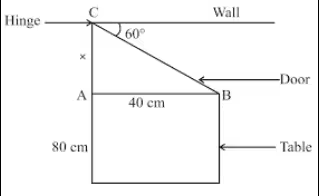
From the figure, ∠ACB=90°-60°=30°.
So, in right-angled triangle ABC-
tan30°=AB/AC =40/x
= 1/√3 =40/x
⇒x=40/√3
=40×1.73
=69.2 cm
Hence, 69.2 cm is the required answer.
Some More Important Question Answers of class 10 Maths
Q1. If sin A = 3/5, find cos A and tan A.
Answer: We know sin A = opposite/hypotenuse = 3/5.
Let opposite side = 3, hypotenuse = 5.
By Pythagoras: adjacent = √(5² – 3²) = √(25 – 9) = √16 = 4.
So, cos A = 4/5, tan A = 3/4.
Q2. If tan θ = 1, find sin θ and cos θ.
Answer: tan θ = 1 means opposite = adjacent.
So the triangle is isosceles right-angled, θ = 45°.
Thus sin 45° = 1/√2, cos 45° = 1/√2.
Q3. Evaluate: sec² 30° – tan² 60°.
Answer: sec 30° = 2/√3 → sec²30° = 4/3.
tan 60° = √3 → tan 2 60° = 3.
So = 4/3 – 3 = 4/3 – 9/3 = –5/3.
Q4. If cos θ = 12/13, find the values of all other trigonometric ratios.
Answer:
cos θ = 12/13 → adjacent = 12, hypotenuse = 13.
Opposite = √(13² – 12²) = √(169 – 144) = √25 = 5.
So:
- sin θ = 5/13
- tan θ = 5/12
- cot θ = 12/5
- sec θ = 13/12
- cosec θ = 13/5
Q5. Show that: (1 + tan²θ) = sec²θ.
Answer: Start with RHS: sec²θ = (1/cos²θ).
Now, tan²θ = (sin²θ/cos²θ).
So, 1 + tan²θ = 1 + (sin²θ/cos²θ) = (cos²θ + sin²θ)/cos²θ.
But sin²θ + cos²θ = 1.
So = 1/cos²θ = sec²θ. ✔
Q6. Find the value of: sin²30° + cos²30°.
Answer: sin 30° = 1/2 → sin²30° = 1/4.
cos 30° = √3/2 → cos²30° = 3/4.
Sum = 1/4 + 3/4 = 1.
Q7. If 3 cot θ = 4, find sin θ and cos θ.
Answer: cot θ = 4/3 = adjacent/opposite.
Take adjacent = 4, opposite = 3.
Hypotenuse = √(3² + 4²) = 5.
So: sin θ = 3/5, cos θ = 4/5.
Q8. If 2 tan A = 3, find sin A and cos A.
Answer: tan A = 3/2.
Take opposite = 3, adjacent = 2.
Hypotenuse = √(3² + 2²) = √13.
So sin A = 3/√13, cos A = 2/√13.
Q9. Evaluate: sin 60° cos 30° + cos 60° sin 30°.
Answer: This is sin(A + B) = sin(60° + 30°).
= sin 90° = 1.
Q10. Prove that: cot²θ + 1 = cosec²θ.
Answer: cot²θ = cos²θ/sin²θ.
Add 1: (cos²θ + sin²θ)/sin²θ = 1/sin²θ = cosec²θ. ✔
Q11.If sin θ = cos θ, find θ.
Answer: sin θ = cos θ → tan θ = 1.
So θ = 45°.
Q12.Evaluate: 3 cosec² 60° – 2 sec² 45°.
Answer: cosec 60° = 2/√3 → cosec² 60° = 4/3.
sec 45° = √2 → sec² 45° = 2.
So, 3 × (4/3) – 2 × 2 = 4 – 4 = 0.
Q13.If cos A = 4/5, find 2 tan²A + 1.
Answer:
cos A = 4/5 → adjacent = 4, hypotenuse = 5.
Opposite = 3.
So tan A = 3/4.
2 tan²A + 1 = 2(9/16) + 1 = 18/16 + 1 = 34/16 = 17/8.
Q14.Prove: (1 + cot²θ) = cosec²θ.
Answer: cot²θ = cos²θ/sin²θ.
1 + cot²θ = (sin²θ + cos²θ)/sin²θ = 1/sin²θ = cosec²θ.
Q15. A tower stands on level ground. From point P the angle of elevation of the top is 30°. A surveyor walks 20 m toward the tower to point Q and the angle becomes 60°. Find (a) height of the tower, (b) distance of P from the tower.
Solution (short): Let T = foot of tower. Let QT = x, so PT = x + 20.
From Q: tan 60° = h / x ⇒ √3 = h / x ⇒ h = x√3.
From P: tan 30° = h / (x + 20) ⇒ 1/√3 = h / (x + 20) ⇒ h = (x + 20)/√3.
Equate: x√3 = (x + 20)/√3 ⇒ multiply by √3 ⇒ 3x = x + 20 ⇒ 2x = 20 ⇒ x = 10 m.
So h = x√3 = 10√3 m ≈ 17.32 m. PT = x + 20 = 30 m.
Answer: height = 10√3 m (≈17.32 m); distance PT = 30 m.
Q16. A cliff top is 50 m above sea level. From that point angles of depression to two boats are 30° and 45°. The boats are on opposite sides of the cliff. Find the distance between the two boats.
Solution: Let distances from cliff foot C to boats be d₁ (30°) and d₂ (45°).
tan 30° = 50 / d₁ ⇒ d₁ = 50 / (1/√3) = 50√3 ≈ 86.60 m.
tan 45° = 50 / d₂ ⇒ d₂ = 50 / 1 = 50 m.
They are on opposite sides ⇒ distance = d₁ + d₂ = 50√3 + 50 ≈ 136.60 m.
Answer: 50√3 + 50 m ≈ 136.6 m.
Q17. A kite is flying such that the string makes an angle 30° with the horizontal. The string length is 80 m. Find the height of the kite (distance above ground). (Ignore sag.)
Solution (short): If string = hypotenuse = 80, angle with horizontal = 30°, height = 80·sin 30°.
sin 30° = 1/2 ⇒ height = 80 × 1/2 = 40 m.
Answer: 40 m.
Q18. Two towers of heights 40 m and 30 m stand on level ground. A point P on the ground is between them. The angle of elevation to the top of the 40 m tower is 60°, and to the top of the 30 m tower is 45°. Find the distance between the two towers (distance along the ground).
Solution: Let the feet of towers be A (40 m) and B (30 m). Let P be between them; distances PA = x and PB = y. We have:
tan 60° = 40 / x ⇒ x = 40 / √3 = (40√3)/3 ≈ 23.094 m.
tan 45° = 30 / y ⇒ y = 30 / 1 = 30 m.
Distance AB = x + y ≈ 23.094 + 30 = 53.094 m.
Answer: exact = 30 + 40/√3 m ≈ 53.09 m.
Q19. A boy 1.5 m tall stands 10 m from a tree and observes the angle of elevation to the top of the tree is 45°. Find the height of the tree.
Solution: Let tree height = H. The vertical difference from boy's eye to top = H − 1.5.
tan 45° = (H − 1.5) / 10 ⇒ 1 = (H − 1.5) / 10 ⇒ H − 1.5 = 10 ⇒ H = 11.5 m.
Answer: 11.5 m.
Q20. Solve the equation tan²θ − tanθ − 2 = 0 for θ in [0°, 180°). (Give angle values in degrees.)
Solution: Let t = tan θ. Then t² − t − 2 = 0. Factor: (t − 2)(t + 1) = 0 ⇒ t = 2 or t = −1.
Case 1: tan θ = 2 ⇒ θ = arctan(2). Principal value ≈ 63.435°. In [0°,180°) tan is positive also in Q3 but that's >180°; in this interval only 63.435°.
Case 2: tan θ = −1 ⇒ tan = −1 at θ = 135° (since tan 45° = 1, negative in QII ⇒ 180° − 45°). So θ = 135°.
(Also tan has a period 180°, so these are the solutions in [0°,180°).)
Answer: θ ≈ 63.435° and θ = 135°.
Extra Questions for Smart Practice!
Q1. If sin θ = 24/25, find cos θ and tan θ.
Q2. Evaluate: (sec²45° − tan²45°) + (cosec²30° − cot²30°).
Q3. A ladder 20 m long is leaning against a wall. The foot of the ladder is 12 m away from the wall. Find the angle of elevation of the ladder with the ground.
Q4. If cot A = 7/24, find the value of sin A and cos A.
Q5. Two complementary angles are such that the difference of their sines is 1/2. Find the angles.
Q6. A man on the top of a 50 m building observes the angle of depression of a car at a distance x m from the building to be 30°. Find the value of x.
Q7. If tan (A + B) = √3 and tan (A − B) = 1/√3, find A and B.
Q8. Evaluate: 2sin²45° + 3cos²30° − tan²60°.
Q9. A kite is flying with its string inclined at 45° to the ground. If the string is 90 m long, find the height of the kite.
Q10. Prove that: (1 + tan²θ)(1 − sin²θ) = 1.
Why Should You Need Class 10 Ch8 Important Questions Maths?
Here are a few reasons why mastering trigonometry is mandatory, especially in class 10.
- Trigonometry also serves as a foundation for several other complex mathematical subjects that you will study in the future, such as calculus and physics, among others. Understanding trigonometry in advance will make it easier to grasp in other educational classes.
- Trigonometry is not merely a subject a learner encounters during exams. Trigonometry finds its application in various fields such as architecture, cartography, and satellite distance determination. Trigonometry is even used in the design of video games to create 3D illustrations. The more you know it today, the more beneficial it will be tomorrow.
- Solving trigonometry problems enhances an individual's analytical skills by facilitating the development of problem-solving steps. For this reason, all activities, whether in scientific, technological, social, or even physical aspects of human life, can benefit from such a logical approach. For better clarity of concepts, you can also go through the NCERT Books Class 10 Maths while practising these questions.
- Trigonometry is one of the most straightforward and high-scoring topics in your Class 10 board exams, provided you understand the fundamentals. Once you grasp the concepts of trigonometry well, they become quite understandable, and with ample practice, you can easily answer all these questions to achieve full marks in this portion.
How to Master Trigonometry Class 10 Important Questions?
This chapter becomes easy with consistent practice and understanding of basic ratios. Follow this plan to study effectively:
Step 1: Learn the Trigonometric Ratios
For a right-angled triangle ABC, with right angle at B, the six trigonometric ratios are defined as:
- sin θ = Perpendicular / Hypotenuse
- cos θ = Base / Hypotenuse
- tan θ = Perpendicular / Base
- cosec θ = 1 / sin θ
- sec θ = 1 / cos θ
- cot θ = 1 / tan θ
Remember these definitions thoroughly, as every question in this chapter is based on them.
Step 2: Memorise Trigonometric Ratios of Standard Angles
Learn the values of trigonometric ratios for standard angles (0°, 30°, 45°, 60°, 90°). These are essential for quick calculations in exams.
Step 3: Understand the Relationship Between Ratios
Remember the fundamental trigonometric identities:
- sin²θ + cos²θ = 1
- 1 + tan²θ = sec²θ
- 1 + cot²θ = cosec²θ
These identities are crucial for simplification and proof-based questions.
Step 4: Learn Complementary Angles
For complementary angles, remember:
sin(90° – θ) = cos θ, cos(90° – θ) = sin θ
tan(90° – θ) = cot θ, cot(90° – θ) = tan θ
sec(90° – θ) = cosec θ, cosec(90° – θ) = sec θ
These relationships are often used in 1-mark and 2-mark questions.
Step 5: Practise Simplification and Evaluation Problems
Simplify trigonometric expressions using reciprocal relations, identities, and complementary angles. Regular practice helps improve both speed and accuracy.
Step 6: Avoid Common Mistakes
Do not confuse between perpendicular and base in triangles. Always relate the angle of reference before applying ratios.
FAQs
Q1. How many marks are usually allotted to this chapter in Class 10 board exams?
Ans. This chapter usually carries 7 to 9 marks, including simplification and value-based questions.
Q2. Which topics are most important for exams?
Ans. Trigonometric ratios of standard angles, trigonometric identities, and complementary angles are most important.
Q3. How can I memorise trigonometric values easily?
Ans. Use visual patterns like the “square root rule”:
For sin θ → √(0, 1, 2, 3, 4)/2 and
For cos θ → reverse order √(4, 3, 2, 1, 0)/2.
Q4. Are proofs of identities asked in exams?
Ans. Yes, 2 or 3-mark questions may ask you to prove standard identities using algebraic steps.
Q5. How can I avoid confusion between trigonometric ratios?
Ans. Always draw a right triangle and label perpendicular, base, and hypotenuse according to the given angle. Then apply ratios accordingly.










.svg)

