
.svg)

The chapter Triangles is one of the most important and concept-heavy topics in Class 10 Mathematics Syllabus. It extends your understanding of geometry by exploring the properties of similar figures, criteria for triangle similarity, and important theorems related to proportions and areas.
This chapter helps you connect algebra and geometry while strengthening logical and deductive reasoning. It is also one of the most scoring topics, as questions are often direct and based on well-defined theorems.
The Triangles Important Questions for Class 10 Mathematics help you:
- Master the concepts of similarity and proportionality.
- Practice proofs and reasoning-based questions.
- Strengthen geometry problem-solving skills for exams.
IMPORTANT QUESTIONS CLASS 10
(Most Important Questions of this Chapter from our 📕)
In the table given below, we have provided the links to downloadable Triangle Important Question Class 10 PDFs. Now you can download them without requiring a login.

Ch6 Triangles Important Questions Class 10 Maths
1. The areas of two similar triangles are 64 cm2 and 121 cm2. If the length of a side of the larger triangle is 55 cm, find the length of the corresponding side of the smaller triangle. Show your work.
Soln. Area of first triangle = 64cm2
Altitude of first triangle = 55 cm
Area of second triangle = 121cm2
Let altitude of second triangle = x
As per formula
(Area of first triangle/Area of second triangle) = (Altitude of first triangle/Altitude of second triangle)2
(64cm2/121cm2) = ( 55cm /x)2
(64cm2/121cm2) = ( 55cm2 /x2)
x2 = ( 55cm2 x 121cm2 /64cm2)
x2 = ( 55cm2 x 121cm2 /64cm2)
x2 = ( 6655cm2/64cm2)
x2 = (103.92)
x = (103.9)
Altitude of second triangle = 103.9 cm
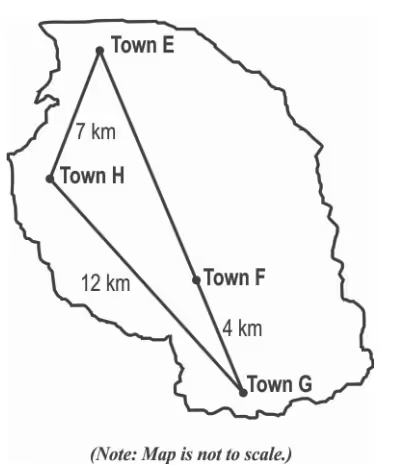
2. Looking at the above figure, Hari said that the shortest distance between Town E and Town F is 15 km.
Is the statement true or false? Justify your answer using the relevant properties.
Soln. Shortest distance between Town E and Town F is 15km.
As per theorem
The sum of two sides is greater than the third side.
EH + HG > EF + FG
12 + 7> 15 + 4
19> 19
But, here sum of two sides is equal to the third side
Hence, Hari’s statement is false
3. Are the two quadrilaterals shown below similar? Give a reason for your answer.
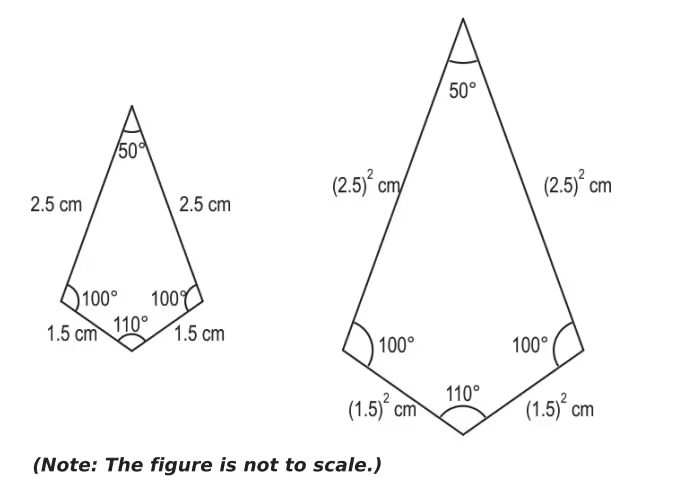
Soln. Two quadrilaterals are similar if:
- If their corresponding angles are equal, and
Angles in both quadrilaterals: 50°, 100°, 110°, and 100°.
- If their corresponding sides are proportional.
Sides of smaller quadrilateral: 2.5cm, 1.5cm, 1.5cm, and 2.5cm
Sides of bigger quadrilateral: (2.5)2cm, (1.5)2cm, (1.5)2cm, and (2.5)2cm
Side ratios=
(2.5)2cm/2.5cm = 2.5cm
(1.5)2cm/1.5cm = 1.5cm
corresponding sides are not proportional.
Hence, the quadrilaterals aren’t similar
4. An insect sitting at corner P of a room flies along the dotted line PS and reaches corner S. Whereas, an ant sitting at corner P, reaches corner S by crawling along the path PR, followed by RS. Both the paths are shown below.
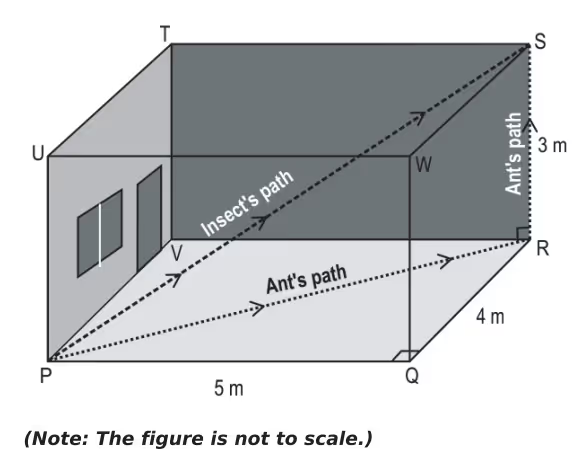
(Note: The figure is not to scale.)
i) Find the length of the path taken by the ant.
ii) Find the length of the path of the insect's flight.
Show your steps.
Soln. i) Find the length of the path taken by the ant.
PQ=5m (length of the room),
QR=4 m (width of the room).
PR=√PQ2+QR2
PR=√52+42m
PR=√25+16m
PR=√41 m
RS=3 m
Ant’s path= PR + RS
Ant’s path= √41 m + 3 m
Ant’s path= 6.40 m + 3 m
Length of the path taken by the ant= 9.40m
ii) Find the length of the path of the insect's flight.
PQ=5m (length),
QR=4 m (width),
RS=3 m (height).
PS=√PQ2+QR2+RS2
PS=√52+42+32
PS=√25+16+9
PS=√50
PS=7.07m
Length of the path of the insect's flight= PS=7.07m
5. Panchami is standing on the ground and flying a kite at a vertical height of 22 m from the ground. The length of the taut string to which the kite is connected is 29 m. Panchami is holding the string roller 1 m above the ground.
i) Draw a figure representing the above scenario.
ii) Find the horizontal distance between the kite and Panchami. Show your work.
Soln.
i) Draw a figure representing the above scenario.
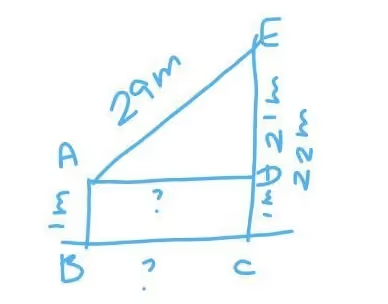
ii) Find the horizontal distance between the kite and Panchami. Show your work.
Let the horizontal distance AD be x.
AE2= AD2 + DE2
292= AD2 + 212
292 - 212 = AD2
841 - 441= AD2
AD2 = 400
AD = √400
AD = 20m
Since AD and BC are parallel and equal to each other
AD = BC= 20m
Horizontal distance between the kite and Panchami is 20m
6. During a mathematics class, a teacher wrote the following three algebraic expressions on the board:
(m2 - n2), (2 mn ) and ( m2 + n2), where m and n are positive integers with n < m
One of the students, Kaivalya, claimed that the above set of expressions ALWAYS represent the sides of a right-angled triangle.Is Kaivalya's claim correct? Justify your answer.
Soln. For any triangle to be a right-angled triangle, the sides must satisfy:
a2+b2=c2
Let the expressions (m2 - n2), (2 mn ) and ( m2 + n2), represent the sides of a triangle
a= (m2 - n2)
b=(2 mn )
c= ( m2 + n2)
Substituting the new values
a2+b2=c2
(m2 - n2)2 + (2 mn )2 = ( m2 + n2)2
Taking LHS
(m2 - n2)2 + (2 mn )2
(m2)2 + (2 mn )2 - 2. (m2 - n2) (2 mn ) + 4mn2
(m4−2m2n2+n4)+4m2n2
m4+2m2n2+n4
c2=(m2+n2)2=m4+2m2n2+n4
a2+b2=m4+2m2n2+n4=c2
Since a2+b2=c2, the expressions (m2−n2), (2mn), and (m2+n2) always satisfy Pythagoras' theorem.
7. In a mathematics class, a teacher drew the following figure where TQ/QR = ⅓. She then asked, "What is the sufficient condition required to prove that ΔTQP ~ ΔRQS?"
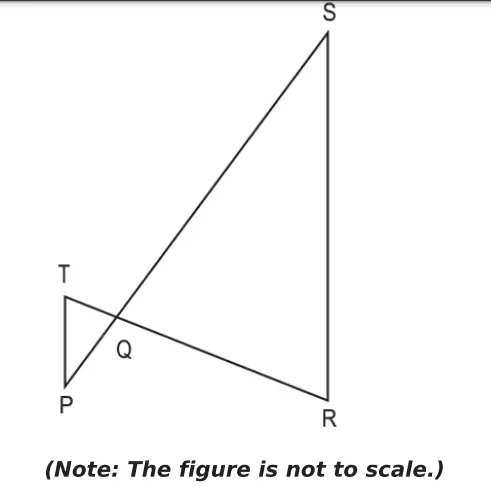
(Note: The figure is not to scale.)
- Darsh said that it is sufficient if it is given that TR/SR = ⅓.
- Bhargav said that it is sufficient if it is given that ∠P = ∠S.
- Tanvi said that it is sufficient if it is given that PQ/RS= ⅓.
Examine whether each of their responses is correct or incorrect. Give reasons.
Soln. TQ/QR = ⅓
Conditions:
- All corresponding angles are equal (AAA),
- Two corresponding sides are proportional, and the included angles are equal (SAS),
- All corresponding sides are proportional (SSS).
Darsh's Theory: It is sufficient if it is given that TR/SR = ⅓.
- If TR/SR = ⅓, this provides another pair of proportional sides
- If TQ/QR = ⅓, and TR/SR = ⅓, we need one more condition, such as an included angle ∠TQR=∠RQS, to prove similarity using the SAS criterion.
Since Darsh did not mention angles, his response is incorrect, as the side ratios alone are insufficient to establish similarity.
Bhargava's Theory: It is sufficient if it is given that ∠P=∠S.
- If ∠P=∠S, this gives us one pair of equal angles.
- Given TQ/QR = ⅓, we have one pair of proportional sides.
- To use the SAS similarity criterion, we need the included angles (∠TQP=∠RQS) to be equal, which is not mentioned in Bhargav's condition.
Therefore, Bhargav's response is incorrect, as ∠P=∠S alone is not sufficient to prove similarity.
Tanvi's Theory: It is sufficient if it is given that PQ/RS = ⅓.
- If PQ/RS = ⅓, this provides another pair of proportional sides
- If TQ/QR = ⅓, and TPQ/RS = ⅓, we need one more condition, such as an included angle ∠TQR=∠RQS, to prove similarity using the SAS criterion.
- To use the SAS similarity criterion, we need the included angles (∠TQP=∠RQS) to be equal, which is not mentioned in Tanvi's condition.
Since Tanvi's response does not mention angles, her response is incorrect, as the side ratios alone are not sufficient to establish similarity.
For △TQP∼△RQS, we need either AAA, SAS, or SSS conditions, hence, all three responses by Darsh, Bhargav, and Tanvi are incorrect
8. In the figure below, OPQ is a triangle with OP = OQ. RS is an arc of a circle with centre
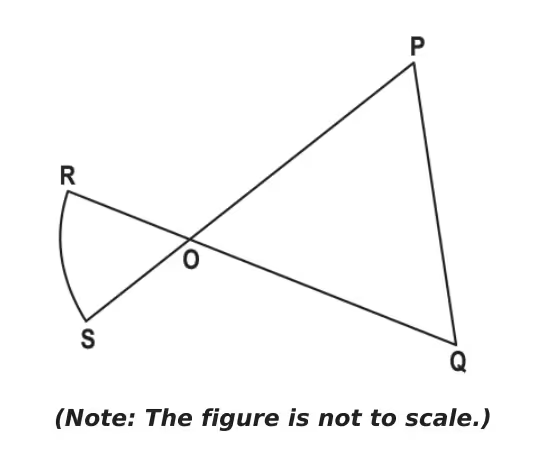
(Note: The figure is not to scale.)
Triangle OSR is similar to triangle OPQ.
Is the above statement true or false? Justify your reason.
Soln.
Given: Δ OPQ is an isosceles triangle with OP=OQ
RS is an arc of a circle with center O.
ΔOSR is formed using the center OOO and points RRR and SSS on the circle.
Δ OSR ~ Δ OPR
To prove:
To check if the statement true or false
Prove:
In Δ OSR and Δ OPR
∠OPQ = ∠OQP
OR = OS (radii of circle)
- ∠ROS is subtended by the arc RS, while ∠POQ is formed by the sides OP and OQ.
- There is no direct evidence that these angles are equal or proportional.
Side Proportionality:
- The sides OP, OQ, OR, and OS do not have any given proportional relationships. Thus, SSS or SAS similarity cannot be established.
Without sufficient information to establish that the corresponding angles are equal or the sides are proportional, the claim that △OSR is similar to △OPQ is false.
9. In the figure below, XYZ is a right-angled triangle. A, B and C are the three YZ such that they divide YZ into 4 equal parts.
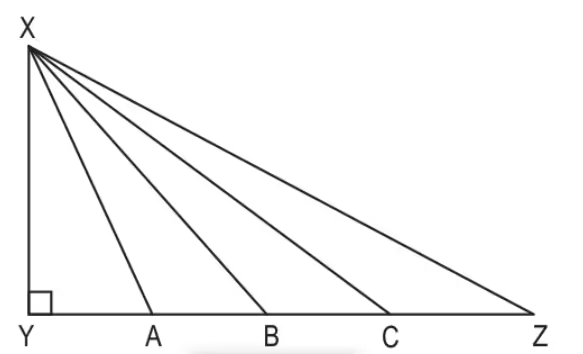
(Note: The figure is not to scale.)
Prove that 3XA2 + XB2 + XC2 - XZ2 = 4XY2.
Soln. Taking LHS
XYZ is a right-angled triangle with ∠Y=90
YZ is divided into 4 equal parts by points A, B, and C.
Let the length of YZ=4d. Thus:
YA=d,
YB=2d,
YC=3d,
YZ=4d
Assume XY=h, the height of the triangle.
For the right triangle XYZ, the hypotenuse is XZ. By the Pythagorean theorem:
XZ2=XY2+YZ2
Substituting YZ=4d:
XZ2=XY2+(4d)2
XZ2=XY2+16d2
Each of the points A, B, and C divides YZ perpendicularly. The distances XA, XB, and XC are calculated using the Pythagorean theorem:
Distance XA: For the right triangle XAY,
XA2=XY2+YA2
Substituting YA=d:
XA2=XY2+d2
Distance XB: For the right triangle XBY,
XB2=XY2+YB2
Substituting YA=2d:
XB2=XY2+(2d)2
XB2=XY2+4d2
Distance XC: For the right triangle XCY,
XC2=XY2+YC2
Substituting YC=3d:
XC2=XY2+(3d)2
XC2=XY2+9d2
Substitute the expressions for XA2, XB2, XC2, and XZ2:
3XA2:= 3(XY2+d2)
3XA2:= 3XY2+3d2
Adding 3XA2 + XB2 + XC2
= (3XY2+3d2) + (XY2+4d2) + (XY2+9d2)
= 5XY2+16d2
Subtracting XZ2:
(5XY2+16d2) - (XY2+16d2)
= 4XY2 i.e. RHS
LHS =RHS
Some More Important Question Answers of Class 10 Triangles
Q1. Two similar triangles have areas 81 cm² and 144 cm². A side of the smaller triangle is 9 cm. Find the corresponding side in the larger triangle.
Solution (step-by-step)
- For similar triangles, ratio of areas = (ratio of corresponding sides)².
- Let ratio of sides (smaller : larger) = r. Then r² = 81 / 144 = 9 / 16.
- So r = √(9/16) = 3/4. That means smaller : larger = 3 : 4.
- Given smaller side = 9 cm → larger side = 9 × (4/3) = 12 cm.
Answer: 12 cm
Q2. A pole of height 4 m casts a shadow 2.5 m. At the same time, a tower casts a shadow of 15 m. What is the height of the tower?
Solution
- With the same sun angle, heights are proportional to shadows: height/pole_shadow = tower-height/tower-shadow.
- So tower_height = 4 × (15 / 2.5). Compute 15 ÷ 2.5 = 6.
- Tower-height = 4 × 6 = 24 m.
Answer: 24 m
Q3. In ΔABC, DE ∥ BC. If AD = 3 cm, DB = 9 cm and AC = 12 cm, find AE.
Solution
- By Basic Proportionality Theorem (BPT): AD/DB = AE/EC.
- AD/DB = 3/9 = 1/3. Write AE = x ⇒ EC = AC − AE = 12 − x.
- So x/(12 − x) = 1/3 ⇒ 3x = 12 − x ⇒ 4x = 12 ⇒ x = 3.
Answer: AE = 3 cm
Q4. The two triangles are similar. The ratio of corresponding sides is 5 : 8. If the altitude of the smaller is 15 cm, what is the altitude of the larger?
Solution
- All linear measures (including altitudes) scale by the same side ratio. Larger altitude = 15 × (8/5).
- Compute 15 × 8 = 120; 120 ÷ 5 = 24.
Answer: 24 cm
Q5. In a right triangle, the legs are 7 cm and 24 cm. Compute the hypotenuse.
Solution
- Use Pythagoras: hyp² = 7² + 24² = 49 + 576 = 625.
- hyp = √625 = 25 cm.
Answer: 25 cm
Q6. In ΔABC, AD is the bisector of ∠A and meets BC at D. Given AB = 10, AC = 15, BC = 12. Find BD and DC.
Solution
- Angle bisector theorem: BD / DC = AB / AC = 10 / 15 = 2 / 3.
- Let BD = 2k and DC = 3k. Then BD + DC = 5k = BC = 12 ⇒ k = 12/5 = 2.4.
- BD = 2k = 4.8 cm; DC = 3k = 7.2 cm.
Answer: BD = 4.8 cm, DC = 7.2 cm
Q7. In ΔABC, AB = 9, AC = 12, BC = 15. Let M be the midpoint of BC. Find AM (median from A).
Solution
- Use Apollonius’ theorem: AB² + AC² = 2(AM² + BM²).
- Compute AB² + AC² = 9² + 12² = 81 + 144 = 225. BM = BC/2 = 7.5, so BM² = 56.25.
- So 225 = 2(AM² + 56.25) ⇒ 225 = 2AM² + 112.5 ⇒ 2AM² = 112.5 ⇒ AM² = 56.25.
- AM = √56.25 = 7.5 cm.
Answer: AM = 7.5 cm
Q8. Two triangles are similar with side ratio 3 : 7 (smaller : larger). If the area of the smaller is 54 cm², find the area of the larger.
Solution
- Area ratio = (3/7)² = 9/49 = area_small/area_large.
- area_large = area_small × (49/9) = 54 × (49/9). Compute 54 ÷ 9 = 6, so area_large = 6 × 49 = 294 cm².
Answer: 294 cm²
Q9. In right ΔABC (right angle at B), altitude BD is drawn to hypotenuse AC. If AD = 4 and DC = 9, find BD, AB, and BC.
Solution
- AC = AD + DC = 4 + 9 = 13.
- Property: altitude² = AD × DC. So BD² = 4 × 9 = 36 ⇒ BD = 6.
- Also AB² = AD × AC = 4 × 13 = 52 ⇒ AB = √52 = 2√13 ≈ 7.211.
- BC² = DC × AC = 9 × 13 = 117 ⇒ BC = √117 = 3√13 ≈ 10.816.
Answer: BD = 6; AB = √52 (≈7.21); BC = √117 (≈10.82)
Q10. In ΔABC, DE ∥ BC. Given AE = 5 cm, EC = 10 cm and DB = 8 cm. Find AD.
Solution
- By BPT: AD / DB = AE / EC = 5 / 10 = 1 / 2.
- So AD / 8 = 1 / 2 ⇒ AD = 8 × (1/2) = 4 cm.
Answer: AD = 4 cm
Q11. Prove that the three medians of a triangle partition it into six small triangles of equal area.
Solution
- A median divides a triangle into two smaller triangles of equal area because they have the same height and their bases are equal (median bisects the base).
- When you draw all three medians, they intersect at the centroid G. Each median is divided by the centroid in the ratio 2 : 1 (vertex to centroid : centroid to midpoint).
- Because of equal bases and shared heights across the small triangles, each of the six small triangles formed around the centroid has the same area. Concretely: start with one median - it forms two equal areas; the second median splits each of those into two equal parts, etc., resulting in six equal parts.
Answer: The medians divide the triangle into six equal-area triangles.
Q12. Two triangles have the same altitude. Their bases are 5 cm and 13 cm. Find their areas and the ratio of areas.
Solution
- Let common altitude = h. Area1 = (1/2) × 5 × h = 2.5h. Area2 = (1/2) × 13 × h = 6.5h.
- Ratio area1 : area2 = 2.5h : 6.5h = 5 : 13 (cancelling 0.5h).
Answer: Areas = 2.5h and 6.5h; ratio 5 : 13 (same as bases)
Q13. In a right triangle, legs=9,12. Find hypotenuse, altitude to hypotenuse, and projections.
Solution: Hyp=15
Altitude=(9×12)/15=7.2
AD=(9²)/15=5.4, DC=(12²)/15=9.6
Answer: Hyp=15, Alt=7.2, Proj=5.4,9.6
Q14. In ΔABC, ∠B = 45° and ∠C = 55°. Find the exterior angle at A.
Solution
- Exterior angle at A equals the sum of the two opposite interior angles: ∠B + ∠C.
- ∠B + ∠C = 45° + 55° = 100°.
Answer: Exterior angle at A = 100°
Q15. Two similar triangles have perimeters in the ratio 8 : 11. If one side of the smaller triangle is 10 cm, find the corresponding side of the larger triangle.
Solution
- Corresponding linear measures scale in the same ratio as the perimeters. So scale = 11/8.
- Corresponding side of larger = 10 × (11/8) = 110/8 = 13.75 cm.
Answer: 13.75 cm
Q16. Prove that if two triangles stand on the same base and between the same parallels, they have equal area. (Give a short example.)
Solution
- If two triangles have the same base and their opposite vertices lie on a line parallel to the base (i.e., they lie between the same parallels), they have equal heights from the base.
- Area = ½ × base × height. Same base and same height ⇒ equal area.
- Example: Base = 10 cm, common altitude = 8 cm → area = ½ × 10 × 8 = 40 cm² for each.
Answer: Areas equal; example area 40 cm².
Q17. In ΔABC, base BC = 16 and altitude from A to BC = 8. Compute its area.
Solution: Area = ½ × base × altitude = ½ × 16 × 8 = 64 cm².
Answer: 64 cm²
Q18. Are the sides 11, 60, 61 of a triangle a right triangle? If yes, identify the hypotenuse.
Solution
- Check Pythagoras: 11² + 60² = 121 + 3600 = 3721.
- 61² = 3721. Since the sum of squares of the two smaller equals the square of the largest, it is a right triangle.
- Hypotenuse = 61 (largest side).
Answer: Yes, right triangle; hypotenuse = 61.
Q19. In isosceles ΔABC with AB=AC=17, BC=16. Find altitude from A.
Solution: Altitude=√(17²−8²)=√(289−64)=√225=15 cm
So the answer is 15cm.
A Few Extra Questions to Prep Before your board exams!
Q1. In two similar triangles, one has area 81 cm² and the other 144 cm². If a side of the smaller triangle is 9 cm, find the same corresponding side in the larger triangle. (You can draw two similar triangles side-by-side.)
Q2. A pole of height 4 m casts a shadow 2.5 m. At the same moment, a tower casts a shadow of 15 m. What is the height of the tower? (Draw right triangles: pole + shadow, tower + shadow.)
Q3. In ΔABC, DE is drawn parallel to BC, intersecting AB at D and AC at E. If AD = 3 cm, DB = 9 cm, and AC = 12 cm, find AE. (Draw ΔABC with DE || BC.)
Q4. The two triangles are similar. The ratio of corresponding sides is 5 : 8. If the altitude of the smaller is 15 cm, what is the altitude of the larger? (Sketch two triangles, mark altitudes.)
Q5. In a right triangle, the legs are 7 cm and 24 cm. Compute the hypotenuse. (Draw the right triangle with legs labeled.)
Q6. In ΔABC, the angle at A is bisected by AD, meeting BC at D. If AB = 10, AC = 15 and BC = 12, find BD and DC. (Draw ΔABC with angle bisector AD.)
Q7. In ΔABC, AB = 9, AC = 12, BC = 15. Let M be the midpoint of BC. Find AM (median). (Draw triangle with median from A to midpoint of BC.)
Q8. Two triangles are similar, with the ratio of sides 3 : 7. If the area of the smaller is 54 cm², find the area of the larger. (Draw two similar triangles.)
Q9. In a right triangle ΔABC (right angle at B), the altitude from B meets AC at D. If AD = 4 and DC = 9, find BD, AB, and BC. (Draw the altitude from right angle to hypotenuse.)
Q10. In ΔABC, DE ∥ BC. If AE = 5 cm, EC = 10 cm, and DB = 8 cm, find AD. (Draw ΔABC with DE || BC.)
Q11. Prove that the three medians of a triangle partition it into six small triangles of equal area. (Draw triangle with medians intersecting at centroid.)
Q12. Two triangles have the same altitude but their bases are 5 cm and 13 cm respectively. Find their areas and ratio. (Draw two triangles standing on the same baseline.)
Q13. In ΔABC, AB = 14, AC = 7, BC = 10. Find the median from A. (Sketch ΔABC and draw the median from A.)
Q14. In a right triangle with legs 9 and 12, find the hypotenuse, altitude to hypotenuse, and the projections split by the altitude. (Draw right triangle, altitude from right angle to hypotenuse.)
Q15. If ∠B = 45° and ∠C = 55° in ΔABC, find the exterior angle at A. (Draw triangle and exterior angle at A.)
How to Ace These Class 10 Triangles Important Questions
To do well in this chapter, you must understand both theoretical theorems and their applications. Here’s how to prepare effectively:
Step 1: Revise the Basic Definition of Similar Figures
Understand what it means for two figures to be similar - they have the same shape but not necessarily the same size. All congruent figures are similar, but all similar figures are not congruent.
Step 2: Learn Criteria for Similarity of Triangles
Memorise and understand the three main similarity criteria:
- AA (Angle-Angle) Criterion: If two angles of one triangle are equal to two angles of another triangle, the triangles are similar.
- SSS (Side-Side-Side) Criterion: If the sides of two triangles are in proportion, the triangles are similar.
- SAS (Side-Angle-Side) Criterion: If one angle of a triangle equals one angle of another and the sides including these angles are in proportion, the triangles are similar.
Step 3: Study Theorems on Similarity and Proportionality
Learn and practise the following important theorems:
- Basic Proportionality Theorem (Thales Theorem): If a line is drawn parallel to one side of a triangle to intersect the other two sides, it divides those sides in the same ratio.
- Pythagoras Theorem: In a right triangle, the square of the hypotenuse equals the sum of the squares of the other two sides.
Step 4: Practise Proof-Based Questions
Proofs are commonly asked in exams. Learn the statements of each theorem clearly and practise writing stepwise, logical proofs with proper reasoning.
Step 5: Study Areas of Similar Triangles
Understand that the ratio of the areas of two similar triangles is equal to the square of the ratio of their corresponding sides.
If two triangles are similar, then
Area₁ / Area₂ = (side₁ / side₂)²
Step 6: Solve Application-Based Questions
Practise numerical problems involving height and distance, proportionality, and area comparison. They test your ability to apply theorems logically.
Benefits of Practicing Class 10 ch6 Important Questions Maths
Studying triangle-important questions in class 10 has numerous advantages that can directly improve your performance in exams. Here are some key benefits:
- The Class 10 Triangles Important Questions with Solutions PDF provides a targeted approach to practice frequently occurring problems. We carefully select these questions to cover key sub-topics and reflect previous exam patterns, enabling you to solve the most important questions.
- One of the biggest challenges students face during exams is managing their time well. Working through the extra questions from Class 10 Triangles helps you practice allocating the right amount of time to each type of problem.
- We design extra questions to cover a wide range of difficulty levels, ensuring you are well-prepared for any type of question. Whether it’s an easy or tricky problem, practicing with class 10 triangle important questions ensures that no area of the topic is left untouched.
Where to Find Class 10 Triangles Important Questions with Solutions PDF
To prepare effectively, you need access to high-quality resources. Many students prefer using class 10 triangle important questions with solutions in PDF for convenience. Here are some places where you can find reliable practice material:
- NCERT/CBSE Textbooks: Always start with your school books, NCERT Books class 10 which contain exercises and solved examples.
- Downloadable PDFs: Many educational websites provide free or paid PDFs that contain sets of important questions and solutions.
- The Educart One Shot Question Bank includes all the extra questions for class 10 on triangles, as well as the important questions for class 10 on triangles.
The Triangles Class 10 Important Questions serve as an invaluable tool for students seeking to enhance their concepts and learning. Students aiming for boards and competitive exams such as JEE can benefit greatly from these questions.
FAQs
Q1. How many marks are usually allotted to this chapter in Class 10 board exams?
Ans. This chapter generally carries 7 to 9 marks, often including one proof-based question and one numerical question.
Q2. Which theorems are most important for exams?
Ans. Basic Proportionality Theorem (BPT), its converse, and Pythagoras Theorem are the most important.
Q3. How can I write proofs effectively in exams?
Ans. Start by stating what is given and what is to be proved. Write each logical step with proper reasoning and end with a clear conclusion.
Q4. Are diagrams necessary in proofs?
Ans. Yes, diagrams are essential in all geometry questions. Label all points clearly and mark equal sides or angles as needed.
Q5. How can I remember the similarity criteria easily?
Ans. Remember AA → two angles; SSS → sides in the same ratio; SAS → one equal angle and two proportional sides.












.svg)

