
.svg)

The chapter Probability is one of the most logical and scoring topics in Class 10 Mathematics Syllaus. It deals with finding the likelihood of an event happening and helps students understand uncertainty in a mathematical way.
Probability has wide applications in real life from weather forecasting and games of chance to genetics, data science, and statistics. Since most questions in exams are direct and based on formula application.
The Probability Important Questions for Class 10 Mathematics help you:
- Strengthen understanding of events, outcomes, and sample space.
- Learn to calculate simple and combined probabilities.
- Prepare for numerical and reasoning-based questions as per the CBSE pattern
IMPORTANT QUESTIONS CLASS 10
(Most Important Questions of this Chapter from our book)
In the table given below, we have provided the links to downloadable Probability Class 10 Important Questions PDFs. Now you can download them without requiring a login.

Ch14 Probability Important Questions Class 10 Maths
1. In a cards game, there are ten cards, 1 to 10. Two players, seated facing each other randomly choose 5 cards each. They arrange their cards in ascending order of the number on the card as shown below.
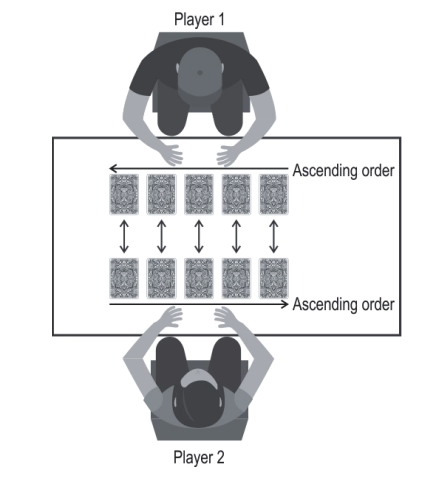
The difference between the corresponding cards is calculated such that the lower value is subtracted from the higher value. In a random game, what is the probability that the sum of the differences is 24?
a. 0
b. ⅕
c. ½
d. (cannot be calculated without knowing the cards chosen by each player.)
Soln. a) 0
Given, two players choose randomly 5 cards and arrange them in increasing order.
For example:
Player 1: 2,5,7,9,10
Player 2:1,3,4,6,8
Difference between them =1,2,3,3,2
Sum of the differences =1+2+3+3+2
=12
As the sum of the difference is always > 24.
Probability =0.
2. At a party, there is one last pizza slice and two people who want it. To decide who gets the last slice, two fair six-sided dice are rolled. If the largest number in the roll is:
1, 3 or 6, Ananya would get the last slice, and
2, 4 or 5, Pranit would get it.
In a random roll of dice, who has a higher chance of getting the last pizza slice?(Note: If the number on both the dice is the same, then consider that number as the larger number.)
a. Ananya
b. Pranit
c. Both have an equal chance
d. (cannot be answered without knowing the exact numbers in a roll.)
Soln.
Since, the two fair six-sided dice are rolled.
The sample space of getting largest number in the roll is given as
S={1,1, 1,2, 1,3, 1,4, 1,5, 1,6, 2,2, 2,3, 2,4, 2,5, 2,6, 3,3, 3,4, 3,5, 3,6, 4,4, 4,5, 4,6, 5,5, 5,6, 6,6}
Let A be the event of getting the largest number in the roll of Ananya's number.
A=1,1, 1,3, 2,3, 3,3, 1,6, 2,6, 3,6, 4,6, 5,6, 6,6
⇒ n(A)=10
Let B be the event of getting the largest number in the roll of Pranit's number.
B={1,2, 2,2, 1,4, 2,4, 3,4, 4,4, 1,5, 2,5, 3,5, 4,5, 5,5}
⇒ n(B)=11
We know that,
Probablity of an event=number of elements in an event/total number of elements in sample space
∵ n(A)<n(B)
So, the chances of event B is more.
Hence, Pranit has a higher chance of getting the last pizza slice.
3. In a medical center, 780 randomly selected people were observed to find if there is a relationship between age and the likelihood of getting a heart attack. The following results were observed.
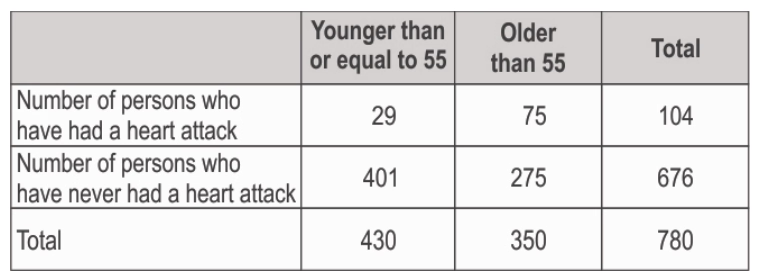
(i) Based on this table, what is the probability that a randomly chosen person from the same sample is younger than or equal to 55 years and has had a heart attack?
(ii) Looking at the data in the table, Giri says, "if a person is randomly chosen, then the probability that the person has had a heart attack is about 12.5%".
Is the statement true or false? Justify your reason.
Soln.
(i) Probability that a randomly chosen person from the same sample is younger than or equal to 55 years and has had a heart attack
Soln. P(Younger than or equal to 55 and had a heart attack)=(Number of people younger than or equal to 55 who had a heart attack/Total number of people)
P = 29/780
P ≈ 0.0372(or 3.72%).
(ii) Giri says, "if a person is randomly chosen, then the probability that the person has had a heart attack is about 12.5%". Is the statement true or false?
Soln. P(People who had a heart attack)=(People who had a heart attack/Total number of people)
P = 104/780
P ≈ 0.133(or 13.75%).
Since 13.33%13.33\%13.33% is not approximately 12.5%12.5\%12.5%, Giri's statement is false.
4. Shown below is a square dart board with circular rings inside.
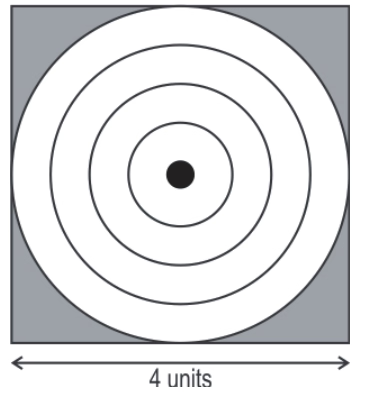
(Note: The figure is not to scale.)
Find the probability that a dart thrown at random lands on the shaded area. Show your steps.
Soln.
The diameter of the circle =4 units.
Then, radius of the circle=2 units
We know that, area of the circle =πr2
⇒ π×22
=4π sq. units
Now, area of square =side2
⇒42
=16 sq. units
Then the area of the shaded region = Area of square-Area of circle
=16-4π sq. units
Thus, the probability of hitting the shaded region when a dart is thrown randomly =16-4π
4=4-π.
Hence, the required probability is 4-π.
5. On a particular day, Vidhi and Unnati couldn't decide on who would get to drive the car. They had one coin each and flipped their coins exactly three times. The following was agreed upon:
If Vidhi gets two heads in a row, she would drive the car.
If Unnati gets a head immediately followed by a tail, she will drive the car.
Who has more probability of driving the car that day? List all outcomes and show your steps.
Soln.
Let S be the sample space
Since, one coin is tossed three times.
S={HHH, HHT, HTH, HTT, THH, THT, TTH, TTT}
So, n(S)=8
Let A be an event that the Vidhi drive the car.
Vidhi drive the car only if she gets heads in a row.
∴ A=HHH,HHT,THH
⇒n(A)=3
∴P(A)=n(A)/n(S)=3/8 ...1
Let B be an event that the Unnati drive the car.
Unnati drive the car only if she gets a head immediately followed by a tail.
∴ B=HHT, HTH, THT, HTT
⇒n(B)=4
∴P(B)=n(B)n(S)=4/8=1/2 ...2
Using equations 1 and 2,
PA>PB
If they flipped their coins exactly three times, Unnati is more likely to drive the car that day.
6. A 4-sided fair die is numbered 1 - 4. Nikhil and Pratik are playing with each other with such a die. They roll their dice once at the same time. A player wins only if they get a number larger than the other player.
What is the probability of Pratik winning the game? Show your work.
Let S be the sample space
Let N1={1, 2, 3, 4} and N2={1, 2, 3, 4}.
S=N1×N2={(x,y)|x∈N1, y∈N2}
So, n(S)=4×4=16
Let N1 represent the outcomes of a 4-sided fair die by Nikhil and N2 represent the outcomes of a 4-sides fair die by Pratik.
Let A be an event that the Pratik win the game.
∴ A=x,y|x<y, x∈N1, y∈N2
A={ (1,2), (1,3), (1,4), (2,3), (2,4), 3,4}
⇒n(A)=6
∴P(A)=n(A)/n(S)=6/16=3/8
Hence, the probability of Pratik winning the game is 3/8.
7. Shown below are two baskets with grey and black balls.
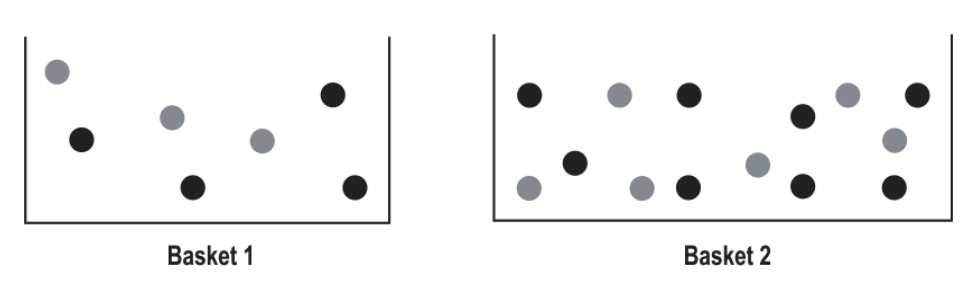
Abhishek is playing a game with his friend, and he has to close his eyes and pick a black ball from one of the baskets in one trial.
He said, "I will try with basket 2 as it has a higher number of black balls than basket 1, and hence the probability of picking a black ball from basket 2 is higher."
Is Abhishek's statement correct? Justify your answer.
Soln.
No, Abhishek's statement is not correct.
Total balls in basket 1=3 Grey balls+4 Black balls
Number of possible outcomes in basket 1=3+4=7
Number of black balls in basket 1=4
Hence, the number of favourable outcomes=4
We have, PE=Number of favourable outcomes/Number of possible outcomes
⇒Pblack ball from basket 1=4/7 ...1
Now, total balls in basket 2=6 Grey balls+8 Black balls
Number of possible outcomes in basket 2=6+8=14
Number of black balls in basket 2=8
Hence, the number of favourable outcomes=8
We have, PE=Number of favourable outcomes/Number of possible outcomes
⇒Pblack ball from basket 2=814=2/7 ...2
From equations 1 and 2,
The probability of picking a black ball from basket 1 is same as basket 2.
8. Rohan has a bag of multiple balls either pink, green or yellow in colour. He randomly picks up one ball.
His friend, Farid, predicted, "The probability of Rohan picking a pink ball is definitely ⅓ as there are 3 colours".Is Farid's statement true or false? Give a valid reason or a counter-example.
Soln.
Farid's statement is false.
We don't know the exact number of pink, green and yellow colour balls in a bag.
Let us consider, the bag has 1 pink ball, 2 green balls and 2 yellow balls.
Total balls in a bag=1 Pink balls+2 Green balls+2 Yellow balls
Number of possible outcomes=1+2+2=5
Number of pink balls in a bag=1
Hence, the number of favourable outcomes=1
We have, PE=Number of favourable outcomes/Number of possible outcomes
⇒pink ball=1/5 ...1
Hence, the probability of Rohan picking a pink ball is 1/5 not 1/3.
9. Shivesh was tossing a fair coin. Shown below are the outcomes of his first 5 tosses. [Tail Tail Tail Tail Tail ]
Is the probability of Shivesh getting a head in his sixth toss higher than the probability of getting a tail? Give a valid reason.
Soln.
No, the probability of Shivesh getting a head in his sixth toss higher than the probability of getting a tail.
We know that,
If a fair coin is tossed the probability of getting a head is equal to the probability of getting a tail.
For example:
If a coin is tossed.
The possible outcomes are H, T
Probability of an event=Number of favourable outcomes/Number of possible outcomes
Hence, P(Head)=1/2=P(Tail)
10. At a fair, there is a game such that it has two bags. Bag 1 has an equal number of red(R) and yellow(Y) cubes and bag 2 has an equal number of red (R) and blue(B) cubes. Rohit has to pick a cube from each of the bags. If he picks up at least 1 red cube, he gets a prize.
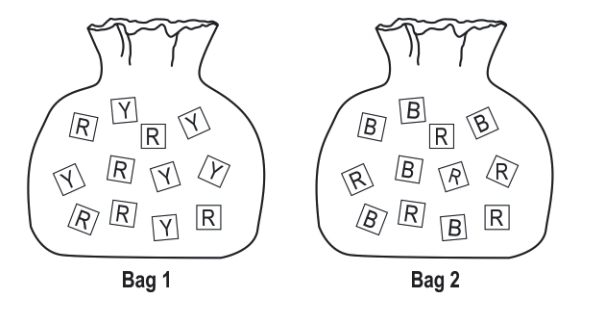
Find the probability of Rohit getting a prize. List all outcomes and show your work.
Soln.
Since, bag 1 has an equal number of red(R) and yellow(Y) cubes.
So, the probability of selecting a red(R) and yellow(Y) cube from the bag 1 are same.
Similarly, bage 2 has an equal number of red(R) and blue(B) cubes.
So, the probability of selecting a red(R) and blue(B) cube from the bage 2 are same.
Let S be the sample space of selecting a cube from each of the bags.
∴ S=RR, RB, YR, YB
⇒ n(S)=4
It is given that, if Rohit picks up atleast one red(R) cube, he gets a prize.
Let A be the event of Rohit getting a prize.
∴ A=RR, RB, YR
⇒ n(A)=3
We know that,
PE=Number of favourable outcomes/Number of possible outcomes
P(A)=¾
Hence, the probability of Rohit getting a prize is ¾
Some More Important Question Answers of Class 10 Maths
Q1. A bag contains 3 red and 5 blue balls. One ball is drawn at random. Find the probability of getting (a) a red ball, (b) not a blue ball.
Solution: Step 1. Total balls = 3 + 5 = 8.
Hence, total number of possible outcomes = 8.
Step 2. (a) Favourable outcomes for red = 3.
P(red) = 3 / 8.
(b) Not blue means red.
Favourable outcomes = 3.
P(not blue) = 3 / 8.
Step 3. Both results agree since P(red) = P(not blue).
Answer: (a) 3/8, (b) 3/8.
Q2. A die is rolled once. Find the probability of getting (a) a number greater than 4, (b) a number less than or equal to 2.
Solution: The sample space is {1, 2, 3, 4, 5, 6}, total = 6.
(a) Numbers greater than 4 = {5, 6} → 2 outcomes.
P = 2 / 6 = 1/3.
(b) Numbers less than or equal to 2 = {1, 2} → 2 outcomes.
P = 2 / 6 = 1/3.
Q3. Two coins are tossed simultaneously. Find the probability of getting (a) two heads, (b) one head, (c) no head.
Solution: Possible outcomes (sample space) = {HH, HT, TH, TT}. Total = 4.
(a) Two heads → {HH}, P = 1/4.
(b) One head → {HT, TH}, P = 2/4 = 1/2.
(c) No head → {TT}, P = 1/4.
Q4. A letter is chosen from the word “MATHEMATICS”. Find the probability of choosing (a) a vowel, (b) a consonant.
Solution: The word MATHEMATICS has 11 letters.
Vowels = A, E, A, I = 4 vowels.
Consonants = 7.
P(vowel) = 4 / 11.
P(consonant) = 7 / 11.
Q5. A die is rolled. Find the probability of getting (a) an even number, (b) a prime number.
Solution: Sample space = {1, 2, 3, 4, 5, 6}, total = 6.
(a) Even numbers = {2, 4, 6} → 3 outcomes.
P(even) = 3 / 6 = 1/2.
(b) Prime numbers = {2, 3, 5} → 3 outcomes.
P(prime) = 3 / 6 = 1/2.
Q6. A card is drawn from a pack of 52 playing cards. Find the probability of getting (a) a red card, (b) a black queen.
Solution: (a) There are 26 red cards (hearts and diamonds).
P(red) = 26 / 52 = 1/2.
(b) Black queens are Queen of spades and Queen of clubs → 2 cards.
P(black queen) = 2 / 52 = 1 / 26.
Q7. Two dice are rolled together. Find the probability of getting a sum of 7.
Solution: Total outcomes = 6 × 6 = 36.
Favourable outcomes = (1,6), (2,5), (3,4), (4,3), (5,2), (6,1) → 6 outcomes.
P(sum = 7) = 6 / 36 = 1 / 6.
Q8. A box has 5 white, 3 red, and 2 black balls. One ball is drawn at random. Find the probability of getting (a) a red ball, (b) a white ball, (c) not a black ball.
Solution: Total = 5 + 3 + 2 = 10.
(a) Red → 3/10.
(b) White → 5/10 = 1/2.
(c) Not black = white or red = 5 + 3 = 8 → 8/10 = 4/5.
Q9. A coin is tossed three times. Find the probability of getting (a) three heads, (b) two heads, (c) at least one head.
Solution: Sample space = {HHH, HHT, HTH, THH, HTT, THT, TTH, TTT}, total = 8.
(a) Three heads → {HHH}, P = 1/8.
(b) Two heads → {HHT, HTH, THH}, P = 3/8.
(c) At least one head → 1 – P(no head) = 1 – 1/8 = 7/8.
Q10. A die is rolled twice. Find the probability that both numbers are odd.
Solution: Odd numbers on die = {1, 3, 5} → 3 outcomes of 6.
P(odd on one roll) = 3/6 = 1/2.
For both odd, multiply: (1/2) × (1/2) = 1/4.
Q11. A bag contains 5 red, 3 green, and 2 blue balls. Two balls are drawn at the same time. Find the probability that both are green.
Ans. Total balls = 10.
Total ways = 10C2 = 45.
Ways to select 2 green = 3C2 = 3.
P(both green) = 3 / 45 = 1 / 15.
Q12. A spinner is divided into 8 equal parts numbered 1 to 8. Find the probability that the pointer stops at (a) an even number, (b) a multiple of 3.
Ans. (a) Even numbers = 2,4,6,8 → 4 outcomes.
P = 4/8 = 1/2.
(b) Multiples of 3 = 3,6 → 2/8 = 1/4.
Q13. A card is drawn at random from a pack. Find the probability that it is (a) a king, (b) a face card, (c) not a face card.
Ans. (a) Kings = 4 → 4/52 = 1/13.
(b) Face cards = 12 → 12/52 = 3/13.
(c) Not face = 1 – 3/13 = 10/13.
Q14. A die is rolled once. Find the probability of getting (a) a multiple of 2 or 3, (b) not a multiple of 3.
Ans. (a) Multiples of 2 or 3 = {2,3,4,6} → 4/6 = 2/3.
(b) Not a multiple of 3 = {1,2,4,5} → 4/6 = 2/3.
Q15. A bag contains 10 tickets numbered from 1 to 10. One ticket is drawn. Find the probability that number is even or a multiple of 5.
Ans. Even numbers = 2,4,6,8,10.
Multiples of 5 = 5,10.
Union = {2,4,5,6,8,10} → 6 numbers.
P = 6/10 = 3/5.
Q16. In a class of 40 students, 15 study mathematics, 10 study science, and 5 study both. If a student is chosen at random, find the probability that he studies (a) only mathematics, (b) only science, (c) both.
Ans. (a) Only maths = 15 – 5 = 10.
(b) Only science = 10 – 5 = 5.
(c) Both = 5.
P(only maths) = 10/40 = 1/4.
P(only science) = 5/40 = 1/8.
P(both) = 5/40 = 1/8.
Q17. A card is drawn from a deck. Find the probability that it is neither red nor a king.
Ans. Red cards = 26, kings = 4, red kings = 2 (common).
Total = 26 + 4 – 2 = 28.
Not red or king = 52 – 28 = 24.
P = 24 / 52 = 6 / 13.
Q18. A bag has 4 black and 2 white balls. Two balls are drawn with replacement. Find the probability that (a) both are black, (b) both are white, (c) one of each.
Ans. Total = 6 balls.
P(black) = 4/6 = 2/3.
P(white) = 2/6 = 1/3.
(a) (2/3)(2/3)=4/9.
(b) (1/3)(1/3)=1/9.
(c) (2/3)(1/3)+(1/3)(2/3)=4/9.
Q19. A fair die is rolled twice. Find the probability that the sum is even.
Ans. When both numbers are odd or both even → sum even.
P(odd)=1/2, P(even)=1/2.
P(sum even)=(1/2)(1/2)+(1/2)(1/2)=1/2.
Q20. One card is drawn from a pack. Find the probability of getting a black card or a king.
Ans. Black cards=26, kings=4, black kings=2 (common).
Total favourable=26+4–2=28.
P=28/52=7/13.
Q21. A die is rolled twice. Find probability that the product is odd.
Ans. Product odd only when both numbers are odd.
P(odd on one roll)=3/6=1/2.
P(product odd)=(1/2)*(1/2)=1/4.
Q22. A bag has 3 red, 2 green, 5 black balls. A ball is drawn and replaced. Then another ball is drawn. Find probability that (a) is both black, (b) one red and one black.
Ans. P(black)=5/10=1/2, P(red)=3/10.
(a) (1/2)(1/2)=1/4.
(b) (3/10)(1/2)+(1/2)*(3/10)=3/10.
Q23. In a lottery of 1000 tickets, one ticket wins a prize. What is the probability of winning?
Ans. Total=1000, favourable=1.
P(win)=1/1000.
Q24. A coin is tossed 4 times. Find the probability of getting exactly 2 heads.
Ans. Total outcomes=16.
Favourable outcomes=number of ways to get 2 heads=4C2=6.
P=6/16=3/8.
Q25. A die is rolled once. Find probability that the number shown is neither divisible by 2 nor by 3.
Ans. Numbers divisible by 2 or 3 = {2,3,4,6}.
Remaining={1,5}.
P=2/6=1/3.
Q26. A bag has 5 red, 3 green, 2 blue balls. A ball is drawn without looking. What is the probability that the ball is blue or green?
Ans. Total=10.
Favourable=3+2=5.
P=5/10=1/2.
Q27. Two dice are rolled. Find the probability that the sum is greater than 10.
Ans. Possible sums >10 are 11 and 12.
Sum=11 → (5,6),(6,5) →2 outcomes.
Sum=12 → (6,6) →1 outcome.
Total favourable=3.
P=3/36=1/12.
Q28. A die is rolled. Find the probability that the square of the number obtained is less than 20.
Ans. Possible outcomes=1–6.
Squares=1,4,9,16,25,36.
Favourable={1,2,3,4} →4/6=2/3.
Q29. A bag has 4 red, 3 blue, 3 green marbles. Two marbles are drawn at random. Find probability both are of same color.
Ans. Ways total=10C2=45.
Red same=4C2=6, Blue=3C2=3, Green=3C2=3.
Total favourable=12.
P=12/45=4/15.
Q30. A coin is tossed once. Find the probability of getting a tail or head.
Ans. All outcomes={H,T}. Both are favorable.
P=2/2=1.
Q31. A class has 30 students, 18 are boys and 12 are girls. A student is chosen at random. Find probability it is a girl.
Ans. P(girl)=12/30=2/5.
Q32. In a class test, 20 students passed and 5 failed. Find the probability that the chosen student failed.
Ans. Total=25, failed=5.
P=5/25=1/5.
Q33. A bag contains 3 white and 7 black balls. One ball is drawn. Find the probability of getting a white ball.
Ans. Total=10, white=3.
P=3/10.
Q34. A card is drawn from a pack. Find the probability that it is a red face card.
Ans. Red suits are hearts and diamonds.
Each has 3 face cards → total 6.
P=6/52=3/26.
Q35. A die is rolled. Find the probability that the number obtained lies between 2 and 6.
Ans. Numbers between 2 and 6 = {3,4,5} → 3 outcomes.
Total = 6.
P = 3/6 = 1/2.
EXTRA QUESTIONS FOR PRACTICE!
Q1. A die is thrown. Find the probability of getting an even prime number.
Q2. A card is drawn from a deck. Find probability it is a club.
Q3. Two coins are tossed together. Find the probability of getting exactly one tail.
Q4. A bag contains 2 red and 4 blue marbles. Find the probability that the drawn marble is blue.
Q5. A spinner numbered 1–10 is spun. Find probability that the pointer lands on a number divisible by 4.
Q6. A die is rolled twice. Find the probability that sum is equal to 5.
Q7. A card is drawn. Find the probability of getting a black face card.
Q8. A bag has 6 black and 2 white balls. Two are drawn without replacement. Find probability both are white.
Q9. A coin is tossed 5 times. Find the probability of getting all heads.
Q10. One card is drawn from 52. Find probability it is not a king
How to Ace These Class 10 Probability Important Questions
This chapter focuses on logic and application. Here’s a simple plan to master it:
Step 1: Understand Key Terms
- Experiment: An action or operation that produces a set of outcomes (e.g., tossing a coin).
- Trial: Performing an experiment once.
- Outcome: Result of an experiment (e.g., getting heads).
- Event: A set of outcomes (e.g., getting an even number when rolling a die).
- Sample Space: The collection of all possible outcomes of an experiment.
Step 2: Learn the Basic Probability Formula
Probability of an event (P) = Number of favourable outcomes ÷ Total number of possible outcomes
Step 3: Understand Complementary Events
If event A occurs, its complement A' means A does not occur.
The sum of both probabilities is always 1:
P(A) + P(A') = 1
Step 4: Practise Common Situations
Be thorough with problems involving:
- Tossing of coins
- Rolling of dice
- Drawing cards from a deck
- Selection of items (balls, marbles, etc.)
Step 5: Learn the Concept of Mutually Exclusive and Exhaustive Events
- Mutually Exclusive: Two events that cannot happen together (e.g., getting heads and tails at the same time).
- Exhaustive Events: All possible outcomes combined (their total probability equals 1).
Step 6: Avoid Common Mistakes
Clearly identify total outcomes and favourable outcomes before applying the formula. Miscounting outcomes is a frequent error in exam questions.
Step 7: Practise Word Problems
Work on real-world examples involving probability of selection, replacement, and multiple trials to build deeper understanding.
Why Extra Questions Are Necessary for Ch14 Maths Mastery?
NCERT Textbook Class 10 Mathemetics questions provide an introduction to probability, but extra questions are where real understanding begins. Extra questions on probability for CBSE Class 10 often involve complex scenarios and multi-step problems, which necessitate a deeper understanding of the subject. These extra questions serve several purposes:
- They introduce students to various types of probability questions, helping them apply different strategies and formulas.
- Extra questions push students beyond typical textbook problems, allowing them to approach challenging concepts with confidence and fluency.
- Exam questions can vary in difficulty, and handling extra questions from Probability Class 10 provides students with a sense of what to expect. It’s a form of pre-exam practice that strengthens time management and analytical thinking.
- Extra questions often involve real-life scenarios or abstract setups that require students to visualize, interpret, and calculate probabilities from scratch. This process builds the foundation for more advanced studies in mathematics and data science.
How to Approach Probability Class 10 Extra Questions?
Extra questions can seem intimidating, but a strategic approach can make them manageable and even enjoyable. Here are some practical tips for handling probability extra questions effectively:
- In probability, visualizing the scenario can be very helpful. If the problem involves rolling dice, drawing cards, or selecting colored balls, sketching the setup can provide a clearer picture of possible outcomes and events. For example, if a question involves selecting cards from a deck, it can help to think of the suits, ranks, and specific counts.
- Probability-extra questions often require multiple steps to arrive at a solution. For example, calculating the probability of drawing two specific cards in succession may involve conditional probabilities or combinations. Divide the problem into smaller parts and solve each step individually to avoid feeling overwhelmed.
- Understanding whether an event is independent or dependent is crucial. Independent events are unaffected by previous outcomes, such as flipping a coin multiple times. Conversely, previous results influence dependent events, such as drawing cards without replacement. Recognizing these distinctions allows students to apply the right probability formulas.
Practice Different Formulas and Scenarios
In probability, various formulas apply to different situations, such as:
- The Addition Rule is useful when calculating the probability of one event or another occurring.
- The Multiplication Rule is applied when calculating the probability of two independent events occurring in sequence.
- The Complementary Rule applies when determining the likelihood of an event not occurring.
These formulas are often incorporated in probability extra questions, which require students to select the appropriate formula based on the specific context.
Frequently Asked Questions
Q1. How many marks are allotted to this chapter in Class 10 board exams?
Ans. This chapter generally carries 7 to 8 marks, usually through 2- and 3-mark questions.
Q2. What is the most important formula in this chapter?
Ans. P(E) = (Number of favourable outcomes) ÷ (Total number of possible outcomes).
Q3. What type of probability is studied in Class 10?
Ans. Theoretical (mathematical) probability, based on reasoning rather than experimentation.
Q4. How can I avoid mistakes in probability questions?
Ans. Write the sample space first and count favourable outcomes carefully. Avoid double-counting or missing outcomes.
Q5. Are there any tricks to solve questions faster?
Ans. Yes, use complement probabilities (like P(not A) = 1 – P(A)) and symmetry in coin and dice problems to save time.











.svg)

