.svg)

Areas Related to Circles is one of the most scoring topics in Class 10 Mathematics Syllabus. Once you understand the formulas and how to apply them in different situations, questions become very straightforward. This chapter deals with finding areas and perimeters of circles, sectors, segments, and combinations of circular shapes.
To help you prepare smarter, here are the Important Questions for Areas Related to Circles, curated according to the latest CBSE pattern. These questions focus on the types that appear most often in exams and help you practise calculations, diagrams, and logic all together.
IMPORTANT QUESTIONS CLASS 10
(Most Important Questions of this Chapter from our 📕)
In the table below, we have provided the links to downloadable Areas Related to Circles Class 10 Important Questions with Answers PDFs. Now you can download them without requiring a login.

Ch11 Areas Related to Circles Important Questions Class 10
1. Shown below are two pendulums of different lengths attached to a bar.
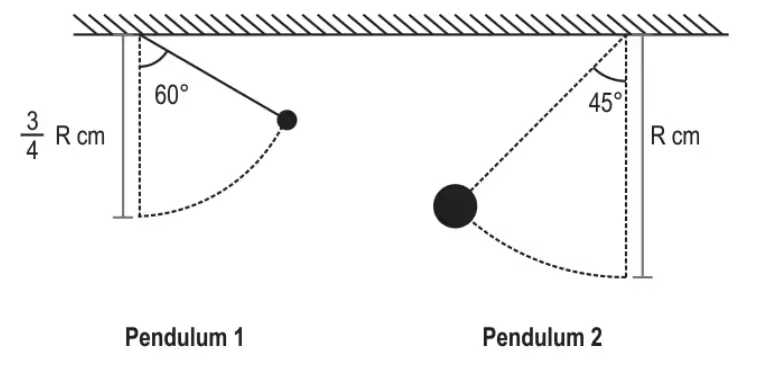
(Note: The figure is not to scale.)
Based on the figure shown above, the arc length of pendulum 1 is length of pendulum 2. a. greater than
b. lesser than
c. equal to
d. (cannot be answered without knowing the value of R.)
Soln.
(c) equal to
Explanation:
Arc length =θ/360°×2πr
Pendulum 1 arc length:
⇒60°/360°×2π×3/4R
⇒1/6×π×3/2R
⇒π/4R
Pendulum 2 arc length:
⇒45°/360°×2πR
⇒18×2πR
⇒π/4R
Both the arc length are equal.
∴ The arc length of pendulum 1 is equal to the arc length of pendulum 2.
2. The figure below is a part of a circle with centre O. Its area is 1250π/9 cm2 and the 10 sectors are identical.
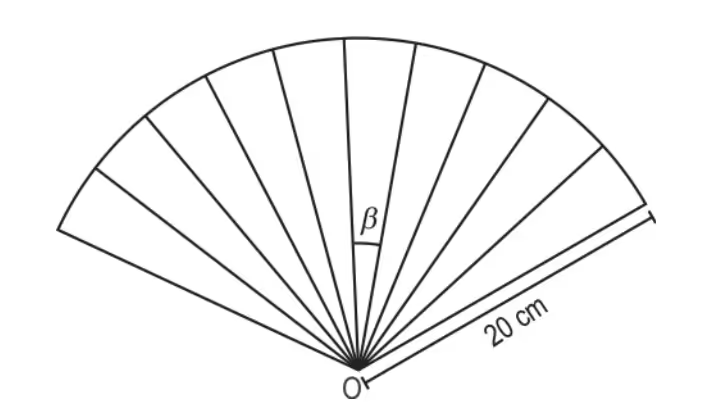
(Note: The figure is not to scale.)
Find the value of ß, in degrees. Show your steps.
Soln.
Given, area =1250π/9cm2
We know that Area of a sector=θ/360°×πr2
1250π/9=θ/360×π×202
1250/9=
θ/360×202 (1250×360/9×400)=θ
⇒θ=125°
⇒β=125/10
=12.5°
Hence, the required answer is 12.5°
3. A cow is tied at one of the corners of a square shed. The length of the rope is 22 m. The cow can only eat the grass outside the shed as shown below.
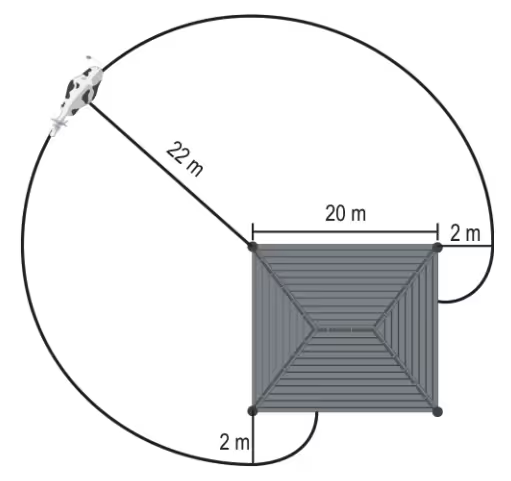
(Note: The figure is not to scale.)
What is the area that the cow can graze on? Show your steps.
(Note: Give the answer in terms of π.)
Soln.
Area that the cow can graze on =3quarter sector with radius 22m +2one quarter sector with radius 2m
⇒3/4×π×222+2/4×π×22
⇒363π+2π
⇒365π m2
4. Ramit drew two circles of different radii. Each of them had an arc that subtended an equal angle at the centre.
He said, "Both arcs are of the same length".
i) Is Ramit right?
ii) If both radii and angles subtended by the two arcs are different, can the arc lengths be the same?Give valid reasons.
Soln.
Arc length =x/360°×circumference of circle
i) Given that two circles are drawn with different radii and same central angle. So, the arc lengths of these two circles will also be different.
Therefore, Ramit is not right as the arc length depends on the radius of the circle.
ii) If both radii and angles subtended by the two arcs are different, the arc lengths can be same when the product of measure of the angle and radius is the same for both circles.
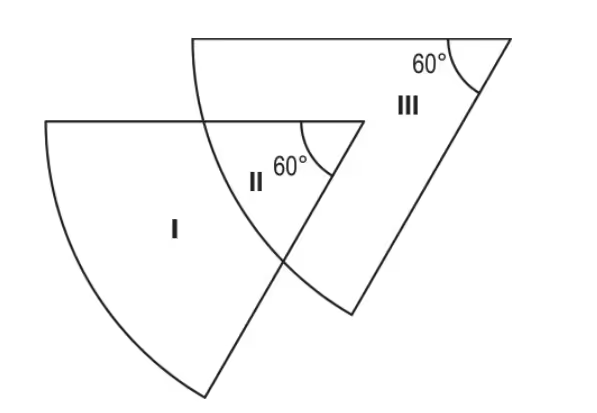
5. Shown below are two overlapping sectors of a circle. The radii of the sectors are 6 cm and 8 cm. The figure is divided into three regions - I, II and III.
(Note: The figure is not to scale.)
Find the difference in the areas of regions I and III. Show your work.
(Note: Take π = 22/7)
Soln.
Radii of sectors= 6 cm and 8 cm
Therefore, we get:
The area of the sector with radius 8 cm=
60/360×π×82
= 64π/6 cm2
The area of the sector with radius 6 cm= 60/360×π×62
= 36π/6 cm2
Now, to find the difference in the areas of regions I and III.
The difference in the areas of regions I and III= Area of regions(I+II)-area of regionsII+III
= 64π/6-36π/6
= (28×22/6×7)
= 443 cm2
Hence, the required answer is 443 cm2.
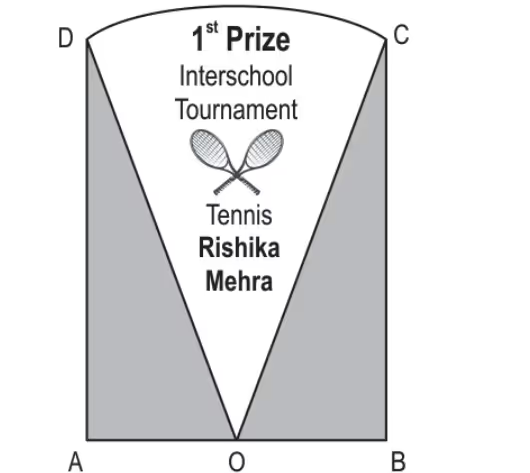
6. Shown below is the trophy shield Rishika received on winning an interschool tennis tournament.
(Note: The figure is not to scale.)
The trophy is made of a glass sector DOC supported by identical wooden right triangles, △DAO and △COB. AO = 7 cm and AO:DA = 1:√3.
Find the area of:
i) the glass sector correct to 2 decimal places.
ii) the wooden triangles correct to 2 decimal places.
Show your steps.
(Note: Take п as 22/7 and √3 as 1.73.)
Soln.
In ∆DOA,
Let ∠DOA=θ⇒tan θ=DA/OA=√3/1
⇒tan θ=√3⇒θ=60°
∴∠DOA=∠COB=60°
∠DOA+∠COB+∠DOC=180°Angles in a straight line⇒∠DOC=180°-60°-60°⇒∠DOC=60°
We know that cos 60°=AO/DO
⇒1/2=7/DO⇒DO=14 cm
Given, AO=7 cm, AO:DA=1:3
⇒7/DA=1/√3⇒DA=7√3cm
Area of the glass sector =θ360×πr2
⇒60°/360×π×142⇒16×π×196⇒102.67 cm2
Area of the wooden triangle =12×b×h
Area of the wooden triangles=12×7×73×2=84.77 cm2
Some More Important Questions Answers of Class 10 Maths Areas Related to Circles
Q1. Define circumference and area of a circle.
Solution: A circle is a closed curve where every point is at the same distance (called the radius) from a fixed point called the centre.
- Circumference: The total length around the circle.
Formula → Circumference = 2πr - Area: The total space enclosed within the circle.
Formula → Area = πr²
Here, π (pi) = 22/7 or 3.14 (approx)
r = radius of the circle
Q2. Find the circumference and area of a circle of radius 7 cm.
Solution: Given: Radius (r) = 7 cm
Step 1: Find circumference
Circumference = 2πr
= 2 × (22/7) × 7
= 44 cm
Step 2: Find area
Area = πr²
= (22/7) × 7 × 7
= 154 cm²
Answer:
Circumference = 44 cm
Area = 154 cm²
Q3. Find the area of a semicircle of diameter 14 cm.
Solution: Radius r=7r = 7r=7 cm.
Area of full circle = πr2=154\pi r^2 = 154πr2=154.
Area of semicircle = ½ × 154 = 77 cm².
Q4. A wheel of radius 21 cm completes 100 revolutions. Find the distance covered.
Solution: Distance covered in 1 revolution = circumference = 2πr = 2×(22/7)×21 = 132 cm.
So for 100 revolutions:
Distance = 132 × 100 = 13,200 cm = 132 m.
Q5. Find the length of the arc of a sector with central angle 90° and radius 14 cm.
Solution: Arc length = (θ / 360) × 2πr
= (90 / 360) × 2 × (22/7) × 14
= (1/4) × 88
= 22 cm
Answer: 22 cm
Q6. Find the area of a quadrant of a circle whose radius is 14 cm.
Solution: Area of quadrant = (θ / 360) × πr²
= (90 / 360) × (22/7) × 14 × 14
= (1/4) × (22/7) × 196
= 154 cm²
Answer: 154 cm²
Q7. The circumference of a circle is 132 cm. Find its radius and area.
Solution: Circumference = 2πr = 132 → r=132/(2×22/7)=21r = 132 / (2 × 22/7) = 21r=132/(2×22/7)=21 cm.
Area = πr² = 22/7 × 21 × 21 = 1386 cm².
Answer: Radius = 21 cm, Area = 1386 cm².
Q8. Find the area of a sector whose radius is 6 cm and central angle is 120°.
Solution: Area = (120/360) × πr² = (1/3) × 3.14 × 6 × 6 = 37.68 cm².
Answer: 37.7 cm².
Q9.A path 2 m wide is built outside a circular garden of radius 35 m. Find the area of the path.
Solution: Radius of garden = 35 m
Outer radius = 35 + 2 = 37 m
Area of path = π(R² – r²)
= (22/7)(37² – 35²)
= (22/7)(1369 – 1225)
= (22/7) × 144
= 3168 ÷ 7
= 452.6 m²
Answer: 452.6 m²
Q10. The area of a circle is 154 cm². Find its circumference.
Solution: Area = πr² → 154 = 22/7 × r² → r² = 49 → r = 7 cm.
Circumference = 2πr = 44 cm.
Answer: 44 cm.
Q11. Find the area of the major sector of a circle of radius 10 cm when its minor sector has angle 60°.
Solution: Area of full circle = πr² = 3.14×100 = 314 cm².
Minor sector = (60/360) × 314 = 52.33 cm².
Major sector = 314 – 52.33 = 261.67 cm².
Q12. Find the area of a segment of a circle of radius 7 cm if the central angle is 60°.
Solution: Area of sector = (60/360) × πr² = (1/6) × 22/7 × 7 × 7 = 25.67 cm².
Area of triangle = ½ × r² × sinθ = ½ × 7² × sin60° = 24.5 × 0.866 = 21.2 cm².
Segment area = 25.7 – 21.2 = 4.5 cm².
Q13. A horse is tied to a rope 10 m long at a corner of a square field of 20 m. Find a grazing area.
Solution: Area grazed = area of quadrant of circle = (¼)πr² = (¼)×3.14×10² = 78.5 m².
Answer: 78.5 m².
Q14. A sector of a circle with radius 6 cm has area 54π cm². Find the angle of the sector.
Solution: Area = (θ/360) × πr²
→ 54π = (θ/360) × π × 6²
→ 54 = (θ/360) × 36 → θ = (54×360)/36 = 540°.
But since 540° > 360°, this means it covers more than one revolution → check again:
If area = 54 cm² (not 54π), then
54 = (θ/360) × π×6²
→ θ = (54×360)/(π×36) = 540/π ≈ 172°.
Answer: 172° (approx).
Q15. Find the area of the shaded portion between two concentric circles with radii 10 cm and 6 cm.
Solution: Area = π(R² – r²) = 3.14(100 – 36) = 3.14×64 = 200.96 cm².
Answer: 200.96 cm².
Q16. The diameter of a wheel is 84 cm. How many revolutions will it make in covering 792 m?
Solution: Circumference = πd = 22/7 × 84 = 264 cm.
Distance = 792 m = 79200 cm.
No. of revolutions = distance / circumference = 79200 / 264 = 300.
Q17. Find the area of the largest circle that can be drawn inside a square of 14 cm.
Solution: Radius = half of side = 7 cm.
Area = πr² = 22/7 × 7 × 7 = 154 cm².
Answer: 154 cm².
Q18. Find the area of the circle circumscribing a triangle of sides 8 cm, 6 cm, and 10 cm.
Solution: Since 82+62=1028^2 + 6^2 = 10^282+62=102, it's a right-angled triangle.
Circumcircle passes through all vertices → hypotenuse = diameter = 10 cm → radius = 5 cm.
Area = πr² = 3.14×25 = 78.5 cm².
Q19. A chord of a circle of radius 15 cm subtends angle 60° at centre. Find the area of the minor segment.
Solution: Area of sector = (60/360)×π×15² = (1/6)×3.14×225 = 117.75 cm².
Area of triangle = ½×r²×sin60° = ½×225×0.866 = 97.4 cm².
Area of minor segment = 117.8 – 97.4 = 20.4 cm².
Q20. A garden is in the shape of a sector of a circle of radius 20 m and angle 72°. Find its area and perimeter.
Solution: Area = (72/360)×πr² = (1/5)×3.14×400 = 251.2 m².
Perimeter = 2r + arc length = 40 + (72/360)×2πr = 40 + (1/5)×2×3.14×20 = 40 + 25.12 = 65.12 m.
Extra Questions for Practice!
Q1. Find the area of a circle whose circumference is 44 cm.
Q2. A circular pond has a radius of 10 m. Find the cost of fencing it at ₹5 per metre.
Q3. A wheel of diameter 84 cm rotates 500 times. Find distance covered.
Q4. Find the area of the ring formed between circles of radii 14 cm and 7 cm.
Q5. Find the area of a sector of radius 7 cm with angle 60°.
Q6. Find the area of the largest circle inside a rectangle of 14 cm × 7 cm.
Q7. Find the area of the minor segment of a circle of radius 14 cm when the angle at centre is 90°.
Q8. A horse tied to a 14 m rope at the corner of square field (side 28 m). Find a grazing area.
Q9. A path 2 m wide is built outside a circular garden of radius 35 m. Find the area of the path.
Q10. The area of a circle is 154 cm². Find diameter and circumference.
Benefits of Practising Areas Related to Circles Important Questions
1. Formula Mastery
Regular practice helps you remember important formulas like circumference, area of a circle, area of a sector, and area of a segment. You will know exactly when to use which formula.
2. Strong Application Skills
The chapter involves real-life applications such as finding the area of pathways, fields, wheels, and circular designs. Practising questions improves your ability to apply formulas to practical situations.
3. Improved Calculation Speed
Most questions involve pi, radius, diameter, and simple geometry. The more you practise, the faster and more accurate your calculations become during exams.
4. Full Coverage of Exam Types
Important questions include one-mark, two-mark, three-mark, and case-based questions. This helps you understand the weightage and style of questions that CBSE prefers.
5. Higher Confidence During Boards
Once you solve a variety of problems, the chapter feels predictable. You walk into the exam knowing that these questions can fetch easy marks if you stay confident and calm.
Tips to Use These Questions Effectively
- Revise all formulas first
Note down formulas for circle area, circumference, area of a sector, and area of a segment and revise them daily.
- Draw diagrams for every question
Even if the diagram is given, redraw it in your notebook. Visualising the shape helps you understand the problem faster.
- Convert all values carefully
Check whether the question gives radius or diameter. Many mistakes happen because students forget to divide by 2.
- Solve easy questions first, then move to tricky ones
This builds confidence and strengthens your base before attempting higher-order problems.
- Use fixed values of pi consistently
If the question does not specify, use 22 by 7 for fractions or 3.14 for decimals. Keep the value constant to avoid confusion.
- Practise writing clear steps
CBSE awards marks for steps. Even if the final answer is slightly off, correct steps can still earn partial marks.
Why Mastering This Ch11 Is Essential for Class 10 Maths Students?
- Geometry, and particularly circle-related calculations, are fundamental for higher mathematics. This chapter sets the stage for more advanced topics that students will encounter in future studies.
- In the Class 10 board exams, questions from this chapter and Areas Related to Circles Class 10 Extra Questions with Answers are commonly asked. These can range from direct calculations of areas and perimeters to complex word problems involving sectors and segments. Mastery of this topic can significantly boost your overall math score.
- Learning how to calculate the areas of circles and their parts enhances your problem-solving skills. These skills extend beyond the classroom and are useful in everyday tasks, as well as in technical fields like engineering and architecture.
- Many complex shapes in geometry can be broken down into circles or parts of circles. Being able to calculate the area and perimeter of these basic components makes it easier to tackle composite shapes.
FAQ’s
Q1. Which formulas are most important in Areas Related to Circles?
Ans. The formulas for circumference, area of a circle, area of a sector, and area of a segment are the most important for exams.
Q2. Is this chapter scoring in the board exam?
Ans. Yes. Most questions are formula based. With practice, students can easily score full marks in this chapter.
Q3. Should I use 22 by 7 or 3.14 for pi?
Ans. Both are correct. If the question does not specify, you can choose either value based on convenience.
Q4. How do I avoid mistakes in these questions?
Ans. Always check whether the question gives radius or diameter and make sure your units remain consistent throughout the solution.
Q5. Do diagrams help in solving problems?
Ans. Yes. Drawing diagrams makes the problem clearer and helps you visualise which parts of the circle are included or excluded.














.svg)

