
.svg)

The chapter Circles is one of the most fundamental and easy-to-score topics in Mathematics Syllabus Class 10. It builds on your earlier understanding of circles from lower classes and focuses on tangents, their properties, and related theorems.
This chapter explains how tangents behave when drawn to a circle from an external point, helping you understand geometrical relationships and reasoning. Since the theorems are direct and proof-based, clear conceptual understanding can help you score full marks easily.
The Circles Important Questions for Class 10 Mathematics help you:
- Strengthen your understanding of tangents and secants.
- Learn key theorems and their step-by-step proofs.
- Practise reasoning-based and application-oriented questions effectively.
IMPORTANT QUESTIONS CLASS 10
(Important Questions of this Chapter from our 📕)
In the table below, we have provided the links to downloadable Extra Questions for Class 10 Maths Circles with Solutions PDFs. Now you can download them without requiring a login.

Ch10 Circles Important Questions Maths 2026
1. In the figure below, ΔPXY is formed using three tangents to a circle centred at O.
(Note: The figure is not to scale.)
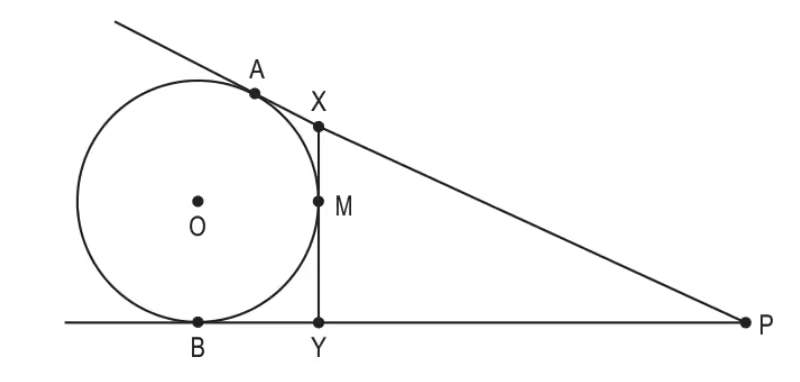
Based on the construction, the sum of the tangents PA and PB is the perimeter of ΔPXY.
a. lesser than
b. greater than
c. equal to
d. (cannot be answered without knowing the tangent lengths)
Soln. (c) equal to
Explanation: As PA, PB and XY are the tangents. So, XA, XM, YM, and YB are also tangents because these are the line segments of the whole tangents.
And we know that if from one external point, two tangents are drawn to a circle, then they have equal tangent segments. Therefore,
XA=XM .....(1)
YM=YB .....(2)
Now, the perimeter of ∆PXY is=PX+XY+YP
=PX+(XM+YM)+YP
=PX+(XA+YB)+YP (From equation 1 and 2)
=(PX+XA)+(YB+YP)
=PA+PB (From the figure)
Hence, the sum of the tangents PA and PB is equal to the perimeter of ∆PXY.
2. A circle has a centre O and radii OQ and OR. Two tangents, PQ and PR, are drawn from an external point, P.
In addition to the above information, which of these must also be known to conclude that the quadrilateral PQOR is a square?
i) OQ and OR are at an angle of 90°.
ii) The tangents meet at an angle of 90°.
a. only i)
b. only ii)
c. either i) or ii)
d. both i) and ii)
Soln. (c) either i) or ii)
Explanation: We have to find the conditions which conclude that the quadrilateral PQOR is a square.
We know that a square has four equal sides and each angle as right angle.
We also know that the tangent to the circle is perpendicular to the radius of the circle at the point of contact.
So, ∠OQP=ORP=90°.
Now, if third angle is also 90°, then the fourth angle will be 90° because the sum of angles of a quadrilateral is 360°. Therefore,
If ∠QOR=90° (when radii are at angle of 90°) or ∠QPR=90° (when the tangents meet an angle of 90°), then the quadrilateral PQOR is a square.
Hence, either (i) or (ii) information must be known.
3. ABCD is a square. CD is a tangent to the circle with centre O as shown in the figure below.
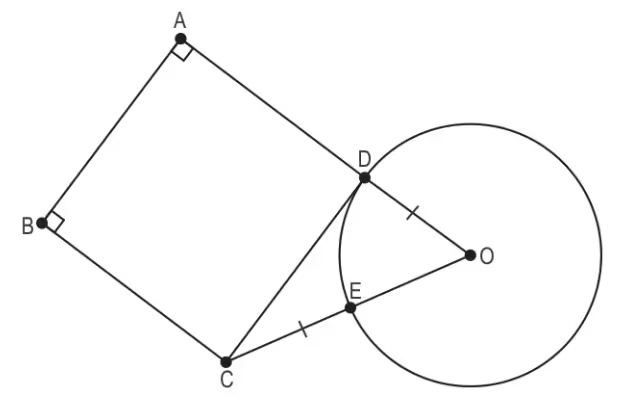
(Note: The figure is not to scale.)
If OD = CE, what is the ratio of the area of the circle and the area of the square?
Show your steps and give valid reasons.
Soln. Given, A circle with centre O is drawn such that CD is the tangent to the circle such that OD=CE
We know that
Area of the square =s2
Area of circle =πr2
Let the side of square is 's’ and 'r' be the radius of circle.
In triangle DOC:
OD2+DC2=OC2
⇒r2+s2=2r2⇒r2+s2=4r2⇒s2=3r2⇒s=3r
∴Area of circle/Area of square=πr2/s2
Substitute the value of s in the formula.
⇒πr23r2=π3
Hence, the required ratio is π:3.
4. Shown below is a circle with centre O and radius 5 units. PM and PN are tangents, and the length of chord MN is 6 units.
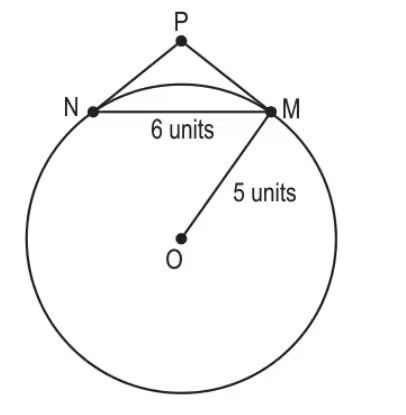
(Note: The figure is not to scale.)
Find the length of (PM + PN). Show your work.
Soln. Connect P to O intersecting MN at T.
We know that OT bisects the chord MN at T.
∴ MT=NT=3 cm
In ∆OTM,
OM2=MT2+OT2
OT2=52-32
OT2=25-9
OT2=16
OT=4 units
Let us consider PM=x units, PT=y units
In ∆PTM,
PM2=PT2+TM2
x2=y2+32
x2-y2=9
In ∆PMO,
PO2=PM2+MO2
⇒x2+25=y+42
⇒x2+25=y2+8y+16
⇒x2-y2=8y-9
Substitute the value of x2-y2, we get
⇒9=8y-9
⇒8y=18
∴y=9/4 units
Substitute y to find the value for x
x2-942=9
x2=9+8116
x2=22516
⇒x=154
We know that two tangents drawn through an external point are equal.
⇒PM=PN
∴PM+PN
=154+154=304
⇒PM+PN
=7.5 units
Hence, the required answer is 7.5 units.
5. Shown below is a circle with centre O. VP = 34 cm, PR and S are the points of tangency.
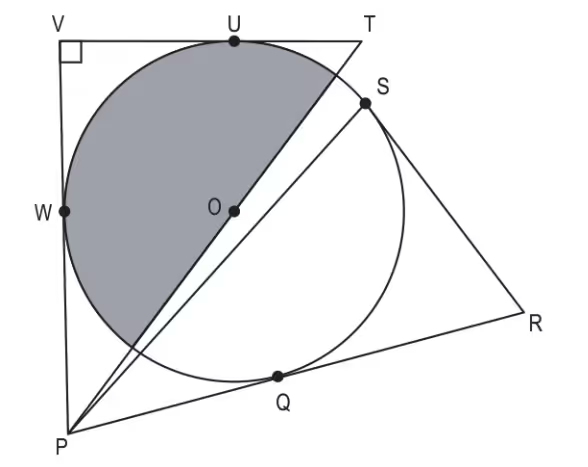
(Note: The figure is not to scale.)
Find the area of the shaded region in terms of π. Show your steps and give valid reasons.
Soln. Given, VP = 34 cm, PR = 36 cm and RS = 17 cm.
We know that if two tangents are drawn to a circle from an external point then they are equal.
∴RS=RQ
⇒RS=RQ=17 cm
⇒PQ=PR-QR
=36 -17
∴PQ=19 cm
PQ and PW are the tangents drawn from an external point. So, they are equal.
⇒PQ=PW
=19 cm
VW and VU are the tangents drawn from an external point. So, they are equal.
⇒VW=VP-PW
=34cm-19cm
⇒VW=15cm
∴VW=VU=15cm
We know that radius is perpendicular to the tangent. So,∠VWO=∠VUO=90°
∴VWOU is a square.
⇒VW=WO=OU=UV=15 cm
Area of a semicircle =πr2/2
⇒π×15×15/2
=112.5π cm2
Hence, the required answer is 112.5π cm2.
6. In the figure below, a circle with centre O is inscribed inside ΔLMN. A and B are the points of tangency.
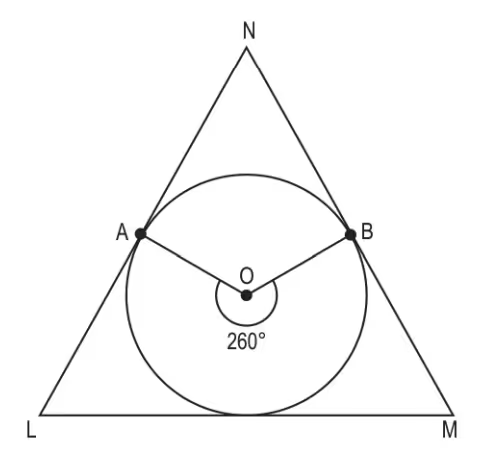
(Note: The figure is not to scale.)
(Note: The figure is not to scale.)
Find ∠ANB. Show your steps.
Soln. Given, major∠AOB=260°
Minor ∠AOB=360°-260°=100°
We know that radius and tangent are perpendicular. So,
∠NAO=∠NBO=90°
In a quadrilateral NAOB,
∠NAO+∠AOB+∠NBO+∠ANB=360°
90°+100°+90°+∠ANB=360°
∠ANB=360°-280°
⇒∠ANB=80°
Hence, the value of ∠ANB is 80°.
7. A point is 25 cm from the centre of a circle of radius 15 cm.
Find the length of the tangent from the point to the circle. Show your steps.
Soln. Given, radius =15cm
Let OB be radius and PB is a tangent.
Now we know that radius is perpendicular to point of contact
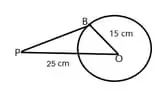
OB is perpendicular to PB
Hence ∠PBO=90°
Consider ∆PBO
Using Pythagoras theorem
PB2+OB2=PO2
PB2+152=252
PB2+225=625
PB2=625-225
PB2=400
PB=√400
PB=20 cm
Hence, the length of the tangent from the point to the circle is 20 cm.
8. In the figure below, PQ and RQ are tangents to the circle with centre O and radius 6√3 cm.
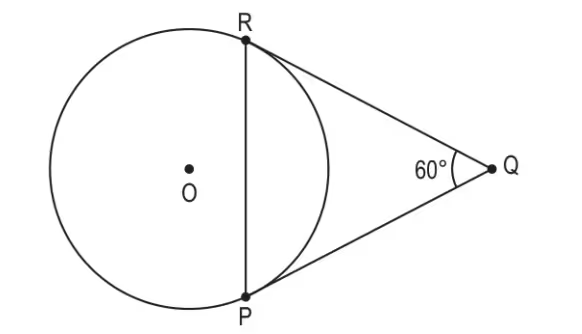
(Note: The figure is not to scale.)
i) Prove that APQR is an equilateral triangle.
ii) Find the length of RP. Show your steps along with a diagram and give valid reasons.
Soln. Given that PQ and RQ are tangents drawn from an external point Q and ∠PQR=60°
We know that the lengths of the tangents drawn from an external point to a circle are equal.
∴PQ=RQ
⇒△PQR is an isosceles triangle.
Let ∠QPR=∠QRP=x°
∴∠PQR+∠QPR+∠QRP=180°
⇒60°+x+x=180°⇒2x=120°
⇒x=60°
All the angles are equal to 60°.
∴△PQR is an equilateral triangle.
ii) To find the length of RP we join OP and OQ
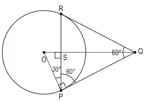
We know that radius is perpendicular to tangent. So, ∠OPQ=90°
⇒∠OPS=∠OPQ-∠QPR
⇒∠OPS=90-60=30°
Given that radius is 6 cm
In △OPS,
cos 30°=PS/OP
√3/2=PS/6
⇒PS=33 cm
We know that the perpendicular from the centre of a circle to a chord bisects the chord. So, RP=2 PS=63 cm.
9. Shown below is an ΔPQR inscribed in a semicircle.
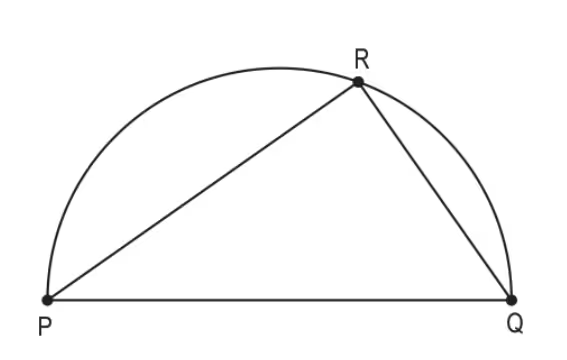
A circle is drawn such that QR is tangent to it at the point R.
How many such circles can be drawn? Justify your answer
Soln. Infinite circles can be drawn such that QR is a tangent at point R.
We know that ∠PRQ = 90° because it is the angle in a semicircle and also the radius is perpendicular to the tangent at the point of contact.
∴ Infinite circles can be drawn with their radii lying on extended PR and R being a point on the circumference of the circle .
10. In the figure below, O is the centre of two concentric circles. APQR is an equilateral triangle such that its vertices and sides touch the bigger and smaller circles respectively. The difference between the area of the bigger circle and the smaller circle is 616 cm2.
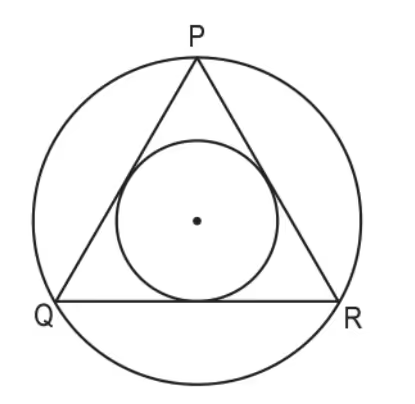
(Note: The figure is not to scale.)
Find the perimeter of APQR. Draw a rough diagram, show your work and give reasons.
(Note: Take π as 22/7)
Soln. Join from centre O to points P and S.
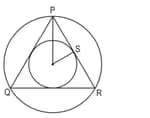
∴ πOP2-OS2=616 cm2
⇒OP2-OS2
=616π
=196 cm2
In ∆OPS, using Pythagoras' theorem, we get
OP2-OS2=PS2
∴PS2=196
PS=14 cm
We know that a perpendicular from the centre of a circle bisects th chord.
⇒PR=2×PS=28 cm
Given that ∆PQR is an equilateral triangle.
Perimeter =3×side length
⇒3×28
⇒84 cm
Hence, the required perimeter is 84 cm.
Some More Important Question Answers of Class 10 Maths Circle
Q1. State the tangent-secant theorem (or alternate segment theorem).
Answer: The tangent-secant theorem (also called the alternate segment theorem) states: If a tangent is drawn to a circle and a chord is drawn through the point of contact, then the angle formed between the tangent and the chord is equal to the angle made by the chord in the alternate segment.
Q2. Prove that the tangent to a circle is perpendicular to the radius at the point of contact.
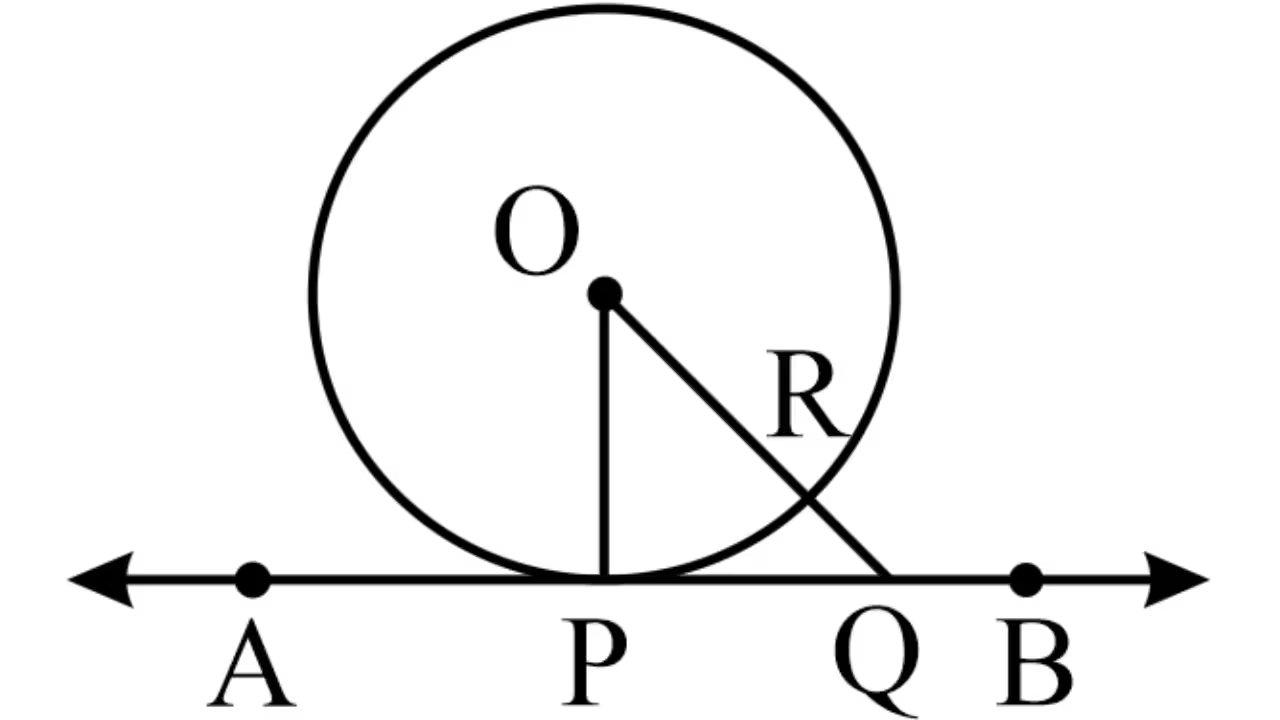
Answer: Let O be the centre of the circle, P a point on the circle, and PQ a tangent at P. Draw radius OP.
Suppose OP is not perpendicular to PQ. Then OP will meet PQ at some point other than P, say R. This means R lies inside the circle, contradicting the fact that tangent meets circle at exactly one point.
Hence, OP ⟂ PQ.
Diagram:
Q3. From an external point, how many tangents can be drawn to a circle? Explain.
Answer:
- Case 1: From a point outside the circle → 2 tangents can be drawn.
- Case 2: From a point on the circle → only 1 tangent.
- Case 3: From a point inside the circle → no tangent.
This is because a tangent touches the circle at exactly one point.
Q4. Two tangents are drawn to a circle from an external point. Prove that they are equal in length.
Answer: Let O be centre, P external point, PA and PQ tangents.
Join OA, OQ, OP.
ΔOAP and ΔOQP are right-angled (radius ⟂ tangent).
OA = OQ (radii), OP = OP, ∠OAP = ∠OQP = 90°.
So, ΔOAP ≅ ΔOQP (RHS rule).
Hence, PA = PQ.
Diagram:
.avif)
Q5. The length of tangent from a point 15 cm away from the centre of a circle is 12 cm. Find the radius of the circle.
Answer: Right triangle formed: radius r, tangent 12, distance OP = 15.
Using Pythagoras:
r² + 12² = 15²
r² + 144 = 225
r² = 81 → r = 9 cm.
Answer: Radius = 9 cm.
Q6. If two tangents are drawn to a circle from an external point, prove that the line joining the external point to the centre bisects the angle between the tangents.
Answer: Let O = centre, P = external point, PA and PB = tangents.
Join OA, OB, OP.
In ΔOAP and ΔOBP:
OA = OB (radii),
OP = OP (common side),
PA = PB (proved).
So ΔOAP ≅ ΔOBP.
Thus, ∠APO = ∠BPO.
Hence, OP bisects ∠APB.
Q7. Draw a tangent to a circle from an external point (construction).
Answer (Steps of Construction):
- Draw circle with centre O.
- Mark external point P.
- Join OP.
- Find midpoint M of OP.
- Draw a circle with centre M, radius OM.
- Let this circle intersect the given circle at Q and R.
- Join PQ and PR. These are tangents.
Q8. The radii of two concentric circles are 5 cm and 13 cm. Find the length of a tangent to the smaller circle from a point on the larger circle.
Answer: Right triangle formed: OP = 13, r = 5, tangent = x.
Using Pythagoras:
x² + 5² = 13²
x² + 25 = 169
x² = 144 → x = 12 cm.
Answer: Tangent length = 12 cm.
Q9. A point 17 cm from the centre of a circle has a tangent of length 8 cm. Find the radius.
Answer: OP = 17, tangent PT = 8, radius r.
Using Pythagoras:
r² + 8² = 17²
r² + 64 = 289
r² = 225 → r = 15 cm.
Q10. Find the length of tangent from a point 25 cm from the centre of a circle of radius 7 cm.
Answer: OP = 25, r = 7.
PT = √(OP² – r²) = √(625 – 49) = √576 = 24 cm.
Answer: Tangent length = 24 cm.
Q11. Prove that the angle between a tangent and a chord through the point of contact equals the angle in the alternate segment.
Answer: (Alternate Segment Theorem)
Given tangent PT at P, chord PQ.
We need to prove ∠TPQ = ∠PRQ.
Proof: Draw radius OP ⟂ PT.
In cyclic quadrilateral OPQR, opposite angles are supplementary.
So, ∠TPQ = ∠PRQ.
Q12. A tangent touches a circle of radius 5 cm at point P. A chord PQ is drawn parallel to the tangent. If length of PQ = 8 cm, find distance of chord from centre.
Answer: Chord PQ parallel to tangent → OP ⟂ PQ.
Length of PQ = 8 cm → half = 4 cm.
Right triangle: OP² = OM² + MQ².
25 = OM² + 16.
OM² = 9 → OM = 3 cm.
Answer: Distance = 3 cm.
Q13. From a point 10 cm away from a circle of radius 6 cm, draw tangents. Find their length.
Answer: OP = 10, r = 6.
Tangent PT = √(10² – 6²) = √(100 – 36) = √64 = 8 cm.
Answer: Tangent = 8 cm.
Q14. Two circles with centres O₁ and O₂, radii 4 cm and 3 cm, touch externally. Find length of common tangent.
Answer: Distance O₁O₂ = 4 + 3 = 7.
Tangent length = √(O₁O₂² – (r₁ – r₂)²).
= √(49 – 1) = √48 = 4√3 ≈ 6.93 cm.
Q15. In a circle of radius 13 cm, a chord is 10 cm from the centre. Find the length of the chord.
Answer: Let chord AB, distance OM = 10, OA = 13.
AM = √(13² – 10²) = √(169 – 100) = √69 ≈ 8.31 cm.
So, AB = 2 × AM ≈ 16.62 cm.
Q16. The radii of two concentric circles are 7 cm and 24 cm. Find the length of the chord of the larger circle which touches the smaller circle.
Answer: Distance from centre to chord = 7.
Radius of larger circle = 24.
Half chord length = √(24² – 7²) = √(576 – 49) = √527 ≈ 22.96.
Chord = 2 × 22.96 ≈ 45.9 cm.
Q17. Two concentric circles have radii 5 cm and 12 cm. Find length of tangent to smaller from point on larger.
Answer: Tangent = √(12² – 5²) = √(144 – 25) = √119 ≈ 10.9 cm.
Q18. A circle of radius 10 cm has a chord 12 cm long. Find the distance of the chord from the centre.
Answer: Half chord = 6 cm.
Distance = √(10² – 6²) = √(100 – 36) = √64 = 8 cm.
Q19. A circle touches two intersecting lines through point A. Prove that the angle between tangents from A is supplementary to the angle between lines.
Answer: Using tangent-radius property, quadrilaterals formed are cyclic.
Hence, ∠ between tangents = 180° – ∠ between lines.
Q20. Find equation of tangent to circle x² + y² = 25 at point (3,4).
Answer: Equation of tangent at (x₁, y₁): xx₁ + yy₁ = r².
Here: 3x + 4y = 25.
Answer: Tangent equation: 3x + 4y = 25.
Extra Questions for practice!
Q1. Prove that the tangent to a circle is perpendicular to the radius at the point of contact.
Q2. From an external point, construct two tangents to a circle and prove they are equal.
Q3. A point is 20 cm away from the centre of a circle of radius 12 cm. Find the length of the tangent.
Q4. A circle of radius 8 cm has a chord 6 cm long. Find the distance of the chord from the centre.
Q5. Two circles touch externally at one point. Prove the common tangents at this point are collinear with centres.
Q6. If two tangents from an external point subtend an angle of 60° at the centre, find distance from external point to centre.
Q7. Construct tangents from a point 5 cm away from the centre of the circle of radius 3 cm.
Q8. Find equation of tangent to circle x² + y² = 16 at point (0,4).
Q9. A line intersects circle x² + y² = 25 at two points. The proof line is a secant.
Q10. Draw diagram of tangent and secant with labelled parts.
How to Ace These Class 10 Circles Important Questions
This chapter is more conceptual than numerical, so your focus should be on learning definitions, theorems, and their logical proofs. Follow this approach for effective preparation:
Step 1: Revise the Basic Concepts of Circles
Understand essential terms such as radius, chord, tangent, secant, and point of contact.a tangent to a circle is a line that touches the circle at exactly one point. A secant is a line that cuts the circle at two distinct points. Going through the NCERT Books Class 10 Mathematics can also help you build clarity before attempting these questions
Step 2: Learn the Key Theorems of the Chapter
- The tangent at any point of a circle is perpendicular to the radius through the point of contact.
- The lengths of tangents drawn from an external point to a circle are equal.
Both theorems are extremely important for board exams and should be practised with proofs.
Step 3: Understand Proof-Based Questions
You may be asked to prove one of these theorems or solve a question based on them. Learn to write stepwise proofs starting with “Given,” “To prove,” and “Construction” (if any), followed by “Proof.”
Step 4: Solve Application Questions
Practise problems where tangents are drawn from external points, using the equality of tangents to find unknown lengths or angles.
Step 5: Draw Neat Diagrams
For every question, draw a clear and properly labeled diagram. It helps in reasoning and ensures you understand the geometry of the situation correctly.
What are circles, & why should you use ch10 important questions Maths?
Solving Class 10 circle important questions becomes important. Regular practice helps students understand how to apply theoretical knowledge in practical situations, building confidence for exams.
- Circle is a chapter that often carries a favorable weight in Class 10 board exams. By focusing on important questions in Class 10, students can target high-scoring areas. These questions frequently appear in exams, so practicing them regularly ensures that students are well-prepared.
- A few key theorems, such as the one about tangents, center the chapter. These theorems form the backbone of all questions related to circles. By practicing the extra circles' questions from Class 10, students can apply these theorems in various ways, ensuring a thorough understanding.
- Geometry, particularly circles, requires a high level of problem-solving ability. The more you practice, the better you get at recognizing patterns and solving questions efficiently. By working through circles on important questions in Class 10, students can develop their problem-solving skills.
- Some students may find geometry confusing, especially when it comes to complex problems involving tangents and chords. However, by solving additional Class 10 circle questions, students gain the confidence to tackle even the most challenging problems.
- Many students struggle with time management during exams, especially when faced with lengthy geometry problems. By practicing circles for important questions in Class 10, students learn to solve problems more efficiently, which can help them manage their time better during exams.
Frequently Asked Questions
Q1. How many marks are allotted to this chapter in Class 10 board exams?
Ans. This chapter generally carries 3 to 5 marks, mostly in the form of one proof and one application-based question.
Q2. Which theorems are most important for exams?
Ans. Both the theorems tangent perpendicular to radius and equal tangents from an external point are equally important.
Q3. How should I write proofs for full marks?
Ans. Begin with the “Given” and “To prove” statements, use proper construction where necessary, write logical steps with reasons, and end with the conclusion.
Q4. Are diagrams compulsory in proof-based questions?
Ans. Yes, diagrams are necessary. They help visualise the circle, tangents, and angles clearly, which is crucial for scoring full marks.
Q5. How can I quickly revise this chapter before the exam?
Ans. Go through both theorems, revise their proofs twice, and solve 2–3 sample problems based on tangent properties.












.svg)

