
.svg)

Browsing through channels might have landed in a heated argument between two or more people talking in favor against a discussion topic or schools if you have participated in debate competitions, after being given a topic, the participant either spoke in favor or against.
This complete guide covers the latest CBSE debate writing format, marking scheme, proven structure, solved examples, practice topics, and expert tips to help score full marks in Class 11 debate writing for the English board exam.
Students can download this PDF for several debate writing samples and practice questions.
What is Debate Writing?
Debate writing is a formal piece of persuasive writing where the writer takes a clear stand - either in favour of or against a given motion - and supports it with logical arguments, facts, and examples. A debate is a structured public discussion in which two sides present opposing views to convince the audience of the validity of their stand.
In the CBSE Class 11 English exam, debate writing is a long writing task based on visual or verbal inputs related to contemporary and topical issues. Unlike an article or an essay, a debate is:
- Addressed directly to an audience (judges, teachers, fellow students)
- Written in a persuasive and argumentative tone
- Structured around a clear stand (for or against the motion)
- Backed by strong reasoning, examples, and a call for action
- Delivered with appropriate salutations and a formal closing
Debate writing is not just an exam skill - it builds critical thinking, research ability, public speaking confidence, and the power to argue effectively, which are invaluable in interviews, group discussions, and professional life.
CBSE Class 11 Debate Writing Marks Distribution (2026-27)
As per the latest CBSE Class 11 English Core syllabus, Debate Writing appears in Section B – Grammar and Creative Writing Skills (23 Marks) under Long Writing Tasks where creative writing skills are for 16 marks. Here is the exact marking scheme:
Points to Remember:
- Word limit: 120-150 words
- Input type: Based on visual/verbal inputs
- Theme: Contemporary and topical issues
- Choice: One out of two given questions to be answered


Importance of Debate Writing
Debate writing holds a valuable place in academic learning and personal growth. Here's why it matters:
- Improves communication skills - helps you express views clearly and persuasively, both in writing and speech.
- Builds research and analytical skills - you learn to study a topic thoroughly before taking a stand.
- Overcomes fear of public speaking - a skill that helps in interviews, presentations, and leadership roles.
- Sharpens critical thinking - you learn to look at issues from multiple angles and counter opposing views.
- Boosts confidence - speaking or writing for an audience strengthens self-belief.
- Prepares you for competitive exams - many college entrance tests and interviews include argumentative writing.
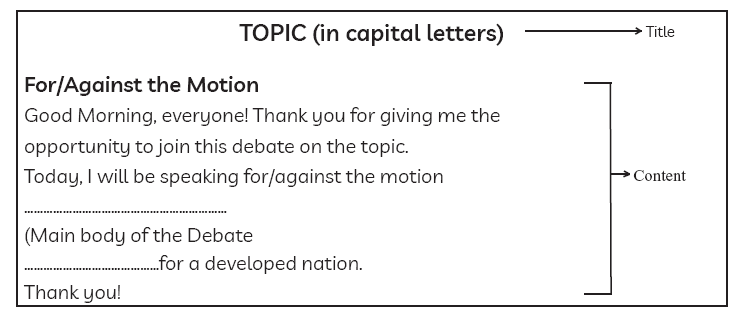
CBSE Class 11 Debate Writing Format
This is the debate writing format CBSE Class 11 students can use in the exams.
Follow this exact format to secure full format marks in your board exam. A well-structured debate has three main parts - Introduction, Body, and Conclusion.
1. Introduction (Opening)
Begin with a formal salutation to greet the audience. Introduce yourself, state the motion, and clearly declare your stand (for or against).
Example: "Good morning, respected judges, teachers, and my dear friends. I, [your name], stand before you to speak for/against the motion - '[state the motion]'."
2. Body (Main Arguments)
This is the core of your debate. Present your arguments in a logical order:
- Statement of Fact - state the situation or issue briefly.
- Arguments with Evidence - support your stand with 2-3 strong points, facts, statistics, or real-life examples.
- Refutation (optional) - briefly counter the opposing view to strengthen your stand.
Use connectors like firstly, moreover, however, in addition, therefore for smooth flow.
3. Conclusion (Closing)
Summarise your main points briefly and end with a strong, memorable closing line. Thank the audience.
Example: "In conclusion, ……. Thank you."
Debate Introduction Examples for Students
There is a significant need to learn how to initiate a debate even if a person is not in favor of the said statement to showcase respect and acknowledgment to every individual including the judges present there. Below are some Introduction debate writing examples for Students examples that students can use.
- Greet every individual present at the debate setting.
- Thankful expression
- Clarify if you are going to speak in favor or against the motions i.e. you stand.
Here are debate introduction examples for students
1. Formal opening (For the motion): Good morning, respected judges, teachers, and my dear friends. I, Riya Sharma, stand before you to speak in favour of the motion - 'Social media does more harm than good to teenagers'.
2. Formal opening (Against the motion): A very good morning to the honourable Chairperson, respected judges, and fellow debaters. I, Aarav Singh, am here today to speak against the motion - 'Online learning is the future of education'.
3. Opening with a quote: 'The future depends on what we do in the present' - Mahatma Gandhi. Good morning everyone. I, Meera Kapoor, stand before you to speak for the motion - 'Students must participate in environmental protection'.
Debate Writing Example
The section below will provide some CBSE board exams debate writing examples to help you get a clear idea.
Example 1: Write a debate in 150-200 words either for or against the motion: ‘Social Media and Its Effects’.
Answer:
SOCIAL MEDIA AND ITS EFFECTS
**In Favour**
Without a doubt, social media has altered the way we connect and communicate with one another. It has enhanced communication between individuals, increased access to information, and given everyone a voice. Social media's capacity to cross borders and unite people from all over the world is one of its advantages. It has made it possible to network, work together, and exchange cultures. Additionally, social media platforms have been crucial in raising public awareness of social concerns, rallying support for campaigns, and giving voice to underrepresented groups.
**Against**
However, it's crucial to consider how social media has affected our culture. On the other hand, it is impossible to ignore social media's detrimental effects. Addiction's potential and its consequences on mental health are two worrying effects. Increased feelings of loneliness, despair, and anxiety have been associated with excessive social media use. Furthermore, exposure to meticulously maintained online personas daily might result in low self-esteem and irrational comparisons. The proliferation of false information and the impact of fake news are further negatives. Social media platforms have developed into a haven for misleading information, which can harm politics, public opinion, and interpersonal harmony. Concerns about privacy invasion, online security hazards, and cyberbullying are also quite important.
In conclusion, social media has an impact on our society that is both positive and detrimental. Utilizing its advantages while being mindful of its possible drawbacks must be balanced. We can use social media for good while reducing its negative consequences by encouraging digital literacy, responsible online behavior, and maintaining a secure and inclusive digital world.
Example 2. Write a debate in 150-200 words either for or against the motion: ‘Academic Excellence Is The Only Requirement For A Successful Career’.
Answer:
ACADEMIC EXCELLENCE IS THE ONLY REQUIREMENT FOR A SUCCESSFUL CAREER
**In Favour **
While academic excellence is undoubtedly important in building a foundation of knowledge and skills, it is not the sole requirement for a successful career. Success in a career is often determined by a combination of factors such as practical experience, soft skills, adaptability, and networking abilities. Real-world application of knowledge, critical thinking, problem-solving, and effective communication skills are essential for thriving in any professional environment. Furthermore, success is often influenced by factors such as creativity, innovation, and the ability to think outside the box. These qualities cannot be solely acquired through academic pursuits but are developed through exposure to diverse experiences and a willingness to take risks.
**Against **
Additionally, a successful career often requires a strong work ethic, resilience, and the ability to collaborate with others. These interpersonal skills are nurtured through experiences like internships, extracurricular activities, and community involvement, which extend beyond academic achievements. While academic excellence is not the sole determinant of success, it still plays a significant role in opening doors to opportunities and providing individuals with a solid foundation on which to build their careers.
In conclusion, while academic excellence is undoubtedly valuable, it is not the only requirement for a successful career. Practical experience, soft skills, adaptability, creativity, and networking abilities are equally crucial. Emphasising holistic development and a well-rounded skill set will better equip individuals for the challenges and opportunities that lie ahead in their careers.
Techniques to Follow for Effective Debate Writing
Use these proven techniques to write a high-scoring debate in your CBSE Class 11 exam:
- Research thoroughly - understand both sides of the motion before choosing a stand.
- Pick a clear side - never stay neutral; a debate demands a firm stand.
- Use strong evidence - facts, statistics, real examples, and expert opinions make arguments convincing.
- Avoid repetition - each argument should add a new angle.
- Use persuasive language - words like undoubtedly, clearly, it is evident, surely add strength.
- Use linking words - firstly, moreover, on the contrary, therefore, in conclusion ensure smooth flow.
- Follow the word limit strictly - stay within 120-150 words.
- Address the audience directly - a debate is spoken aloud, so maintain a speaker-audience tone.
- End powerfully - close with a strong line and a polite "Thank you."
- Proofread for grammar and spelling - these fall under the 2 marks allotted for Expression.
Debate Writing vs Speech Writing: Key Differences
Many students confuse debate with speech. Here's a clear comparison:
Do’s and Don’ts of Debate Writing in CBSE Class 11
Keep this quick checklist in mind every time while writing a debate - it covers every key factor CBSE examiners evaluate.
Practice Questions for English Debate Writing Class 11
Here are some examples of debate writing which students can use to practice better:
- Write a debate in 150-200 words either for or against the motion: ‘Online Smart Classes Are The Future Of Education Style’.
Answer:
ONLINE SMART CLASSES ARE THE FUTURE OF EDUCATION STYLE
**In Favour**
Online smart classes have become a popular educational resource in the digital age, altering the way we study and laying the groundwork for the future of education. Online smart classes give a wide range of advantages that conventional classroom settings frequently find difficult to match. First, flexible scheduling and accessibility are promoted via online smart classes. Students can access instructional content whenever it is convenient for them thanks to the availability of recorded lectures and online tools, enabling individualised learning experiences. People are also able to pursue school while juggling other responsibilities because of this flexibility. Second, technology is used in online smart classrooms to increase interaction and engagement. Videos, simulations, and interactive exercises are examples of multimedia components that make learning more engrossing and engaging. This method encourages active engagement and accommodates different learning styles, improving concept retention and comprehension. Online smart classes also support a worldwide learning community. Students can connect with peers and educators from all around the world through online platforms, exchanging ideas, working together on projects, and learning about various viewpoints. Students are more equipped for a diversified and interconnected society because of this worldwide exposure.
**Against**
However, it's critical to recognize the difficulties and restrictions associated with online smart classes. Effective online learning can be hampered by a lack of dependable internet connectivity, technical issues, the need for self-discipline, and a lack of enthusiasm. Additionally, the lack of face-to-face interaction may impede the growth of specific interpersonal and social skills.
In conclusion, by providing flexibility, interactivity, and global connectivity, online smart classrooms have the potential to revolutionize education. Online smart classes are a potential option for the future of education, despite the obstacles that must be addressed. We can develop a dynamic and inclusive educational environment that equips students for success in the digital era by utilizing technology efficiently and resolving its limits.
- Write a debate in 150-200 words either for or against the motion: ‘Stray dogs should not be put to sleep’.
Answer:
STRAY DOGS SHOULD NOT BE PUT TO SLEEP
**In Favour:**
Dogs are also creations of God but they do not have the power of logical thinking like humans. They are unable to differentiate between what is good for them and what is not. Today I speak for the motion that stray dogs should not be put to sleep. They begin barking when they notice people nearby or come across anything strange, which frightens many people. They might also attack someone who didn't touch the dog at the same time. Is the issue resolved by adoption? Although raising dogs is a potential solution, it requires a lot of time, money, and effort. There should be no roadside euthanasia. Dogs can find shelter in places like rehabilitation centers, and there is also an option to adopt them. How many people, though, actually take on this duty? While some people may feel at ease raising dogs, others may not. In such circumstances, adopting a stray dog comes at the expense of another person's peace of mind.
**Against**
Accidents are the main issue that stray dogs cause by cavorting on public streets. Both the dog and the car driver in this incident have to deal with injuries that are fatal to them. These dogs shouldn't be sleeping on roads, which are designed for moving cars. As a solution, separate areas could be set aside for stray dogs to reside in so that they can sleep, and people won't be bothered by their presence.
- Write a debate in 150-200 words either for or against the motion: ‘21st century is an age of greed’.
Answer:
21ST CENTURY IS AN AGE OF GREED
**In Favour**
Declaring that the 21st century is an age of greed is the most straightforward way to describe it. And I do support the notion that the "21st century is an age of greed" because I completely concur with it. The material needs and comforts of modern life are numerous. An individual strives to fulfill his need for social acceptance by going above and beyond the call of duty. This is because he is judged based on his status and class in society. He crosses all boundaries and puts on as much of a show as he can for this. To top it all off, social media is a major contributor to the 21st century's reputation as an era of greed. On social media, people frequently try to emulate the lifestyles of rich or famous people in addition to simply following them. Because they lack the resources to maintain that standard of living, they become envious and have a thirst for money. This then motivates a person to engage in bad deeds and illegal activities. In addition, people incur significant losses or debts to maintain their social standing.
**Against**
Everybody wants to live happily and do everything they want to do. However, becoming avaricious to further one's interests is not a quality of an ethical person. Today's society is rife with such individuals, so it is perfectly acceptable to refer to them as greedy.
- Write a debate in 150-200 words either for or against the motion: ‘Use of technology does not lead to loss of employment’.
Answer:
USE OF TECHNOLOGY DOES NOT LEAD TO LOSS OF EMPLOYMENT
**In Favour**
Technology is like a blade with two sides. It has advantages and disadvantages, but how each person uses it will depend on that person. I will speak in favor of the motion today that technology use shouldn't result in job loss. Technology has recently made things possible that were only inconceivable a few years ago. Nowadays, almost anything we can imagine is already available online. The adoption of a digital platform has increased the number of jobs available. After technological advancements, work has gotten simpler, more efficient, and of higher quality. These positions include cab drivers and delivery services. Additionally, it offers excellent opportunities to resellers. As they were needed to set up and run these online businesses, the demand for skilled workers increased at the same time. Overall, the use of technology has improved productivity, increased the need for labor, and provided many benefits for the economy. Intelligent people have benefited greatly from technology.
**Against**
While technology has indeed created new job opportunities, it's essential to acknowledge that it has also led to the automation and elimination of certain traditional jobs. Industries like manufacturing and retail have seen significant job displacement due to automation and technology-driven processes. While technology can create jobs, it can also disrupt and displace existing ones, leading to concerns about job security for some individuals.
- Write a debate in 150-200 words either for or against the motion: ‘Spare the rod and spoil the child’.
Answer:
SPARE THE ROD AND SPOIL THE CHILD
**In Favour**
This proverb 'Spare the rod, spoil the child' means that a child should be punished severely for his offenses, otherwise, he will be spoiled. This proverb seems to be the product of those Spartan days when people knew only one language, which was harsh discipline, and often severe brutal punishment. Even though it has been demonstrated through experiments that even wild animals understand love and kindness, it is possible that a rod cannot control a child like it can a wild animal. We are all familiar with the tale of Androcles and the lion, in which a hungry lion refrains from attacking Androcles in memory of his kindness.
**Against**
In reality, the presence of a whip rather than its absence will spoil a child. A child can only be nurtured and raised affectionately to develop into a fine specimen of humanity. In contrast, a child who is severely punished grows up to be insensitive, uncaring, and a hardened man with God only knowing what kind of complexes, that is, psychological and emotional issues are deeply ingrained in his mind. A happy childhood is a guarantee of a happy and successful life in the future.
- The Nilgiris Senior Secondary School is holding an interschool debate on the topic, ‘School bullies are a menace; they should be expelled’. You will be participating from your school in the debate. Write your debate in 150-200 words choosing a stand for or against the motion’.
Answer:
SCHOOL BULLIES ARE A MENACE; THEY SHOULD BE EXPELLED
**In Favour**
Today, I stand before you to shed light on the topic, "School bullies are a menace; they should be expelled." While it is true that bullying poses a serious risk to students' well-being, I argue against the motion because expulsion may not be the best way to deal with this problem. Expulsion may only serve to reinforce the vicious cycle of hostility and isolation. Instead, our attention should be directed toward putting in place comprehensive anti-bullying initiatives that seek to inform, rehabilitate, and foster a welcoming environment for all students. Expulsion also misses the mark in terms of addressing the underlying causes of bullying. It is crucial to address problems like a lack of empathy, low self-esteem, and inadequate social abilities, which frequently lead people to engage in bullying behavior. Bullies are not equipped to learn and build wholesome relationships through expulsion.
**Against**
In conclusion, even though bullies at school are undoubtedly a threat, expulsion may not be the best course of action. We must approach this problem with empathy, comprehension, and dedication to changing bullies' behavior. Let's concentrate on putting in place thorough anti-bullying initiatives and developing a supportive environment that fosters the growth and development of all students. Thank you.
FAQs
Q1. What is the word limit for debate writing in Class 11 CBSE?
Ans. The prescribed word limit for debate writing in CBSE Class 11 is 120-150 words, as per the latest syllabus. Writing more or fewer words can lead to mark deduction.
Q2. How many marks is debate writing for Class 11?
Ans. Debate Writing carries 5 marks in the CBSE Class 11 English Core board exam. The breakup is: Format (1) + Content (2) + Expression (2).
Q3. What is the format of debate writing in Class 11?
Ans. The CBSE Class 11 debate writing format has three parts: Introduction (salutation + motion + stand), Body (arguments with evidence and refutation), and Conclusion (summary + "Thank you"). It is based on visual/verbal inputs.
Q4. How many steps are there in debate writing?
Ans. There are five key steps in debate writing: Introduction, Statement of Fact, Evidence, Refutation, and Conclusion. These ensure a clear, structured, and persuasive argument.
Q5. How should I start a debate in the exam?
Ans. Begin with a formal salutation addressing the judges, teachers, and audience. Then introduce yourself, state the motion, and clearly declare whether you are speaking for or against it.
Q6. Can I stay neutral in debate writing?
Ans. No. A debate requires you to take a clear stand - either for or against the motion. Staying neutral will cost you both content and format marks.


.svg)

