
.svg)
Circles are seen everywhere around us, from wheels and clocks to coins and rings, making them an essential part of everyday mathematics. Circles are not just about definitions. Important theorems, especially those related to tangents, help explain the special properties of circles and are frequently asked in exams. Learning these concepts step by step helps in solving problems accurately and with confidence.
Circle Class 9 Notes PDF Download
These Circle Class 9 notes cover all key definitions, theorems and NCERT-based examples, making them useful for both quick revision and detailed understanding of the chapter. Download them from below:

Circle Summary Class 9
In this chapter, we study the basic concepts related to circles, including their parts and properties. A circle is defined as the set of all points in a plane that are at a fixed distance from a given point. This fixed distance is called the radius, and the given point is the centre of the circle.
We also learn about chords, diameters, arcs, sectors, segments and tangents, along with their properties. Special attention is given to theorems related to tangents, such as the fact that a tangent to a circle is perpendicular to the radius at the point of contact.
1. Basic Terms Related to Circles
a) Circle: A circle is a closed plane figure formed by all points that are at a fixed distance from a fixed point in the plane. This fixed point is known as the centre of the circle, and the fixed distance is called the radius.
b) Centre of the Circle: The centre of the circle is the point from which every point on the circle is equally distant. It lies inside the circle and plays an important role in defining all parts of the circle.
c) Radius: The radius is the distance from the centre of the circle to any point on the circle. All radii of the same circle are equal in length. The radius is generally denoted by the letter r.
d) Diameter: A diameter is a line segment that passes through the centre of the circle and joins two points on the circle. It is the longest chord of the circle and its length is equal to twice the radius.
e) Chord: A chord is a line segment that joins any two points on the circle. While every diameter is a chord, not every chord passes through the centre and hence is not a diameter.
f) Arc: An arc is a part of the circumference of a circle between two points. When two points are taken on the circle, they divide the circumference into two arcs.
g) Major Arc and Minor Arc: The major arc is the longer arc formed between two points on the circle, while the minor arc is the shorter arc between the same two points.
h) Circumference: The circumference of a circle is the total length of its boundary. It is similar to the perimeter of polygons but is curved instead of straight.
i) Sector: A sector is the region of the circle enclosed by two radii and the arc between them. It looks like a portion cut out from the circle.
2. What is a segment in a circle?
It refers to a region enclosed by a chord and the arc.
The locus of a point which moves in a plane in such a manner that its distance from a given fixed point is always constant, is called a circle.
- The fixed point is called the centre and constant distance is called the radius of the circle.
In the figure, ‘O’ is centre and OP = r is a radius. We denote it by C(O, r). - A line segment, terminating (or having its end points) on the circle is called a chord. A chord passing through the centre is called a diameter of the circle.
- A line which intersects a circle in two distinct points is called a secant of the circle.
- A line intersecting the circle in exactly one point is called a tangent to the circle.
3. Fundamentals of Circles
Let us learn more about circles:
a) Chords and Angles at the Centre
Let’s begin with the connection between chords and angles at the centre.
Equal chords of a circle (or of congruent circles) always subtend equal angles at the centre.
This relationship also works in reverse - if two chords subtend equal angles at the centre, then the chords must be equal.
b) Centre, Chords and Perpendiculars
Whenever a line is drawn from the centre of a circle to a chord and it bisects the chord, that line will be perpendicular to the chord.
Similarly, if a line from the centre is perpendicular to a chord, it will always bisect the chord. These results are frequently used together in geometry problems.
c) Distance from the Centre and Length of Chords
Chords have a strong link with their distance from the centre.
Equal chords of a circle are always equidistant from the centre, and if two chords are equidistant from the centre, then they must be equal in length.
d) Arcs and Their Corresponding Chords
Arcs also follow clear rules. Chords corresponding to equal arcs are equal, and congruent arcs of a circle always subtend equal angles at the centre.
e) Angles Subtended by an Arc
One of the most important ideas in this chapter is about angles formed by arcs.
The angle subtended by an arc at the centre is always double the angle subtended by the same arc at any point on the remaining part of the circle.
f) Special Angle Properties in a Circle
Circles show some beautiful angle patterns. Angles in the same segment are equal, and the angle in a semicircle is always a right angle. These results are very helpful for quick problem-solving.
g) Cyclic Quadrilaterals
When four points lie on the same circle, they form a cyclic quadrilateral. In such a quadrilateral, the sum of either pair of opposite angles is always 180°.
Conversely, if the opposite angles of a quadrilateral are supplementary, then the quadrilateral is cyclic.
h) Cyclic Points
If a line segment joining two points subtends equal angles at two other points lying on the same side of the line, then all four points lie on the same circle, which means the points are cyclic.
4. Theorems
Now let us look at some circle theorems:
a) Theorem 1
Statement: Equal chords of a circle subtend equal angles at the centre.
Given: AB and CD are chords of a circle with centre O, such that AB = CD.
To prove: ∠AOB = ∠COD
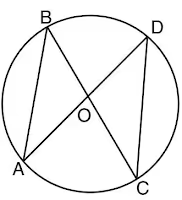
Proof:
In △AOB and △COD,
AO = CO (radii of the same circle)
BO = DO (radii of the same circle)
AB = CD (given)
∴ △AOB ≅ △COD (SSS)
Hence, ∠AOB = ∠COD (c.p.c.t.)
b) Theorem 2
Statement: If the angles subtended by the chords of a circle at the centre are equal, then the chords are equal.
Given: Two chords PQ and RS of a circle C(O, r), such that ∠POQ = ∠ROS.
To prove: PQ = RS
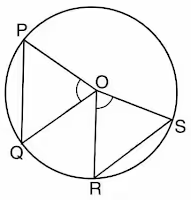
Proof: In △POQ and △ROS,
OP = OQ = OR = OS = r (radii of the same circle)
and ∠POQ = ∠ROS (given)
∴ △POQ ≅ △ROS (SAS)
∴ PQ = RS. (c.p.c.t.)
c) Theorem 3
Statement: The perpendicular from the centre of a circle to a chord bisects the chord.
Given: AB is the chord of a circle with centre O and OD ⊥ AB.
To prove: AD = DB
Construction: Join OA and OB.
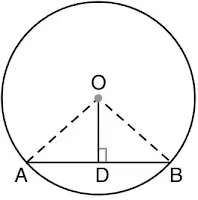
Proof:
In △ODA and △ODB,
OA = OB (radii of the same circle)
OD = OD (common)
∠ODA = ∠ODB (each is a rt. angle)
△ODA ≅ △ODB (R.H.S.)
AD = DB (c.p.c.t.)
d) Theorem 4
Statement: Equal chords of a circle (or of congruent circles) are equidistant from the centre (or centres).
Given: AB and CD are two equal chords of a circle. OM and ON are perpendiculars from the centre to the chords AB and CD.
To prove: OM = ON.
Construction: Join OA and OC.
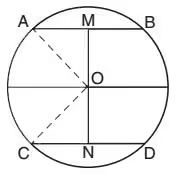
Proof:
In △AOM and △CON,
OA = OC (radii of the same circle)
MA = CN (Since, OM and ON are perpendicular to the chords and it bisects the chord and AM = MB, CN = ND)
∠OMA = ∠ONC = 90°
∴ △AOM ≅ △CON (R.H.S.)
∴ OM = ON (c.p.c.t.)
Equal chords of a circle are equidistant from the centre.
e) Theorem 5
Statement: Chords equidistant from the centre of a circle are equal in length.
Given: OM and ON are perpendiculars from the centre to the chords AB and CD and OM = ON.
To prove: Chord AB = Chord CD.
Construction: Join OA and OC.
Proof:
OM ⊥ AB ⇒ 1/2 AB = AM
ON ⊥ CD ⇒ 1/2 CD = CN
Consider △AOM and △CON,
OA = OC (radii of the same circle)
OM = ON (given)
∠OMA = ∠ONC = 90° (given)
△AOM ≅ △CON (RHS congruency)
AM = CN ⇒ 1/2 AB = 1/2 CD ⇒ AB = CD
The two chords are equal if they are equidistant from the centre.
f) Theorem 6
Statement: The angle subtended by an arc at the centre is double the angle subtended by it at any point on the remaining part of the circle.
Given: O is the centre of the circle.
To prove: ∠BOC = 2∠BAC
Construction: Join O to A.
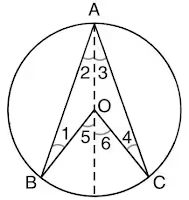
Proof:
In △AOB,
OA = OB (radii of the same circle)
⇒ ∠1 = ∠2
Similarly in △AOC,
∠3 = ∠4
Now, by exterior angle property,
∠5 = ∠1 + ∠2
∠6 = ∠3 + ∠4
⇒ ∠5 + ∠6 = ∠1 + ∠2 + ∠3 + ∠4
⇒ ∠5 + ∠6 = 2∠2 + 2∠3 = 2(∠2 + ∠3)
⇒ ∠BOC = 2∠BAC
g) Theorem 7
Statement: Angles in the same segment of a circle are equal.
Given: Two angles ∠ACB and ∠ADB are in the same segment of a circle C(O, r).
To prove: ∠ACB = ∠ADB
Construction: Join OA and OB.
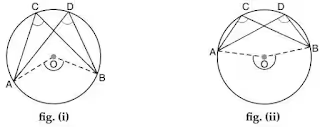
Proof:
In fig. (i), we know that, angle subtended by an arc of a circle at the centre is double the angle subtended by the arc in the alternate segment.
Hence, ∠AOB = 2∠ACB
∠AOB = 2∠ADB
So, ∠ACB = ∠ADB
In fig. (ii), we have,
Reflex ∠AOB = 2∠ACB and Reflex ∠AOB = 2∠ADB
2∠ACB = 2∠ADB
∴ ∠ACB = ∠ADB
Formulas to Remember
- Circumference: C = πd or C = 2πr
- Area of Circle: A=π r2
- Length of Arc: s = rθ
In sum, these are the rapid revision notes. If Students keep practicing this chapter they will surely learn to solve all types of this chapter problems .
Revising this note's students will be a step ahead in the revision of exams. These notes guide you to study faster during the exam time.
FAQs
Q1. Why is the diameter called the longest chord of a circle?
Ans. The diameter passes through the centre of the circle. Since it goes straight across the widest part of the circle, no other chord can be longer than the diameter.
Q2. What is the relation between an arc and the angle it subtends?
Ans. An arc subtends an angle at the centre and also at points on the circle. The angle subtended by an arc at the centre is always double the angle subtended by the same arc at any point on the remaining part of the circle.
Q3. How does the centre help in comparing chords?
Ans. The centre helps us compare chords by their distance from it. Equal chords are at the same distance from the centre, and chords that are equidistant from the centre are equal in length.
Q4. Why is the angle in a semicircle always a right angle?
Ans. A semicircle is formed by a diameter. The arc of a semicircle always subtends a right angle at any point on the circle, which is a special and important property of circles.
Q5. How can we tell if a quadrilateral is cyclic?
Ans. A quadrilateral is cyclic if the sum of either pair of its opposite angles is 180°. This property is often used to check whether four points lie on the same circle.












.svg)

