
.svg)
Feeling confused about crests, compressions, Doppler effect, or standing waves before your exam? Don’t worry - you’re not alone.
In these Waves Class 11 Notes, we’ll break down the chapter in a super simple way so you can actually understand what’s happening instead of just memorising formulas.Get complete chapter details in CBSE Syllabus Class 11 Physics.
Waves are basically how energy travels without matter moving from one place to another. From sound and music to water ripples and communication systems - everything connects back to this chapter. Let’s simplify it step by step.

Waves Summary
Waves are one of the most common ways in which energy is transferred from one point to another without any actual transport of matter. The study of waves is important because it explains various natural phenomena such as sound, light, and water ripples, and also finds applications in communication systems, musical instruments, and modern physics.
When a disturbance is created in a medium, the particles of the medium get displaced from their equilibrium position and oscillate about it. This oscillation of particles results in the transfer of energy from one place to another in the form of a wave. The medium itself does not move along with the wave; only the disturbance propagates.
Characteristics of Waves
Every wave can be described in terms of certain essential quantities:
- Wavelength (λ): The distance between two consecutive crests or troughs in a transverse wave, or two consecutive compressions or rarefactions in a longitudinal wave.
- Frequency (f): The number of complete oscillations of the medium particles per unit time.
- Time Period (T): The time taken for one complete oscillation of a particle. It is related to frequency by T = 1 / f.
- Wave Speed (v): The speed at which the disturbance propagates through the medium. It is related to wavelength and frequency as:
V = λ f
- Amplitude (A): The maximum displacement of particles of the medium from their mean position. It determines the energy carried by the wave.
- Wave Number (k): The number of wavelengths per unit distance, given as:
k = 2 π / λ
- Angular Frequency (ω): It is the angular displacement per unit time and is related to frequency by:
ω = 2 π f
Types of Waves
There are mainly two kinds of waves:
(a) Mechanical Waves
Mechanical waves require a medium for propagation. They cannot travel in vacuum. Their motion involves the oscillation of particles of the medium around their mean position, and energy is transferred due to these oscillations. Examples include sound waves, water waves, and seismic waves.
(b) Electromagnetic Waves
Electromagnetic waves do not need a medium to travel. They consist of oscillating electric and magnetic fields perpendicular to each other and to the direction of propagation. Examples include light, radio waves, and X-rays.
Classification of Mechanical Waves
Mechanical waves are classified depending on the direction of vibration of particles with respect to the direction of propagation of the wave.
(a) Transverse Waves
In transverse waves, particles of the medium vibrate perpendicular to the direction in which the wave travels. Examples include waves on a string and water surface waves. A transverse wave is characterized by the formation of crests (points of maximum upward displacement) and troughs (points of maximum downward displacement).
These waves can only propagate in media that possess shear elasticity, i.e., solids and the surface of liquids.
(b) Longitudinal Waves
In longitudinal waves, the particles of the medium oscillate parallel to the direction of propagation of the wave. The wave is characterized by compressions (regions of high pressure and density) and rarefactions (regions of low pressure and density). Sound waves in air are the best example of longitudinal waves.
Speed of Mechanical Waves
The speed of a wave depends on the properties of the medium.
(a) Speed of a Wave on a Stretched String
If a string of linear mass density μ is under tension T, the speed of transverse waves on it is given by:
v = √(T / μ)
(b) Speed of Sound in a Medium
For a longitudinal wave such as sound, the speed is given by:
v = √(B / ρ)
where B is the bulk modulus of the medium and ρ\rho is its density. This explains why sound travels fastest in solids (large bulk modulus), slower in liquids, and slowest in gases.
Displacement Relation in a Progressive Wave
A progressive wave is one that continuously travels forward carrying energy. For a wave traveling along the positive x-axis, the displacement of a particle at position xx and time tt can be expressed as:
y(x,t) = A sin (kx − ωt + ϕ)
Here,
- A = amplitude
k = wave number - ω = angular frequency
- ϕ = initial phase constant
This is called the displacement relation of a progressive wave.
Principle of Superposition
When two or more waves pass simultaneously through the same medium, the resultant displacement of the particle is the algebraic sum of the displacements due to each wave. This principle is valid as long as the medium remains elastic.
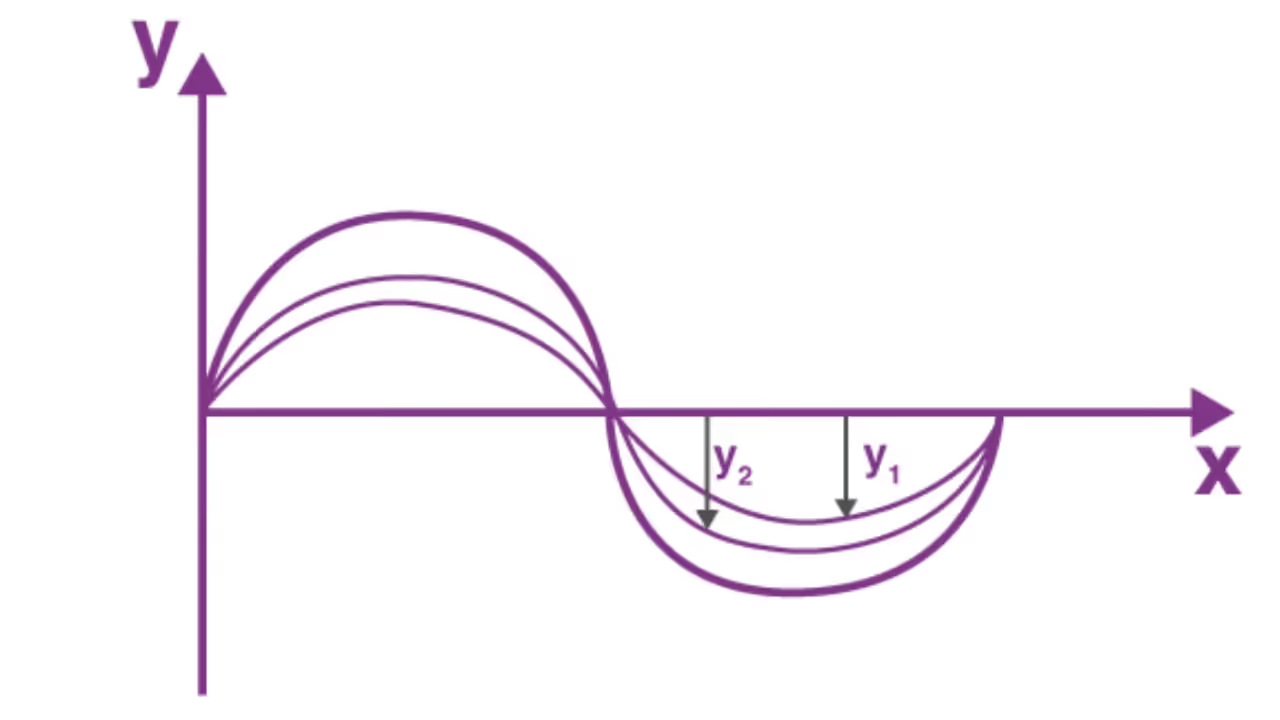
Mathematically, if y1 and y2 are displacements due to two waves, the resultant displacement is:
y = y1 + y2
Interference of Waves
When two waves of the same frequency and wavelength overlap, they interfere with each other.
- Constructive Interference: If the two waves are in phase, their amplitudes add up, resulting in a wave of larger amplitude.
- Destructive Interference: If the waves are out of phase by 180°, their amplitudes cancel, resulting in a wave of smaller or even zero amplitude.
This principle forms the basis of many applications, such as noise-canceling headphones.
Stationary Waves
Stationary or standing waves are formed when two identical progressive waves traveling in opposite directions superpose. Unlike progressive waves, they do not transfer energy from one point to another but store it in the form of oscillations.
The displacement relation for a stationary wave is:
y(x,t) = 2 A sin(kx) cos (ωt)
Here, the amplitude depends on position xx, unlike in a progressive wave.
- Nodes: Points where displacement is always zero.
- Antinodes: Points where displacement is maximum.
These are separated by half a wavelength.
Note: In stationary waves, energy is not transferred along the medium - it remains confined between nodes.
Standing Waves in a String
When a string is fixed at both ends, stationary waves can be set up. The allowed patterns correspond to the condition that an integral number of half wavelengths must fit into the length of the string.
If the length of the string is LL, the wavelengths are:
λn= 2L/n , n = 1,2,3,…
The corresponding frequencies are:
fn= nv /2L
where fn are called the natural frequencies or harmonics of the string.
- n = 1: Fundamental frequency or first harmonic
- n = 2: Second harmonic
- n = 3: Third harmonic, and so on.
Standing Waves in an Air Column
Air columns can also sustain stationary waves.
- Closed Organ Pipe: One end closed, other end open. Only odd harmonics are present. The fundamental frequency is:
f1 = v/4L - Open Organ Pipe: Both ends open. Both odd and even harmonics are present. The fundamental frequency is:
f1 = v/2L
This explains the working of musical instruments like flutes and clarinets.
Resonance
Resonance occurs when the frequency of an external force matches the natural frequency of a system.
At resonance:
- Amplitude becomes maximum
- Energy transfer becomes most efficient
Examples:
- Swing pushed at correct timing
- Musical instruments
- Breaking of glass by sound
Beats
When two waves of slightly different frequencies interfere, the resultant sound varies in intensity with time. This variation is called beats.
The beat frequency is equal to the difference in the frequencies of the two waves:
fbeats = ∣f1 − f2∣
Beats are useful for tuning musical instruments.
Doppler Effect
The Doppler effect is the apparent change in frequency or wavelength of a wave when there is relative motion between the source and the observer.
- If the source and observer approach each other, the observed frequency increases.
- If they move apart, the observed frequency decreases.
The general formula is:
f′ = f(v ± v0 / v∓vs)
where
- f = frequency of source
- v = speed of wave in medium
- v0 = velocity of observer (positive if moving towards source)
- vs = velocity of source (positive if moving away from observer)
Energy Transport in Waves
A progressive wave carries energy across the medium. In transverse waves on a string, the average power transmitted is proportional to the square of amplitude and frequency:
P = ½ μ ω2 A2 v
This shows:
- Energy depends on amplitude squared
- Energy depends on frequency squared
Even a small increase in amplitude can significantly increase energy transfer. This is why loud sounds require much more energy.
Conclusion
That’s a wrap on Waves. If you understand how oscillations turn into wave motion, half the chapter becomes easy. Focus on concepts like standing waves, and Doppler effect - they’re exam favourites. Revise the formulas once more, and you’re good to go. Share it with your friends if these notes have helped you in any way.
FAQs
Q1. What is a standing wave?
Ans. A standing wave is formed when two waves of the same frequency and amplitude traveling in opposite directions superimpose, producing nodes and antinodes.
Q2. What is resonance in waves?
Ans. Resonance happens when a system vibrates at its natural frequency due to an external force, leading to maximum amplitude.
Q3. What is the principle of superposition of waves?
Ans. It states that when two or more waves overlap, the resultant displacement is the algebraic sum of the individual displacements.
Q4. What is beats phenomenon?
Ans. Beats occur when two waves of slightly different frequencies interfere, producing periodic variations in sound intensity.
Q5. What are transverse and longitudinal waves?
Ans. In transverse waves, particles vibrate perpendicular to the direction of wave propagation (e.g., light waves). In longitudinal waves, particles vibrate parallel to the direction of propagation (e.g., sound waves).












.svg)

