
.svg)
Finally, NCERT has officially launched their new Class 9 book for Social Science (Part 1) on 24th June 2026. NCERT has redesigned Class 9 Social Science for 2026-27 with an entirely new approach to learning; focusing on learning outcomes and competencies instead of rote-learning.
NCERT Class 9 Social Science Textbook PDF 2026-27 (Part I)
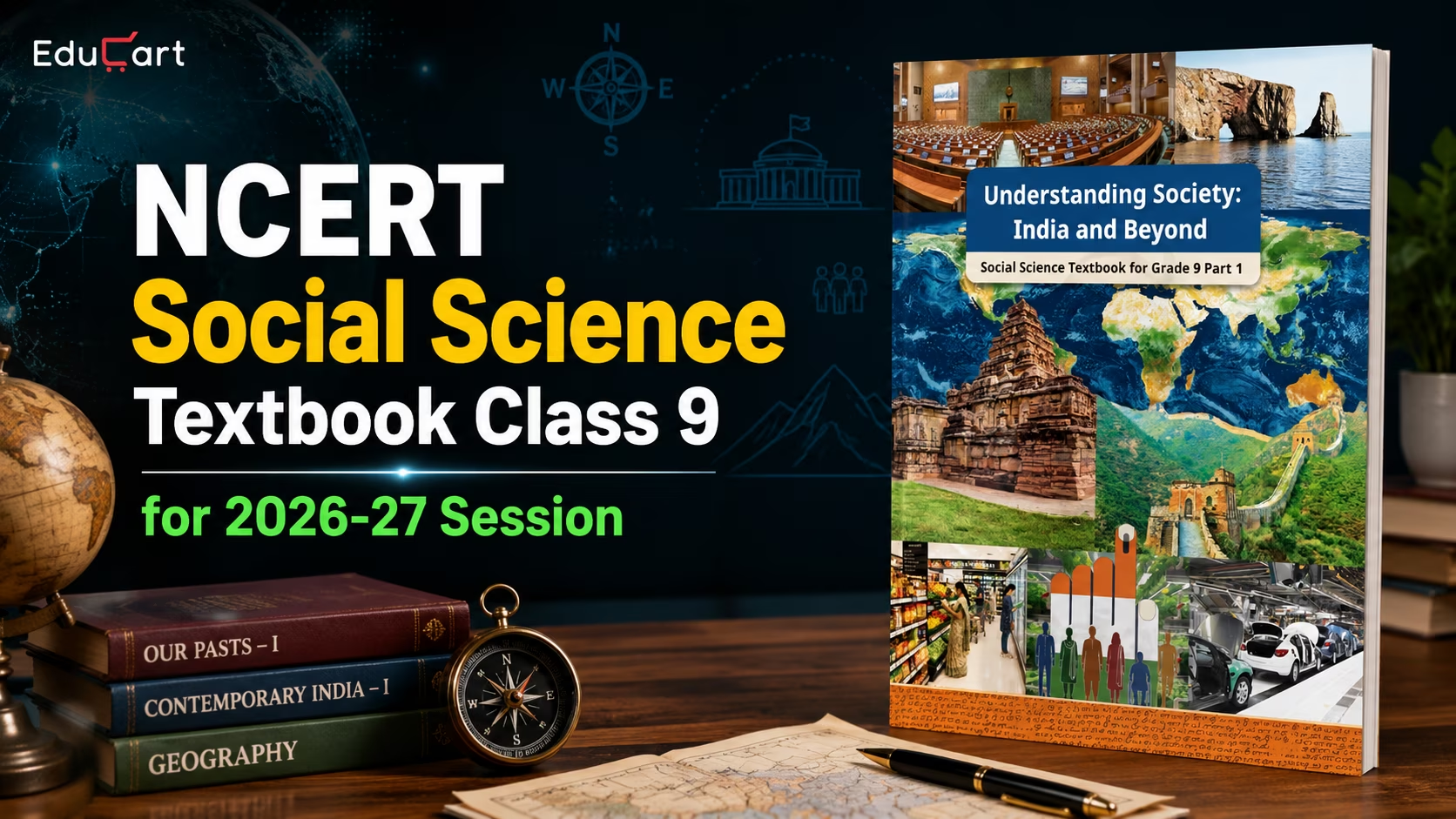
Instead of studying History, Geography, Political Science, and Economics as separate subjects, New Class 9 SST book PDF is now consolidated into two parts.
NCERT Class 9 Understanding Society (SST) Ch-wise PDFs
Understanding Society: India and Beyond Class 9 SST Book 2026-27 Updated
NCERT Class 9 Social Science Textbook PDF 2026-27 (Part II)
~Will be uploaded soon~
Class 9 Social Science Old v/s New Syllabus (2026–27)
Here’s a quick comparison depicting the key changes introduced in the 2026-27 NCERT SST book as per the latest class 9 syllabus.
Chapter-wise Overview of the New Class 9 SST NCERT Books
As per our analysis, the updated NCERT textbooks are set to promote skill-building and understanding in students through Social Science as an integrated subject. Instead of traditional chapters, students will now move through interconnected themes.
Let’s see how each section/ theme plays a part in this.
1. History and Society explore how societies emerged, civilisations developed and communities changed over time in India
Key focus:
- Early societies
- Historical continuity and change
- India’s interaction with the wider world
- Social resilience and transitions
2. Geography and Environment explain how Earth systems shape life and everything living in it.
Key focus:
- Earth processes
- Atmosphere and climate
- Oceans and ecosystems
- Human & environment interaction
3. Democracy and Citizenship show how Indian societies organise power and participation in the 21st century.
Key focus:
- Democracy
- Elections
- Authority
- Institutions and citizenship
4. Economic and Everyday Life is more on relatability and real-life skills in terms of economics, entrepreneurship and financial literacy
Key focus:
- Economic decision-making
- Markets
- Entrepreneurship
- Personal financial understanding
What Has Changed in the New Class 9 Social Science Book 2026-27?
The new textbook, Understanding Society: India and Beyond, is based on NCF-SE 2023 and NEP 2020 to make Social Science more integrated and practical with real-life examples.
Up until 2025-26, the books were divided into History, Geography, Political Science, and Economics but the current, revised textbook brings them together into connected themes.
For example:
- History is no longer studied only as dates, events, and revolutions.
- Geography moves beyond physical features, covering environmental understanding in detail.
- Political Science now teaches participation and citizenship, as per the IKS (Indian Knowledge System).
- Economics introduces practical concepts students encounter in everyday life like personal finance and entrepreneurship.


Summary of Class 9 NCERT SST Chapters
Below is a list comparison of old and new chapters as per the latest class 9 SST NCERT textbook (Part I & II) and old one.
New Methods of Assessment in NCERT Class 9 SST book:
There are so many new types of Qs and exercises included in these new NCERT books. Here we have explained how each one of those matters for this year’s assessment.
- Big Questions - This is how the chapter is introduced; students ponder on these Qs before getting into the reading.
![big questions.png [apng-to-avif output image]](https://www.educart.co/img-cache/https%3A%2F%2Fcdn.prod.website-files.com%2F5f5cf4627107791c0412287b%2F6a3b9fd3b46cad20c696dde0_ezgif-1ae2e9f4655dcf3c.avif)
- Let’s Explore/ Recall/ Analyse - The whole chapter is filled with activity-based tasks and checkpoints to encourage observation and discussion.
![collage.png [apng-to-avif output image]](https://www.educart.co/img-cache/https%3A%2F%2Fcdn.prod.website-files.com%2F5f5cf4627107791c0412287b%2F6a3b9fe6d81b8f8cfb90af58_ezgif-3ee36ca853a4fd7d.avif)
- Don’t Miss Out - To add on to the curiosity of students, interesting facts and lesser-known insights for deeper learning are given under this section.
![dont miss out.png [apng-to-avif output image]](https://www.educart.co/img-cache/https%3A%2F%2Fcdn.prod.website-files.com%2F5f5cf4627107791c0412287b%2F6a3b9ff64570c83c2c2c5b6b_ezgif-3217c3630bbcb45e.avif)
- QR-based Interactive Learning - This is very new-age. Access videos, stories, games, and additional activities connected to the topic.
- Map-based, timelines & visual summaries - Visualise and get a better geographical understanding.
Note: Other than these, simple explanations of difficult terms and concepts are also spread out within the chapters.
What Does This Mean for Class 9 SST Teachers?
The new Class 9 Social Science textbook changes not just what students learn but also how learning happens in classrooms.
From what we have studied in this Part I book for Class 9 SST (all 4 subjects now combined), teachers will now help students make links across ideas, events, environments, and social systems more than just being the primary source of information.
For that, they will need to make the best use of activities, visuals, maps, discussions, and reflective Qs from these new NCERT textbooks.
CBSE teachers who use NCERT SST books for Class 9 can request free teacher specimen copy 2026-27 to better evaluate question patterns and prepare students for board-style assessments.
Benefits of Using NCERT Class 9 SST Textbook
Class 9 NCERT SST book builds on class 6-8 experiences and helps students develop a deeper understanding of society through its all four integrated cores.
Students will be able to enhance these skills.
- Learning critical thinking and the real-life application of knowledge.
- Ask questions, analyse information, and examine multiple perspectives.
- Explore and experience both individually and collaboratively.
Overall, every shift in these NCERT textbooks as per the latest 9th syllabus change, students will be able to understand how the past, present, and future are interconnected and how each shapes the lives we lead today.
Takeaway
The Social Science syllabus for Grade 9 for 2026-27 is a bold, forward-looking reform. It is lighter yet has a depth to it in terms of . The new syllabus is deeply connected with India’s civilisation heritage and knowledge system and equips students with skills and learning crucial for the 21st century.
This is a major transformation in Social Science to make the subject relevant and engaging for the learners and not just a shift in the syllabus.
FAQs
Q1. How to download the Class 9th Social Science NCERT book PDF 2026-27?
Ans. The SST class 9 new book PDF is available on this page. The new NCERT Class 9 Social Science integrated textbook 2026-27 (Part I) is officially released.
Q2. Is the new syllabus only for CBSE schools or for all boards?
Ans. The draft is released by NCERT for the national level, so it applies to all CBSE-affiliated schools.
Q3. Can I use the old class 9 NCERT Social Science for 2026-27?
Ans. Not recommended. Almost all chapters have been replaced. Students should download the latest class 9 SST book pdf from this page or ncert.nic.in.
Q4. Where can I download the official draft syllabus PDF?
Ans. Available on the NCERT website ncert.nic.in under “Syllabus” section → NCERT Grade 9 Syllabus - Science, Mathematics and Social Science (Secondary Stage, Phase I Part 2).
Q5. How different is the 2026-27 SST NCERT syllabus from the 2025-26 syllabus ?
Ans. Completely different. The old syllabus had 20+ discipline-specific chapters; the new one has 16 integrated themes and a strong IKS and competency focus.
Q6. Is the new textbook for class 9 social science more difficult?
Ans. Not necessarily. Content load is definitely lighter but understanding and application expectations are higher from students.













.svg)

