
.svg)

The chapter Acids, Bases and Salts is one of the most essential and concept-rich parts of Class 10 Chemistry. It connects simple everyday experiences like the sour taste of lemon, the slippery touch of soap, or the reaction of vinegar with baking soda to the actual science of chemical reactions.
Through this chapter, students learn about the nature, behavior, and interactions of acids, bases, and salts. It explains how these substances react, how indicators help identify them, and how neutralization leads to the formation of salts. Understanding this topic also builds a strong base for Class 11 and 12 Chemistry, especially in physical and inorganic chemistry.
The Class 10 Acids, Bases and Salts Important Questions listed in this guide are based on the CBSE 2025–26 syllabus and help you:
- Revise all important reactions and definitions.
- Understand the logic behind everyday chemical phenomena.
- Prepare effectively for both board exams and internal tests.
PREMIUM EDUCART QUESTIONS
(Most Important Questions of this Chapter from our 📕)
In the table below, we have provided the links to downloadable PDFs of Important Question of Acid Base and Salt. Now you can download them without requiring a login.

Chapter 2 Acids Bases and Salts : Important Questions
Q1. Which of these graphs shows how the pH of milk changes as it forms curd?
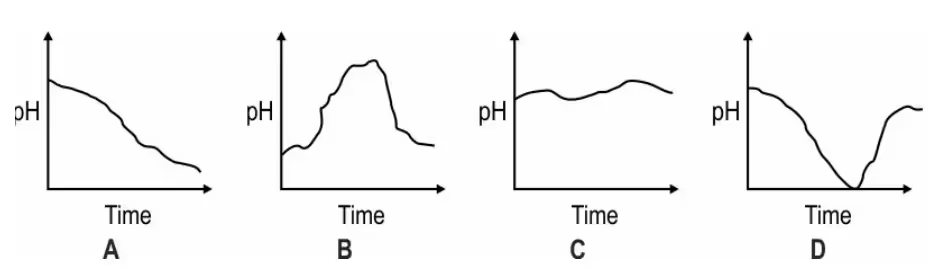
Answer: Graph A
Explanation:
During the process of curd formation, milk undergoes fermentation, during which lactic acid bacteria convert lactose into lactic acid. This increases the acidity of the milk, leading to a gradual decrease in pH over time.
Q2. The following table lists the pH values of some substances.
What would happen to the pH of an acid and a base when each is diluted (pure distilled water is added to it)?
Answer:
When a substance is diluted with pure distilled water:
- For an Acid: The pH will increase (become less acidic).
Adding water decreases the concentration of hydrogen ions [H+], reducing acidity and moving the pH closer to 7.
- For a Base: The pH will decrease (become less basic).
Adding water decreases the concentration of hydroxide ions [OH−], reducing basicity and moving the pH closer to 7.
However, in both cases, the substance will not become neutral unless diluted extensively.
Q3. A remarkable property of acids is that they can 'dissolve' metals. When metals are added to an acid, they disintegrate and disappear into the acid.
(a) State one other common observation when metals 'dissolve' in acids. Explain the reason for this observation.
(b) If the acid with the 'dissolved' metal is evaporated, can we get the metal back? Why or why not?
(c) In this question, the word 'dissolve' is used within quotes. This is because it is not actually an example of dissolving.
What is the MAIN difference between a metal 'dissolving' in an acid and sugar dissolving in water?
Answer:
(a) State one other common observation when metals 'dissolve' in acids. Explain the reason for this observation.
Observation: Effervescence (bubbles) is commonly observed when metals 'dissolve' in acids.
Explanation: The effervescence occurs due to the production of hydrogen gas (H2) as a result of the chemical reaction between the metal and the acid. The reaction can be represented as:
Metal+Acid→Salt+Hydrogen
For example:
Zn+2HCl→ZnCl2+H2↑
The bubbles are the visible release of hydrogen gas.
(b) If the acid with the 'dissolved' metal is evaporated, can we get the metal back? Why or why not?
No, the metal cannot be recovered by evaporating the acid.
Reason: When a metal reacts with an acid, it forms a salt and hydrogen gas is released. The metal is chemically transformed into a salt, and the original metal atoms are no longer in their elemental form. Evaporation of the acid will only leave behind the salt but not the original metal.
(c) In this question, the word 'dissolve' is used within quotes. This is because it is not actually an example of dissolving. What is the MAIN difference between a metal 'dissolving' in an acid and sugar dissolving in water?
The main difference is chemical reaction vs physical process:
- Metal 'dissolving' in acid: This involves a chemical reaction where the metal reacts with the acid to form a new compound (salt) and releases hydrogen gas. The metal's composition is altered.
- Sugar dissolving in water: This is a physical process where sugar molecules disperse in water without undergoing any chemical change. The sugar retains its chemical identity and can be recovered unchanged by evaporation.
Q4. To prepare a salad dressing, Parag adds a solution of sodium chloride in distilled water to vinegar.
State what change will occur in the following:
(i) the pH of the vinegar
(ii) the acidity of the vinegar
Answer:
When sodium chloride (NaCl) solution is added to vinegar, the following changes occur:
(i) The pH of the vinegar:
There will be no significant change in the pH of the vinegar.
- Sodium chloride is a neutral salt that does not affect the concentration of hydrogen ions (H+) in the solution. Hence, the acidity (pH) of the vinegar remains largely unchanged.
(ii) The acidity of the vinegar:
The acidity of the vinegar decreases slightly.
- Acidity refers to the concentration of hydrogen ions (H+). When sodium chloride solution is added, it dilutes the vinegar, reducing the relative concentration of hydrogen ions in the solution. This reduces the acidity, even though the pH may not change significantly.
In summary:
- The pH remains nearly constant because the dilution effect is minimal and sodium chloride does not react with the acetic acid.
- The acidity decreases due to the dilution of the vinegar.
Q5. Rajesh was given a substance and asked to identify it. He conducted three tests on the substance and recorded the results below.(P) It releases carbon dioxide, water and a sodium salt on heating with water.(Q) It turns universal indicator greenish-blue.(R) It can be prepared from ammonia as a raw material.
5.1 What substance was Rajesh given?
5.2 Give ONE use of the substance based on the properties mentioned in P and Q.
5.3 Rajesh later read that recrystallisation of the sodium salt formed in P gives another basic salt that is used in manufacture of borax.
Identify the sodium salt formed in P.
Answer:
5.1 The substance Rajesh was given is sodium carbonate (Na₂CO₃).
Explanation:
- (P): When heated with water, sodium carbonate releases carbon dioxide, water, and a sodium salt. This suggests a reaction where sodium carbonate breaks down or reacts with water.
- (Q): It turns universal indicator greenish-blue, indicating the substance is alkaline (basic), which fits sodium carbonate, a base.
- (R): Sodium carbonate can be prepared from ammonia as a raw material through the Solvay process, where ammonia is involved in the production of sodium carbonate.
5.2 One use of sodium carbonate (based on its properties in P and Q) is in the manufacture of glass. Sodium carbonate is used to lower the melting point of silica in glass production, and its basic nature (as shown in Q) is useful in many chemical processes.
5.3 The sodium salt formed in P is sodium bicarbonate (NaHCO₃).
Explanation: When sodium carbonate reacts with water and carbon dioxide, sodium bicarbonate is typically formed. Recrystallisation of sodium bicarbonate gives sodium carbonate, and sodium carbonate is involved in the manufacture of borax, which aligns with the statement in R.
Q6. Dipti has three flasks containing dilute hydrochloric acid, dilute sulphuric acid and dilute sodium hydroxide respectively. The flasks are not labeled and she does not have any pH indicator.
(a) Which of the solutions will she be able to identify just by making mixtures of pairs of the substances.
(b) What observation will help her to make this identification?
Answer:
(a) Which of the solutions will she be able to identify just by making mixtures of pairs of the substances?
Dipti can identify all three solutions (dilute hydrochloric acid, dilute sulfuric acid, and dilute sodium hydroxide) by mixing pairs of the substances. The three substances are:
- Dilute hydrochloric acid (HCl)
- Dilute sulfuric acid (H₂SO₄)
- Dilute sodium hydroxide (NaOH)
By mixing different pairs, she will be able to distinguish them because of the nature of the reactions that occur between acids and bases.
(b) What observation will help her to make this identification?
The observation that will help Dipti identify the solutions is based on the nature of the reactions between acids and bases, which result in neutralization and the formation of salts and water:
- Mixing either of the acids (HCl or H₂SO₄) with the sodium hydroxide (NaOH):
- Acid + Base → Salt + Water
- The reaction between an acid and sodium hydroxide will result in a neutralization reaction, producing heat (exothermic reaction) and water.
- This observation (heat and the formation of water) indicates a neutralization reaction, and Dipti can confirm that one of the solutions is sodium hydroxide.
- Mixing the two acids (HCl and H₂SO₄):
- When the two acids are mixed together, there will be no reaction, as both are acids.
- This observation helps identify that the two solutions being mixed are both acidic, and therefore, they must be either dilute hydrochloric acid (HCl) or dilute sulfuric acid (H₂SO₄).
- Observing the strength of acidity:
- Hydrochloric acid (HCl) is a strong acid and will show a more immediate and noticeable neutralization with sodium hydroxide.
- Sulfuric acid (H₂SO₄), though a strong acid, may produce additional reactions due to the presence of sulfate ions, but in dilute form, the reactions with sodium hydroxide will still lead to neutralization.
In summary, the key observations that will help Dipti identify the solutions are:
- The formation of heat and water when the base (NaOH) reacts with either acid (HCl or H₂SO₄), indicating a base.
- The lack of a reaction when the two acids (HCl and H₂SO₄) are mixed together.
Q7. pH is measured using a pH meter, which comprises a detecting unit consisting of a pH sensitive glass electrode and an indicating unit which indicates the pH as shown below.
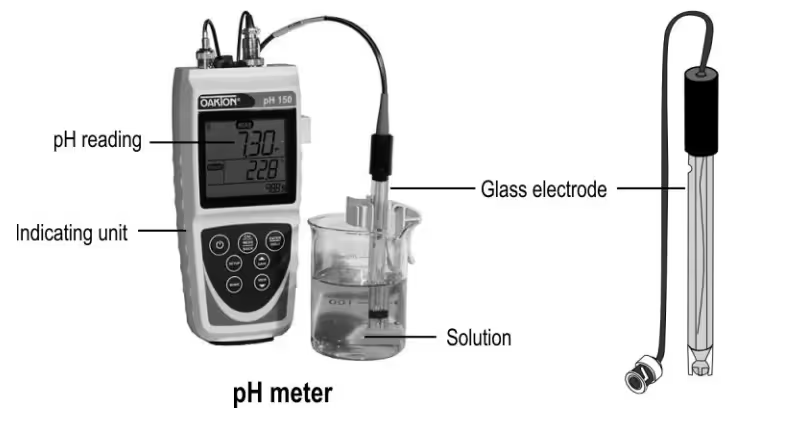
To measure the pH of a solution, the glass electrode is dipped into the solution and the pH is displayed on the screen of the indicating unit. Before measuring the pH of another solution, the glass electrode is rinsed with distilled water and dried carefully with tissue paper.
How is the pH reading of the second solution likely to be affected if the glass electrode is not dried with tissue paper in the following cases?
(i) if the second solution being measured is acidic in nature
(ii) if the second solution being measured is basic in nature
Answer:
If the glass electrode is not dried with tissue paper after rinsing with distilled water before measuring the pH of a second solution, the leftover water can dilute the solution being tested. This dilution can affect the pH reading as follows:
(i) if the second solution being measured is acidic in nature
The presence of distilled water on the glass electrode would dilute the acidic solution. Since dilution of an acid decreases the concentration of hydrogen ions (H+), the pH of the solution would appear higher (less acidic) than its actual value.
(ii) if the second solution being measured is basic in nature
Similarly, the dilution caused by the residual distilled water would decrease the concentration of hydroxide ions (OH−) in the basic solution. As a result, the pH of the solution would appear lower (less basic) than its actual value.
In both cases, drying the electrode with tissue paper ensures accurate pH measurements by preventing unintended dilution.
Q8. pH is measured on a scale of 0 to 14, with lower values indicating high hydrogen ion concentration (more acidic) and higher values indicating low hydrogen ion concentration (less acidic). A pH of 7 is considered as neutral. Every whole unit in pH represents a ten-fold increase in or decrease in hydrogen ion concentration. What would the hydrogen ion concentration of a solution of pH 4 be compared to a solution of pH 8?
Answer:
The pH scale is logarithmic, meaning that for every whole number change in pH, the hydrogen ion concentration changes by a factor of 10.
If a solution has a pH of 4, it is more acidic, and its hydrogen ion concentration is higher compared to a solution with a pH of 8. To find out how much more concentrated the hydrogen ions are in the pH 4 solution compared to the pH 8 solution, we calculate the difference in pH values.
- The difference in pH between 4 and 8 is: 8−4=4
- Since each whole pH unit corresponds to a ten-fold change in hydrogen ion concentration, a difference of 4 pH units means the hydrogen ion concentration in the pH 4 solution is 104 (or 10,000) times higher than in the pH 8 solution.
Therefore, the hydrogen ion concentration of the pH 4 solution is 10,000 times higher than the hydrogen ion concentration of the pH 8 solution.
Q9. Sunita carried out the following reactions in the laboratory:
(i) complete neutralisation of one mole of sodium carbonate with hydrochloric acid
(ii) complete neutralisation of one mole of sodium bicarbonate with hydrochloric acid She found that the amount of carbon dioxide formed in both the reactions was the same.
(a) Is her finding correct? Justify your answer.
(b) How does the amount of salt formed in case (i) compare with the amount of salt formed in case (ii)?
Answer:
(a) Is her finding correct? Justify your answer.
Yes, Sunita's finding is correct. Both reactions (i) and (ii) result in the formation of the same amount of carbon dioxide, because in both reactions, one mole of carbon dioxide is released as a result of the neutralisation process.
- Reaction (i): Sodium carbonate reacts with hydrochloric acid as follows:
Na2CO3(aq)+2HCl(aq)→2NaCl(aq)+H2O(l)+CO2(g)
In this reaction, 1 mole of sodium carbonate releases 1 mole of carbon dioxide.
- Reaction (ii): Sodium bicarbonate reacts with hydrochloric acid as follows:
NaHCO3(aq)+HCl(aq)→NaCl(aq)+H2O(l)+CO2(g)
In this reaction, 1 mole of sodium bicarbonate also releases 1 mole of carbon dioxide.
Thus, the amount of carbon dioxide formed in both reactions is indeed the same, as each reaction releases 1 mole of CO₂.
(b) How does the amount of salt formed in case (i) compare with the amount of salt formed in case (ii)?
In reaction (i), 2 moles of sodium chloride (NaCl) are formed per mole of sodium carbonate, because the balanced equation shows 2 moles of NaCl are produced:
Na2CO3(aq)+2HCl(aq)→2NaCl(aq)+H2O(l)+CO2(g)
In reaction (ii), 1 mole of sodium chloride (NaCl) is formed per mole of sodium bicarbonate:
NaHCO3(aq)+HCl(aq)→NaCl(aq)+H2O(l)+CO2(g)
Therefore, the amount of salt formed in case (i) (2 moles of NaCl) is twice the amount of salt formed in case (ii) (1 mole of NaCl).
Some More Important Question Answers of Class 10
Q1. Why does dry HCl gas not change the colour of litmus paper, while HCl solution does?
Ans. Dry hydrogen chloride does not show acidic properties because there are no free hydrogen ions in it. Acids show their acidic character only in aqueous solution. When HCl is dissolved in water, it dissociates into H⁺ (as H₃O⁺) ions which turn blue litmus red. Since dry HCl gas does not release ions, it does not change the colour of litmus paper.
Q2. Why is it important to brush teeth regularly? What happens if pH inside the mouth falls below 5.5?
Ans. The tooth enamel is made of calcium phosphate. It is the hardest substance in the body but can be corroded by acids. Bacteria present in the mouth act on sugar particles to produce acids like lactic acid.
When the pH inside the mouth falls below 5.5, the acid starts dissolving calcium phosphate, leading to tooth decay. Brushing teeth regularly with basic toothpaste neutralises these acids and protects enamel from corrosion.
Q3. A student accidentally touches nettle leaves and feels a stinging pain. Suggest the reason and remedy.
Ans. Nettle leaves contain methanoic acid (formic acid) which causes burning pain when it comes in contact with skin. The effect of this acid can be neutralised by rubbing the area with a mild base such as baking soda solution or calamine lotion (ZnCO₃). This works on the principle of acid–base neutralisation.
Q4. Why is it always advised to add acid to water and not water to acid during dilution?
Ans. Dilution of a concentrated acid is a highly exothermic process. If water is poured into acid, the heat generated is so high that the water can boil instantly and cause the acid to splash out, leading to severe burns.
On the other hand, if acid is added slowly into water with constant stirring, the large volume of water absorbs the heat safely.
The correct method is to always add acid to water, never water to acid.
Q5. With the help of an activity, explain that all bases are not alkalis.
Ans. Take some copper oxide (CuO) powder in a beaker and add water to it. It does not dissolve in water. Now add dilute hydrochloric acid to the same beaker. The black colour of copper oxide slowly disappears and a blue solution of copper chloride is formed.
This shows that copper oxide reacts with acid to form salt and water, hence it is a base. But since it is insoluble in water, it cannot be called an alkali.
Equation: CuO(s)+2HCl(aq)→CuCl2(aq)+H2O(l)
Thus , from the above activity we can infer that All alkalis are bases, but all bases are not alkalis!
Q6. What happens when an acid reacts with a metal carbonate? Give an activity to show this reaction.
Ans. When an acid reacts with a metal carbonate, it produces salt, carbon dioxide, and water.
Activity:
- Take some dilute HCl in a test tube.
- Add a pinch of sodium carbonate (Na₂CO₃).
- Brisk effervescence is seen due to CO₂ gas.
- Pass this gas through lime water, it turns milky confirming CO₂.
Reaction: Na2CO3+2HCl→2NaCl+CO2+H2O
Q7. Write an activity to show that metallic oxides are basic in nature.
Ans. Take a small amount of copper oxide powder in a beaker and add dilute HCl. The black powder dissolves forming a blue solution of copper chloride and water. This shows that copper oxide reacts with acid to form salt and water, which is the property of a base. Thus, metallic oxides are basic in nature.
Q8. Write an activity to show that non-metallic oxides are acidic in nature.
Ans. Burn a small piece of sulphur in a deflagrating spoon and collect the gas formed (SO₂) in a test tube. Add water to the test tube and shake well. Now dip blue litmus paper into this solution. It turns red, showing that SO₂ forms sulphurous acid which is acidic in nature. Hence, non-metallic oxides are acidic.
Q9. A solution of substance ‘X’ is bitter in taste and turns red litmus blue. What is ‘X’? Give one example.
Ans. Since the solution is bitter and turns red litmus blue, ‘X’ must be a base.
Example: Sodium hydroxide (NaOH) solution.
Q10. What is a neutralisation reaction? Give two examples from everyday life.
Ans. A neutralisation reaction is one in which an acid reacts with a base to form salt and water.
Examples:
- Antacids (magnesium hydroxide) neutralize excess HCl in the stomach.
- Lime solution neutralising acidic soil in agriculture.
Equation: HCl+NaOH→NaCl+H2O
Q11. Explain the importance of pH in our daily life with two examples.
Ans. pH plays a very important role in our daily life.
- In our digestive system: Our stomach produces HCl which helps in digestion of food. When excess acid is produced, it causes acidity. Antacids like Mg(OH)₂ neutralise this acid and give relief.
- In agriculture: The pH of soil is tested before growing crops. Some plants require slightly acidic soil, others require slightly basic soil. If soil is too acidic, it is treated with quick lime; if it is too basic, it is treated with organic matter.
Thus, maintaining proper pH is essential for health, farming, and many other activities.
Q12. What is baking soda chemically? Write its uses.
Ans. Chemically, baking soda is sodium hydrogen carbonate (NaHCO₃).
Uses:
- Used in baking powder which makes cakes and breads soft and spongy.
- Used in medicines as an antacid.
- Used in fire extinguishers.
Q13. What happens when baking soda is heated? Give an equation.
Ans. On heating, sodium hydrogen carbonate decomposes to form sodium carbonate, carbon dioxide, and water.
2NaHCO3→Na2CO3+CO2+H2O
This reaction is used in baking, where CO₂ makes the dough rise.
Q14. Name the raw materials used in the preparation of washing soda. Write its chemical formula.
Ans. Raw materials: Sodium chloride (NaCl), limestone (CaCO₃), and ammonia (NH₃).
Washing soda is chemically sodium carbonate decahydrate (Na₂CO₃·10H₂O).
Q15. What is bleaching powder? How is it prepared? Write its uses.
Ans. Bleaching powder is chemically calcium oxychloride (CaOCl₂). It is prepared by passing chlorine gas over dry slaked lime:
Ca(OH)2+Cl2→CaOCl2+H2O
Uses:
- For disinfecting drinking water.
- As a bleaching agent in the textile industry.
- In paper and laundry for bleaching.
Q16. Why is Plaster of Paris written as CaSO₄·½H₂O? What happens when it is left exposed to air?
Ans. Plaster of Paris (POP) is calcium sulphate hemihydrate, CaSO₄·½H₂O. It is written like this because one molecule of water is shared between two formula units. When POP is left exposed to air, it absorbs moisture and gets converted into gypsum (CaSO₄·2H₂O), losing its property of setting.
Q17. State the differences between strong acid and weak acid with one example each.
Ans.
- Strong acid: Completely ionises in water. Example: HCl.
- Weak acid: Partially ionises in water. Example: CH₃COOH.
Q18. Write two differences between salts of strong acid + strong base and salts of weak acid + strong base.
Ans.
- Salts of strong acid and strong base are neutral in nature (e.g., NaCl).
- Salts of weak acid and strong base are basic in nature (e.g., CH₃COONa).
Q19. A substance ‘Y’ is used as an antacid and also in making bread soft. Identify ‘Y’ and write its chemical formula.
Ans. The substance is baking soda. Formula: NaHCO₃ (sodium hydrogen carbonate).
Q20. Write the reaction when bleaching powder is added to water. What is the reason for its strong smell?
Ans. When bleaching powder is added to water, it releases chlorine:
CaOCl2+H2O→Ca(OH)2+Cl2, The strong smell of chlorine is due to this reaction.
Video Lecture: Must-watch for Quick Revision
Extra Questions for Practice – Test Your Acid–Base Superpowers!
Q1. Why does the colour of copper sulphate solution fade when sodium hydroxide solution is added to it? Write the chemical equation for the reaction.
Q2. How does the pH of soil affect the growth of crops? What measures can farmers take if the soil is too acidic or too basic?
Q3. A drop of dilute HCl is placed on marble chips. Write the observations you expect and explain with a balanced equation.
Q4. Which gas is released when hydrochloric acid reacts with zinc granules? How would you confirm the identity of this gas in the laboratory?
Q5. Why does common salt become sticky during the rainy season? Which property of salt is responsible for this behaviour?
Q6. With the help of an activity, show that carbon dioxide is an acidic oxide.
Q7. Explain why the crystals of copper sulphate turn white on heating. What change is observed when water is added again?
Q8. A solution ‘A’ turns red litmus blue and solution ‘B’ turns blue litmus red. What will be the effect when these two solutions are mixed in equal amounts? Write the type of reaction.
Q9. What happens when bleaching powder is exposed to air? Give one application of this property in daily life.
Q10. Write one difference between baking soda and baking powder. Why is tartaric acid added to baking powder?
How to Ace These Class 10 Acids, Bases and Salts Important Questions
To score well in this chapter, focus on clarity and regular practice rather than memorization. Here is a step-by-step strategy:
Step 1: Begin with NCERT Concepts
Read the chapter thoroughly from the NCERT textbook. Focus on how acids and bases behave in aqueous solutions, what ions they form, and how their reactions lead to salt formation.
Step 2: Learn the Different Types of Indicators
Learning the difference between natural indicators like litmus and turmeric, synthetic indicators like phenolphthalein and methyl orange, and the universal indicator. Make a quick table showing the color change in each type of solution.
Step 3: Revise the pH Scale and Its Applications
Know what the pH scale represents and what each range means. Connect it to real-life contexts like the acidity of rainwater, the neutrality of pure water, or the basicity of toothpaste.
Step 4: Practise Reaction Equations
Write and balance equations showing how acids and bases react with metals, metal oxides, and carbonates. Practice explaining the products formed in each type of reaction.
Step 5: Study the Preparation and Uses of Salts
Memorize how salts such as sodium chloride, washing soda, baking soda, bleaching powder, and Plaster of Paris are prepared and used. These are frequently asked in both short and case-based questions.
Step 6: Connect Concepts with Real Life
Knowing why antacids relieve acidity or how factory waste can affect soil pH makes the subject more meaningful and easier to remember.
Why Focus on Acids, Bases, and Salts in Class 10: Important Questions?
- Chemistry, unlike many other subjects, is not just about memorizing formulas; it's about understanding the "why" and "how" behind reactions. Acids, bases, and salts Class 10's important questions require students to apply their knowledge. By solving these questions, students strengthen their grasp of key concepts such as how acids and bases react, how salts are formed, and why the pH scale is important for measuring acidity and alkalinity.
- The Class 10 board exams are one of the most important academic stages in a student’s life. Practicing acids, bases, and salts in class 10 important questions is a must. These questions are designed to reflect the kinds of questions that appear in the actual exams.
- Practicing class 10 acids, bases, and salts important questions helps in developing essential problem-solving skills. Students must know how to analyze reactions, balance chemical equations, and understand the role of various acids, bases, and salts in different chemical processes.
- Students always look for high-scoring topics, and acids, bases, and salts Class 10 important questions are exactly that. These questions often cover topics that frequently appear in exams.
FAQs
Q1. How many marks are generally asked from this chapter in the CBSE Class 10 Science exam?
Ans. Usually, questions worth 3 to 5 marks are asked from this chapter, often including both reaction-based and reasoning-based parts.
Q2. How can I remember the reactions easily?
Ans. Group reactions by type. For example, keep all acid-metal reactions together and all base-carbonate reactions together. Write them repeatedly to build muscle memory.
Q3. Is pH an important topic for board exams?
Ans. Yes, pH and its real-life applications are very important. You can expect at least one question related to pH indicators or its effects.
Q4. How should I prepare the topic of salts?
Ans. Make a table for common salts, their chemical names, formulas, and everyday uses. Understanding their preparation reactions helps you recall them faster.
Q5. Do I need to learn chemical formulas in detail?
Ans. Yes, chemical formulas are the base for writing balanced equations. You should know the formulas of common acids, bases, and salts accurately.












.svg)

