
.svg)

The chapter Pair of Linear Equations in Two Variables is a key topic in Class 10 Maths Syllabus that combines algebra and geometry. It introduces students to systems of two linear equations and their solutions using different methods.
The topic forms a foundation for higher-level algebra, coordinate geometry, and systems of equations in later classes. Since it involves both conceptual learning and numerical accuracy, regular practice is the best way to score full marks.
The Pair of Linear Equations in Two Variables Important Questions are designed to help you:
- Understand methods of solving equations systematically.
- Apply concepts to word problems and graphical representations.
- Strengthen accuracy and confidence in solving equations for board exams
IMPORTANT QUESTIONS Class 10
(Most Important Questions of this Chapter from our 📕)
In the table given below, we have provided the links to downloadable Class 10 Quadratic Equations Important Questions PDFs. Now you can download them without requiring a login.

Class 10 Ch4 Quadratic Equations Important Questions Maths
1. Aman solved a quadratic equation and found its roots to be real.
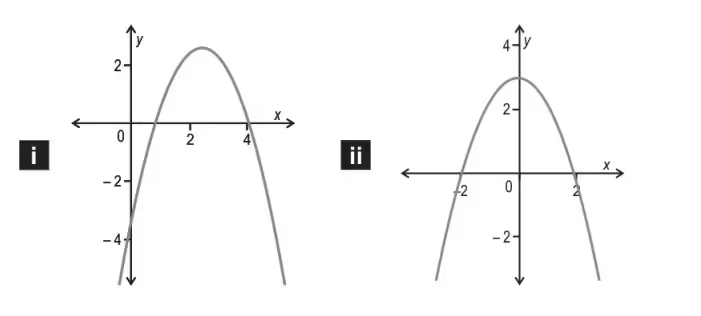
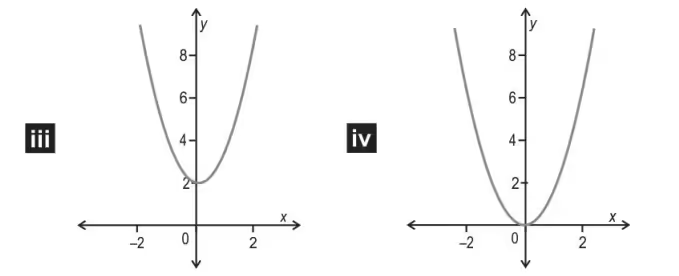
Which of these could represent the graph of the equation Aman solved?
a. only iii)
b. only i) and ii)
c. only iii) and iv)
d. only i), ii) and iv)
Soln. (d) only i), ii) and iv)
Explanation:
We must analyse each graph to determine which graph represents the quadratic equation with real roots. A quadratic equation has real roots if its parabola intersects the x-axis.
Graph (i):
- The parabola opens downwards.
- The graph intersects the x-axis at two distinct points.
- This means the equation has two distinct real roots.
- Graph (i) could represent the equation Aman solved.
Graph (ii):
- The parabola opens downwards.
- The graph touches the x-axis at one point (vertex).
- This means the equation has one real root (a repeated root).
- Graph (ii) could represent the equation Aman solved.
Graph (iii):
- The parabola opens upwards.
- The graph does not intersect the x-axis.
- This means the equation has no real roots.
- Graph (iii) cannot represent the equation Aman solved.
Graph (iv):
- The parabola opens upwards.
- The graph touches the x-axis at one point (vertex).
- This means the equation has one real root (a repeated root).
- Graph (iv) could represent the equation Aman solved.
The graphs that could represent the quadratic equation Aman solved are:
- Graph (i) (two distinct real roots),
- Graph (ii) (one real root),
- Graph (iv) (one real root).
2. Three students were asked how they would verify their solution of a quadratic equation, (x-2)(x-5)= 0. Shown below are their responses.
Student 1 said, "In the first bracket, x must equal 2, and in the second bracket, equal 5. So, (2-2)(5 - 5) = 0."
Student 2 said, "In the first bracket, x must equal 2, but in the second bracket, have any real number value. For example, (2-2)(3-5)= 0 or (2-2)(10-5) = 0
Student 3 said, "Both brackets should always have the same x value. So, x is ei or 5 in both brackets. For example, (2-2)(2 - 5) = 0 and (5-2)(5-5) = 0.
"Whose response is correct?
a. only student 1
b. only student 3
c. only students 1 and 2
d. all students 1, 2 and 3
Soln. (a) only student 1
Explanation:
Let’s carefully analyze the responses of all three students with respect to the given quadratic equation:
(x−2)(x−5)=0
For (x−2)(x−5)=0, the product will be zero when:
- x−2=0 ⟹ x=2, or
- x−5=0 ⟹ x=5
Student 1: Student 1 says, "In the first bracket, x must equal 2, and in the second bracket, x must equal 5.
So, (2−2)(5−5)=0"
- Correct interpretation: Student 1 correctly identifies the two solutions, x=2 and x=5, and substitutes them into the equation to verify.
- Verdict: Student 1 is correct
Student 2: Student 2 says, "In the first bracket, x must equal 2, but x can have any real value in the second bracket. For example, (2−2)(3−5)=0 or (2−2)(10−5)=0"
- Incorrect interpretation: The zero product property states that one of the brackets must equal zero, but the other factor does not need to be zero. Student 2 misinterprets this as x being allowed to have different values in the second bracket, which is invalid for solving the equation.
- Verdict: Student 2 is incorrect.
Student 3: Student 3 says, "Both brackets should always have the same x value. So, x is either 2 or 5 in both brackets. For example,(2−2)(2−5)=0 and (5−2)(5−5)=0"
- Incorrect interpretation: The two brackets represent different conditions for x to satisfy the equation. It is not required for both brackets to have the same x value simultaneously.
- For x=2, the first bracket is zero. For x=5, the second bracket is zero.
- The statement x must be the same for both brackets is invalid.
- Verdict: Student 3 is incorrect.
3. Arpit was asked to represent the following statements in the form of a quadratic equation:
"The sum of the squares of two positive integers is 225. The square of the larger number is 16 times the smaller number."
If Arpit wrote the equation correctly, what could he have written?
Soln.
x = the smaller number (a positive integer),
y = the larger number (a positive integer).
"The sum of the squares of two positive integers is 225":
Mathematically:
x2+y2=225
"The square of the larger number is 16 times the smaller number":
Mathematically:
y2=16x
Substitute y2=16x in x2+y2=225
x2+16x=225.
x2+16x−225=0.
This is the required quadratic equation.
4. Find the solution(s) of the following equation.
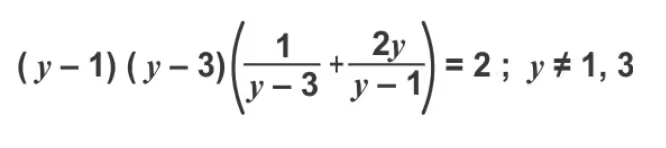
Show your steps and give valid reasons.
Soln. Simplify ( (1/y-3)+(2y/y-1))
(y−1)+(2y2−6y)/(y−3)(y−1)
(2y2−5y-1)/(y−3)(y−1)
Now original equation
(y-1) (y-3) (y−1)+(2y2−5y-1)/(y−3)(y−1) = 2
(since y≠1,3)
2y2−5y−1=2
2y2−5y−1−2=0
2y2−5y−3=0
2y2−3y-2y−3=0
y= -1/2 or y = 3
(since y≠1,3)
y= -1/2
5. One of the solutions of the following equation is -7 where k is a constant.
z2 - kz - 28 = 0
i) Find the value of k.
ii) Find the other solution
Show your steps.
Soln.
i) Find the value of k.
z2−kz−28=0
z=−7
(−7)2−k(−7)−28=0
49+7k−28=0
49−28+7k=0
21+7k=0
7k=−21
k=−3
ii) Find the other solution.
The equation is now:
z2−(−3)z−28=0 or z2+3z−28=0.
z= −b±√b2−4ac /2a
z= −(3)±√(3)2−4(1)(-28) /2(1)
z= −3±√121 /2
z= −3±11 /2
z= 4 or z = -7
6. A quilt maker has a rectangular quilt measuring 12 units by 8 units. He wants to add a border to it as shown in the figure below. He has 64 sq units of fabric for the border.
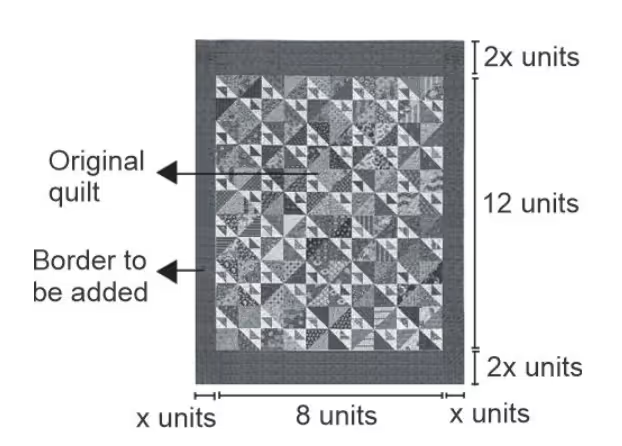
(Note: The figure is not to scale.)
i) If x and 2 x are the widths of the border as shown, frame a quadratic equation
using the total area enclosed by the new quilt (with the border).
ii) Find the measures of the new quilt (with the border).
Show your work along with valid reasons.
Soln.
i) If x and 2 x are the widths of the border as shown, frame a quadratic equation
using the total area enclosed by the new quilt (with the border).
Width=8+x+x=8+2x
Height=12+2x+2x=12+4x.
Total Area=Width×Height.
Total Area=(8+2x)(12+4x)
Area of Original Quilt=12×8=96square units.
Area of Border=Total Area−Area of Original Quilt
Total Area−96=64
(8+2x)(12+4x)−96=64
(8+2x)(12+4x)=8(12)+8(4x)+2x(12)+2x(4x) (distributive property)
(8+2x)(12+4x)=96+32x+24x+8x2.
(8+2x)(12+4x)= 8x2+56x+96
Now substitute this into the equation:
8x2+56x+96 = 64
8x2+56x= 64
8x2+56x−64=0
x2+7x−8=0
x= −b±√b2−4ac / 2a
x= −(7)±√(7)2−4(1)(-8) / 2(1)
x= −7±9 / 2
x= 1 or x = -8
ii) Find the measures of the new quilt (with the border).
New width:
8+2x=8+2(1)=10units.
New height:
12+4x=12+4(1)=16 units.
7. Study the given information and answer the questions that follow.
Bangalore city corporation is building parks in residential areas across the city. Shown below is one such park. The rectangular park consists of various components like walking track, kids play area, open gym, pond etc.
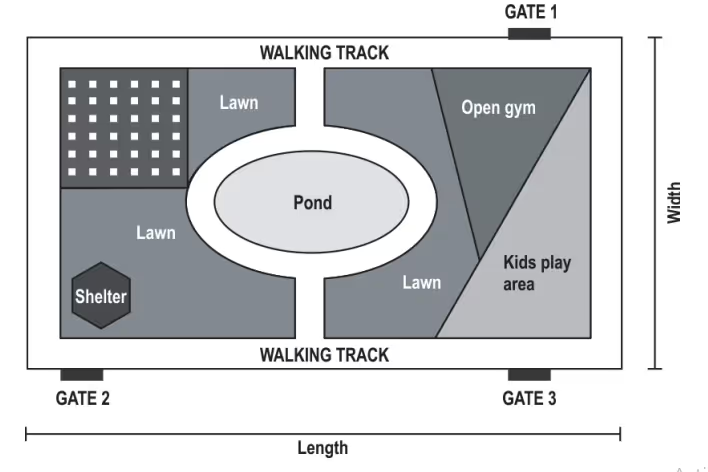
(Note: The image is not to scale.)
(i) Gate 3 has been placed exactly opposite to gate 1 on the boundary of the park. The distance between gate 3 and gate 2 is 1 m more than the distance between gate 3 and gate 2.
The shortest distance between gates 1 and 2 is 29 m, find the width of the park. Show your work.
(ii) The caretaker of the park is attempting to plant saplings in the form of a square. That is, number of rows of saplings is the same as the number of columns of saplings. On arranging the saplings, he found that 24 saplings were still left with him. When he increased the number of rows and columns by 1, he found that he was short of 25 saplings.
Find the number of saplings available with him. Show your work.
Soln.
(i) Gate 3 has been placed exactly opposite to gate 1 on the boundary of the park. The distance between gate 3 and gate 2 is 1 m more than the distance between gate 3 and gate 2.
The shortest distance between gates 1 and 2 is 29 m, find the width of the park. Show your work.
Let the width of the park be denoted as W. The length of the park is given as 26 + 1 = 27 m. The configuration tells us that Gate 1 and Gate 3 are opposite each other along the longer side (length), while Gate 2 is positioned such that it maintains the shortest distance of 29 m to Gate 1.
From the problem, we know:
- The distance between Gate 3 and Gate 1 is equal to W (since they are on the same side).
- The distance between Gate 3 and Gate 2 is W + 1 m.
Using the information about distances, we can set up the equation for the shortest distance between Gate 1 and Gate 2:
Distance(Gate 1 to Gate 2) = Distance(Gate 3 to Gate 1) + Distance(Gate 3 to Gate 2)
29 m = W + (W + 1)
Simplifying the equation:
29 = W + W + 1
29 = 2W + 1
28 = 2W
W = 14
The width of the park is 14 meters.
(ii) The caretaker of the park is attempting to plant saplings in the form of a square. That is, number of rows of saplings is the same as the number of columns of saplings. On arranging the saplings, he found that 24 saplings were still left with him. When he increased the number of rows and columns by 1, he found that he was short of 25 saplings.
Find the number of saplings available with him. Show your work.
Let N be the number of rows (and columns) of saplings that the caretaker originally planned to plant. The total number of saplings he needs is N2. According to the problem, he has 24 saplings left after planting:
N2 + 24 = Total Saplings Available
Next, when he increases the rows and columns by 1:
(N + 1)2 = Total Saplings Available - 25
From the new arrangement:
(N + 1)2 = N^2 + 25
Expanding (N + 1)^2 gives us:
N2 + 2N + 1 = N2 + 25
Now, simplifying:
2N + 1 = 25
2N = 24
N = 12
The caretaker initially planned to plant 12 rows and 12 columns of saplings.
8. 3(3)2m + 11(3)m = 4
Use the substitution 3m = x to solve for m. Show your steps.
Soln.
32m=(3m)2=x2.
3x2+11x=4.
3x2+11x−4=0
x= (−b±√b2−4ac)/2a
x= (−11±√169)/2(3)
x= (−11±13)/6
x= ⅓ or x=-4
Recall that x=3m. Substituting back:
⅓ =3m
3-1 =3m
m = -1
For x=−4:
3m=−4
However, 3m (an exponential function with base 3) can never be negative because the exponential function is always positive.
Therefore, this solution is not valid.
9. (2 x + 1)3 = 8x (x2 + 1) + 3
Write the zeroes of the above equation in the form (x,y). Show your steps.
Soln.
(2x+1)3−8x(x2+1)−3=0
(2x+1)3=(2x)3+3(2x)2(1)+3(2x)(12)+13 (Binomial Theorem)
(2x+1)3=8x3+12x2+6x+1.
(8x3+12x2+6x+1)−(8x3+8x)−3=0
After simplifying
12x2−2x−2=0.
x= (2±10)/4
x= ½ or x= -⅓
Since the corresponding y-value is (x, y)(x,y) are:
( ½, 0) or ( -⅓,0)
10. The graph below represents the path of a ball thrown by Ankush. The maximum height, h, the ball reaches with respect to time, t, is represented by the polynomial h (t) = t2+ 19/4t + 5/4
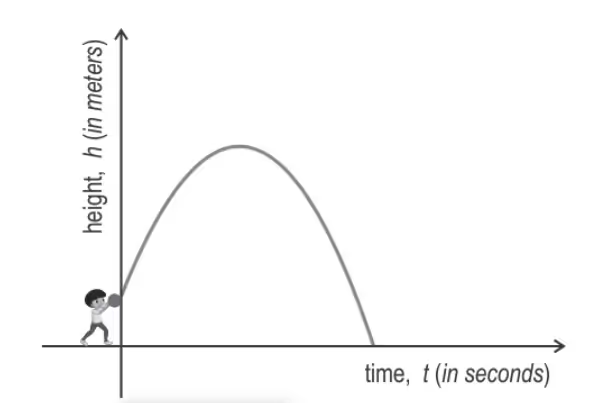
(Note: The figure is not to scale.)
How long will it take for the ball to reach the ground? Show your steps.
Soln.
h (t) = t2+ 19/4t + 5/4
t2+ 19/4t + 5/4 = 0
4t2+19t+5=0.
t= −b±√b2−4ac /2a
where a=4 b=19, and c=5.
Substituting the values
t= −(19)±√(19)2−4(4) (5) /2 (4)
t= −(19)±√361-80 /8
t= −(19)±√281 /8
t= −(19)±16.76 /8
t≈−0.28 or ≈−4.47 seconds
t≈4.47 seconds.
It will take approximately 4.47 seconds for the ball to reach the ground.
Some More Important Question Answer of Class 10th Maths
Q1. Solve by substitution: x + y = 10, 2x – y = 1.
Ans. From first: y = 10 – x.
Substitute in second: 2x – (10 – x) = 1 ⇒ 2x – 10 + x = 1 ⇒ 3x = 11 ⇒ x = 11/3.
Then y = 10 – 11/3 = 19/3.
Answer: (11/3, 19/3)
Q2. Solve by elimination: 3x + 2y = 11, 2x – 3y = –4.
Ans. Multiply first by 3: 9x + 6y = 33.
Multiply second by 2: 4x – 6y = –8.
Add: 13x = 25 ⇒ x = 25/13.
Substitute: 3(25/13) + 2y = 11 ⇒ 75/13 + 2y = 11 ⇒ 2y = 68/13 ⇒ y = 34/13.
Answer: (25/13, 34/13)
Q3. The sum of two numbers is 30. Their difference is 4. Find the numbers.
Ans. x + y = 30, x – y = 4.
Add: 2x = 34 ⇒ x = 17. Then y = 13.
Answer: 17 and 13
Q4. A two-digit number has tens digit 3 more than units digit. The sum of the number and its reverse is 121. Find the number.
Ans. Let tens = x, units = y. Then x = y + 3.
Number + reverse = 11(x + y) = 121 ⇒ x + y = 11.
So (y + 3) + y = 11 ⇒ 2y = 8 ⇒ y = 4, x = 7.
Number = 74.
Answer: 74
Q5. One number is twice the other. Their sum is 36. Find the numbers.
Ans. Let smaller = y, larger = x = 2y.
x + y = 36 ⇒ 2y + y = 36 ⇒ y = 12, x = 24.
Answer: 24 and 12
Q6. Find k if 2x + 3y = 7 and 4x + ky = 14 have infinitely many solutions.
Ans. For infinitely many solutions: 2/4 = 3/k = 7/14 ⇒ 1/2.
So 3/k = 1/2 ⇒ k = 6.
Answer: k = 6
Q7. Find k if x + 2y = 3 and 5x + ky = 7 have no solution.
Ans. Condition: a1/a2 = b1/b2 ≠ c1/c2.
Here 1/5 = 2/k ⇒ k = 10.
Check: 3/7 ≠ 1/5.
Answer: k = 10
Q8. Solve: 7x – 3y = 5, 3x + 2y = 11.
Ans. Multiply first by 2: 14x – 6y = 10.
Multiply second by 3: 9x + 6y = 33.
Add: 23x = 43 ⇒ x = 43/23.
Substitute: 3(43/23) + 2y = 11 ⇒ 2y = 124/23 ⇒ y = 62/23.
Answer: (43/23, 62/23)
Q9. The sum of ages of father and son is 45. Five years ago my father had 4 sons. Find present ages.
Ans. F + S = 45.
F – 5 = 4(S – 5). ⇒ F = 4S – 15.
Substitute: 4S – 15 + S = 45 ⇒ 5S = 60 ⇒ S = 12, F = 33.
Answer: Father 33 years, Son 12 years
Q10. A two-digit number is divisible by the sum of digits and the quotient is 4. Digits differ by 2. Find the number.
Ans. 10x + y = 4(x + y). ⇒ 10x + y = 4x + 4y ⇒ 6x = 3y ⇒ y = 2x.
|x – y| = 2 ⇒ |x – 2x| = 2 ⇒ x = 2 ⇒ y = 4.
Number = 24.
Answer: 24
Q11. Solve: x + y = 5, 2x – y = 4.
Ans. x + y = 5, 2x – y = 4.
Add: 3x = 9 ⇒ x = 3, y = 2.
Answer: (3, 2)
Q12. Solve: 5x – 4y = –2, –7x + 6y = 10.
Ans. Multiply first by 3: 15x – 12y = –6.
Multiply second by 2: –14x + 12y = 20.
Add: x = 14.
Substitute: 5(14) – 4y = –2 ⇒ –4y = –72 ⇒ y = 18.
Answer: (14, 18)
Q13. Solve: 9x + 7y = 59, 4x + 3y = 26.
Ans. Multiply first by 3: 27x + 21y = 177.
Multiply second by 7: 28x + 21y = 182.
Subtract: –x = –5 ⇒ x = 5.
Then 4(5) + 3y = 26 ⇒ 3y = 6 ⇒ y = 2.
Answer: (5, 2)
Q14. Solve: 3x + 4y = 10, 2x – y = 1.
Ans. From second: y = 2x – 1.
Substitute: 3x + 8x – 4 = 10 ⇒ 11x = 14 ⇒ x = 14/11.
y = 28/11 – 1 = 17/11.
Answer: (14/11, 17/11)
Q15. Solve: 2x + 3y = 12, 3x + 2y = 13.
Ans. Multiply first by 3: 6x + 9y = 36.
Multiply second by 2: 6x + 4y = 26.
Subtract: 5y = 10 ⇒ y = 2.
Then 2x + 6 = 12 ⇒ x = 3.
Answer: (3, 2)
Q16. Solve: x/2 + y/3 = 5, x/3 + y/2 = 6.
Ans. Multiply by 6: 3x + 2y = 30, 2x + 3y = 36.
Multiply first by 3: 9x + 6y = 90.
Multiply second by 2: 4x + 6y = 72.
Subtract: 5x = 18 ⇒ x = 18/5.
Then 3(18/5) + 2y = 30 ⇒ 2y = 96/5 ⇒ y = 48/5.
Answer: (18/5, 48/5)
Q17. Solve: 4x + 5y = 19, 7x – 2y = 20.
Ans. Multiply first by 2: 8x + 10y = 38.
Multiply second by 5: 35x – 10y = 100.
Add: 43x = 138 ⇒ x = 138/43.
Substitute: 4x + 5y = 19 ⇒ y = 31/25.
Answer: (138/43, 31/25)
Q18. Solve: 5x + y = 11, x + 5y = 7.
Ans. Multiply first by 5: 25x + 5y = 55.
Subtract second: 24x = 48 ⇒ x = 2.
Substitute: 5(2) + y = 11 ⇒ y = 1.
Answer: (2, 1)
Q19. The larger of two numbers is three times smaller. Sum is 60. Find numbers.
Ans. Let smaller = y, larger = 3y.
3y + y = 60 ⇒ 4y = 60 ⇒ y = 15, larger = 45.
Answer: 45 and 15
Q20. The sum of two numbers is 100. If the larger is decreased by 10 and the smaller increased by 6, the larger becomes three times the smaller. Find the numbers.
Ans.
- Let the larger number be xxx and the smaller be yyy.
Given: x+y=100x + y = 100x+y=100 …(1). - After changes: Larger → x−10x - 10x−10, Smaller → y+6y + 6y+6.
Condition: x−10=3(y+6)x - 10 = 3(y + 6)x−10=3(y+6) …(2). - Expand (2): x−10=3y+18x - 10 = 3y + 18x−10=3y+18 ⇒ x=3y+28x = 3y + 28x=3y+28.
- Substitute in (1): 3y+28+y=1003y + 28 + y = 1003y+28+y=100.
⇒ 4y+28=1004y + 28 = 1004y+28=100.
⇒ 4y=724y = 724y=72.
⇒ y=18y = 18y=18. - From (1): x+18=100x + 18 = 100x+18=100 ⇒ x=82x = 82x=82.
- Check: Sum = 82 + 18 = 100 ✓
After change: 82 – 10 = 72; 18 + 6 = 24; and 72 = 3 × 24 ✓
Answer: The numbers are 82 and 18.
Q21. A factory makes tables and chairs. Each table needs 3 units of wood, each chair 2 units. In one day 88 items were made, using 210 units of wood. Find tables and chairs.
Ans. T + C = 88.
3T + 2C = 210.
C = 88 – T.
3T + 2(88 – T) = 210 ⇒ 3T + 176 – 2T = 210 ⇒ T = 34, C = 54.
Answer: 34 tables, 54 chairs
Q22. System: x + 2y = 11, 3x + ky = 33. For what k infinite/unique solutions?
Ans. Multiply first by 3: 3x + 6y = 33.
Compare with 3x + ky = 33.
For infinite: k = 6.
Unique: k ≠ 6.
Answer: Infinite for k = 6, unique for k ≠ 6
Q23. A bag contains 20p and 25p coins, 50 in all, total value ₹11.25. Find coins.
Ans.
x + y = 50.
20x + 25y = 1125 (in paise).
y = 50 – x.
20x + 25(50 – x) = 1125 ⇒ –5x + 1250 = 1125 ⇒ –5x = –125 ⇒ x = 25, y = 25.
Answer: 25 coins of each type
Q24. A rectangle has length 4 m more than breadth. Perimeter = 56 m. Find dimensions.
Ans. Let breadth = b, length = b + 4.Perimeter: 2(l + b) = 56 ⇒ l + b = 28.b + 4 + b = 28 ⇒ 2b = 24 ⇒ b = 12, l = 16.Answer: Length 16 m, Breadth 12 m
Extra Practice – For you to ace your board examinations!
Q1. The sum of the digits of a two-digit number is 9. If the digits are reversed, the new number is 27 more than the original. Find the number.
Q2. A person buys 2 pens and 3 pencils for ₹38, and another person buys 3 pens and 2 pencils for ₹44. Find the cost of a pen and a pencil.
Q3. The sum of a two-digit number and the number obtained by reversing its digits is 99. If the difference of digits is 3, find the number.
Q4. A boat goes 12 km downstream in 4 hours and comes back the same distance upstream in 6 hours. Find the speed of the boat in still water and the speed of the stream.
Q5. Solve for x and y: 2x+3y=11, 3x−2y=42x + 3y = 11,\; 3x - 2y = 42x+3y=11,3x−2y=4.
Q6. A two-digit number is such that the product of digits is 24. If we add 18 to the number, the digits get interchanged. Find the number.
Q7. The sum of the ages of a father and son is 50 years. Ten years ago, the father’s age was three times that of his son. Find their present ages.
Q8. The larger of two numbers is 5 more than twice the smaller. If their sum is 65, find the numbers.
Q9. Find the value of k for which the system has infinitely many solutions:
3x−y=7, 6x−2y=k3x - y = 7,\; 6x - 2y = k3x−y=7,6x−2y=k.
Q10. The area of a rectangle is 180 m². If its length is 5 m more than its breadth, find its length and breadth.
How to Ace These Class 10 Pair of Linear Equations Important Questions
This chapter becomes easy when you understand the meaning of a “solution” and the relationship between equations. It also helps to revise the concepts from the NCERT Book Class 10 Maths before practising questions. Here’s a clear plan to prepare:
Step 1: Revise the General Form of Linear Equations
Understand the standard form of a pair of linear equations as:
a₁x + b₁y + c₁ = 0
a₂x + b₂y + c₂ = 0
Learn how the coefficients (a₁, b₁, c₁, a₂, b₂, c₂) determine whether the lines intersect, are parallel, or coincide.
Step 2: Understand the Graphical Method
Learn to plot both equations on a coordinate plane.
- If the lines intersect, the system has one unique solution.
- If the lines are parallel, there is no solution.
- If the lines coincide, there are infinitely many solutions. Practise drawing graphs neatly with proper scales and labeling.
Step 3: Learn the Algebraic Methods of Solving Equations
Study all four algebraic methods step by step:
- Substitution Method – Replace one variable and solve.
- Elimination Method – Add or subtract equations to eliminate a variable.
- Cross Multiplication Method – Use the cross multiplication formula for direct solution.
- Comparison Method – Compare coefficients to find relationships between equations.
Step 4: Study Consistency of Equations
Understand the conditions for consistency and types of solutions based on the ratio of coefficients:
- a₁/a₂ ≠ b₁/b₂ → one solution
- a₁/a₂ = b₁/b₂ ≠ c₁/c₂ → no solution
- a₁/a₂ = b₁/b₂ = c₁/c₂ → infinitely many solutions
Step 5: Solve Word Problems
Practise application-based questions on speed, distance, age, and geometry. These are common in exams and test your ability to translate real-life situations into equations.
Step 6: Double-Check Calculations
Since most errors come from arithmetic steps, carefully check each step when simplifying or substituting values.
Importance of Class 10 Important Questions
Practice is never completed in subjects like math. Class 10 math: important questions are the best to help students make their concepts strong. Here’s why extra questions are essential:
- Extra questions range from basic to complex, enabling you to delve into various facets of quadratic equations. This deepens your understanding and solidifies your knowledge of the topic.
- By practicing a variety of questions, you become better at finding patterns and solving problems more efficiently.
- Solving extra questions helps you gain confidence as you get used to different types of problems that may appear in exams.
- The concepts learned in Class 10 serve as the basis for higher-level mathematics. Extra questions help ensure you're well-prepared for future challenges.
- The more you practice, the better you get. Extra questions can expose you to different problem-solving methods, helping you perform better in exams.
Benefits of Solving Important Questions Ch4 Maths class 10
Practicing important questions offers multiple benefits beyond just helping you score well on exams. Here’s how these questions can be beneficial:
- Working through important questions revises the lessons you've learned in class, helping to reinforce those concepts in your mind.
- Many important questions require you to think critically and analytically, skills that are not only important for math but for problem-solving in general.
- Regular practice with these questions helps improve your speed and accuracy, both of which are essential during timed exams.
- By practicing a variety of questions using Quadratic Equation Class 10 Important Questions with Solutions, you start to develop strategies for approaching different types of problems, which can be incredibly useful in an exam setting.
- Identifying your weaknesses during practice lets you focus on them and improve before the exam.
FAQs
Q1. How many marks are usually allotted to this chapter in Class 10 board exams?
Ans. This chapter generally carries 6 to 8 marks, including one word problem and one numerical or reasoning question.
Q2. Which topics are most important for exams?
Ans. Algebraic methods (especially elimination and substitution), conditions for consistency, and word problems based on speed, age, and geometry are most important.
Q3. How can I easily remember the cross multiplication method?
Ans. Use the pattern:
x / (b₁c₂ – b₂c₁) = y / (c₁a₂ – c₂a₁) = 1 / (a₁b₂ – a₂b₁)
Practise it several times until it feels natural.
Q4. Are graphical questions asked frequently?
Ans. Yes, you may be asked to draw graphs to show the number of solutions or interpret given graphs, so practise graph plotting neatly.
Q5. How can I prepare for word problems effectively?
Ans. Write the problem in words, define your variables clearly, form equations systematically, and then use the elimination or substitution method to solve.












.svg)

