.svg)
Motion in a Straight Line Summary
The branch of mechanics that deals with the motion of objects without considering the cause (forces) is called kinematics. In this chapter, we focus on rectilinear motion or motion in a straight line, a fundamental topic in understanding how objects move.
We describe motion using physical quantities like position, distance, displacement, speed, velocity and acceleration, along with graphs and equations of motion. Graphical representation plays a major role. Position-time and velocity-time graphs help us understand motion visually.
Finally, we study equations of motion for uniformly accelerated motion, relative velocity in one dimension, and motion under gravity - which is just a special case of constant acceleration. View the official curriculum details in the CBSE 11th Physics Syllabus.

Basic Terms and Definitions
These terms form the base of the chapter. Let us get ourselves familiar with these terms.
1. Rest and Motion
- An object is said to be at rest if it does not change its position with time relative to its surroundings.
- An object is in motion if it changes its position with time relative to its surroundings.
Note: Rest and motion are relative concepts. An object may be in motion relative to one observer and at rest relative to another.
2. Point Object
An object is considered a point object if the size of the object is negligible compared to the distance it travels. It helps simplify the analysis of motion.
Position, Path Length and Displacement
Let us now learn the difference between position, path length and displacement:
- Position
The location of an object at any instant of time is called its position. It is usually measured from a reference point along a straight line using a coordinate system.
- Path Length (Distance)
It is the actual length of the path traversed by a particle during motion. It is a scalar quantity and always positive.
- Displacement
Displacement is the shortest distance between the initial and final positions of the object, along with the direction. It is a vector quantity.
Important Points:
- Displacement can be positive, negative, or zero.
- Displacement ≤ Path length
What is Position and Reference Frame ?
Motion can only be described when we choose a reference point. Without a reference, motion has no meaning. If a car moves 10 m from a tree, the tree becomes the reference point. Always remember - motion is relative.
Distance vs Displacement
Distance:
- Total path covered
- Always positive
- Scalar quantity
Displacement:
- Shortest path between initial and final position
- Can be positive, negative or zero
- Vector quantity
Important:
If a person walks 5 m forward and 5 m backward, Distance = 10 m; Displacement = 0
Types of Motion
There are two types of motion:
1. Uniform Motion
An object is said to be in uniform motion if it covers equal distances in equal intervals of time.
2. Non-uniform Motion
When an object covers unequal distances in equal intervals of time, the motion is non-uniform. It may involve changing speed or direction.
Speed and Velocity
Speed and velocity are kind of similar. But let us learn the difference between them:
1. Speed
Speed is the rate of change of distance with respect to time. It is a scalar quantity
Formula: speed = distance travelled (s) / time (t)
Types of Speed:
- Uniform Speed: Constant speed
- Variable Speed: Changing speed
- Average Speed: Total distance/Total time
- Instantaneous Speed: Speed at a particular instant (limit as Δt → 0)
2. Velocity
Velocity is not just speed with direction. If speed is constant but direction changes - velocity changes. Velocity is the rate of change of displacement with time. It is a vector quantity.
Formula: velocity (v) = displacement (Δx) / time (Δt)
Key Points:
- Velocity can be positive, negative, or zero.
- If direction changes, velocity changes even if speed is constant.
- Average velocity: Total displacement / Total time
- Instantaneous velocity: Velocity at a given moment (limit as Δt → 0)
3. Acceleration
Acceleration tells how quickly velocity changes. It is the rate of change of velocity with respect to time.
Formula: Acceleration (a) = Δv / Δt, where
Δv = change in velocity and Δt = time interval
Key Points:
- Acceleration is a vector.
- It can be positive (increasing speed), negative (deceleration or retardation), or zero.
- Uniform acceleration: Acceleration remains constant.
- Non-uniform acceleration: Acceleration varies with time.
Graphical Representation of Motion
1. Position-Time (x-t) Graph
- Straight line with positive slope: Uniform motion in positive direction.
- Straight line with negative slope: Uniform motion in negative direction.
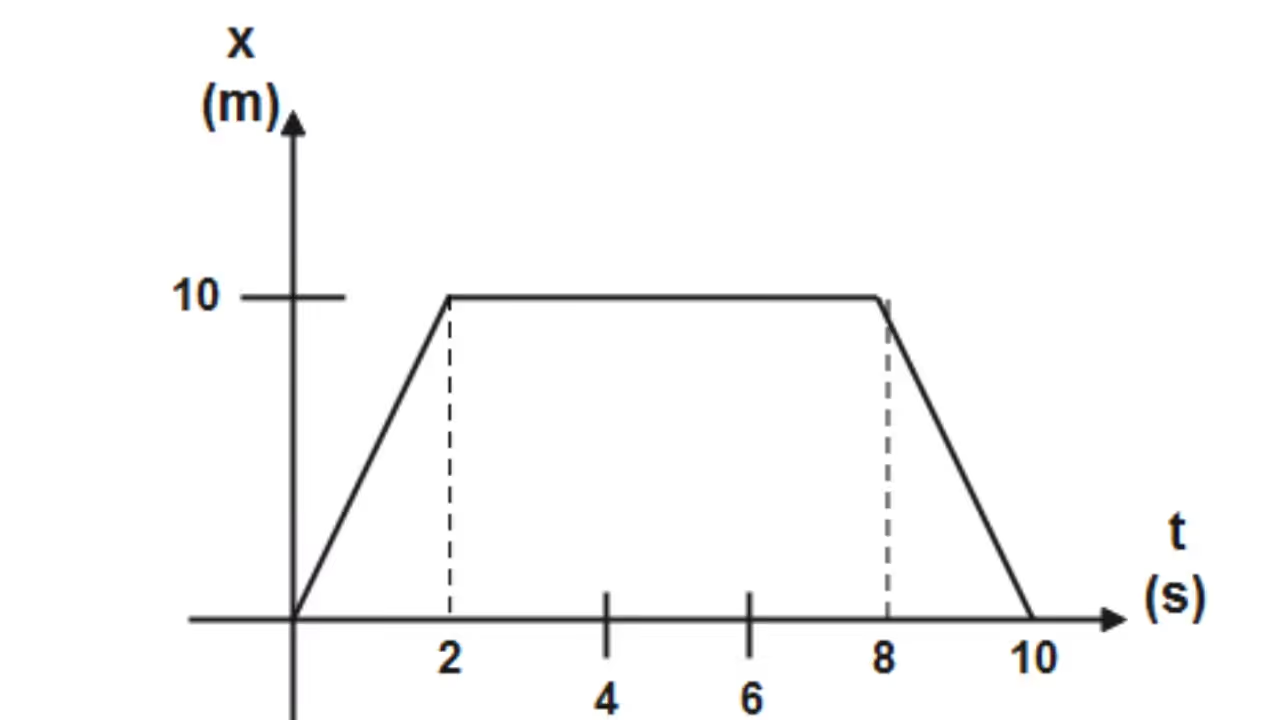
- Curve: Non-uniform motion
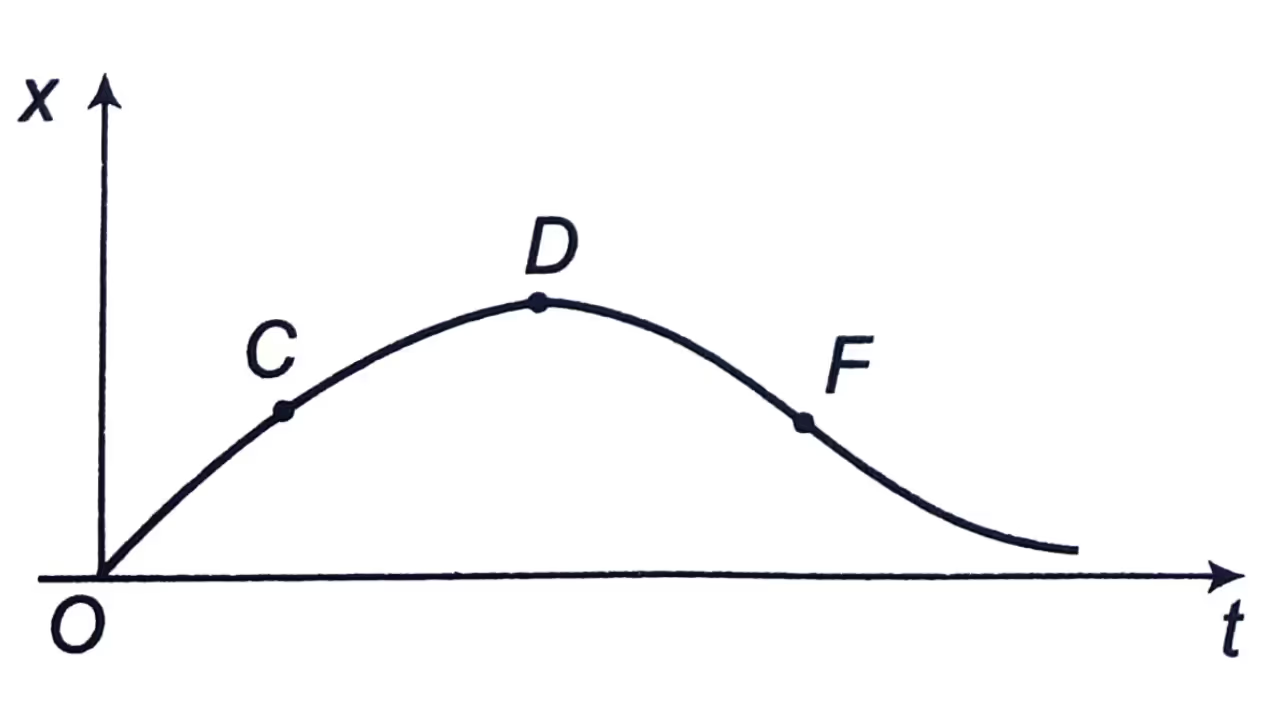
- Slope of x-t graph = velocity
2. Velocity-Time (v-t) Graph
- Straight horizontal line: Constant velocity
- Straight sloped line: Uniform acceleration
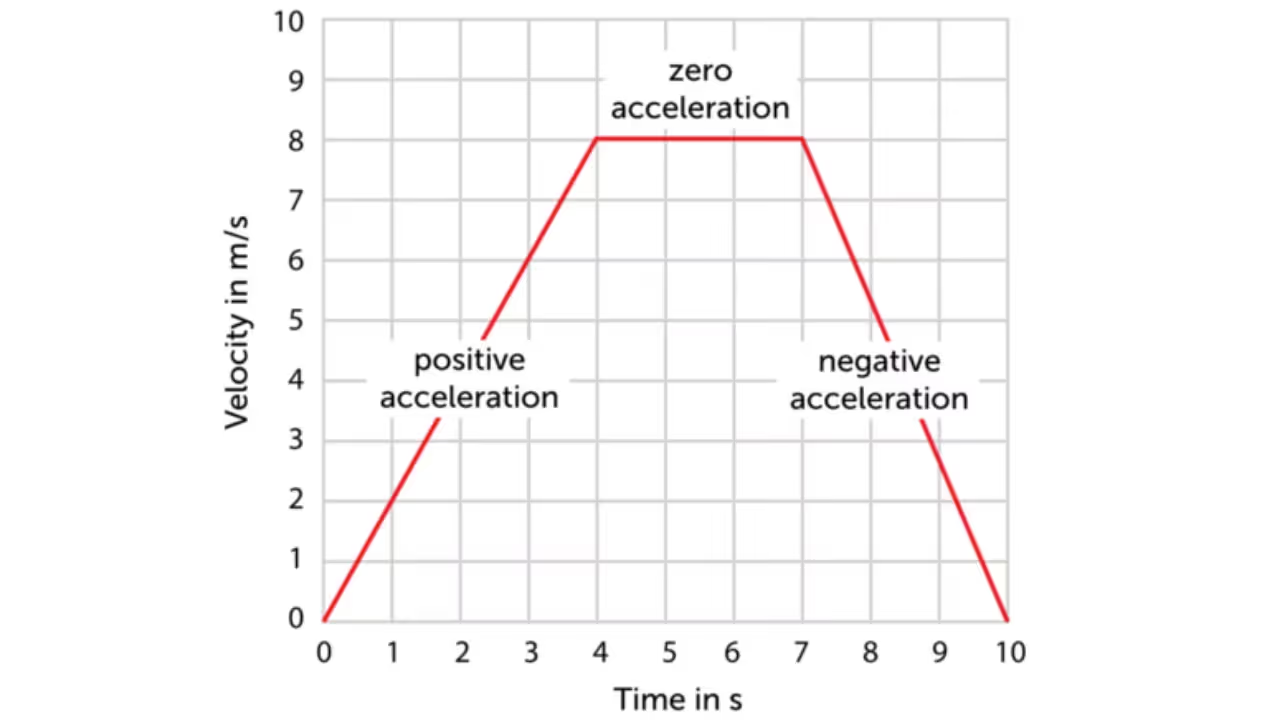
- Area under v-t graph = Displacement
- Slope of v-t graph = Acceleration
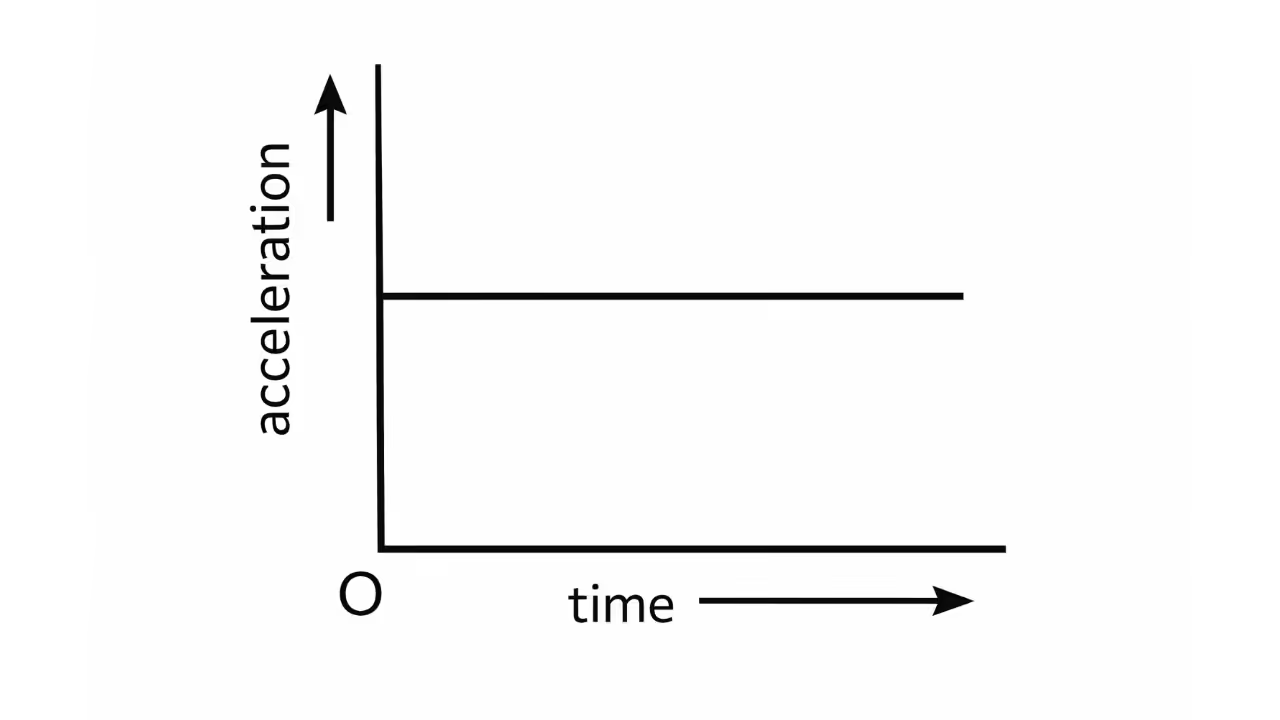
3. Acceleration-Time (a-t) Graph
- Horizontal line: Constant acceleration
- Area under a-t graph = Change in velocity
Equations of Motion (Uniform Acceleration)
For motion with constant acceleration, the following three equations are used:
- v = u + at
(Final velocity after time t) - s = ut + (1/2)at²
(Displacement in time t) - v² = u² + 2as
(Relates velocity and displacement)
Where:
- u = Initial velocity
- v = Final velocity
- a = Acceleration
- s = Displacement
- t = Time
These equations are only valid for uniformly accelerated motion.
Relative Velocity (in 1D)
The relative velocity of object A with respect to object B is defined as:
vₐᵦ = vₐ − vᵦ
Relative Velocity = Velocity of object A - Velocity of object B
- If two objects move in the same direction, subtract the velocities.
- If they move in opposite directions, add the velocities.
Motion Under Gravity
When objects fall freely under gravity (ignoring air resistance), the acceleration is constant and equal to g ≈ 9.8 m/s² downward.
For upward or downward motion under gravity:
- Acceleration a = −ga = -ga = −g (when going up)
- Acceleration a = +ga = +ga = +g (when coming down)
Use the same equations of motion by substituting a = ±g.
Special Cases
The following are some special cases of motion under gravity
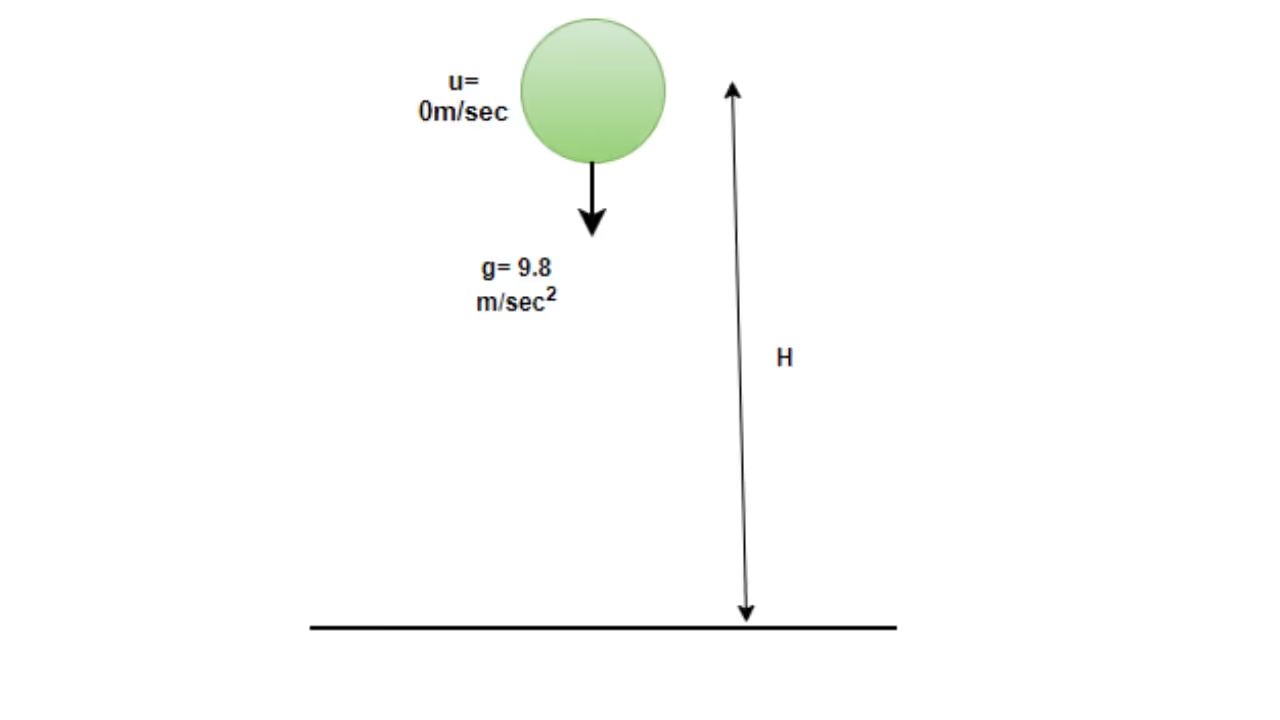
Free Fall:
- u = 0 (starts from rest)
- a = g downward
- Motion is uniformly accelerated
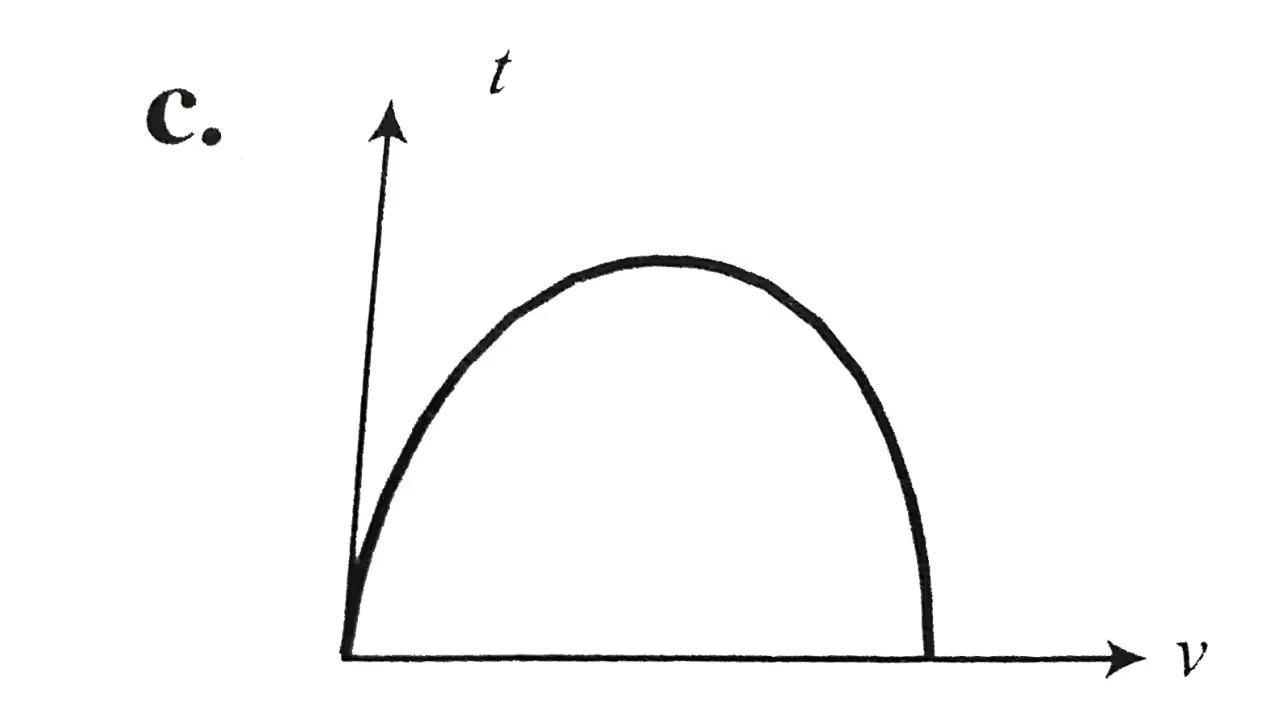
Object Thrown Vertically Upward:
- Final velocity at the highest point = 0
- a = -g (since motion is against gravity)
- Symmetrical motion: time to rise = time to fall
Conclusion
That’s the summary of Motion in a Straight Line for you. If you understand acceleration, graphs and equations clearly, this chapter becomes one of the easiest in Class 11 Physics. Don’t memorise formulas blindly - understand where they come from. Revise once, practice numericals, and you’re exam-ready. Share it with a friend if it helped you.
FAQs
Q1. What are the three equations of motion in Class 11 Physics?
Ans. The three equations are: v = u + at, s = ut + ½ at², and v² = u² + 2as. These equations apply only when acceleration is constant.
Q2. What is the difference between distance and displacement?
Ans. Distance is the total path covered and is always positive. Displacement is the shortest distance between two points and has direction.
Q3. What does the slope of the velocity-time graph represent?
Ans. The slope of a velocity-time graph represents acceleration. If the slope is positive, acceleration is positive; if negative, it shows retardation.
Q4. What is relative velocity in one dimension?
Ans. Relative velocity is the velocity of one object with respect to another. It is calculated as vₐᵦ = vₐ − vᵦ.
Q5. What is motion under gravity in Class 11 Physics?
Ans. Motion under gravity is motion where acceleration is only due to gravity. It is a special case of uniformly accelerated motion with acceleration equal to g.












.svg)

