
.svg)
Physics tries to explain why objects move, stop, or change direction. In everyday life, we see a ball rolling, a car suddenly stopping, or a rocket flying upward. All these actions follow certain natural rules. These rules are called the Laws of Motion.
Long ago, Aristotle believed that objects need a continuous push to keep moving. Later, Galileo corrected this by showing that objects continue moving unless something stops them, like friction. Finally, Newton combined these ideas into his three famous laws of motion, which became the base of mechanics.
By learning this chapter, you will see how simple rules can explain complex movements happening all around us. Read full CBSE Class 11 Physics syllabus guide

Force and Laws of Motion Summary
Galileo, through his experiments with inclined planes, introduced the idea of inertia and uniform motion in the absence of external forces. Newton unified these ideas into his famous three laws of motion, which became the foundation of classical mechanics.
In this chapter, we study these laws, their applications, and related concepts such as friction, momentum, and equilibrium.
Aristotle’s Fallacy
Aristotle stated that a body moves only if a force is continuously applied; if no force acts, the body comes to rest. This is incorrect because he did not recognize the role of friction. We now know that a body continues to move with uniform velocity if no net external force acts on it. The slowing down of moving objects is due to friction, not the absence of force.
Galileo’s Observations
Galileo studied the motion of objects on inclined planes. His important conclusions were:
- If a body moves down an inclined plane, it accelerates.
- If a body moves up an inclined plane, it decelerates.
- If a body moves on a perfectly smooth horizontal plane, it continues to move with constant velocity without needing an external force.
This led to the concept of inertia.
Inertia
Inertia is the natural tendency of a body to resist changes in its state of rest or motion.
Types of inertia:
- Inertia of Rest → A body at rest remains at rest unless acted upon (e.g., passengers jerk backward when a stationary bus suddenly moves).
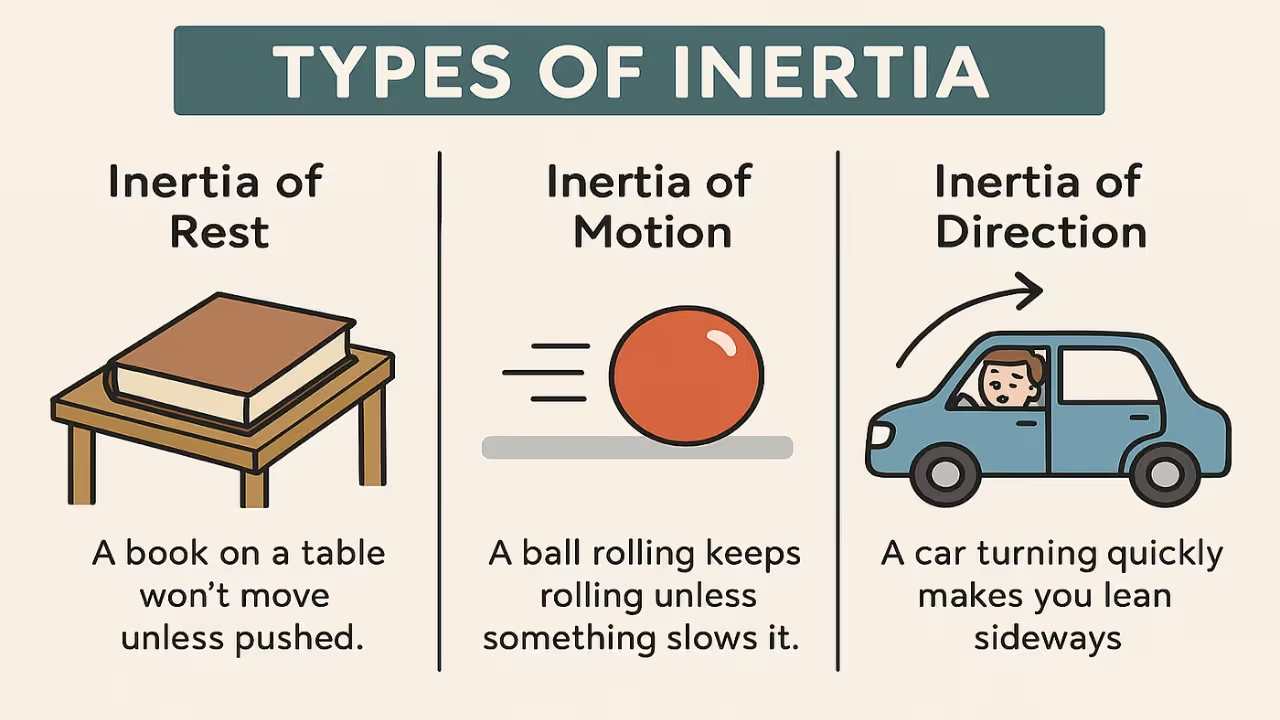
- Inertia of Motion → A body in motion continues in motion with the same velocity unless acted upon (e.g., passengers jerk forward when a moving bus stops suddenly).
- Inertia of Direction → A moving body continues in the same direction unless compelled to change (e.g., mud flying tangentially from a rotating wheel).
Force
Force is a physical quantity that changes or tends to change the state of motion of a body. It is a vector quantity, measured in newtons (N). Forces can be contact forces (friction, tension, normal reaction) or non-contact forces (gravitational, electrostatic, magnetic).
Newton’s Laws of Motion
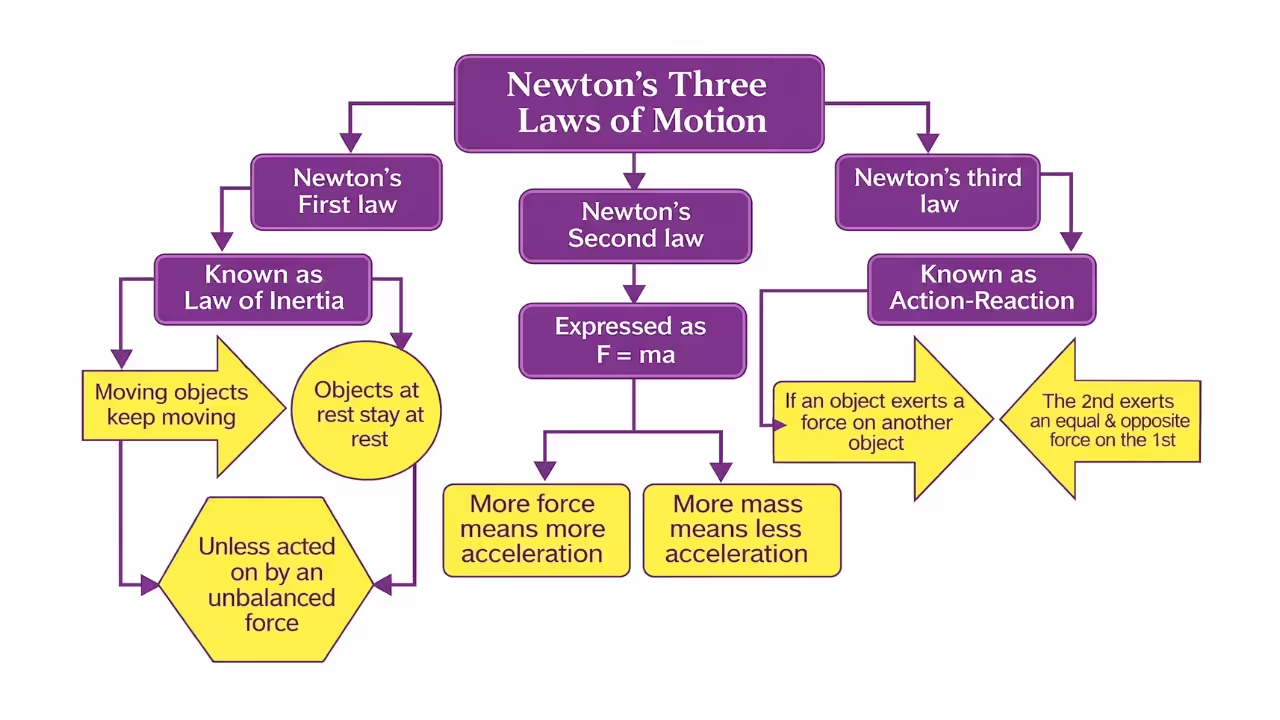
Newton’s First Law of Motion (Law of Inertia)
A body continues in its state of rest or uniform motion in a straight line unless compelled to change that state by an external force.
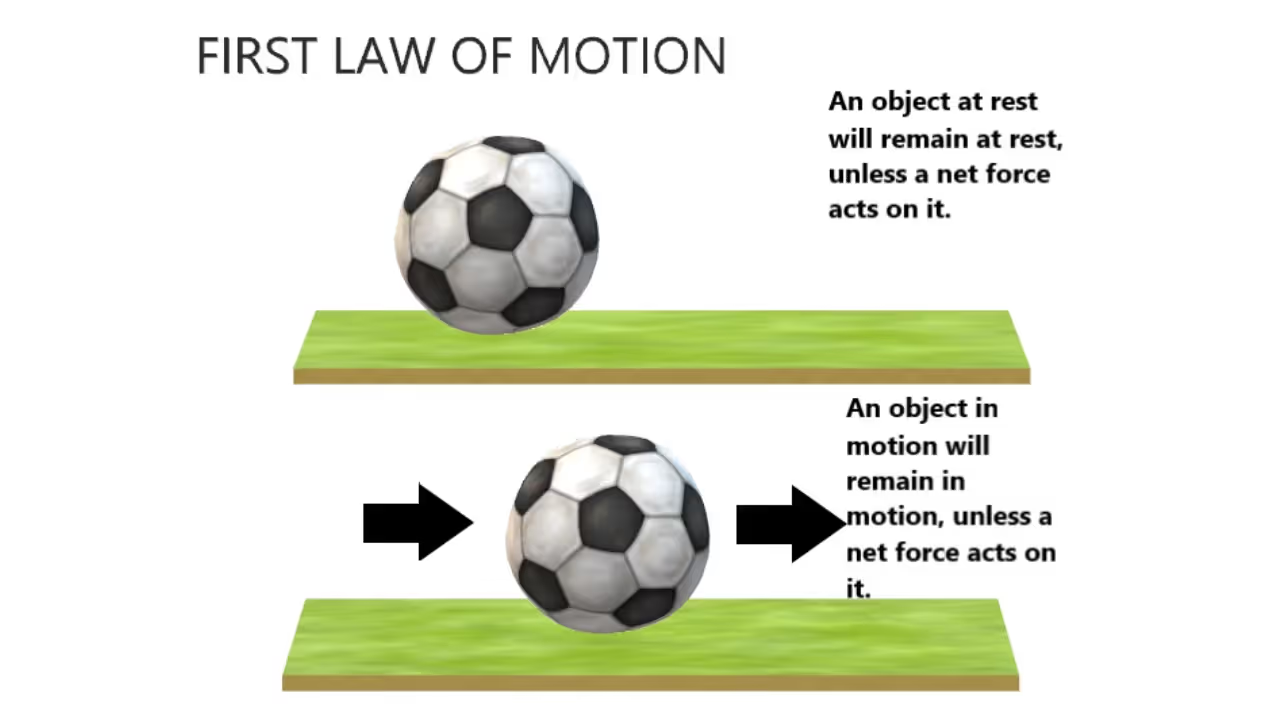
This law defines inertia and introduces the concept of force. If net external force is zero, velocity remains constant.
Newton’s Second Law of Motion
Newton’s Second Law states that the net force acting on a body is equal to the rate of change of its momentum and acts in the direction of the force.
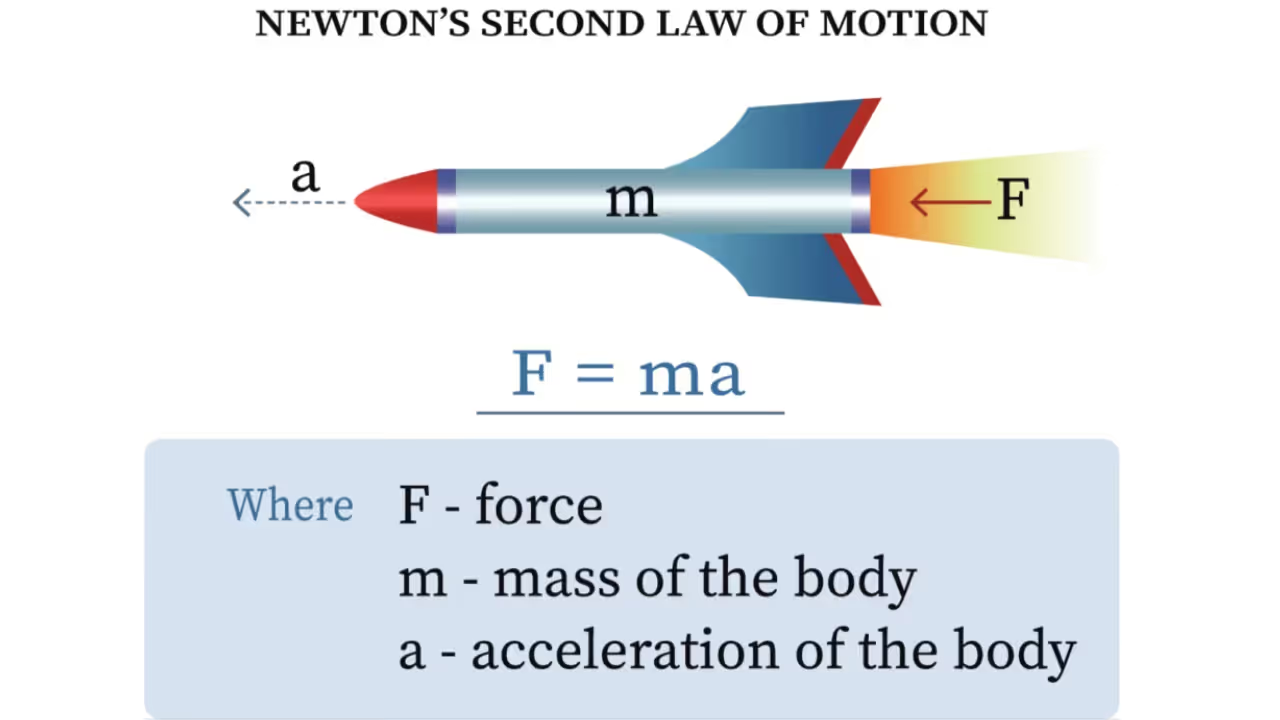
Mathematically:
F = dp / dt
Since p = mv,
F = m(dv / dt) = ma
Thus, force is the product of mass and acceleration. This law gives the quantitative definition of force.
Impulse: Impulse is defined as the product of force and the time for which it acts.
Impulse = F x t
Impulse is equal to the change in momentum. This explains why a cricketer pulls his hands backward while catching a ball - increasing time reduces force.
Newton’s Third Law of Motion
For every action, there is an equal and opposite reaction.
If body A exerts a force on body B, then body B exerts an equal and opposite force on body A. These forces act on different bodies and never cancel each other.
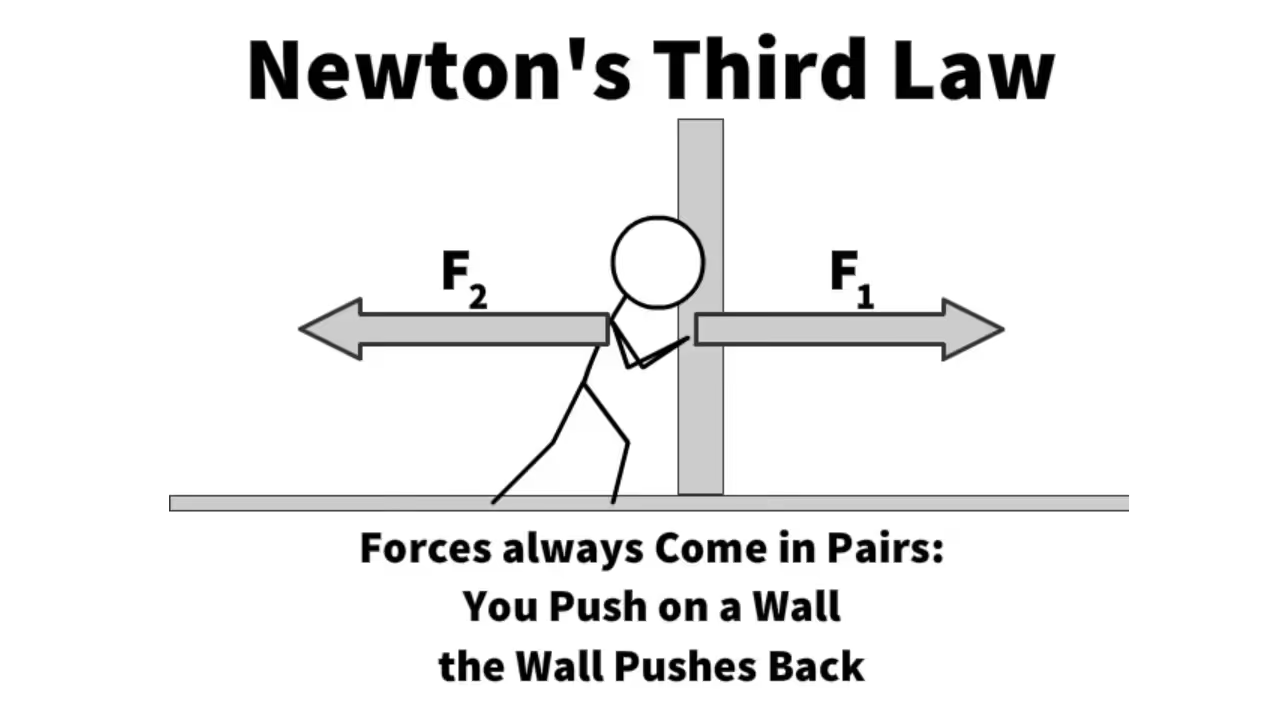
Examples:
- Walking (foot pushes ground backward, ground pushes foot forward).
- Recoil of a gun (bullet moves forward, gun moves backward).
- Motion of a rocket (exhaust gases push downward, rocket moves upward).
Linear Momentum
Momentum of a body is defined as the product of its mass and velocity:
p = mv
It is a vector quantity. Newton’s second law is expressed in terms of momentum.
Law of Conservation of Momentum
In an isolated system (no external force), the total momentum of the system remains constant.
Derivation:
Consider two bodies A and B interacting with each other in an isolated system. According to Newton’s Third Law,
Force on A by B = − Force on B by A
Using Newton’s Second Law:
F = dp/dt
So,
dp₁/dt = − dp₂/dt
Rearranging:
dp₁ + dp₂ = 0
This means total momentum before interaction equals total momentum after interaction. Hence, the total momentum of an isolated system remains constant.
Applications:
- Recoil of a gun
- Motion of rockets
- Collisions (elastic and inelastic)
Equilibrium of a Particle
A particle is in equilibrium when the vector sum of all forces acting on it is zero.
Conditions:
- ∑ Fx = 0
- ∑ Fy = 0
If these conditions are satisfied, the particle does not accelerate.
Common Forces in Mechanics
Weight
Weight is the force with which the Earth attracts a body:
W = mg
It acts vertically downward.
Normal Force
When a body is placed on a surface, the surface exerts a reaction force perpendicular to it, called the normal reaction.
Tension
Tension is the pulling force in a string, rope, or cable when it is stretched. It is directed along the string and away from the object.
Friction
Friction is the force that opposes relative motion between two surfaces in contact.
Types of friction:
- Static Friction → Opposes the initiation of motion.
- Limiting Friction → Maximum value of static friction, just before motion starts.
Fs ≤ μsN
- Kinetic Friction → Opposes motion once the body has started moving.
fk = μkN
- Rolling Friction → Smaller than sliding friction, responsible for rolling motion.
Laws of Friction:
- Friction is directly proportional to normal reaction.
- Independent of area of contact (within limits).
- Independent of velocity (for small speeds).
Applications of Friction:
- Walking, writing, driving, brakes in vehicles.
- However, friction also causes wear and energy loss.
Circular Motion and Centripetal Force
When a body moves in a circular path with constant speed, it experiences acceleration toward the center (centripetal acceleration).
a = v2 / r
The corresponding force is called centripetal force:
Fc = mv2 / r
Examples: motion of planets, vehicles turning on curved roads, stone tied to a string.
If centripetal force is absent, the body flies off tangentially due to inertia.
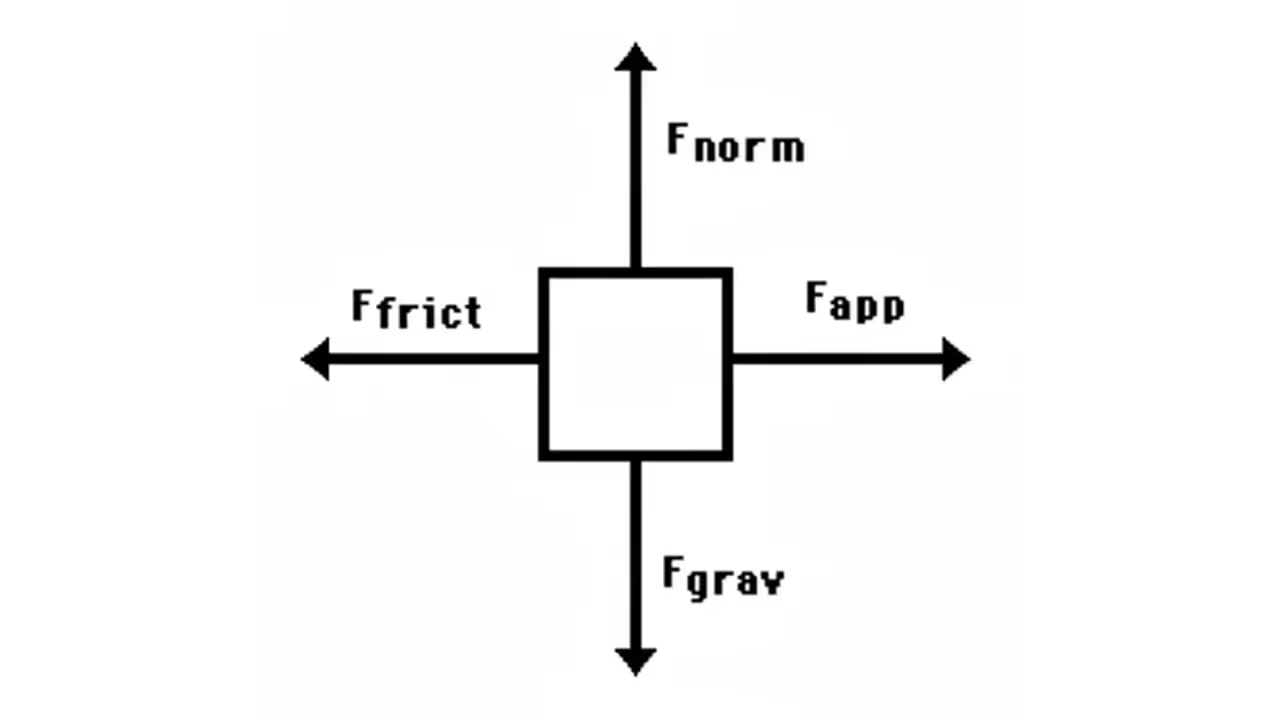
Free Body Diagrams
An FBD is a pictorial representation showing all forces acting on a body. It simplifies analysis of problems in mechanics.
Applications of Newton’s Laws
- Motion of two blocks connected by a string
- Motion on an inclined plane
- Motion of lifts (apparent weight)
- Pulley systems
- Motion in circular paths
Conclusion
That’s a wrap on Laws of Motion Class 11. If you understand inertia, force, momentum, and friction clearly, most numericals become easy. These laws are not just theory - they explain every push, pull, and movement around you. Revise the formulas, practice diagrams, and you’re exam-ready.
FAQs
Q1. What is the importance of Newton’s First Law?
Ans. Newton’s First Law explains inertia and tells us that a body will not change its state of rest or motion unless an external force acts on it. It also gives the basic definition of force.
Q2. How is Newton’s Second Law used in numericals?
Ans. Newton’s Second Law helps calculate force, mass, or acceleration using the formula F = ma. It is the most important law for solving numerical problems in this chapter.
Q3. Why do action and reaction forces not cancel each other?
Ans. Action and reaction forces act on two different bodies. Since they do not act on the same object, they cannot cancel each other.
Q4. What is impulse?
Ans. Impulse is the product of force and time and is equal to the change in momentum. It explains situations like airbags in cars or catching a ball by moving hands backward.
Q5. What is centripetal force?
Ans. Centripetal force is the force required to keep a body moving in a circular path. It always acts toward the center of the circle and is given by mv²/r.












.svg)

