
.svg)
Class 9 NCERT Science Chapter 5 is all about Mixtures and their Seperation, helping students understand the science behind their formation through different substances and their classification. The chapter starts by explaining how salt is extracted from seawater, how sugar crystals are obtained from sugarcane, and how the mixtures we see every day are separated.
This is where NCERT Solutions for Class 9 Science Chapter 5 shines. These solutions are fully aligned with the latest 2026-27 curriculum, helping students get complete solutions for each NCERT question, InText exercise, and activity in the new Exploration textbook.
Download NCERT Class 9 Science Ch5 Solutions PDF
Want to learn without Internet? Download Class 9 Science Chapter 5 NCERT Solutions PDF and get all the answers to the questions available in the chapter. The PDF is based on the current version of the Exploration Textbook (2026-27) and is helpful for revision, homework and exam preparation. Just click the "Download" button below and have the entire chapter's solutions on hand for easy access.

Overview of NCERT Exploration Chapter 5: Exploring Mixtures and their Separation
Ever wonder why sugar dissolves completely in water, while sand settles to the bottom? Or how cream is separated from milk and clean drinking water is prepared? The answers to these everyday questions are explained in Class 9 Science Chapter 5 – Exploring Mixtures and Their Separation. This chapter explains different types of mixtures, like homogeneous and heterogeneous mixtures, and separation techniques such as crystallisation, distillation, chromatography, sublimation and centrifugation. As you move through the chapter, you’ll learn how to measure concentration accurately using % m/m, % m/v, and % v/v, and solubility curves.
NCERT Solutions for Class 9 Science Chapter 5 - Questions and Answers
Revise, Reflect, and Refine - NCERT Class 9 Science Ch5 Solutions [NCERT Textbook Pg. No. 90]
Question 1: Which of the following mixtures are correctly classified as homogeneous (Hm) and heterogeneous (Ht)? Choose the correct option.
(a) Air — Hm, Milk — Ht, Sugar solution — Hm, Smoke — Hm
(b) Brass — Ht, Fog — Ht, Vinegar — Ht, Muddy water — Hm
(c) Copper sulfate solution — Hm, Salt solution — Hm, Milk — Hm, Bronze — Hm
(d) Muddy water—Ht, Milk—Ht, Blood—Ht, Brass — Hm
Answer:
(d) Muddy water — Ht, Milk — Ht, Blood — Ht, Brass — Hm
Explanation: A homogeneous mixture has a uniform composition throughout, while a heterogeneous mixture does not. Muddy water is a suspension in which mud particles remain suspended and settle over time, while milk and blood are colloids with fine particles dispersed in a liquid medium. Hence, muddy water, milk, and blood are all heterogeneous mixtures. Brass, on the other hand, is homogeneous, as it is an alloy of copper and zinc with a uniform composition throughout.
Question 2: Choose the correct options, and explain the reason for the correct and incorrect options. Which among the following mixtures show the Tyndall Effect?
A mixture of:
(I) Air and dust particles
(II) Copper sulfate and water
(III) Starch and water
(IV) Acetone and water
Options:
(a) (I) and (II) (b) (II) and (IV)
(c) (I) and (III) (d) (III) and (IV)
Answer:
(c) (I) and (III)
Explanation: The Tyndall effect is the scattering of light by particles in a mixture. It is shown by colloids and suspensions because their particles are large enough to scatter light. Air with dust particles shows the Tyndall effect because dust particles remain suspended in air and scatter light. Starch in water also shows the Tyndall effect because it forms a colloidal solution. However, copper sulfate in water and acetone in water form true solutions, whose particles are too small to scatter light.
Question 3: A mixture can be categorised as a solution, a suspension, or a colloid, each possessing distinct properties. Utilise the words or phrases provided in the box to fill in the given table. Words and phrases may be used more than once.
Words and Phrases
Large-sized particles; Particles remain evenly distributed; Small-sized particles (less than 1 nm diameter); Moderate-sized particles (1–1000 nm); Settles down when left undisturbed (more than 1000 nm in diameter); Does not settle down; Scatters light; Separates by filtration; Transparent; Salt solution; Milk; Sand in water; Smoke; Heterogeneous mixture; Cannot be separated by filtration; Mud; Butter; Brass.
Complete the table.
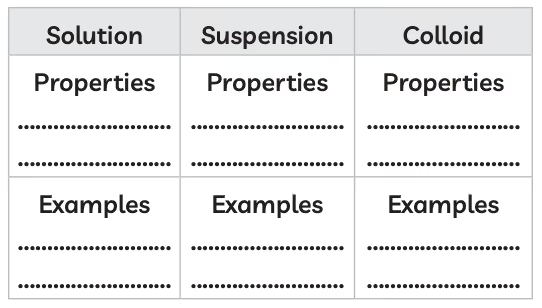
Answer:
A solution, suspension, and colloid differ in their particle size, appearance, and behaviour. Based on these distinct properties, the words and phrases can be arranged as follows:
Question 4: Solve the following problems:
(A) A cake recipe uses dry ingredients, namely 75 g of sugar for 420 g of all-purpose flour and 5 g of sodium hydrogencarbonate.
Express the concentration of each component in the mixture using an appropriate method.
(B) A brass alloy contains 70% copper by mass. Calculate the quantities of copper and zinc present in 120 g of brass.
Answer:
(A) Since all the ingredients in the mixture are solids, the appropriate method to express their concentration is mass by mass percentage (% m/m).
Total mass of the mixture = Mass of sugar + Mass of flour + Mass of sodium hydrogencarbonate = 75 g + 420 g + 5 g = 500 g
Using the formula,
Mass by mass %
= Mass of component/ Total mass of mixture ×100
Concentration of sugar:
= (75/ 500) ×100 = 15% m/m
Concentration of all-purpose flour:
= (420/ 500) ×100 = 84% m/m
Concentration of sodium hydrogencarbonate:
= (5/ 500) ×100 = 1% m/m
(B) Brass is an alloy of copper and zinc. Given that the alloy contains 70% copper by mass, the remaining 30% must be zinc.
Mass of copper in 120 g of brass:
= (70/ 100) ×120 = 84 g
Mass of zinc in 120 g of brass:
= 120 – 84 = 36 g
Hence, 120 g of brass contains 84 g of copper and 36 g of zinc.
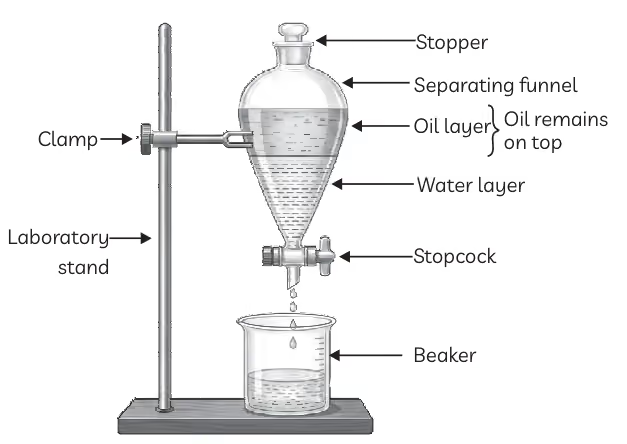
Question 5: The label on a cooking oil pack says one litre (910 g). If this oil is mixed with water, will it form a separate layer? If so, which substance will be on top? How will you separate the two layers? Also, draw the diagram of the apparatus used.
Answer:
Yes, cooking oil and water will form two separate layers because they are immiscible liquids, meaning they do not mix with each other. The oil will form the upper layer because 1 litre of oil has a mass of 910 g, so its density is 0.91 g/mL, which is less than the density of water.
The two layers can be separated using a separating funnel. This method works on the principle that immiscible liquids of different densities form separate layers. The mixture is poured into the separating funnel and left undisturbed until the two layers become clear. The stopcock is then opened slowly to drain out the lower layer of water into a beaker. Once the water is completely drained, the stopcock is closed, and the oil is collected separately in another container.
Question 6: Assertion (A): Solutions do not exhibit the Tyndall effect.
Reason (R): The particles in solutions are larger than 100 nm, so they cannot scatter light.
Choose the correct option:
(a) Both (A) and (R) are true, and (R) is the correct explanation of (A).
(b) Both (A) and (R) are true, but (R) is not the correct explanation of (A).
(c) (A) is true but (R) is false.
(d) (A) is false but (R) is true.
Answer:
(c) (A) is true but (R) is false.
Explanation: The Tyndall effect is the scattering of light by particles present in a mixture. It is shown by colloids and suspensions, but not by true solutions. The particles in a true solution are very small, usually less than 1 nm in diameter, not larger than 100 nm. Due to their extremely small size, solution particles cannot scatter light effectively. Therefore, true solutions do not show the Tyndall effect.
Question 7: How would you separate the mixtures provided in the given table? Mention the reason for choosing your method. If a mixture cannot be separated, explain why.
Answer:
The mixtures can be separated using different techniques based on the physical properties of their components, such as solubility, density, particle size, and sublimation behaviour.
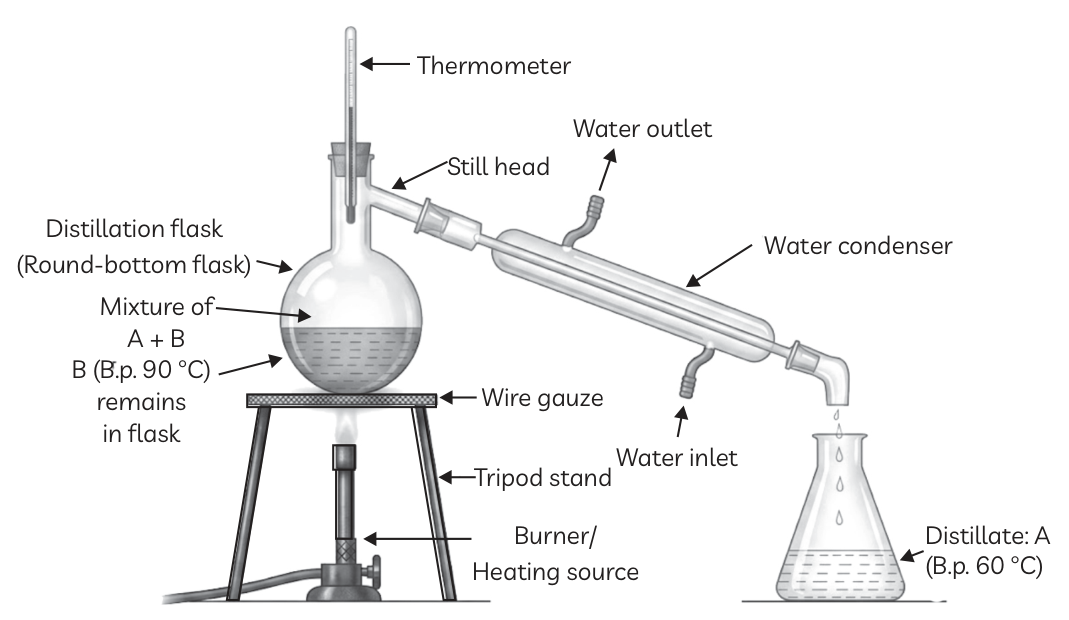
Question 8: Two miscible liquids, A and B, are present in a mixture. The boiling point of A is 60 °C and the boiling point of B is 90 °C. Suggest a method to separate them. Also, draw a labelled diagram of the method suggested.
Answer:
The two miscible liquids A and B can be separated by the process of distillation. This method is suitable because their boiling points differ by 30 °C, which is more than the minimum required difference of 25 °C for distillation to work effectively. Since liquid A has a lower boiling point (60 °C), it will vaporise
first on heating the mixture. The vapours then pass through the condenser, where they are cooled and converted back into pure liquid A, which is collected separately in a conical flask. Liquid B (boiling point 90 °C), having a higher boiling point, remains in the distillation flask and can be collected later.
Question 9: Compare evaporation, crystallisation and distillation. In which situation, would you prefer each of these over the others?
Answer:
Evaporation, crystallisation, and distillation are three different techniques used to separate the components of a mixture, and each one is preferred in a specific condition depending on what we want to recover.
Comparison of the three methods:
Evaporation is preferred when we only want to recover the solid solute and the solvent is not required, such as obtaining salt from seawater. Crystallisation is preferred when we want to obtain a pure solid from a solution containing soluble impurities, such as purifying copper sulfate. Distillation is preferred when we want to recover a liquid solvent from a solution or separate two miscible liquids with sufficiently different boiling points, such as separating acetone from water.
Question 10: Blood is an example of a colloidal mixture.
(A) What would happen if blood behaved like a true suspension inside the body?
(B) In a blood sample, identify the dispersed phase and the dispersion medium.
Answer:
(A) If blood behaved like a true suspension inside the body, its components such as red blood cells, white blood cells and platelets would not remain uniformly distributed in plasma. They would tend to settle when the flow becomes slow, causing uneven distribution of blood components and possible blockage of small blood vessels. This would disturb the smooth flow of blood and affect the transport of oxygen, nutrients, hormones and wastes to different parts of the body. As a result, normal body functioning would be severely affected and could become life-threatening.
(B) In a blood sample, the dispersed phase consists of the formed components, such as red blood cells, white blood cells and platelets. The dispersion medium is plasma, the liquid part of blood in which these components remain suspended.
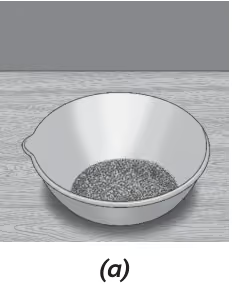
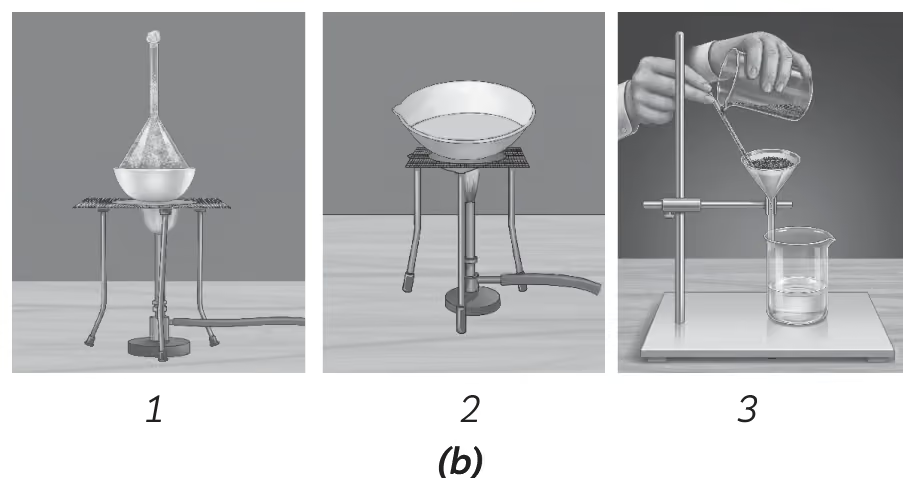
Question 11: You are given a mixture of sand, common salt and naphthalene as shown in fig. (a). The fig. (b) depicts various steps used to separate the components of this mixture. Identify and write down the correct sequence of separation techniques.
Answer:
The given mixture contains three components: Sand (insoluble in water and non-sublimable), common salt (soluble in water and non-sublimable), and naphthalene (sublimable solid). Since each component has a different physical property, the mixture can be separated by carrying out three techniques in the following correct sequence:
Sublimation → Dissolution and Filtration → Evaporation
Step-1 (Sublimation): The mixture is first heated gently in a china dish with an inverted funnel placed over it and the mouth of the funnel is plugged with cotton, so as to prevent the escape of vapours. Naphthalene sublimes (changes directly from solid to vapour) and deposits as a solid on the cooler walls of the funnel, while sand and common salt remain in the china dish.
Step-2 (Dissolution and Filtration): Water is added to the remaining mixture of sand and salt. Salt dissolves in water, while sand does not. This mixture is then filtered. Sand remains as a residue on the filter paper, and the salt solution passes through as the filtrate.
Step-3 (Evaporation): The salt solution (filtrate) is heated in a china dish. The water evaporates, leaving behind pure common salt as a solid residue.
In this way, all three components naphthalene, sand, and common salt are separated successfully.
Question 12: Why is distillation an effective method for separating a mixture of water and acetone?
Answer:
Distillation is an effective method for separating a mixture of water and acetone because they are miscible liquids and have a sufficiently large difference in their boiling points. Acetone boils at about 56 °C, while water boils at 100 °C, giving a difference of about 44 °C. This difference is suitable for separation by simple distillation.
On heating the mixture, acetone, having the lower boiling point, vaporises first, while most of the water remains in the distillation flask. The acetone vapours pass through the condenser, where they cool and condense back into liquid acetone. The acetone is then collected in a separate vessel, and water remains behind in the flask. Thus, the two liquids can be separated based on their different boiling points.
Question 13: Answer the following questions with the help of the data given in the table:
Table: Solubility of various salts (in g per 100 g of water) at different temperatures
(A) What mass of potassium nitrate would be needed to prepare its saturated solution in 50 g of water at 40 °C?
(B) A student makes a saturated solution of potassium chloride in water at 80 °C and leaves the solution to cool at room temperature (25 °C). What would she observe as the solution cools? Explain.
(C) What is the effect of a change in temperature on the solubility of salts? Also, compare the changes in the solubility of the four given salts with increasing temperature from 10 °C to 80 °C.
Answer:
(A) According to the data, the solubility of potassium nitrate at 40 °C is 62 g per 100 g of water. This means that 100 g of water can dissolve 62 g of potassium nitrate at this temperature.
Therefore, the mass of potassium nitrate needed for 50 g of water at 40 °C:
= (62/ 100)×50 = 31 g
Hence, 31 g of potassium nitrate is needed to prepare a saturated solution in 50 g of water at 40 °C.
(B) As the solution cools, crystals of potassium chloride will separate out. This happens because the solubility of potassium chloride decreases at lower temperatures, so the excess dissolved salt crystallises from the solution.
(C) The solubility of most solid salts in water increases with an increase in temperature, although the extent of increase depends on the nature of the salt.
From 10 °C to 80 °C, potassium nitrate shows the maximum increase in solubility, from 21 g to 167 g per 100 g of water. Ammonium chloride also increases considerably, from 24 g to 66 g. Potassium chloride shows a gradual increase, from 35 g to 54 g, while sodium chloride shows almost negligible change, from 36 g to 37 g. Therefore, the order of increase in solubility from 10 °C to 80 °C is: Potassium nitrate > Ammonium chloride > Potassium chloride > Sodium chloride
Question 14: Three students, A, B and C, are preparing sugar solutions for an experiment:
• Student A dissolves 20 g of sugar in 80 g of water.
• Student B dissolves 20 g of sugar in 100 g of water.
• Student C dissolves 30 g of sugar in 80 g of water.
(A) Calculate the mass percentage (% m/m) concentration of sugar in each student's solution.
(B) Whose solution is the most concentrated? Explain why.
Answer:
(A) The mass by mass percentage is calculated by using the formula:
Mass by mass % = Mass of solute/ Mass of solution × 100
Where, Mass of solution = Mass of solute + Mass of solvent
Student A: Mass of sugar = 20 g,
Mass of water = 80 g,
Mass of solution = 20 + 80 = 100 g
% m/m = 20/ 100 × 100 = 20% m/m
Student B: Mass of sugar = 20 g,
Mass of water = 100 g,
Mass of solution = 20 + 100 = 120 g
% m/m=20/ 120 × 100 = 16.67% m/m
Student C: Mass of sugar = 30 g,
Mass of water = 80 g,
Mass of solution = 30 + 80 = 110 g
% m/m=30/ 110 × 100 = 27.27% m/m
(B) Student C's solution is the most concentrated, with a mass percentage of approximately 27.27% m/m. This is because the concentration of a solution depends on the amount of solute dissolved in a given mass of the solution, i.e., the higher the proportion of solute, the more concentrated the solution.
Question 15: Examine the fig. given below:
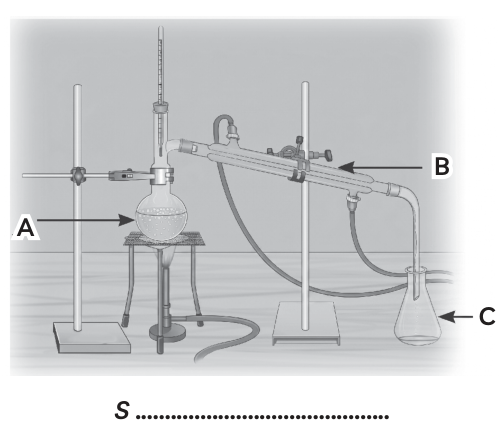
(A) Identify the separation technique marked as 'S'.
(B) Label the apparatus A, B and C.
(C) Which of the following mixtures can be separated by the technique identified in the given figure? Use the data given in the table.
Mixtures:
(i) water — acetone
(ii) water — salt
(iii) acetone — alcohol
(iv) sand — salt
(v) alcohol — chloroform
(vi) alcohol — benzene
Table: Boiling points of some compounds
Answer:
(A) The separation technique marked as 'S' is distillation.
(B) A — Distillation flask
B — Water condenser
C — Conical flask
(C) Distillation is used to separate two miscible liquids whose boiling points differ by at least 25 °C. It can also be used to separate a liquid from a solution of a non-volatile solid solute. On checking each mixture, the mixtures that can be separated by distillation are (i) water — acetone and (ii) water — salt.
Think It Over - NCERT Class 9 Science Ch5 Solutions
Question 1: Why do suspended particles settle in muddy water over time but not in milk? [Pg. No. 72]
Answer:
Suspended particles settle in muddy water because it is a suspension. The mud particles are comparatively large and heavy, so they settle down under the effect of gravity when left undisturbed. Milk, however, is a colloid in which tiny fat droplets and protein particles are dispersed in water. These particles are very small and remain suspended due to continuous random motion and stabilising substances present in milk. Therefore, particles in milk do not settle easily on standing, unlike mud particles in muddy water.
Question 2: How is evaporation different from boiling? [Pg. No. 72]
Answer:
Evaporation and boiling are both processes in which a liquid changes into vapour, but they occur in different ways. Evaporation is a slow process that occurs only from the surface of a liquid and can take place at any temperature below the boiling point. For example, water in wet clothes evaporates and dries at room temperature. Boiling is a fast process that occurs throughout the entire liquid at a fixed temperature called the boiling point. During boiling, bubbles of vapour form inside the liquid and rise to the surface. For example, water boils at about 100 °C at normal atmospheric pressure.
Question 3: Why do you see bright rays of sunlight when it passes through small gaps between the leaves of a dense tree? [Pg. No. 72]
Answer:
You see bright rays of sunlight through small gaps between the leaves of a dense tree due to the Tyndall effect. The small gaps allow sunlight to enter as narrow beams, and tiny dust particles, water droplets and other suspended particles in the air scatter this light. Because of this scattering, the path of sunlight becomes visible as bright rays. This is why sunbeams are clearly seen in a dusty or misty atmosphere.
What If..- NCERT Class 9 Science Ch5 Solutions
Question 4: What if two immiscible liquids of the same density are mixed in a separating funnel, how will the layers form? [Pg. No. 83]
Answer:
If two immiscible liquids have the same density, they will still not dissolve in each other, but they will not form a clear upper and lower layer based on density. Since neither liquid is heavier or lighter than the other, one liquid will not settle below the other in a definite way. Instead, the mixture may appear cloudy
or dispersed due to formation of overlapping droplets or an emulsion. Thus, for a separating funnel to work properly, the liquids should be immiscible and should have different densities.
Threads of Curiosity - NCERT Class 9 Science Ch5 Solutions
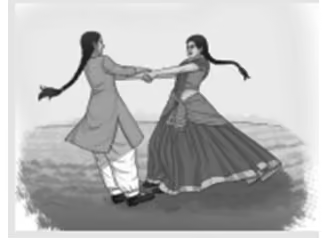
Question 5: The spinning game is a folk dance called phugadi in Marathi and kikli in Punjabi. What is this called in your local language?[Pg. No. 85]
Answer:
In my local language, this game is called "Chakri," which means a spinning game played by holding hands.
Think as a Scientist - NCERT Class 9 Science Ch5 Solutions
Question 6: If a hot, saturated solution of copper sulfate is cooled rapidly in ice-cold water, smaller and less well-formed crystals will form than if it is cooled slowly at room temperature. How would you design and perform an experiment to test this hypothesis?
(Hint: Prepare a hot saturated solution of copper sulfate and divide it into two equal parts.) [Pg. No. 79]
Answer:
Aim: To compare the size and shape of copper sulfate crystals formed by rapid cooling and slow cooling of a hot saturated copper sulfate solution.
Materials required: Copper sulfate, water, beaker, glass rod, filter paper, two equal test tubes/beakers, ice-cold water bath, thread/seed crystal, and a magnifying lens.
Procedure:
(1) Prepare a hot saturated solution of copper sulfate by dissolving copper sulfate in hot water until no more solute dissolves.
(2) Filter the hot solution to remove undissolved impurities.
(3) Divide the solution into two equal parts in two clean beakers or test tubes.
(4) Keep the first part in an ice-cold water bath so that it cools rapidly. Keep the second part undisturbed at room temperature so that it cools slowly.
(5) After crystals form in both setups, separate them and observe their size and shape using a magnifying lens.
Observation: The solution cooled rapidly in ice-cold water forms smaller and less well-formed crystals, while the solution cooled slowly at room temperature forms larger and better-shaped crystals.
Conclusion: The hypothesis is supported. Slow cooling gives more time for copper sulfate particles to arrange themselves in a regular pattern, so larger and well-formed crystals are produced. Rapid cooling causes quick crystallisation, resulting in smaller and less regular crystals.
Pause and Ponder - NCERT Class 9 Science Ch5 Solutions
Question 7: A common talcum powder contains 4% m/m zinc oxide, which acts as an antiseptic. How much zinc oxide is present in 300 g of the talcum powder?
[Pg. No. 76]
Answer:
Given:
Talcum powder = 300 g
Zinc oxide = 4% m/m
Mass of oxide = 4/ 100 × 300 = 12 g
Therefore, 12 g of zinc oxide is present in 300 g of talcum powder.
Question 8: Your mother gives you a bottle of orange juice concentrate to mix with water and serve it to your visiting friends. She asks you to mix two tablespoons of the concentrate with water in a glass tumbler. If each tablespoon measures 15 mL and you make 150 mL of juice per person, what is the % v/v of orange juice concentrate in the mixture you prepared? [Pg. No. 76]
Answer:
Given:
Volume of one tablespoon = 15 mL
Volume of two tablespoons = 2 × 15 = 30 mL
Total volume of prepared juice = 150 mL
% v/v=Volume of soluteVolume of solution×100=30150×100=20%
% v/v= Volume of solution/ Volume of solute ×100
= 150/ 30 × 100=20%
Therefore, the orange juice concentrate in the prepared mixture is 20% v/v.
Question 9: Vinegar, used as a food preservative and additive, contains 5% v/v acetic acid. Glacial acetic acid is a liquid, i.e., 100% acetic acid. If you want to make vinegar from glacial acetic acid, how would you proceed? [Pg. No. 76]
Answer:
Since vinegar contains 5% v/v acetic acid, it means 5 mL of acetic acid is present in 100 mL of vinegar solution.
Glacial acetic acid is considered 100% acetic acid, so to prepare 100 mL of vinegar, take 5 mL of glacial acetic acid and add water to make the final volume 100 mL.
% v/v = Volume of acetic acid/ Volume of solution × 100
5 = Volume of acetic acid/ 100 × 100
Volume of acetic acid = 5 mL
Therefore, 5 mL of glacial acetic acid should be diluted with water to make 100 mL of vinegar.
Question 10: Refer to the solubility curves given in the graph provided below. If equal masses of hot, saturated solutions of compounds 'A' and 'B' are cooled from 80 °C to 60 °C, which solution is likely to deposit more solid? [Pg. No. 79]
Answer:
Compound B solution is likely to deposit more solid.
From the graph, when the temperature is lowered from 80 °C to 60 °C, the solubility of compound B decreases much more sharply than that of compound A. Compound A shows only a small decrease in solubility, so only a small amount of solid will separate out. Since a hot saturated solution contains the maximum solute at 80 °C, cooling reduces its solubility, and the excess solute crystallises out. Therefore, the saturated solution of compound B will deposit more solid on cooling.
Question 11: Will there be any change in the size of common salt crystals if the rate of evaporation is increased or decreased? Explain. [Pg. No. 79]
Answer:
Yes, the size of common salt crystals changes with the rate of evaporation. During slow evaporation, salt particles get more time to arrange themselves in a regular pattern, so larger and well-formed crystals are produced. During fast evaporation, crystals form quickly and do not get enough time to grow properly, so smaller crystals are formed. Thus, slow evaporation generally gives bigger crystals, while rapid evaporation gives smaller crystals.
Question 12: State whether the following statements are True or False. Also, correct the False statements.
(A) Salt can be separated from a salt solution by evaporation or distillation.
(B) Distillation can be used for separation of two liquids even when these have the same boiling point.
(C) In paper chromatography, the solvent level should be above the sample spot at the beginning of the experiment.
(D) Evaporation and crystallization are the same processes. [Pg. No. 82]
Answer:
(A) True
Explanation: Salt can be separated from salt solution by evaporation. It can also be separated by distillation, where water distils over and salt remains behind.
(B) False
Correction: Distillation cannot separate two liquids having the same boiling point. It is used when the liquids have different boiling points.
(C) False
Correction: In paper chromatography, the solvent level should be below the sample spot. If the spot is dipped in the solvent, the sample may dissolve directly into the solvent.
(D) False
Correction: Evaporation and crystallisation are not the same. In evaporation, the solvent is removed by heating, while in crystallisation, pure solid crystals are obtained from a concentrated solution, usually by cooling or slow evaporation.
Question 13: Why do immiscible liquids form two separate layers in a separating funnel? [Pg. No. 84]
Answer:
Immiscible liquids form two separate layers in a separating funnel because they do not dissolve in each other. Their particles are not able to mix uniformly, so they remain as separate liquids. The liquid with higher density settles at the bottom, while the liquid with lower density forms the upper layer. For example, in a mixture of oil and water, water forms the lower layer because it is denser, while oil forms the upper layer.
Question 14: Is sublimation different from evaporation? Justify. [Pg. No. 84]
Answer:
Yes, sublimation is different from evaporation. Sublimation is the change of a substance directly from the solid state to the gaseous state without passing through the liquid state, as seen in camphor, iodine or ammonium chloride. Evaporation, on the other hand, is the change of a liquid into vapour from its surface at temperatures below its boiling point. Thus, sublimation involves a solid-to-gas change, while evaporation involves a liquid-to-gas change.
Question 15: Clouds are made up of tiny water droplets or ice crystals floating in the air. Based on what you know about solutions, suspensions and colloids, what type of mixture do you think clouds are and why? [Pg. No. 88]
Answer:
Clouds are colloidal mixtures, more specifically aerosols, because tiny water droplets or ice crystals are dispersed in air. These particles are not dissolved in air, so clouds are not true solutions. They are small enough to remain suspended for some time and do not settle quickly like ordinary suspension particles. The droplets and ice crystals also scatter sunlight, showing the Tyndall effect, which makes clouds visible. When these droplets join together and become larger and heavier, they may fall as rain or snow.
Key Topics in Class 9 Science Chapter 5
Chapter 5 of the new Class 9 Exploration textbook provides an introduction to mixtures and the different methods of separating them. Here is what you’ll learn throughout the chapter:
- Difference between homogeneous and heterogeneous mixtures
- Solutions, colloids, and suspensions
- Solubility of substances and factors affecting it
- Different ways of expressing the concentration of a solution
- Physical methods of separating mixtures
- Centrifugation, separating funnel, and paper chromatography
- Everyday uses of separation techniques
- The Tyndall effect and its significance
- Purification processes: filtration, evaporation, crystallisation, distillation and sublimation
- Scientific contributions - Electricity-free paperfuge for malaria detection and Kannauj’s traditional Deg-Bhapka distillation method
The wide range of topics covered in this chapter makes it both academically comprehensive and highly applicable for the 2026-27 session. Mastering these topics not only boosts conceptual understanding and exam readiness, but also equips you with the skills to connect science to real-life scenarios.
Why are NCERT Solutions for Class 9 Science Chapter 5 important?
Several new terms, practical activities and various separation techniques are presented in Chapter 5 that students often mix up while studying. Referring to NCERT solutions for science can make learning a lot easier and more understandable. We have provided you with NCERT Solutions for Class 9 Science (Chapter-wise), which will help you to study with confidence.
These solutions will enable you to:
- access detailed step-by-step answers to each question in the Exploration book.
- understand complex concepts in easy-to-understand language
- develop correct approaches to answering questions from the textbook.
- quickly revise key concepts before school exams
- learn to avoid common errors between solutions, suspensions and colloids
- build a good foundation of Chemistry for future classes
Instead of memorising answers to questions, you will understand the reasoning behind each concept, making it easier to solve school and exam questions.
Frequently Asked Questions (FAQs)
Q1. Do these NCERT Solutions follow the most recent CBSE syllabus?
Ans. Yes. The solutions are prepared for the latest NCERT Exploration textbook and are based on the current CBSE syllabus for the academic year 2026–27.
Q2. What are the key topics of Class 9 Science Chapter 5?
Ans. Chapter 5 explains several chemical and physical methods of separation (filtration, evaporation, crystallisation, distillation, centrifugation, sublimation and chromatography) and different types of mixtures, solutions, suspensions and concentration of solutions.
Q3. Where to download the NCERT Solutions for Class 9 Science Chapter 5 PDF?
Ans. You can easily download the latest NCERT Solutions for Class 9 Science Chapter 5: Exploring Mixtures and Their Separation PDF from the link provided above. The solutions are designed as per the CBSE Class 9 syllabus 2026-27 and cover all the questions mentioned in the Exploration book.
Q4. Are these NCERT Solutions helpful in Exam Preparation too?
Ans. These solutions ensure every answer is explained in simple language and adopts the latest answer-writing format. They assist you in grasping concepts clearly, revising key topics rapidly and sitting exams with confidence.
Q5. Can I make use of these NCERT Solutions for homework and revision?
Ans. Absolutely. These solutions are useful for completing homework, checking answers, resolving queries, and revising the chapter before class tests and annual examinations.





.svg)

