
.svg)
NCERT Solutions for Class 9 Science Exploration Chapter 3 Tissues in Action provide simple, detailed solutions to all questions given in the new Exploration textbook. The chapter introduces students to the concept of cells and how groups of specialised cells make up tissues to perform particular functions. These tissues then work together to form skin, muscles, bones, nerves, and organs of the body. However, these solutions provide answers to the questions throughout the chapter, including InText, Revise, Reflect, Refine, and Activity sections.
Download NCERT Class 9 Science Exploration Chapter 3 Solutions
Educart provides free, chapter-wise PDF solutions for Class 9 Science Exploration Chapter 3 Tissues in Action, enabling students to verify answers, polish difficult topics, and practice effectively for school exams.
These Class 9 Science Exploration Chapter 3 solutions are carefully curated for the latest Class 9 CBSE syllabus for 2026-27, making them a reliable resource for study and exam preparation. The chapter explains plant and animal tissues, the musculoskeletal system, various types of joints, and how nutrition and exercise can help keep bones and muscles healthy. Its broad topical range makes it an essential chapter for strengthening the foundation of biology for higher-level classes.

NCERT Solutions for Class 9 Science Exploration Chapter 3
Below, you’ll find clear, step-by-step questions and answers to all exercises from Tissues in Action in the new Class 9 Exploration textbook, explained in detail to make concepts easier to understand.
Revise, Reflect, Refine
Question 1: Meristematic tissues divide repeatedly. What property of their cells allows them to do this?
(a) They have thick walls for protection.
(b) They contain large vacuoles that store nutrients.
(c) They have thin walls, dense cytoplasm and large prominent nucleus.
(d) They are functionally differentiated cells.
Answer:
(c) They have thin walls, dense cytoplasm and large prominent nucleus.
Explanation: Meristematic cells are structurally adapted for continuous and rapid cell division. Their thin cell walls allow easy growth and division, while the dense cytoplasm provides active metabolic support required for cell division. The large, prominent nucleus controls repeated division and helps in the replication of genetic material before cell division. Vacuoles are either absent or very small, allowing more space for the nucleus and cytoplasm.
Question 2: If a plant is unable to transport food from leaves to roots, which tissue is malfunctioning?
(a) Xylem
(b) Phloem
(c) Epidermis
(d) Sclerenchyma
Answer:
(b) Phloem
Explanation: Phloem is the complex permanent tissue responsible for transporting food prepared in the leaves to different parts of the plant, including the roots. This process is called translocation. Sieve tubes carry food, while companion cells help sieve tubes in this transport. Therefore, if food cannot be transported from leaves to roots, the phloem tissue is malfunctioning. Xylem transports water and min
Question 3: Why are the epithelial tissues that line an animal's internal organs usually only one or a few cells thick?
(a) To store food efficiently.
(b) To provide maximum strength.
(c) To allow quick exchange of materials across them.
(d) To reduce friction.
Answer:
(c) To allow quick exchange of materials across them.
Explanation: The epithelial tissues lining many internal organs are usually only one or a few cells thick to minimise the distance through which substances need to diffuse. This enables rapid and efficient exchange of materials such as gases, nutrients and wastes. For example, in the lungs, a thin epithelium allows quick exchange of oxygen and carbon dioxide, while in the small intestine it helps in efficient absorption of nutrients.
Question 4: You can perform these two jumps as shown in the figure:
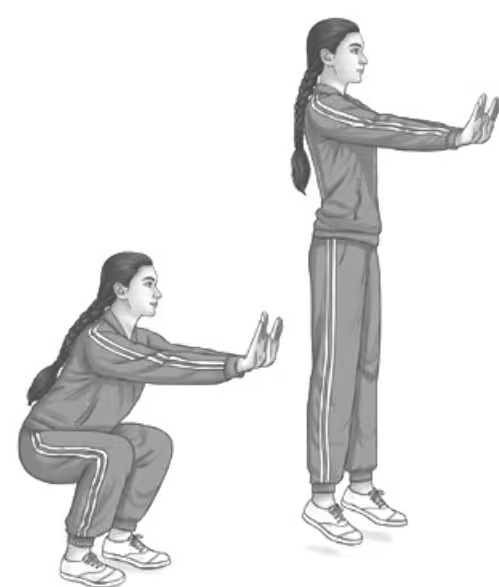
Straight-leg jump — Keep knees and ankles stiff.
Normal jump — Bend knees and ankles naturally.
How did your ankle, knee and hip positions differ between the two jumps?
Answer: The differences observed between the two jumps are as follows:
(1) Straight-leg jump (Stiff knees and ankles): In this case, the knees and ankles remain rigid with little or no bending, and the hip joint also bends very little. Since the joints do not bend naturally, the impact of landing is not absorbed properly by the body. As a result, the landing feels harder and less comfortable.
(2) Normal jump (Knees and ankles bent naturally): In this case, the ankles, knees and hip joint bend naturally before take-off and during landing. During take-off, these joints straighten to push the body upward. This coordinated movement helps absorb shock and distribute the force evenly, making the movement smoother and more efficient.
Thus, natural bending of the ankle, knee and hip joints allows better balance, flexibility and shock absorption during movement.
Question 5: Which type of joint is involved when you bend your knees and ankles?
(a) Ball and socket
(b) Hinge
(c) Pivot
Answer:
(b) Hinge
Explanation: The knee and ankle are examples of hinge joints. A hinge joint allows movement mainly in one plane, such as bending (flexion) and straightening (extension), similar to the movement of a door hinge. These joints provide controlled movement and stability. Ball and socket joints allow movement in multiple directions, while pivot joints permit rotational movement.
Question 6: In each of the following cases (A, B, C and D), choose the correct option as given below:
(a) Both (A) and (R) are true, and (R) is the correct explanation of (A).
(b) Both (A) and (R) are true, but (R) is not the correct explanation of (A).
(c) (A) is true but (R) is false.
(d) (A) is false but (R) is true.
(A) Assertion (A): Epithelium is well-suited for gas exchange in the lungs.
Reason (R): It consists of multiple layers of tall cells that slow down diffusion.
(B) Assertion (A): Cardiac muscle can contract continuously without fatigue.
Reason (R): Cardiac muscle cells have a high number of mitochondria and an abundant blood supply.
(C) Assertion (A): Tendons connect bone to bone and allow joint movement.
Reason (R): Tendons are made of tough connective tissue that transmits force from muscle to bone.
(D) Assertion (A): In a hinge joint, movement occurs primarily in one plane.
Reason (R): The bone ends are shaped to allow sliding in all directions.
Answer:
(A) (c) (A) is true but (R) is false.
Explanation: The epithelium lining the alveoli of the lungs is well adapted for gas exchange. The alveoli are lined by a single layer of thin, flat squamous epithelial cells, not multiple layers of tall cells. This thin structure reduces the diffusion distance and allows rapid exchange of oxygen and carbon dioxide. Multiple cell layers would increase the diffusion distance and slow down diffusion.
(B) (a) Both (A) and (R) are true, and (R) is the correct explanation of (A).
Explanation: Cardiac muscles work continuously and rhythmically throughout life and are highly resistant to fatigue under normal conditions. This is because their cells contain a large number of mitochondria and receive a rich blood supply. These features ensure a constant supply of oxygen and ATP required for continuous contraction, along with efficient removal of metabolic wastes.
(C) (d) (A) is false but (R) is true.
Explanation: Tendons do not connect bone to bone; they connect muscles to bones. Bones are connected to each other by ligaments, which provide stability to joints and prevent excessive movement.
Tendons are tough, fibrous connective tissues that transmit the force generated by muscle contraction to bones, thereby helping in movement at the joints.
(D) (c) (A) is true but (R) is false.
Explanation: In a hinge joint, movement occurs mainly in one plane, such as bending (flexion) and straightening (extension). However, the bone ends are not designed to allow sliding in all directions. Instead, they are shaped in a way that restricts movement to a single plane and provides controlled movement with stability. Sliding movement occurs in gliding joints, while movement in multiple directions is a characteristic of ball and socket joints.
Question 7: Plot a graph between the age of a tree (in years) on the x-axis and the diameter of the tree (in cm) along with the number of annual rings formed over time on the y-axis, using the data given in the table.
Table: Data related to the age of a teak tree, and corresponding increase in the diameter of stem and number of annual rings.
(A) Analyse the graph in terms of the diameter of the stem over time and share the interpretation.
(B) What is the relation between the diameter of the teak tree to the annual rings formed?
(C) Which specialised tissue is responsible for the girth of the stem and where is it located?
Answer:
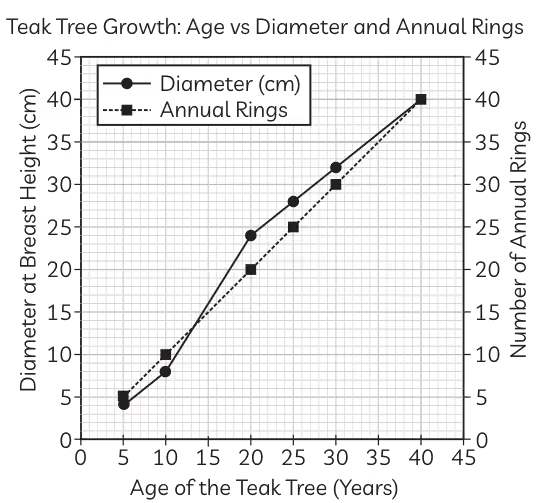
(A) The graph shows that the diameter of the teak tree stem increases with age. At 5 years, the diameter is 4 cm, and it reaches 40 cm by 40 years. The increase is fastest between 10 and 20 years, after which the stem continues to thicken steadily. This increase occurs due to secondary growth caused by cambium activity, which adds new tissues and increases the girth of the stem, providing greater support over time.
(B) There is a direct and positive relationship between the diameter of the teak tree and the number of annual rings formed. As the number of annual rings increases, the diameter of the stem also increases. This is because each annual ring represents one year of secondary growth, during which the cambium adds new layers, mainly secondary xylem, increasing the girth of the stem. However, the increase in diameter may not be exactly equal every year, as the growth rate can vary with age and environmental conditions.
(C) The lateral meristem, mainly the cambium, is responsible for the increase in girth of the stem. It is located along the sides of the stem, especially between the xylem and phloem. Its actively dividing cells produce new tissues, mainly secondary xylem and phloem, which increase the thickness of the plant body.
Question 8: In a forest, it was observed that one of the trees was severely debarked by an elephant to meet its food requirements, as the bark is a rich source of nutrients (given in the figure). Based on your learning, answer the following:
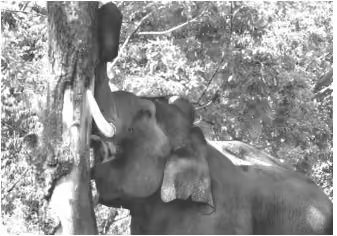
(A) Which function(s) of the tree is/are hampered by debarking?
(B) Which plant tissue would be affected by further damage to the tree trunk even after debarking?
(C) Which function of the tree would be hampered if the tissues beneath the bark were severely damaged?
(D) What assumptions are you making to answer the questions above? How would the answer change if your assumptions are also changed?
Answer:
(A) Debarking removes the bark and damages tissues present beneath it. Therefore, the following functions are affected:
(1) Protection against mechanical injury, pathogens and water loss is reduced.
(2) Transport of food from leaves to roots and other parts of the plant is disrupted due to damage to the phloem tissue.
(3) Excessive water loss from the exposed region may also occur.
(B) Further damage to the trunk may affect the vascular cambium (lateral meristem) and the xylem tissue present beneath the bark.
(C) If tissues beneath the bark, especially the xylem, are severely damaged, the transport of water and minerals from roots to leaves would be affected. This would reduce the availability of water for photosynthesis and other metabolic activities. If the damage is extensive, the plant may eventually die.
(D) It is assumed that:
(1) The debarking is severe and has damaged the bark along with the phloem tissue.
(2) The tree is a mature tree with well-developed tissues.
(3) The damaged region covers a large portion of the trunk or forms a ring around it.
If the damage is only partial, some conducting tissues may remain intact, and the tree may continue to survive with less severe effects. However, if the bark and phloem are removed all around the trunk, food transport from leaves to roots may stop, which can seriously affect the survival of the tree.
Question 9: Aamrapali observed that a young mango sapling's stem bends flexibly during monsoon winds and does not break. Which tissue is responsible for this flexibility? Predict and provide your explanation of the impact if the existing tissue was replaced by sclerenchyma.
Answer:
The tissue responsible for the flexibility of a young mango sapling's stem is collenchyma. Collenchyma is a living supporting tissue present in young stems and other young growing parts of plants. Its cells have unevenly thickened corners due to the deposition of pectin and cellulose, which provides both strength and flexibility. Therefore, the stem can bend during strong monsoon winds without breaking and recover its shape to some extent. If collenchyma were replaced by sclerenchyma, the stem would lose much of its flexibility because sclerenchyma cells have thick, lignified cell walls that make them hard and rigid. As a result, the stem would become stiff and would not bend easily under wind pressure. Strong winds could cause the stem to crack or break instead of bending. Thus, collenchyma provides the necessary balance of support and flexibility, which is essential for young plant parts.
Question 10: Sohan designed an experiment for the regeneration of sugarcane, where he used cuttings to grow sugarcane. He used two types of cuttings, type 'P' and type 'Q' as shown in the given figure. After a few weeks, type 'Q' cuttings sprouted and developed into sugarcane plants, whereas the type 'P' cuttings did not sprout.
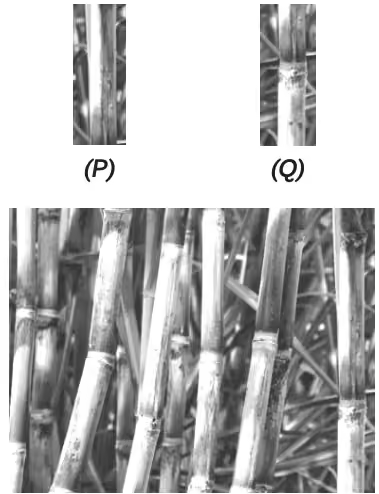
(A) Why were the type 'Q' cuttings able to grow as sugarcane but type 'P' could not?
(B) What difference was present in type 'Q' compared to type 'P'?
(C) What observation or measurement was made to determine whether this change had an effect?
(D) What parameters should be kept the same for both types of cuttings to ensure a fair comparison?
Answer:
(A) Type 'Q' cuttings were able to grow because they contained a node with a bud or eye. This bud has meristematic cells that can divide and differentiate to form new shoots, roots and other tissues required for growth. Type 'P' cuttings lacked a node or bud, so they could not sprout and develop into new sugarcane plants.
(B) Type 'Q' cuttings had nodes with buds or eyes containing meristematic cells, whereas type 'P' cuttings lacked nodes and consisted only of internodal regions. The presence of these actively dividing cells in the buds enabled type 'Q' cuttings to sprout and regenerate into new sugarcane plants.
(C) The effect was determined by observing whether new shoots sprouted from the cuttings. Additional measurements such as the time taken for sprouting, the number of shoots formed, and shoot length, could also be used to assess growth.
(D) To ensure a fair comparison, the following parameters should be kept constant:
(1) Same soil type and composition of soil.
(2) Same length and size of cuttings.
(3) Same supply of water.
(4) Same light intensity and temperature.
(5) Same depth and time of planting.
(6) Cuttings taken from the same sugarcane variety.
Keeping these variables constant ensures that the observed differences are due to the presence or absence of nodes.
Question 11: During the discussion in class, Rohan gives a statement that, "A tissue is a group of similar cells performing similar functions". But Rajiv counter argues that, "This is true in case of simple tissues but little different in case of complex tissues". Provide your explanation in view of the discussion in class.
Answer:
Rohan's statement is correct for simple tissues, because simple tissues are made up of similar types of cells that perform similar functions. For example, parenchyma, collenchyma and sclerenchyma are simple tissues.
Rajiv's counter-argument is also correct because complex tissues are made up of different types of cells that work together to perform a common function. For example, xylem has tracheids, vessels, xylem parenchyma and xylem fibres, which together help in the transport of water and minerals. Similarly, phloem has sieve tubes, companion cells, phloem parenchyma and phloem fibres, which together help in the transport of food.
So, a better explanation is: A tissue is a group of cells that work together to perform a specific function; in simple tissues the cells are similar, while in complex tissues the cells are different but function together.
Question 12: Coconut husk fibres are used for mats which are tough and fibrous. Which tissue has structural features suitable for providing this strength? Explain why living parenchyma couldn't serve the same purpose.
Answer:
The tissue responsible for the strength and toughness of coconut husk fibres is sclerenchyma. Sclerenchyma is a simple permanent tissue made up of cells with thick, lignified cell walls, which provide high mechanical strength and rigidity. These cells are usually dead at maturity and form strong fibrous strands that can withstand stretching and mechanical stress. Therefore, coconut husk fibres are tough and suitable for making mats, ropes and brushes.
Living parenchyma cannot serve the same purpose because its cells are thin-walled, soft and mainly involved in storage and other metabolic activities. They usually lack lignified walls, so they do not provide the same toughness and mechanical strength as sclerenchyma. Parenchyma cells are also generally not long and fibre-like, so they cannot form strong strands needed for woven materials like mats. Hence, parenchyma cannot substitute for sclerenchyma in coconut husk fibres.
Question 13: Vibha claims to her friend Neha that, "Meristematic cells are located only at the root and shoot apices". What do you think about this statement? What question can Neha ask Vibha to help her understand further if the statement is incorrect?
Answer:Verified
Vibha's statement is incomplete and therefore incorrect. Although apical meristems are present at the tips of roots and shoots and are responsible for an increase in length, meristematic tissues are not found only at these locations. Plants possess three types of meristematic tissues:
(1) Apical meristem: Present at root and shoot tips; responsible for increase in length.
(2) Lateral meristem: Present along the sides of stems; responsible for increase in girth.
(3) Intercalary meristem: Present at the base of internodes or near nodes in certain plants; responsible for regrowth after cutting.
Therefore, meristematic tissues are present at different locations in plants depending on their function.
Neha can ask Vibha:
'If meristematic cells are present only at root and shoot apices, then how does the stem increase in thickness or how do grasses regrow after being cut?'
Question 14: A plant cell and an animal cell are of the same size.
(A) Which cell will have a larger vacuole? Give reasons.
(B) What assumptions are you making to answer the question above?
Answer:
(A) The plant cell will have a larger vacuole. In mature plant cells, a large central vacuole occupies a major part of the cell and stores water, minerals, nutrients, and waste products. It also helps maintain turgor pressure, which keeps the plant cell firm and provides support to the plant body.
(B) The following assumptions are made:
1. (1) The plant cell is assumed to be a mature plant cell, since young meristematic cells have either small or no vacuoles.
2. (2) The animal cell is assumed to be a typical animal cell and not a specialised cell.
3. (3) Both cells are assumed to be in a normal physiological condition.
4. (4) Both cells are assumed to have the same total cell size or volume for comparison.
Question 15: A textbook states, "Each plant tissue performs only one specific function". What questions would you ask to critically examine the correctness of this statement? What examples of tissues would you take to find out the answers to these questions?
Answer:
The statement 'Each plant tissue performs only one specific function' needs critical examination because many plant tissues perform more than one function. To test the correctness of this statement, a variety of questions can be asked:
(1) Does parenchyma perform only storage, or can it perform other functions too?
For example, chlorenchyma, a type of parenchyma containing chloroplasts, carries out photosynthesis, while aerenchyma helps in aeration and buoyancy in aquatic plants.
(2) Does epidermis only protect the plant body?
For example, root hairs are extensions of epidermal cells and help in the absorption of water and minerals. Stomata present in the epidermis help in gaseous exchange and transpiration.
(3) Does xylem only conduct water and minerals?
For example, xylem fibres provide mechanical support, while xylem parenchyma helps in storage.
These examples show that many plant tissues have a primary function along with additional functions. Therefore, the statement is not completely correct.
Think It Over
Question 1: How is the study of cells and tissues significant for understanding the life processes and human welfare?
[Pg. No. 28]
Answer:
Cells are the basic structural and functional units of life, while tissues are groups of similar cells that perform specific functions. Studying cells and tissues helps us understand how living organisms carry out life processes such as nutrition, respiration, growth, reproduction and excretion and where do these process take place. It helps us understand the correlation between structural anatomy and specific functions.
It also helps in identifying the causes of diseases, developing medicines and improving medical treatments. Therefore, the study of cells and tissues is important for understanding life processes and promoting human welfare.
Question 2: How are tissues in plants and animals different, and why?
[Pg. No. 28]
Answer:
Plant tissues and animal tissues differ in their structure and functions. Plant tissues are mainly concerned with growth, support and transport of materials. Many plant tissues are made up of dead cells because plants require less energy and have sedentary life cycle. Animal tissues are specialised for movement, coordination, protection and transportation. Most animal tissues consist of living cells because animals need continuous energy for movement and other activities.
Question 3: How is the division of labour at various levels of organisation in multicellular organisms correlated with their structure and function? [Pg. No. 28]
Answer:
In multicellular organisms, different cells are specialised to perform specific functions. Similar or dissimilar cells form tissues, different tissues combine to form organs, and organs work together in organ systems. This organisation creates a division of labour in which each level performs a particular function efficiently. For example, muscle cells are specialised for movement, muscle tissues form muscles, and muscles work with bones to bring about body movement. Thus, the structure of cells, tissues, organs and organ systems is closely related to the functions they perform, ensuring efficient functioning of the organism.
Pause and Ponder
Question 4: You may have noticed that fibres of coconut husk are hard and brittle, whereas the leaf stalks of coriander are soft and flexible. Find out the reason. [Pg. No. 33]
Answer:
The fibres of coconut husk are mainly made of sclerenchyma tissue, which consists of dead cells with thick, lignified cell walls. These thick walls make the fibres hard and brittle. In contrast, the leaf stalks of coriander contain collenchyma tissue, whose living cells have unevenly thickened walls that provide flexibility and support. Therefore, coriander leaf stalks are soft and flexible.
Question 5: Why do you think that a thick cuticle on the outer wall of epidermis is advantageous for a plant living in the desert but disadvantageous for a plant living underwater? [Pg. No. 34]
Answer:
A thick cuticle reduces the loss of water through evaporation. This is beneficial for desert plants because water is scarce in their surroundings. However, in underwater plants, a thick cuticle is unnecessary and disadvantageous because water is readily available and gases can diffuse directly through the plant surface. A thick cuticle may hinder this exchange of gases and materials.
Question 6: Once water is absorbed by plant roots, it has to travel against gravity through xylem. How do the 'dead' cells of the xylem work together with the living cells of leaves at the top to keep the water moving? [Pg. No. 34]
Answer:
The dead xylem cells form continuous hollow tubes that provide a pathway for water movement from roots to leaves. In the leaves, living cells lose water through transpiration. This process creates transpiration pull, which draws water upward through the xylem against gravity. Thus, the dead xylem cells and the living leaf cells work together to maintain the upward movement of water.
Question 7: What do you think will happen if there were no stomata in the epidermis of the stem or leaves?
[Pg. No. 34]
Answer:
If stomata were absent, the plant would not be able to exchange gases efficiently with the environment. Carbon dioxide required for photosynthesis would not enter, and oxygen produced during photosynthesis would not be released easily. Transpiration would also stop, reducing the upward movement of water and minerals from the roots. As a result, the plant's growth and survival would be severely affected.
Question 8:
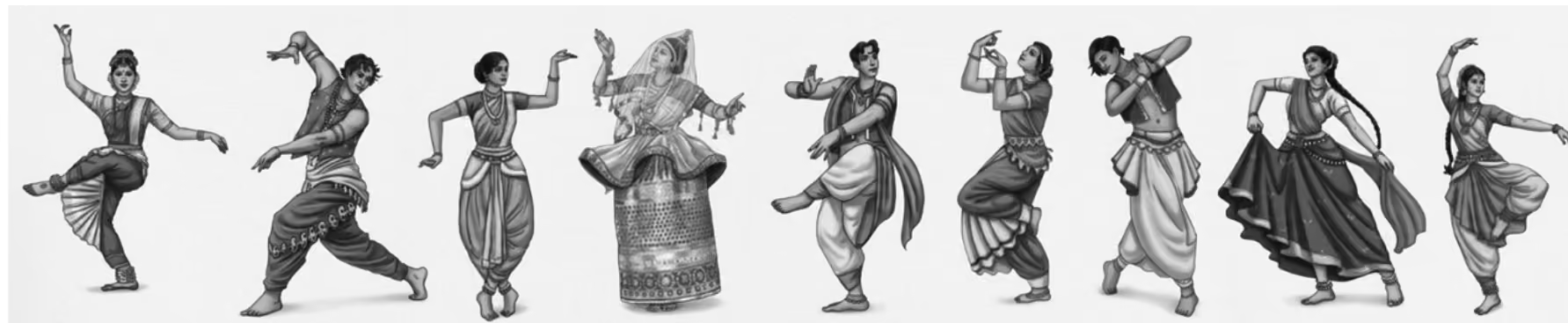
Look at the picture given below. Carefully observe the various poses of classical and folk dances of India. Can you identify which joints are involved? Also, what type of movement does each joint allow?
[Pg. No. 40]
Answer:
In the dance poses shown in the given image, the shoulders and hips allow the arms and legs to move in various directions, the elbows and knees help in bending and stretching, and the neck allows the head to turn. The coordinated action of these joints enables dancers to perform different classical and folk dance movements.
Topics covered in Class 9 Science Exploration Chapter 3
From organisation of cells to specialised tissues that enable plants and animals to grow, function, move and respond, Chapter 3, Tissues in Action, takes you there. The chapter covers:
- Level of organisation in living organisms
- Meaning and importance of tissues
- Plant vs animal tissues
- Epithelial tissue
- Connective tissue
- Muscular tissue
- Nervous tissue
- Permanent tissues in plants
- Meristematic tissues and their features
- Functions of different plant tissues
- Structure and function of animal tissues
- Musculoskeletal system
- Parenchyma, collenchyma and sclerenchyma
- Xylem and phloem as complex permanent tissues
- Different types of joints
- Tendons, ligaments and cartilage
- Bones, muscles and their role in movement
- Common injuries and basic care of the musculoskeletal system
Key Concepts to Revise from Chapter 3: Tissues in Action
To make Class 9 Science Exploration Chapter 3 easier, it’s crucial to master the basics, like cell organisation, tissue specialisation, and types of tissues. Start by understanding why multicellular organisms need tissues and how the structure of a tissue relates to the function it performs.
For Plant Tissues: Understand the difference between meristematic and permanent tissues, along with the role of apical, intercalary and lateral meristems. Also, you should be able to distinguish xylem, phloem, parenchyma, collenchyma, and sclerenchyma.
For Animal Tissues: Revise the four main groups of animal tissues: epithelial, muscular, connective, and nervous tissues, and understand how their structure enables them to perform different functions.
Additionally, understand the relationship between tissues and the musculoskeletal system, including bones, muscles, tendons, ligaments, cartilage, and joints. Mastering these key concepts helps you more than simply memorising definitions.
What You’ll Find in These NCERT Solutions
These Chapter 3 Solutions are prepared based on the new Class 9 Science Exploration textbook and can be used to check your understanding of concepts throughout the chapter. They cover:
- In-text questions and prompts
- Think It Over questions
- Pause and Ponder questions
- Revise, Reflect, Refine exercise questions
- Activity- and observation-based questions
- Diagram- and classification-based questions
- Comparison-based answers
- Clear explanations of plant and animal tissues
- Questions related to the musculoskeletal system and joints
- Step-by-step answers that help improve answer-writing skills
Practical Tips to Make the Most Out of It
- Read the textbook first: Go through the corresponding part of the Class 9 Science textbook before looking at the solution.
- Try on your own: Attempt to answer the question on your own and then verify against the given solution.
- Differentiate concepts precisely: Use small comparison tables to differentiate tissues and their function for classification topics.
- Draw neat diagrams: Practice well-labelled diagrams wherever required to strengthen your understanding.
- Practice using question banks: After completing the NCERT textbook, start practising questions from a good Class 9 Science Question Bank for 2026-27 along with these solutions.
- Revise regularly: Make short notes across every chapter and schedule short revision sessions to understand concepts and mitigate last-minute stress.
FAQs on NCERT Solutions for Class 9 Science Chapter 3.
Q1. What does Class 9 Science Exploration Chapter 3 cover?
Ans. Chapter 3 of Class 9 Science is titled Tissues in Action and explains specialised groups of cells that work together to perform different tasks. The chapter also includes different kinds of joints, common injuries, and the musculoskeletal system.
Q2. What is the most important topic in Science Chapter 3?
Ans. Honestly, the complete Chapter 3 is important for students of Class 9. But here are a few concepts that have a high probability of appearing in exams: plant tissues, animal tissues, meristematic tissues, permanent tissues, epithelia, connective, muscular and nervous system, the musculoskeletal system, and joints.
Q3. What are meristematic tissues?
Ans. Meristematic tissues are plant tissues made up of actively dividing cells responsible for growth. They comprise apical meristem, intercalary meristem and lateral meristem, which ensure continuous growth and creation of new cells in plants.
Q4. What are the four important animal tissues?
Ans. The four major types of animal tissues are epithelial, connective, muscular and nervous tissues. Each has a distinct structure and performs specialised functions in the body.
Q5. What is the difference between xylem and phloem?
Ans. Xylem transports mainly water and minerals throughout the plant, while phloem transports food manufactured in the leaves to other parts of the plant.
Q6. What is the musculoskeletal system made up of?
Ans. The musculoskeletal system is composed primarily of bones, muscles and connective tissue, which are used to provide support and facilitate the movement of the body. It also shields vital organs and offers structure to the body.
Q7. What is the difference between a tendon and a ligament?
Ans. There is a difference between a tendon and a ligament – a tendon attaches a muscle to a bone; a ligament attaches one bone to another bone. Both are supportive and stabilising the musculoskeletal system.
Q8. Why are plant tissues different from animal tissues?
Ans. The lives and needs of plants and animals are different. Animals have highly specialised tissues for movement, coordination and response, and plants have specialised tissues for growth, support and transport.
Q9. Do these NCERT Solutions match the new book of Exploration?
Ans. Yes. The solutions are based on the NCERT Class 9 Science Exploration Chapter 3, fully aligned with the 2026- 27 academic session.
Q10. Do these NCERT Class 9 Science Exploration Chapter 3 Solutions help in exam preparation?
Ans. Yes. They assist you in reviewing answers to the textbook questions, explaining concepts, practising structured responses and revising key topics prior to school exams.














.svg)

