
.svg)
Class 9 Maths Chapter 3 - The World of Numbers introduces different kinds of number, their evolution, and how they are related. The chapter explains to students what Natural Numbers, Whole Numbers, Real Numbers, Integers, Rational Numbers, and Irrational Numbers are. NCERT Class 9 Maths Ganita Manjari Chapter 3 Solutions are designed to help you provide step-wise answers for each question of the Latest Ganita Manjari NCERT Textbook 2026-27. These simple solutions break down every concept into an easy-to-understand, step-by-step manner, so that you understand the “why” behind every question.
Download NCERT Class 9 Chapter 3 Maths PDF Solutions
Save the complete ch-wise NCERT solutions PDF for Chapter 3 for offline access. The PDF includes detailed exercise-wise questions and answers aligned with the latest NCERT Ganita Majari Textbook.

What’s Included in Chapter 3: The World of Numbers
Chapter 3 of Class 9 Mathematics makes the learning exciting by blending mathematical history, conceptual clarity, and logical problem-solving. The chapter introduces the development journey of the number system, from the evolution of mathematics to the concept of numbers on the number line, types of numbers, and decimal expansions. However, this NCERT solution helps you develop a strong understanding of the chapter and boost confidence in solving various types of questions.
Here are some important concepts the chapter covers:
- Natural numbers and their origin
- The revolution of Zero (Shunya)
- Whole numbers and integers
- Rational numbers and their properties
- Equivalent rational numbers
- Comparing and ordering rational numbers
- Decimal representation of rational numbers
- Terminating and recurring decimals
- Irrational numbers
- Identifying irrational numbers through decimal expansion
- Real numbers
- Representation of real numbers on the number line
- Positive and negative numbers on the number line
- Surds and square roots
- Laws of exponents
- Solving problems involving rational and irrational numbers
NCERT Class 9 Maths Ganita Manjari Chapter 3 Solutions
NCERT Solutions for Class 9 Maths Ganita Manjari Chapter 3 includes a clear, step-by-step explanation for each question from Exercise Set 3.1, 3.2, 3.3, 3.4, 3.5, and End of Chapter Exercise tailored with the NCERT Maths syllabus 2026-27.
Grade 9 - Ganita Manjari (Part I)
Exercise Set 3.1
1. A merchant in the port city of Lothal is exchanging bags of spices for copper ingots. He receives 15 ingots for every 2 bags of spices. If he brings 12 bags of spices to the market, how many copper ingots will he leave with?
Solution:
Let the number of copper ingots the merchant has be x.
Using the ratio, we have
2 bags : 15 ingots = 12 bags : x ingots
x = 90 ingots
Hence, the merchant will leave with 90 copper ingots.
2. Look at the sequence of numbers on one column of the Ishango bone: 11, 13, 17, 19. What do these numbers have in common? List the next three numbers that fit this pattern.
Solution:
All the numbers 11, 13, 17, 19 are prime numbers.
They have no divisors other than 1 and themselves.
The next three primes after 19 are: 23, 29, 31.
3. We know that Natural Numbers are closed under addition (the sum of any two natural numbers is always a natural number). Are they closed under subtraction? Provide a couple of examples to justify your answer.
Solution:
No, Natural numbers are not closed under subtraction.
Example 1: 5 − 3 = 2 (natural number)
Example 2: 3 − 5 = −2 (not a natural number)
Example 3: 4 − 4 = 0 (not a natural number, since N = {1, 2, 3, …})
Since we can find two natural numbers whose difference is not a natural number, the set ℕ is not closed under subtraction.
4. Ancient Indians used the joints of their fingers to count, a practice still seen today. Each finger has 3 joints, and the thumb is used to count them. How many can you count on one hand? How does this relate to the ancient base-12 counting systems? *
Solution:
One hand has 4 fingers, excluding the thumb, and each finger has 3 joints.
So, the total number of joints is 4 * 3 = 12.
This number, 12, forms the base of the duodecimal system. In ancient times, people used the thumb as a pointer to count these joints and reach up to 12 on one hand. With both hands, one hand counted up to 12 while the other kept track of the number of groups, allowing counting up to, called a gross.
This is one reason why the base 12 system was commonly used in history, such as in 12 months of a year, 12 inches in a foot, and 12 hours on a clock.
Exercise Set 3.2
1. The temperature in the high-altitude desert of Ladakh is recorded as 4 °C at noon. By midnight, it drops by 15 °C. What is the midnight temperature?
Solution:
Temperature at noon = 4°C
and drop in temperature = 15°C
A “drop” means the temperature decreases, so we treat it as a negative change (−15°C).
Thus, Midnight temperature = −11°C
Hence, the temperature falls below zero, so it becomes 11 degrees below freezing point.
2. A spice trader takes a loan (debt) of ₹ 850. The next day, he makes a profit (fortune) of ₹ 1,200. The following week, he incurs a loss of ₹ 450. Write this sequence as an equation using integers and calculate his final financial standing.
Solution:
Given, loan (debt) of ₹ 850 = -850
profit (fortune) of ₹ 1,200 = +1200
loss of ₹ 450 = -450
So, equation is given by using integers
(−850) + 1200 + (−450)
= 1200 − 850 − 450
= 350 − 450 = −100
Hence, the trader is still in debt of ₹ 100 after all transactions.
3. Calculate the following using Brahmagupta’s laws:
(A) (–12) × 5
(B) (– 8) × (–7)
(C) 0 – (–14)
(D) (–20) ÷ 4
Solution:
(A) (−12) × 5 = −60 (debt × fortune = debt)
(B) (−8) × (−7) = 56 (debt × debt = fortune)
(C) 0 − (−14) = 0 + 14 = 14 (0 - debt = fortune)
(D) (−20) ÷ 4 = −5 (debt ÷ fortune = debt)
4. Explain, using a real-world example of debt, why subtracting a negative number is the same as adding a positive number (e.g., 10 – (–5) = 15).
Solution:
Imagine you have ₹ 10 in your pocket, and you owe a friend ₹ 5, which is a debt of ₹ 5.
If your friend forgives this debt, you no longer have to pay ₹ 5.
So, your money increases by ₹ 5, and your total becomes ₹ 10 + ₹ 5 = ₹ 15.
This shows that subtracting a debt is the same as adding money.
Exercise Set 3.3
1. Prove that the following rational numbers are equal (using ad = bc):
(A) 2/3 and 4/6: 2 × 6 = 12 and 3 × 4 = 12. Since 12 = 12, they are equal.
(B) 5/4 and 10/8: 5 × 8 = 40 and 4 × 10 = 40. Equal.
(C) −3/5 and −6/10: (−3) (10) = −30 and 5(−6) = −30. Equal.
(D) 9/3 and 3 (= 3/1): 9 × 1 = 9 and 3 × 3 = 9. Equal.
2. Find the sum:
(A) 2/5 + 3/10 = 4/10 + 3/10 = 7/10
(B) 7/12 + 5/8 = 14/24 + 15/24 = 29/24
(C) −4/7 + 3/14 = −8/14 + 3/14 = −5/14
3. Find the difference:
(A) 5/6 − 1/4 = 10/12 − 3/12 = 7/12
(B) 11/8 − 3/4 = 11/8 − 6/8 = 5/8
(C) −7/9 − (−2/3) = −7/9 + 2/3 = −7/9 + 6/9 = −1/9
4. Find the product:
(A) (2/3) × (3/10) = 6/30 = 1/5
(B) (7/11) × (5/8) = 35/88
(C) (−4/7) × (5/14) = −20/98 = −10/49
5. Find the quotient:
(A) (2/3) ÷ (3/10) = (2/3) × (10/3) = 20/9
(B) (7/11) ÷ (5/8) = (7/11) × (8/5) = 56/55
(C) (−4/7) ÷ (5/14) = (−4/7) × (14/5) = −56/35 = −8/5
6. Show that (1/2 + 3/4) × 8/3 = (1/2) × (8/3) + (3/4) × (8/3).
Solution:
LHS = 1/2 + 3/4 = 2/4 + 3/4 = 5/4
(5/4) × (8/3) = 40/12 = 10/3
RHS = (1/2)(8/3) + (3/4)(8/3) = 8/6 + 24/12 = 4/3 + 6/3 = 10/3
LHS = RHS
Hence, verified.
7. Simplify using distributive property: (7/9)(6/7 − 3/4).
Solution:
(7/9)(6/7) − (7/9)(3/4)
= 42/63 − 21/36
= 2/3 − 7/12
= 8/12 − 7/12 = 1/12
8. Find the rational number x such that 5/6(x + 3/5) = (5/6)x + 1/2.
Solution:
Expand LHS using distributive law:
(5/6)x + (5/6)(3/5) = (5/6)x + 1/2
(5/6)x + 15/30 = (5/6)x + 1/2
(5/6)x + 1/2 = (5/6)x + 1/2
This is true for every rational number x. So, any rational number x satisfies the equation.
Exercise Set 3.4
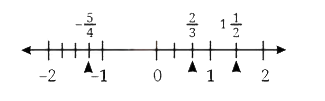
1. Represent 2/3, −5/4 and 1½ on a single number line.
Solution:
• 2/3 lies between 0 and 1, dividing the segment [0, 1] into 3 equal parts and taking the 2nd division point.
• −5/4 = −1 1⁄4 lies between −2 and −1, at ¼ of the way from −1 towards −2.
• 1½ = 3/2 lies exactly midway between 1 and 2.
Order on the line (left to right): -5/4 < 2/3 < 3/2
2. Find three distinct rational numbers strictly between −1/2 and 1/4.
Solution:
Common denominator: make both fractions have denominator 4.
−1/2 = −2/4 and 1/4.
Rational numbers between −2/4 and 1/4 include: −1/4, 0, 1/8, etc.
Three choices: −1/4, 0, 1/8.
3. Simplify: (−1/4) + (5/12).
Solution:
LCM(4, 12) = 12
= -1/4 + 5/12
= −3/12 + 5/12 = 2/12 = 1/6.
4. A tailor has 15¾ metres of silk; each kurta requires 2¼ metres. Exactly how many kurtas can he make?
Solution:
Total silk = 15¾ = 63/4 m.
Per kurta = 2¼ = 9/4 m.
Number of kurtas = (63/4) ÷ (9/4)
= (63/4) × (4/9)
= 63/9
= 7
He can make exactly 7 kurtas.
5. Find three rational numbers between 3.1415 and 3.1416.
Solution:
Any three numbers between these two words.
For example:
3.14151, 3.14155, 3.14159
(In fractional form: 314151/100000, 314155/100000 = 62831/20000, 314159/100000.)
6. Can you think of another way(s) to find a rational number between any two rational numbers? *
Solution:
Yes, there are methods:
1. Taking average:
If a and b are two rational numbers, then (a + b)/2 lies between them.
2. By making common denominator:
Convert both numbers to same denominator and choose a number in between.
3. By decimal expansion:
Convert into decimals and pick numbers in between.
Exercise Set 3.5
1. Without long division, determine whether 7/20, 4/15 and 13/250 have terminating or repeating decimals. Then verify.
Solution:
Rule: p/q (in lowest form) terminates iff prime factors of q are only 2s and/or 5s.
• 7/20: 20 = 2² × 5 → only 2 and 5 → TERMINATING.
Verify: 7/20 = 35/100 = 0.35
• 4/15: 15 = 3 × 5 → contains 3 → REPEATING.
Verify: 4/15 = 0.2666… = 0.2(6) (dtp: bar on 6)
• 13/250: 250 = 2 × 5³ → only 2 and 5 → TERMINATING.
Verify: 13/250 = 52/1000 = 0.052
2. Perform long division for 1/13. Identify the repeating block. Check cyclic property for 2/13, 3/13, 4/13, …
Solution:
1/13 = 0.076923076923… = 0.(076923) (6-digit repeating block)
2/13 = 0.(153846)
3/13 = 0.(230769)
4/13 = 0.(307692)
5/13 = 0.(384615)
6/13 = 0.(461538)
7/13 = 0.(538461)
8/13 = 0.(615384)
9/13 = 0.(692307)
10/13 = 0.(769230)
11/13 = 0.(846153)
12/13 = 0.(923076)
Observation: The repeating blocks fall into TWO cyclic groups:
Group 1 (076923 family): 1/13, 3/13, 4/13, 9/13, 10/13, 12/13
Group 2 (153846 family): 2/13, 5/13, 6/13, 7/13, 8/13, 11/13
Within each group, the digits are cyclic permutations of one another.
3. Classify as rational or irrational. Find the fraction if rational.
(A) √81 = 9 = 9/1
Hence, it is a RATIONAL.
(B) √12 = 2√3 (since √3 is irrational)
Hence, it is a IRRATIONAL.
(C) 0.33333… = 0.(3) = 1/3
Hence, it is a RATIONAL.
(D) 0.123451234512345… = 0.(12345)
Since, this is a pure repeating decimal.
Let x = 0.(12345); 100000x = 12345.(12345)
Subtract: 99999x = 12345.
So x = 12345/99999 = 4115/33333
Hence, it is a RATIONAL.
(E) 1.01001000100001…
Since, this digits follow a pattern (one more zero between 1s each time) but do NOT form a repeating block.
Hence, it is a IRRATIONAL.
(F) 23.560185612239874790120
Since, a terminating decimal (21 digits after point)
i.e., 23560185612239874790120 / 1021
Hence, it is a RATIONAL.
4. Show that 0.(9) = 1 using algebra.
Solution:
Let x = 0.9999…
Multiply by 10: 10x = 9.9999…
Subtract: 10x − x = 9.9999… − 0.9999…
9x = 9
⇒ x = 1
Therefore, 0.(9) = 1.
5. Find more numbers n whose reciprocals 1/n have cyclic repeating blocks. *
Solution:
Reciprocals of so-called 'full-reptend primes' produce cyclic numbers. These are primes p for which the repeating block of 1/p has length exactly p − 1.
Examples (besides 7):
• 1/17 = 0.(0588235294117647) — 16-digit cyclic block
• 1/19 = 0.(052631578947368421) — 18-digit cyclic block
• 1/23 = 0.(0434782608695652173913) — 22-digit cyclic block
• 1/29, 1/47, 1/59, 1/61, 1/97 are further examples.
For such primes p, the blocks for 2/p, 3/p, …, (p−1)/p are cyclic permutations of the block for 1/p (as we saw with 1/7).
End of Chapter Exercises
1. Convert to decimals by long division:
(A) 3/50:
50 = 2 × 5² (only 2s and 5s) → TERMINATES
3/50 = 6/100 = 0.06
(B) 2/9:
9 = 3² (contains 3) → REPEATS
2/9 = 0.2222… = 0.(2)
2. Prove that √5 is irrational.
Solution:
Assume, for contradiction, that √5 is rational.
Then √5 = p/q, where p and q are co-prime integers and q ≠ 0.
Squaring: 5 = p²/q²
⇒ p² = 5q² … (i)
So, p² is divisible by 5.
Since 5 is prime, p must also be divisible by 5.
Let p = 5k.
Substituting in (i),
(5k)² = 5q²
⇒ 25k² = 5q²
⇒ q² = 5k².
So, q² is divisible by 5, hence q is divisible by 5.
But then 5 divides both p and q, contradicting the fact that they are co-prime.
Hence, our assumption is false, and √5 is irrational.
3. Convert the following decimals to p/q form:
(A) 12.6 = 126/10 = 63/5
(B) 0.0120 = 120/10000 = 3/250
(C) 3.0(52): Let x = 3.0525252…
10x = 30.52525…
1000x = 3052.52525…
Subtract:
1000x − 10x = 3052.5252… − 30.5252… = 3022
990x = 3022
⇒ x = 3022/990 = 1511/495
(D) 1.2(35): Let x = 1.23535353…
10x = 12.35353…
1000x = 1235.3535…
Subtract:
1000x − 10x = 1235.3535 − 12.3535 = 1223
990x = 1223
⇒ x = 1223/990
(E) 0.(23): Let x = 0.232323…
100x = 23.2323…
Subtract:
99x = 23
⇒ x = 23/99
(F) 2.0(5): Let x = 2.0555…
10x = 20.555…
100x = 205.555…
Subtract:
100x − 10x = 185
⇒ 90x = 185
⇒ x = 185/90 = 37/18
(G) 2.12(5): Let x = 2.12555…
100x = 212.555… 1000x = 2125.555…
1000x − 100x = 2125.555 − 212.555 = 1913
900x = 1913 ⇒ x = 1913/900
(H) 3.12(5): Let x = 3.125555…
100x = 312.5555…
1000x = 3125.5555…
Subtract:
1000x − 100x = 2813
900x = 2813
⇒ x = 2813/900
(I) 2.(1625):
Let x = 2.1625162516251625…
10000x = 21625.(1625)
Subtract:
10000x − x = 21625.1625… − 2.1625… = 21623
9999x = 21623
⇒ x = 21623/9999
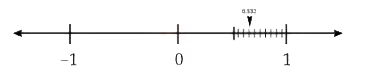
4. Locate the following on the number line:
(A) 0.532:
(B) 1.1(5) = 1.1555… = 1 + (0.1 + 0.0555…) = 1 + 0.1 + 1/18 = 1 + 9/90 + 5/90 = 1 + 14/90 = 104/90 = 52/45.
Locate the point 52/45 = 1.1555… between 1.15 and 1.16, slightly beyond 1.15.

5. Find 6 rational numbers between 3 and 4.
Solution:
Write both with a denominator large enough. 3 = 21/7 and 4 = 28/7.
Six numbers between them: 22/7, 23/7, 24/7, 25/7, 26/7, 27/7.
6. Find 5 rational numbers between 2/5 and 3/5.
Solution:
Enlarge denominators: 2/5 = 20/50 and 3/5 = 30/50.
Five rationals: 21/50, 22/50 (= 11/25), 23/50, 24/50 (= 12/25), 25/50 (= 1/2).
7. Find 5 rational numbers between 1/6 and 2/5.
Solution:
LCM(6, 5) = 30. 1/6 = 5/30 and 2/5 = 12/30. Only 6 integers (6 to 11) lie strictly between 5 and 12 in the numerator, so we enlarge further.
Multiply both by 2: 1/6 = 10/60 and 2/5 = 24/60.
Five rationals: 11/60, 13/60, 1/4 (= 15/60), 17/60, 19/60.
8. If x/3 + x/5 = 16/15, find x.
Solution:
Take LCM 15 on LHS: (5x + 3x)/15 = 16/15
8x/15 = 16/15
⇒ 8x = 16
⇒ x = 2.
9. Let a and b be non-zero rationals with a + 1/b = 0. Is ab positive or negative?
Solution:
From a + 1/b = 0
⇒ a = −1/b
⇒ ab = b × (−1/b) = −1.
Since ab = −1, ab is NEGATIVE.
10. A rational number has a terminating decimal whose last non-zero digit is at the 4th decimal place. Show it can be written as p/10⁴ with p not divisible by 10. Is the denominator (in lowest form) necessarily divisible by 2⁴ or 5⁴?
Solution:
If the last non-zero digit is at the 4th place, the decimal has the form 0.d₁d₂d₃d₄ (with d₄ ≠ 0). Multiplying by 10⁴ gives the integer p = d₁d₂d₃d₄. So, the number equals p/10⁴.
Since d₄ ≠ 0, the last digit of p is not 0, so p is NOT divisible by 10.
When written in lowest form, the denominator need NOT be divisible by 2⁴ or 5⁴.
Counter-example: 0.0625 = 625/10000. Simplify: gcd(625, 10000) = 625 → 0.0625 = 1/16 = 1/2⁴. Denominator = 2⁴ (divisible by 2⁴ but not 5⁴).
Another: 0.0016 = 16/10000 = 1/625 = 1/5⁴ (divisible by 5⁴ but not 2⁴).
Another: 0.0003 = 3/10000. gcd(3, 10000) = 1 → denominator = 10000 = 2⁴ × 5⁴ (divisible by both).
So, the denominator must be of the form 2ᵃ × 5ᵇ where 0 ≤ a, b ≤ 4 and max(a, b) = 4. It is NOT necessary that both 2⁴ and 5⁴ divide it.
11. Without division, is 18/125 terminating or non-terminating? If terminating, how many decimal places?
Solution:
125 = 5³. Denominator has only 5 as prime factor, so 18/125 TERMINATES.
Multiply numerator and denominator by 2³ = 8: 18/125 = 144/1000 = 0.144
Number of decimal places = 3.
12. A rational number in lowest form has denominator 2³ × 5. How many decimal places will its decimal expansion have?
Solution:
Denominator q = 2³ × 5 = 40. Make it a power of 10, multiply numerator and denominator by 5² = 25:
p/(2³ × 5) = (25p)/(2³ × 5 × 5²) = 25p/(2³ × 5³) = 25p/1000
The denominator becomes 10³, so the decimal has 3 decimal places.
In general, for q = 2ᵃ × 5ᵇ, the number of decimal places is max(a, b).
Here a = 3, b = 1, so max = 3.
*13. Let a = 7/12 and b = 5/6 . Express both a and b in the form km1 and km2 where k1, k2 and m are integers and k2 – k1 > 6. Using the same denominator m, write exactly five distinct rational numbers lying between a and b keeping an integer numerator. Explain why the condition k2 – k1 > n + 1 is necessary to find n such rational numbers between the two rational numbers a and b using this method.
Solution:
Choose m = 24. a = 7/12 = 14/24 (so k₁ = 14). b = 5/6 = 20/24 (so k₂ = 20).
k₂ − k₁ = 6. This is not > 6, so enlarge. Take m = 48.
a = 7/12 = 28/48 (k₁ = 28); b = 5/6 = 40/48 (k₂ = 40).
k₂ − k₁ = 12 > 6.
Five rationals strictly between them: 29/48, 30/48 (= 5/8), 31/48, 32/48 (= 2/3), 33/48 (= 11/16).
Reasoning: between k₁/m and k₂/m we need integer numerators strictly between k₁ and k₂. The number of such integers is k₂ − k₁ − 1. To get at least n distinct rationals, we require k₂ − k₁ − 1 ≥ n, i.e., k₂ − k₁ > n, equivalently k₂ − k₁ ≥ n + 1 (so k₂ − k₁ > n + 1 guarantees strictly more than n options).
14. Three rational numbers x, y, z satisfy x + y + z = 0 and xy + yz + zx = 0. Show that all the rational numbers x, y, z must be simultaneously zero. *
Solution:
Given, x + y + z = 0 and xy + yz + zx = 0
Since, (x + y + z)² = x² + y² + z² + 2(xy + yz + zx).
Substituting the values, we have
0² = x² + y² + z² + 2(0)
⇒ x² + y² + z² = 0.
Since squares of rational numbers are non-negative, and the sum of non-negative numbers is 0 only when each is 0,
x² = 0, y² = 0, z² = 0
⇒ x = 0, y = 0, z = 0.
Hence, proved.
15. Show that the rational number lies between the rational numbers a and b.*
Solution:
Assume a < b.
To show: a < < b.
Left inequality: − > a = = > 0 (since b > a).
So > a.
Right inequality: b − = = > 0.
So < b.
Therefore a < < b.
Also, since a and b are rationals, it is rational (rationals are closed under addition and division by a non-zero integer).
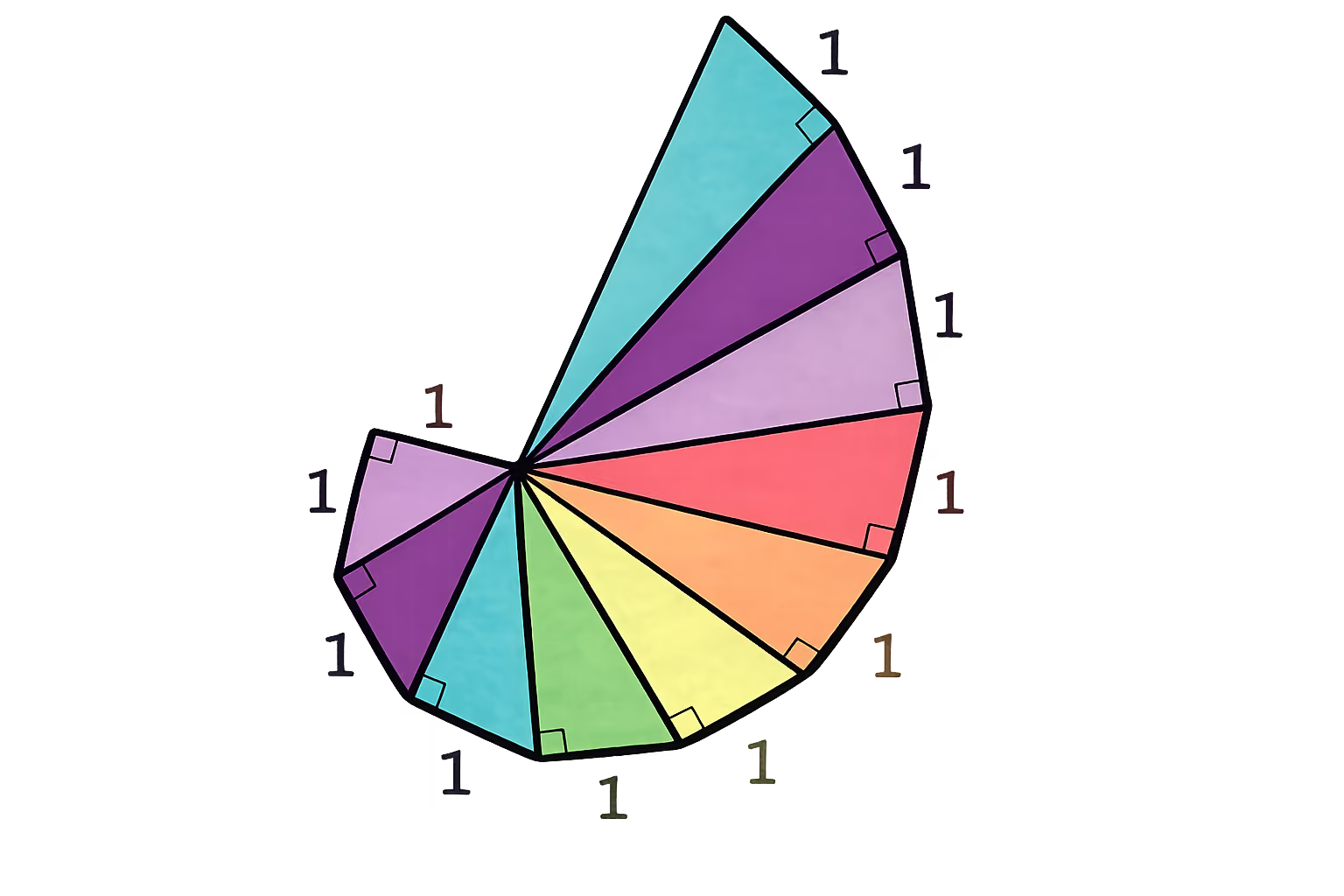
16. Find the lengths of the hypotenuses of all the right triangles in the given figure which is referred to as the square root spiral.
Solution:
In a square-root spiral, start with a right triangle having both legs of length 1. Each new triangle is right-angled, with one leg being the previous hypotenuse and the other leg of length 1.
Triangle 1: legs 1 and 1 ⇒ hypotenuse = √(1² + 1²) = √2
Triangle 2: legs √2 and 1 ⇒ hypotenuse = √(2 + 1) = √3
Triangle 3: legs √3 and 1 ⇒ hypotenuse = √(3 + 1) = √4 = 2
Triangle 4: legs 2 and 1 ⇒ hypotenuse = √(4 + 1) = √5
Triangle 5: legs √6 and 1 ⇒ hypotenuse = √6
Triangle 6: legs √7 and 1 ⇒ hypotenuse = √7
Triangle 7: legs √7 and 1 ⇒ hypotenuse = √8 = 2√2
Triangle 8: legs √8 and 1 ⇒ hypotenuse = √9 = 3
Triangle 9: legs 3 and 1 ⇒ hypotenuse = √10
Triangle 10: legs √10 and 1 ⇒ hypotenuse = √11
Key Learning of Class 9 Maths Chapter 3 : The World Of Numbers
Below are some mathematical results of this chapter given; make sure to remember these before appearing in exams:
- All natural numbers are whole numbers, but all whole numbers are not natural numbers.
- All integers are rational numbers.
- Every rational number can be expressed as a fraction p/q with q ≠ 0.
- A rational number has either a terminating or recurring decimal expansion.
- An irrational number has a non-terminating and non-repeating decimal expansion.
- The collection of rational and irrational numbers together is called the set of real numbers.
- Exponents have specific laws which make calculations with powers easier.
Points to Note While Solving Class 9 Maths Ch3 : The World Of Numbers Questions
- Determine the type of number before selecting the method of solving it.
- Be careful not to mix up a recurring decimal with a non-recurring decimal.
- Always simplify rational numbers whenever possible.
- When comparing rational numbers, turn them to a common denominator if necessary.
- Carefully use the laws of exponents to avoid sign errors.
- When required to represent the question graphically, draw a neat number line.
Before moving to additional resources like a question bank or sample papers, do some practice questions from the Maths NCERT textbook to strengthen concept understanding.
Why Use NCERT Solutions for Chapter 3?
Learning the theory is essential, but solving questions helps to know how each and every concept is applied. The NCERT Solutions for Class 9 Maths Ganita Manjari Chapter 3 will be helpful for students to understand complex concepts such as Rules of exponents, Irrational numbers, and Decimal expansion.
After completing the NCERT exercises you can further strengthen your preparation by solving questions from a Class 9 Maths Question Bank. This lets you have extra practice of the different types of questions and builds confidence for school exams and future competitive assessments.
FAQs
Q1. Are these NCERT Solutions for Class 9 Maths Chapter 3 aligned with the latest curriculum?
Ans. Yes. These solutions are prepared according to the latest NCERT Class 9 Ganita Manjari syllabus and are explained using a step-by-step approach to all the exercises.
Q2. What topics does NCERT Class 9 Maths Chapter 3 Solution cover?
Ans. The solution consists of Natural numbers, Integers, Rational numbers, Irrational numbers, Real numbers, Decimal expansions, Number line representation and Laws of exponents based on the latest Ganita Manjari textbook.
Q3. Is Chapter 3 important for Class 9 Maths exams?
Ans. Yes. Questions on rational numbers, irrational numbers, decimal expansions and the laws of exponents are frequently encountered in school examinations and are also the stepping stone for higher mathematics.
Q4. What is the difference between rational and irrational numbers?
Ans. A rational number has a terminating or recurring decimal expansion, which can be represented as p/q (q ≠ 0). An irrational number cannot be written in this form and has an infinite, non-repeating decimal expansion.
Q5. Do I have to practice only NCERT questions for Chapter 3?
Ans. The priority should be NCERT questions as they promote conceptual understanding. Once completed, doing extra questions from a Maths Question Bank for Class 9 can enhance speed, accuracy and examination readiness.












.svg)

