
.svg)
NCERT Solutions for Class 9 Maths Ganita Manjari Chapter 2: Introduction to Linear Polynomials, based on the new 2026-27 curriculum, will help students build an important algebraic foundation. Chapter 2 of the NCERT textbooks covers definitions of terms, variables and constants, coefficients, degree of polynomials, and many more concepts of algebraic expressions. Educart’s comprehensive Maths solution explains every concept in simple, structured steps with solved examples and exam-oriented practice.
Download NCERT Solutions for Class 9 Maths Chapter 2 PDF
Get complete Chapter 2 Introduction to Linear Polynomials solutions PDF here for free. Strengthen your understanding of Linear Polynomials, Linear Growth and Decay, and Linear Pattern with this NCERT Class 9 Math solution whenever you need them.

NCERT Class 9 Maths Ganita Manjari Chapter 2 Solutions
NCERT Solutions Class 9 Maths Ganita Manjari Chapter 2 includes step-by-step answers for each question from Exercise Set 2.1, 2.2, 2.3, 2.4, 2.5, 2.6, as well as the End of Chapter Exercise aligned with the NCERT Class 9 Maths textbook 2026-27.
Grade 9 - Ganita Manjari (Part I)
Exercise Set 2.1
1. Find the degrees of the following polynomials:
(A) 2x² − 5x + 3
(B) y³ + 2y − 1
(C) −9 (D) 4z − 3
Solution:
(A) Highest power of the polynomial is 2.
Degree = 2
(B) Highest power of the polynomial is 3.
Degree = 3
(C) Highest power of the polynomial is 0.
Degree = 0 (constant polynomial)
(D) Highest power of the polynomial is 1.
Degree = 1
2. Write polynomials of degrees 1, 2 and 3.
Solution:
Degree 1 (linear): 3x + 5
Degree 2 (quadratic): x² − 4x + 7
Degree 3 (cubic): 2x³ + x² − x + 1
3. What are the coefficients of x² and x³ in the polynomial x⁴ − 3x³ + 6x² − 2x + 7?
Solution:
Coefficient of x² = 6
Coefficient of x³ = −3
4. What is the coefficient of z in the polynomial 4z³ + 5z² − 11?
Solution:
The polynomial has no z-term.
Thus, coefficient of z = 0.
5. What is the constant term of the polynomial 9x³ + 5x² − 8x − 10?
Solution:
The term without any variable is called the constant term. In the gicen polynomial -10 is without variable.
So, constant term = −10
Exercise Set 2.2
1. Find the value of the linear polynomial 5x − 3 if:
(A) x = 0 (B) x = −1 (C) x = 2
Solution:
- 5(0) − 3 = −3
- 5(−1) − 3 = −5 − 3 = −8
- 5(2) − 3 = 10 − 3 = 7
2. Find the value of the quadratic polynomial 7s² − 4s + 6 if:
- s = 0
- (B) s = −3
- (C) s = 4.
Solution:
- 7(0)2 − 4(0) + 6 = 0 – 0 + 6 = 6
- 7(-3)2 – 4(−3) + 6 = 7(9) + 12 + 6 = 63 + 12 + 6 = 8
- 7(4)2 – 4(4) + 6 = 7(16) − 12 + 6 = 112 − 16 + 6 = 102
3. The present age of Salil’s mother is three times Salil’s present age. After 5 years, their ages will add up to 70 years. Find their present ages.
Solution:
Let Salil's present age = z years. Then mother's age = 3z years.
After 5 years,
Salil's present age = (z + 5) years
mother's age = (3z + 5) years
According to Problem,
(z + 5) + (3z + 5) = 70
⇒ 4z + 10 = 70
⇒ 4z = 60 ⇒ z = 15
Hence, Salil's present age = 15 years;
Mother's present age = 3(15) = 45 years.
4. The difference between two positive integers is 63. The ratio of the two integers is 2:5. Find the two integers.
Solution:
Let the integers be 2k and 5k.
Then 5k − 2k = 63
⇒ 3k = 63
⇒ k = 21.
Hence, the integers are 2(21) = 42 and 5(21) = 105.
5. Ruby has 3 times as many two-rupee coins as she has five-rupee coins. If she has a total `88, how many coins does she have of each type?
Solution:
Let the number of five-rupee coins = x. Then two-rupee coins = 3x.
Total amount = 5x + 2(3x) = 88
⇒ 5x + 6x = 88
⇒ 11x = 88
⇒ x = 8
Hence, five-rupee coins = 8 and two-rupee coins = 3(8) = 24.
6. A farmer cuts a 300 feet fence into two pieces of different sizes. The longer piece is four times as long as the shorter piece. How long are the two pieces?
Solution:
Let shorter piece = x feet. Then longer piece = 4x feet.
Thus, x + 4x = 300
⇒ 5x = 300
⇒ x = 60.
Hence, shorter piece = 60 feet and longer piece= 4(60) = 240 feet.
7. If the length of a rectangle is three more than twice its width and its perimeter is 24 cm, what are the dimensions of the rectangle?
Solution:
Let width = w cm. Then, length = (2w + 3) cm.
Perimeter = 2(length + width)
= 2[(2w + 3) + w]
= 2(3w + 3)
= 6w + 6
= 24
⇒ 6w = 18 ⇒ w = 3.
Hence, width = 3 cm and length = 2(3) + 3 = 9 cm.
Exercise Set 2.3
1. A student has ₹ 500 in her savings bank account. She gets ₹ 150 every month as pocket money. How much money will she have at the end of every month from the second month onwards? Find a linear expression to represent the amount she will have in the nth month
Solution:
End of month 1: 500 + 150 = ₹650
End of month 2: ₹800;
End of Month 3: ₹950;
End of Month 4: ₹1100; …
Expression for nth month: Amount = 500 + 150n (rupees)
2. A rally starts with 120 members. Each hour, 9 members drop out of the group. How many members will remain after 1, 2, 3, … hours? Find a linear expression to represent the number of members at the end of the nth hour.
Solution:
Initial member in rally = 120
Number of members drop out every hour = 9
After 1 hour, number of members = 120 − 9 = 111
After 2 hour, number of members = 111 − 9 = 102
After 3 hour, number of members = 102 − 9 = 93
Hence, linear expression of number of members after nth hour = 120 – 9n.
3. Suppose the length of a rectangle is 13 cm. Find the area if the breadth is (A) 12 cm, (B) 10 cm,
(C) 8 cm. Find the linear pattern representing the area of the rectangle.
Solution:
Let breadth of rectangle be x and length is given as 13 cm
(A) x = 12: Area = 13 × 12 = 156 cm²
(B) x = 10: Area = 13 × 10 = 130 cm²
(C) x = 8: Area = 13 × 8 = 104 cm²
Hence, the linear pattern is given by A = 13x.
4. Suppose the length of a rectangular box is 7 cm and breadth is 11 cm. Find the volume if the height is (A) 5 cm, (B) 9 cm, (C) 13 cm. Find the linear pattern representing the volume of the rectangular box.
Solution:
Given length = 7 cm, breadth = 11 cm
Volume = 7 × 11 × h = 77h
(A) h = 5: 77 × 5 = 385 cm³
(B) h = 9: 77 × 9 = 693 cm³
(C) h = 13: 77 × 13 = 1001 cm³
Linear pattern: V = 77h
5. Sarita is reading a book of 500 pages. She reads 20 pages every day. How many pages will be left after 15 days? Express this as a linear pattern.
Solution:
Here, total number of pages = 500
Number of pages read every day = 20
Pages left after d days = 500 − 20d
After 15 days, number of pages = 500 − 20(15) = 500 − 300 = 200 pages left.
Exercise Set 2.4
1. Suppose a plant has height 1.75 feet and it grows by 0.5 feet each month.
(A) Find the height after 7 months.
(B) Make a table of values for t varying from 0 to 10 months and show how the height, h, increases every month.
(C) Find an expression that relates h and t, and explain why it represents linear growth.
Solution:
(A) Height after 7 months = 1.75 + 0.5(7) = 1.75 + 3.5 = 5.25 feet
(B) Table of values (t in months, h in feet):
(C) Expression of given problem is given by
h = 1.75 + 0.5t
It represents linear growth because h increases by the fixed amount 0.5 ft for every unit increase in t.
2. A mobile phone is bought for ₹ 10,000. Its value decreases by ₹ 800 every year.
(A) Find the value of the phone after 3 years.
(B) Make a table of values for t varying from 0 to 8 years and show how the value of the phone, v, depreciate with time.
(C) Find an expression that relates v and t, and explain why it represents linear decay.
Solution:
(A) Value after 3 years = 10000 − 800(3) = 10000 − 2400 = ₹ 7600
(B) Table of values:
(C) Expression of given problem is given by
v = 10000 − 800t.
It represents linear decay since v decreases by a constant amount ₹ 800 per year.
3. The initial population of a village is 750. Every year, 50 people move from a nearby city to the village.
(A) Find the population of the village after 6 years.
(B) Make a table of values for t varying from 0 to 10 years and show how the population, P, increases every year.
(C) Find an expression that relates P and t, and explain why it represents linear growth.
Solution:
(A) Population after 6 years = 750 + 50(6) = 750 + 300 = 1050
(B) Table of values:
(C) Expression of given problem is given by
P = 750 + 50t
It represents linear growth because P increases by a constant 50 every year.
4. A telecom company charges ₹ 600 for a certain recharge scheme. This prepaid balance is reduced by ₹ 15 each day after the recharge.
(A) Write an equation that models the remaining balance b(x) after using the scheme for x days. Explain why it represents linear decay.
(B) After how many days will the balance run out?
(C) Make a table of values for x varying from 1 to 10 days and show how the balance b(x), reduces with time.
Solution:
(A) Balance equation: b(x) = 600 − 15x. It is linear decay since balance decreases by a constant ₹ 15 daily.
(B) Balance runs out when b(x) = 0
⇒ 600 − 15x = 0
⇒ x = 40 days.
(C) Table of values:
The balance decreases steadily by ₹15 each day, clearly showing a uniform linear drop.
Exercise Set 2.5
1. A learning platform charges a fixed monthly fee and an additional cost per digital learning module accessed. A student observes that when she accessed 10 modules, her bill was ₹ 400. When she accessed 14 modules, her bill was ₹ 500. If the monthly bill y depends on the number of modules accessed, x, according to the relation y = ax + b, find the values of a and b.
Solution:
Given expression is y = ax + b
When x = 10, y becomes 400 then expression is given by
400 = 10a + b …(i)
When x = 14, y becomes 500 then expression is given by
500 = 14a + b …(ii)
Subtract eq. (i) from eq. (ii), we have
500 – 400 = 14a + b – 10a – b
⇒ 100 = 4a
⇒ a = 25
Substitute in eq. (i), we have
b = 400 − 10(25) = 400 − 250 = 150
Hence, the value of a and b is 25 and 150 respectively.
2. A gym charges a fixed monthly fee and an additional cost per hour for using the badminton court. A student using the gym observed that when she used the badminton court for 10 hours, her bill was `800. When she used it for 15 hours, her bill was ₹1100. If the monthly bill y depends on the hours of the use of the badminton court, x, according to the relation y = ax + b, find the values of a and b.
Solution:
Given relation is y = ax + b
When x = 10, y becomes 800 then expression is given by
800 = 10a + b …(i)
When x = 15, y becomes 1100 then expression is given by
1100 = 15a + b …(ii)
Subtract eq. (i) from eq. (ii), we have
1100 – 800 = 15a + b – 10a - b
⇒ 300 = 5a
⇒ a = 60
Substitute in eq. (i), we have
b = 800 − 10(60) = 200
Substitute in eq. (i), we have
Hence, the value of a and b is 60 and 200 respectively.
3. Consider the relationship between temperature measured in degrees Celsius (°C) and degrees Fahrenheit (°F), which is given by °C = a °F + b. Find a and b, given that ice melts at 0 degrees Celsius and 32 degrees Fahrenheit, and water boils at 100 degrees Celsius and 212 degrees Fahrenheit. (Hint: When °C = 0, °F = 32 and when °C = 100, °F = 212. Use this information to find a and b, and thus, the linear relationship between °C and °F.) Solution:
Given relation is °C = a °F + b
Given that ice melts at 0 degrees Celsius and 32 degrees Fahrenheit, then expression is given by
0 = 32a + b …(i)
Also, given that water boils at 100 degrees Celsius and 212 degrees Fahrenheit, then expression becomes
100 = 212a + b …(ii)
Subtract eq. (i) from eq. (ii), we have
100 – 0 = 212a + b – 32a – b
100 = 180a
⇒ a = =
Substitute in eq. (i), we have
b = −32a = −32 × = -
Therefore, value of a is and value of b is (-
Hence, the linear relationship between °C and °F is given by
°C = ( )°F - = ( )(°F − 32)
Exercise Set 2.6
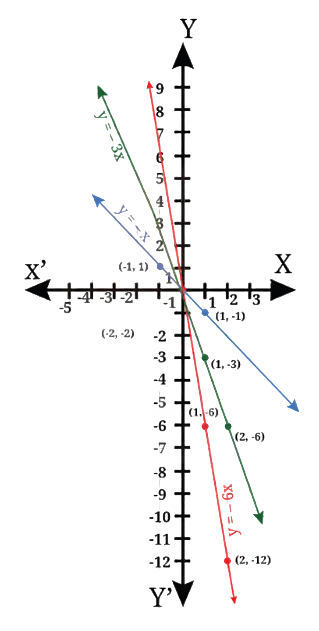
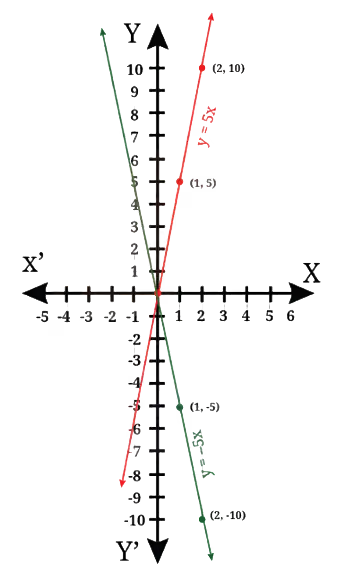
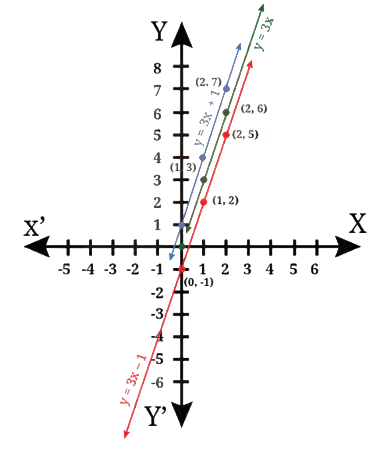
1. Draw the graphs of the following sets of lines. In each case, reflect on the role of ‘a’ and ‘b’.
(A) y = 4x, y = 2x, y = x
(B) y = –6x, y = –3x, y = –x
(C) y = 5x, y = –5x
(D) y = 3x – 1, y = 3x, y = 3x + 1
(E) y = –2x – 3, y = –2x, y = 2x + 3
Solution: (A) y = 4x, y = 2x, y = x
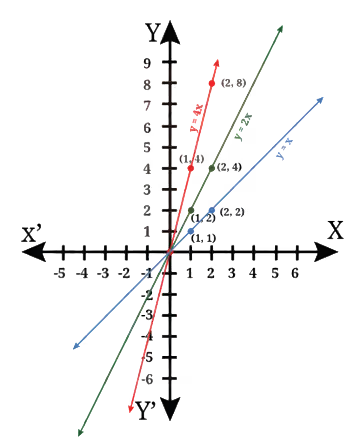
All the lines have and positive slopes; as the value of increases, the line becomes steeper.
(B) y = –6x, y = –3x, y = –x
Here, and the slopes are negative, so each line decreases from left to right. As increases, the line becomes steeper in the downward direction.
(D) y = 5x, y = −5x
Both pass through origin. y = 5x rises steeply; y = −5x falls steeply. They are mirror images about the x-axis (and also about the y-axis).
(D) y = 3x − 1, y = 3x, y = 3x + 1
Same slope 3 ⇒ all three lines are parallel. y-intercepts are −1, 0, 1 respectively.
Plot points:
y = 3x − 1: (0, −1), (1, 2)
y = 3x: (0, 0), (1, 3)
y = 3x + 1: (0, 1), (1, 4)
(E) y = −2x − 3, y = −2x, y = 2x + 3
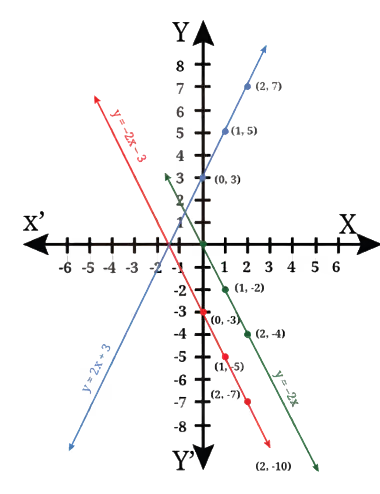
y = −2x − 3 and y = −2x are parallel (both slope −2). y = 2x + 3 has slope 2 (opposite sign), so it is NOT parallel to the others.
Plot points:
y = −2x − 3: (0, −3), (1, −5)
y = −2x: (0, 0), (1, −2)
y = 2x + 3: (0, 3), (1, 5)
End-of-Chapter Exercises
1. Write a polynomial of degree 3 in the variable x, in which the coefficient of the x2 term is –7.
Solution:
Example: 2x³ − 7x² + 4x + 5. Any cubic polynomial with −7x² is acceptable.
2. Find the values of the following polynomials at the indicated values of the variables.
(A) 5x2 – 3x + 7 if x = 1
(B) 4t3 – t2 + 6 if t = a
(A) 5x² − 3x + 7 at x = 1:
= 5(1) − 3(1) + 7 = 5 − 3 + 7 = 9
(B) 4t³ − t² + 6 at t = a:
= 4a³ − a² + 6
3. If we multiply a number by and add to the product, we get . Find the number.
Solution:
Let the number be x. Then ( )x + =
( )x = − = − = =
x = ( ) × ( ) = =
Hence, the number is.
4. A positive number is 5 times another number. If 21 is added to both the numbers, then one of the new numbers becomes twice the other new number. What are the numbers?
Solution:
Let the smaller number be x and the larger number be 5x.
After adding 21 to both numbers, we have
New smaller number = (x + 21) and New larger number = (5x + 21).
According to problem, we have
5x + 21 = 2(x + 21)
5x + 21 = 2x + 42
⇒ 3x = 21
⇒ x = 7
Hence, the numbers are 7 and 35.
5.If you have ₹ 800 and you save ₹ 250 every month, find the amount you have after (A) 6 months (B) 2 years. Express this as a linear pattern.
Solution:
Linear pattern: Amount after n months = 800 + 250n
(A) After 6 months: 800 + 250(6) = 800 + 1500 = ₹2300
(B) After 2 years (24 months): 800 + 250(24) = 800 + 6000 = ₹ 6800
6. The digits of a two-digit number differ by 3. If the digits are interchanged, and the resulting number is added to the original number, we get 143. Find both the numbers.
Solution:
Let the tens digit be x and units digit be y.
Original number = 10x + y;
reversed number = 10y + x.
According to problem,
(10x + y) + (10y + x) = 143
⇒ 11x + 11y = 11(x + y) = 143
⇒ x + y = 13.
Also |x − y| = 3.
Case 1: x − y = 3 and x + y = 13 ⇒ x = 8, y = 5 ⇒ Number = 85
Case 2: y − x = 3 and x + y = 13 ⇒ y = 8, x = 5 ⇒ Number = 58
Hence, the two numbers are 58 and 85.
7. Draw the graph of the following equations, and identify their slopes and y-intercepts. Also, find the coordinates of the points where these lines cut the y-axis.
(A) y = –3x + 4
(B) 2y = 4x + 7
(C) 5y = 6x – 10
(D) 3y = 6x – 11
Are any of the lines parallel?
By the graph (ii) and (iv) are parallel lines as both have slope 2.
8. If the temperature of a liquid can be measured in Kelvin units as x K and in Fahrenheit units as y °F, the relation between the two systems of measurement of temperature is given by the linear
equation y = ( ) (x – 273) + 32.
(A) Find the temperature of the liquid in Fahrenheit if the temperature of the liquid is 313 K.
(B) If the temperature is 158 °F, then find the temperature in Kelvin.
Solution:
(A) x = 313 K:
y = ( ) (313 − 273) + 32
= ( ) (40) + 32
= 72 + 32
= 104 °F
(B) y = 158 °F:
158 = ( )(x − 273) + 32
⇒ 126 = ( )(x − 273)
⇒ x − 273 = 126 × ( = 70
⇒ x = 343 K
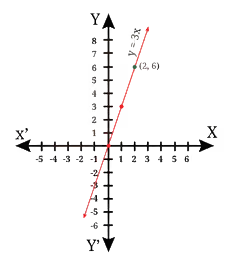
9. The work done by a body on the application of a constant force is the product of the constant force and the distance travelled by the body in the direction of the force. Express this in the form of a linear equation in two variables (work w and distance d), and draw its graph by taking the constant force as 3 units. What is the work done when the distance travelled is 2 units? Verify it by plotting it on the graph.
Solution:
Linear equation: w = 3d
When d = 2: w = 3 × 2 = 6 units
Two points for plotting: (0, 0) and (2, 6). The graph is a straight line through the origin with slope 3. Reading the graph at d = 2 gives w = 6, confirming the answer.
10. The graph of a linear polynomial p(x) passes through the points (1, 5) and (3, 11).
(A) Find the polynomial p(x).
(B) Find the coordinates where the graph of p(x) cuts the axes.
(C)Draw the graph of p(x) and verify your answers.
Solution:
(A) Let p(x) = ax + b
At (1, 5): a + b = 5 …(i)
At (3, 11): 3a + b = 11 …(ii)
Subtract (i) from (ii): 2a = 6 ⇒ a = 3; then b = 2.
So, p(x) = 3x + 2.
(B) Cuts y-axis (x = 0): y = p(0) = 2, i.e., (0, 2).
Cuts x-axis (y = 0): 3x + 2 = 0 ⇒ x = −2/3, i.e., (−2/3, 0).
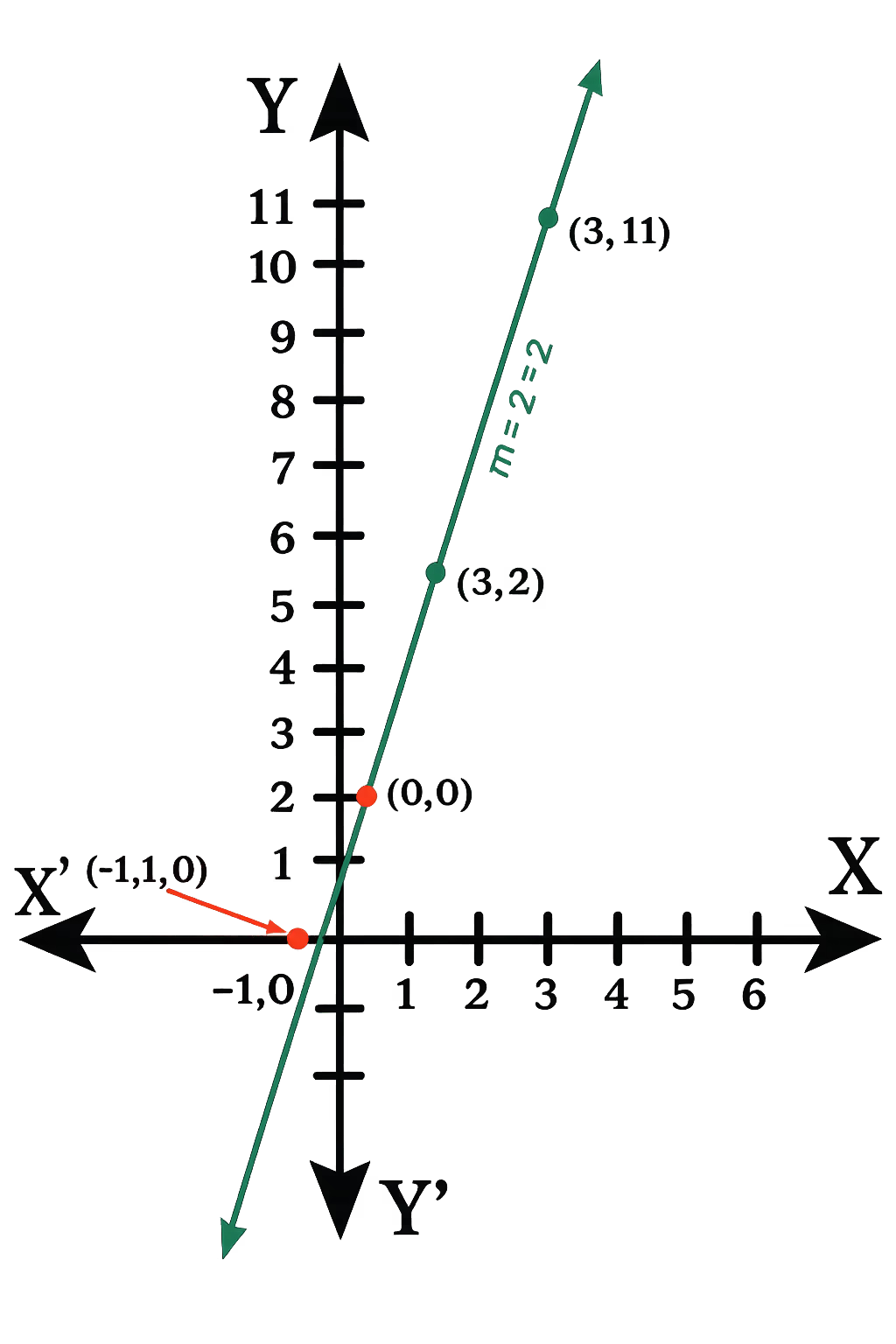
(C) From (B) by the graph (0, 2) and (−2/3, 0) at y-axis and x-axis respectively passes through the straight line.
11. Let p(x) = ax + b and q(x) = cx + d be two linear polynomials such that:
(A) p(0) = 5.
(B) The polynomial p(x) – q(x) cuts the x-axis at (3, 0).
(C) The sum p(x) + q(x) is equal to 6x + 4 for all real x.
Find the polynomials p(x) and q(x).
Solution:
From (A): p(0) = b = 5.
From (B): p(x) + q(x) = (a + c)x + (b + d) = 6x + 4
⇒ a + c = 6 and b + d = 4. Since b = 5, d = 4 − 5 = −1.
From (B): p(x) − q(x) = (a − c)x + (b − d). At x = 3, value = 0:
3(a − c) + (5 − (−1)) = 0 ⇒ 3(a − c) + 6 = 0 ⇒ a − c = −2.
Solve a + c = 6 and a − c = −2: a = 2, c = 4.
Therefore, p(x) = 2x + 5 and q(x) = 4x − 1.
12. Look at the first three stages of a growing pattern of hexagons made using matchsticks. A new hexagon gets added at every stage which shares a side with the last hexagon of the previous stage.
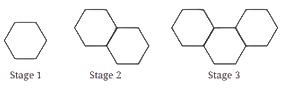
(A) Draw the next two stages of the pattern. How many matchsticks will be required at these stages?
(B) Complete the following table.
(C) Find a rule to determine the number of matchsticks required for the nth stage.
(D) How many matchsticks will be required for the 15th stage of the pattern?
(E) Can 200 matchsticks form a stage in this pattern? Justify your answer.
Solution:
Stage 1: one hexagon 6 matchsticks.
Stage 2: two hexagons sharing a side → 6 + 5 = 11 matchsticks.
Stage 3: three hexagons → 11 + 5 = 16 matchsticks.
Each new stage adds 5 matchsticks.
(A) Stage 4 has 3 + 4 × 5 + 1 = 21 matchsticks? Let's verify: 16 + 5 = 21. Stage 5: 21 + 5 = 26.
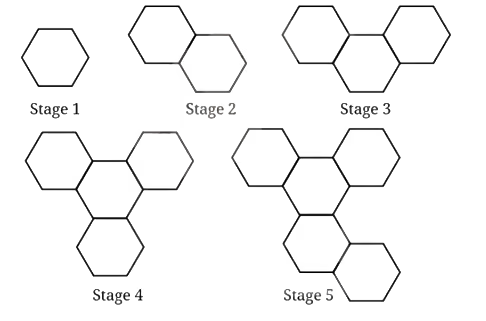
(B) Table of values:
(C) General rule: Number of matchsticks = 5n + 1
(D) 15th stage: 5(15) + 1 = 76 matchsticks.
(E) Can 200 matchsticks form a stage? 5n + 1 = 200 ⇒ 5n = 199 ⇒ n = 39.8, which is not a whole number.
So, 200 matchsticks cannot exactly form a stage of this pattern.
13. Let p(x) = ax + b and q(x) = cx + d be two linear polynomials such that:
(A) The graph of p(x) passes through the points (2, 3) and (6, 11).
(B) The graph of q(x) passes through the point (4, –1).
(C)The graph of q(x) is parallel to the graph of p(x).
Find the polynomials p(x) and q(x). Also, find the coordinates of the point where these lines meet the x-axis.
Solution:
For p(x): 2a + b = 3 and 6a + b = 11.
Subtract: 4a = 8 ⇒ a = 2; then b = 3 − 4 = −1.
So, p(x) = 2x − 1.
Parallel lines have equal slopes, so c = 2.
q(x) passes through (4, −1): −1 = 2(4) + d ⇒ d = −9.
So, q(x) = 2x − 9.
p(x) cuts x-axis: 2x − 1 = 0 ⇒ x = 1/2 ⇒ (1/2, 0).
q(x) cuts x-axis: 2x − 9 = 0 ⇒ x = 9/2 ⇒ (9/2, 0).
14. What do all linear functions of the form f(x) = ax + a, a > 0, have in common?
Solution:
Here, f(x) = ax + a = a(x + 1).
So, f(x) = 0 when x = −1.
All these lines pass through the same point.
So, no matter what value is, the x-intercept is always.
What You’ll Learn in Class 9 Maths Ganita Manjari Chapter 2?
The following are the important topics that you’ll learn in Chapter 2: Introduction to Linear Polynomials from CBSE Class 9 Maths Syllabus. Understanding what you’re going to learn before solving questions helps improve contextual understanding and boost confidence.
- Algebraic Expressions: Comprehending algebraic expressions consisting of numbers, variables, terms and mathematical operations.
- Terms and Coefficients: Identifying the different terms of an algebraic expression and the numerical coefficient of each term.
- Polynomials: Definitions and some basic properties of polynomials.
- Types of Polynomials: Defining the various types of polynomials by their degree, such as constant, linear, quadratic, and other polynomial expressions.
- Linear Polynomials: Understanding of the first degree polynomials and how they are used in mathematical situations.
- Degree of a Polynomial: Determining the highest power of the variable in a polynomial.
- Linear Patterns: Recognising patterns in which quantities increase or decrease by a fixed amount.
- Linear Growth and Decay: Modelling situations involving a quantity that is changing at a constant rate.
- Linear Relationships: Representing relationships between two variables with linear expressions and equations.
- Visualising Linear Relationships: Representing linear relationships with tables, coordinate points and graphs.
- Y-intercept: Finding the point where a line intersects the y-axis.
- Slope of a Line: Learn how to understand the idea of rate of change represented by a straight line.
- Graph of y = ax + b: Know how the values of a and b affect the slope and change the position of a straight-line graph.
How NCERT Class 9 Maths Chapter 2 Solutions Helps Students
The second chapter of the NCERT maths textbook introduces a wide number of algebraic ideas that build the foundation for more complex mathematical relationships. However, various concepts like algebraic expressions, patterns, equations and graphs feel hard for students at first. They can use NCERT Solutions Class 9 Maths Ganita Manjari Chapter 2 to learn how to solve the questions in the textbooks and how a particular concept is being applied.
These solutions can help students to:
- Grasp the concept of Polynomials with clear explanation, solve questions step-by-step.
- Comprehend phrases that describe algebraic expressions, such as terms, coefficients, variables and constants.
- Strengthen concept understanding and score well in school exams.
- Determine the degree and the type of a polynomial.
- Understand how linear expressions can be used to represent real-life situations.
- Recognise and analyse patterns involving a constant rate of change.
- Write algebraic expressions to model linear growth and linear decay.
- Recognize and interpret the correspondence between equations, tables and graphs.
- Revise important ideas before tests and exams.
However, students need to first attempt textbook questions independently and then move to NCERT Class 9 Maths Solutions to check their method, identify mistakes, and verify the steps and answers.
Tips to Prepare Chapter 2 - Introduction to Linear Polynomials
Clear the basic foundation: Make sure you can recognise terms, variables, coefficients, and constants as well as the degree of a polynomial.
Practice classification: Understand the difference between different types of polynomials and how to classify them based on their degree.
Identify patterns: In linear patterns, identify how values change from one step to the next.
Connect equations to situations: Try to understand the meaning of variables and constants in a word problem.
Carefully practise graphs: For a linear relationship, make sure the points are plotted accurately and note the resulting straight line.
Know the meaning of slope and y-intercept: Make sure you know the meaning of these terms and not just the definitions, as you will not be able to calculate them if they are not understood.
Practice makes perfect: Solve more questions to enhance your understanding and application skills after completing the questions in the textbook.
FAQs
Q1. Can NCERT Solutions for Class 9 Maths Ganita Manjari Chapter 2 be downloaded in PDF format?
Ans. Yes, students can get the PDF of Class 9 Maths Chapter 2 solutions for getting step-by-step solutions to the textbook problems.
Q2. Are NCERT Class 9 Maths Chapter 2 solutions suitable for exam preparations?
Ans. Students can use NCERT solutions to review the concepts and verify their own answers, to learn how to do things correctly, and to make changes to the important question types.
Q3. Which concepts do students need to revise before solving Polynomials problems?
Ans. Students should revise the terms, coefficients, degree, types of polynomials and the concept of zeroes before solving the chapter exercises.
Q4. What is the best way to learn Chapter 2 of Class 9 Maths?
Ans. Students are advised to read the concepts and examples given in the Ganita Manjari textbook, solve the problems by themselves and then verify the answers and learn the tricky steps from NCERT Solutions. Further practice using an appropriate Maths Class 9 Question Bank can reinforce the concepts.
Q5. Can I use NCERT Maths Solutions for exam preparation?
Ans. NCERT Solutions give detailed explanations to the problems found in the Textbook Questions and thus help the students in understanding the concept of polynomials and solve the problems in the exercise questions correctly.












.svg)

