
.svg)
The NCERT Solutions Class 9 Maths Ganita Manjari Chapter 1: Orienting Yourself: The Use of Coordinates is based on the new revised CBSE Class 9 Mathematics syllabus. These solutions cover step-by-step explanations for each problem given in exercise sets and end-of-chapter questions. Our top subject matter experts at Educart explain each problem efficiently, ensuring students can understand the logic and context behind every answer.
Get NCERT Solutions Class 9 Maths Ganita Manjari Chapter 1 PDF
<cta2>Download<cta2>
What's inside the Ganit Manjari Ch1 for Class 9 Mathematics?
Class 9 Maths Chapter 1, Orienting Yourself: The Use of Coordinates, from the Ganita Manjari NCERT Textbook, introduces students to several key concepts, such as the coordinate plane and mathematical language used to find points. The chapter involves real-life examples, room layout, door, furniture, computer screen, and city streets to build understanding of the x-axis and y-axis, quadrants, origin, and ordered pairs. Additionally, students learn to plot points, find midpoints, calculate distance between points, and apply coordinates to circles and geometric figures.

NCERT Class 9 Maths Ganita Majari Chapter 1 Solutions
Exercise Set 1.1
In the given figure is Reiaan's room with points OABC marking its corners. The x- and y-axes are marked in the figure. Point O is the origin.
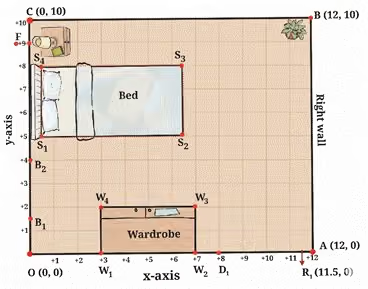
1. If D1R1 represents the door to Reiaan’s room, how far is the door from the left wall (the y-axis) of the room? How far is the door from the x-axis?
Solution: From the figure, D₁ lies on the bottom wall (the x-axis) at x = 8.
So,
Distance of the door from the y-axis (left wall) = 8 ft (the x-coordinate of D₁).
Distance of the door from the x-axis = 0 ft (the door is on the x-axis itself).
2. What are the coordinates of D₁?
Solution: D₁ is on the x-axis, i.e. y = 0. From the figure, its x-coordinate 8.
Thus, D₁ = (8, 0).
3. If R1 is the point (11.5, 0), how wide is the door? Do you think this is a comfortable width for the room door? If a person in a wheelchair wants to enter the room, will he/she be able to do so easily?
Solution: Both D₁ and R₁ lie on the x-axis, so the door width is simply the difference of x-coordinates:
Width of door = (x-coordinate of R₁) – (x-coordinate of D₁) = 11.5 – 8 = 3.5 ft.
A 4 ft wide door is quite comfortable; standard residential doors are usually about 3 ft wide. A wheelchair typically requires a minimum clear width of about 32 inches, though 36 inches is recommended. Since 3.5 ft is well above this, a person in a wheelchair can enter easily.
4. If B1 (0, 1.5) and B2 (0, 4) represent the ends of the bathroom door, is the bathroom door narrower or wider than the room door?
Solution: Both B₁ and B₂ lie on the y-axis (x = 0). The door width is the difference in y-coordinates:
Bathroom door width = 4 – 1.5 = 2.5 ft.
Width of door = (x-coordinate of R₁) – (x-coordinate of D₁) = 11.5 – 8 = 3.5 ft.
The bathroom door (2.5 ft) is narrower than the room door (3.5 ft).
Exercise Set 1.2
On a graph sheet, mark the x-axis and y-axis and the origin O. Mark points from (– 7, 0) to (13, 0) on the x-axis and from (0, – 15) to (0, 12) on the y-axis. (Use the scale 1 cm = 1 unit.) Using Fig. 1.5, answer the given questions.
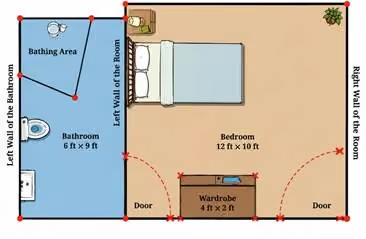
1. Place Reiaan’s rectangular study table with three of its feet at the points (8, 9), (11, 9) and (11, 7). (A) Where will the fourth foot of the table be? (B) Is this a good spot for the table? (C) What is the width of the table? The length? Can you make out the height of the table?
Solution:
(A) The three given feet form three corners of a rectangle. Label them:
P₁ = (8, 9), P₂ = (11, 9), P₃ = (11, 7).
P₁P₂ is horizontal (same y = 9). P₂P₃ is vertical (same x = 11). So, the missing vertex P₄ must be horizontally level with P₃ and vertically level with P₁:
P₄ = (8, 7).
(B) Check that all four feet lie inside the room: all do. The table is placed inside the bedroom, away from the door and clear of the bed. It is positioned near the wall. Hence yes, it is a good spot.
(C) Dimensions:
Length (along x) = 11 – 8 = 3 ft.
Width (along y) = 9 – 7 = 2 ft.
The height of the table CANNOT be read from this floor-plan figure the plan only shows the top-view (the floor). Heights are vertical out of the page and are not captured by a 2-D coordinate plane.
2. If the bathroom door has a hinge at B1 and opens into the bedroom, will it hit the wardrobe? Are there any changes you would suggest if the door is made wider?
Solution:
The bathroom door is B₁B₂ with B₁ = (0, 1.5), B₂ = (0, 4), so the door length = 2.5 ft. It hinges at B₁ and swings into the bedroom (into x > 0).
When fully open (swung 90° into the room), the free end B₂ sweeps to the point (3, 2) i.e., the door becomes horizontal along the line y = 2, stretching from x = 0 to x = 3.
The wardrobe has corners W₁(3, 0), W₂(7, 0), W₃(7, 2), W₄(3, 2). Its nearest edge to the door is x = 3 (the left face of the wardrobe).
Since the door’s swept region reaches only up to x = 2.5 and the wardrobe starts at x = 3, there is a clearance of 0.5 ft. The door just misses the wardrobe.
If the door were made wider (say 3 ft or more), the free end would reach up to x = 3 (or beyond), and it WOULD hit the left face of the wardrobe. Suggestion: if the door is widened, either (a) move the wardrobe further right, or (b) change the hinge position / door-swing direction (e.g., make it open outward, slide sideways, or fold).
3. Look at Reiaan’s bathroom. (A) What are the coordinates of the four corners O, F,R, and P of the bathroom (B) What is the shape of the showering area SHWR in Reiaan’s bathroom? Write the coordinates of the four corners. (C) Mark off a 3 ft × 2 ft space for the washbasin and a 2 ft × 3 ft space for the toilet. Write the coordinates of the corners of these spaces.
Solution:
The bathroom lies to the LEFT of the y-axis in Fig. 1.5, i.e. in the region x < 0. Reading Fig. 1.5 carefully (bathroom is 6 ft wide × 9 ft tall, attached to the left wall of the bedroom):
(A) Bathroom corners:
O = (0, 0) (bottom-right shared with the bedroom’s bottom-left corner)
F = (0, 9) (top-right of bathroom)
R = (–6, 9) (top-left of bathroom)
P = (–6, 0) (bottom-left of bathroom)
(B) The showering area SHWR is a rectangle in the top part of the bathroom. From Fig. 1.5, reading the markings:
S = (–6, 5), H = (–3, 5), W = (–2, 9), R = (–6, 9).
(Going S → H → W → R traces out a rectangle.) So, the shape is a rectangle of size 3 ft × 3 ft (a square).
(C) Washbasin (3 ft × 2 ft) and toilet (2 ft × 3 ft). One reasonable layout uses the lower half of the bathroom:
Washbasin corners: (–6, 0), (–3, 0), (–3, 2), (–6, 2) [3 ft along x, 2 ft along y].
Toilet corners: (–6, 2), (–4, 2), (–4, 5), (–6, 5) [2 ft along x, 3 ft along y].
(Other reasonable placements are acceptable as long as the objects fit inside the bathroom and do not overlap each other or the showering area.)
4. Other rooms in the house: (A) Reiaan’s room door leads from the dining room which has the length 18 ft and width 15 ft. The length of the dining room extends from point P to point A. Sketch the dining room and mark the coordinates of its corners. (B) Place a rectangular 5 ft × 3 ft dining table precisely in the centre of the dining room. Write down the coordinates of the feet of the table.
Solution:
(A) P and A are points of the existing plan. From Fig. 1.5, P = (–6, 0) (bottom-left of the bathroom) and A = (12, 0) (bottom-right of the bedroom).
Check: length PA = 12 – (–6) = 18 ft (matches the stated length).
The dining room is on the OUTSIDE of the bedroom/bathroom along the bottom wall i.e., in the region y ≤ 0. Its length (18 ft) is along the x-axis (from x = –6 to x = 12) and its width is 15 ft, so it extends 15 ft downward (y goes from 0 down to –15).
Four corners of the dining room:
P = (–6, 0), A = (12, 0), A′ = (12, –15), P′ = (–6, –15).
(B) The centre of this rectangle is the midpoint of its diagonal:
Centre = ((–6 + 12)/2, (0 + (–15))/2) = (3, –7.5).
Place a 5 ft × 3 ft table with its centre at (3, –7.5). Take the 5 ft side along the x-axis and the 3 ft side along the y-axis. Then the four feet are at:
(3 – 2.5, –7.5 – 1.5) = (0.5, –9)
(3 + 2.5, –7.5 – 1.5) = (5.5, –9)
(3 + 2.5, –7.5 + 1.5) = (5.5, –6)
(3 – 2.5, –7.5 + 1.5) = (0.5, –6)
Hence, (A) Dining room corners: P(–6, 0), A(12, 0), (12, –15), (–6, –15). (B) Table feet: (0.5, –9), (5.5, –9), (5.5, –6), (0.5, –6).
End-of-Chapter Exercises
1. What are the x-coordinate and y-coordinate of the point of intersection of the two axes?
Solution:
The two axes are the x-axis and y-axis, and they intersect at the origin. So, the coordinates are (0, 0).
2. Point W has x-coordinate equal to – 5. Can you predict the coordinates of point H which is on the line through W parallel to the y-axis? Which quadrants can H lie in?
Solution:
Any line parallel to the y-axis is vertical, so every point on it has the same x-coordinate. Hence every point on this line has x = –5. The y-coordinate can be any real number.
H = (–5, y), where y be any real number.
Since x = –5 < 0:
If y > 0, H is in Quadrant II.
If y < 0, H is in Quadrant III.
If y = 0, H lies on the x-axis.
3. Consider the points R (3, 0), A (0, – 2), M (– 5, – 2) and P (– 5, 2). If they are joined in the same order, predict: (A) Two sides of RAMP that are perpendicular to each other. (B) One side of RAMP that is parallel to one of the axes. (C) Two points that are mirror images of each other in one axis. Which axis will this be? Now plot the points and verify your predictions.
Solution:
On plotting the points in the Cartesian plane:
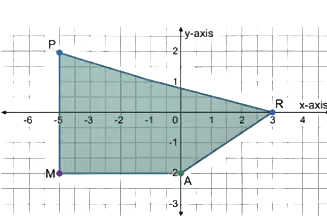
(A) A horizontal line and a vertical line are perpendicular. So, AM ⟂ MP.
(B) AM has slope 0, so AM is parallel to the x-axis. Also, MP is parallel to the y-axis.
(C) M(–5, –2) and P(–5, 2) has same x-coordinate and opposite y-coordinates. They are mirror images in the
x-axis.
4. Plot point Z (5, – 6) on the Cartesian plane. Construct a right-angled triangle IZN and find the lengths of the three sides. (Comment: Answers may differ from person to person.)
Solution:
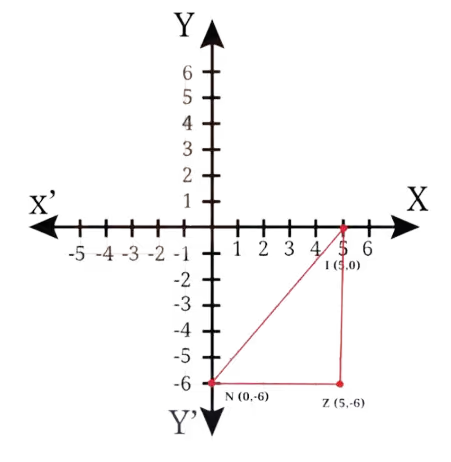
Z is in Quadrant IV. Construct a triangle with Z as one vertex and the right angle at Z, with legs parallel to the axes, this makes the calculations easy.
Sample construction:
Z = (5, –6)
I = (5, 0) (directly above Z)
N = (0, –6) (directly right of Z)
Angle at Z is between IZ (vertical) and ZN (horizontal), so it is 90°.
Side lengths:
IZ = |(0) – (–6)| = 6 units
ZN = |5 – 0| = 5 units
IN (hypotenuse) = √(5² + 6²) = √(25 + 36) = √61 units.
5. What would a system of coordinates be like if we did not have negative numbers? Would this system allow us to locate all the points on a 2-D plane?
Solution:
Without negative numbers, we can only measure distances to the RIGHT of the origin (along the positive x-axis) and upward (along the positive y-axis). The coordinate axes would consist only of rays starting at O, not complete lines.
This restricts us to the first quadrant alone, points with x ≥ 0 and y ≥ 0. Points to the left of the y-axis (second and third quadrants) and points below the x-axis (third and fourth quadrants) could not be described.
So, no; without negative numbers we cannot locate ALL points of the plane; only one-fourth of it (Quadrant I, together with the positive halves of the axes and the origin).
6. Are the points M (– 3, – 4), A (0, 0) and G (6, 8) on the same straight line? Suggest a method to check this without plotting and joining the points.
Solution: Given, points M (– 3, – 4), A (0, 0) and G (6, 8).
To check collinearity, we use the distance formula and verify:
MA + AG = MG
By distance formula, we have
D=√(x2−x1)2+(y2−y1)2
MA = √(0−(−3))2 + (0−(−4))2 = √(32 + 42) = √(9 + 16) = √25 =5
AG = √((6−0)2 + (8−0)2) = √(36 + 64) =√100 = 10
MG = √ (6−(−3))2 + (8−(−4))2 = √(92 + 122) = √(81 + 144) = √225 = 15
Now, MA + AG = 5 + 10 = 15 = MG
Hence, the three points are collinear.
7. Use your method (from Problem 6) to check if the points R (– 5, – 1), B (– 2, – 5) and C (4, – 12) are on the same straight line. Now plot both sets of points and check your answers.
Solution:
Verification via distances:
RB = √[(–2 + 5)² + (–5 + 1)²] = √(3² + (–4)²) = √25 = 5.
BC = √[(4 + 2)² + (–12 + 5)²] = √(6² + (–7)²) = √85 ≈ 9.22.
RC = √[(4 + 5)² + (–12 + 1)²] = √(9² + (–11)²) = √202 ≈ 14.21.
If collinear we would need RB + BC = RC exactly. But 5 + √85 ≠ √202. Hence not collinear.
8. Using the origin as one vertex, plot the vertices of: (A) A right-angled isosceles triangle. (B) An isosceles triangle with one vertex in Quadrant III and the other in Quadrant IV.
Solution:
(A) A right-angled isosceles triangle with right angle at O and the two equal legs along the axes works well. Sample:
O = (0, 0), A = (4, 0) on the x-axis, B = (0, 4) on the y-axis.
OA = OB = 4 units (the two equal legs). Angle AOB = 90° (angle between the axes). Hypotenuse AB = √(16+16) = 4√2. So, ΔOAB is right-angled and isosceles.
(B) Want an isosceles triangle with O as one vertex, one vertex in Quadrant III (x<0, y<0) and another in Quadrant IV (x>0, y<0). Pick two points symmetric in the y-axis so that their distances from O are equal. Sample:
O = (0, 0), P = (–3, –4) in Q-III, Q = (3, –4) in Q-IV.
OP = √(9+16) = 5, OQ = √(9+16) = 5. So, OP = OQ, the triangle OPQ is isosceles.
9. The following table shows the coordinates of points S, M and T. In each case, state whether M is the midpoint of segment ST. Justify your answer.
When M is the mid-point of ST, can you find any connection between the coordinates of M, S and T?
Solution:
Rule: M is the midpoint of ST iff M = ((Sx + Tx)/2, (Sy + Ty)/2).
Connection (the MIDPOINT FORMULA): If M is the midpoint of segment ST, then
Mx = (Sx + Tx) / 2 and My = (Sy + Ty) / 2.
Equivalently: the coordinates of the midpoint are the AVERAGES of the coordinates of the two endpoints.
10. Use the connection you found to find the coordinates of B given that M (–7, 1) is the midpoint of A (3, – 4) and B (x, y).
Solution:
Apply M = ((Ax + Bx)/2, (Ay + By)/2).
(–7, 1) = ((3 + x)/2, (–4 + y)/2)
Equate the two coordinates separately.
(3 + x)/2 = –7 ⇒ 3 + x = –14 ⇒ x = –17.
(–4 + y)/2 = 1 ⇒ –4 + y = 2 ⇒ y = 6.
Check: midpoint of A(3,–4) and B(–17,6) = ((3–17)/2, (–4+6)/2) = (–7, 1).
11. Let P, Q be points of trisection of AB, with P closer to A, and Q closer to B. Using your knowledge of how to find the coordinates of the midpoint of a segment, how would you find the coordinates of P and Q? Do this for the case when the points are A (4, 7) and B (16, –2).
Solution:
P divides AB in the ratio 1 : 2 (AP : PB = 1 : 2). Equivalently, P is obtained by moving from A one-third of the way to B:
P = A + (1/3)(B – A)
Write B – A = (16 – 4, –2 – 7) = (12, –9). Then
P = (4 + (1/3)(12), 7 + (1/3)(–9)) = (4 + 4, 7 – 3) = (8, 4).
Similarly, Q divides AB in the ratio 2 : 1 (AQ : QB = 2 : 1). Move from A two-thirds of the way to B:
Q = A + (2/3)(B – A) = (4 + (2/3)(12), 7 + (2/3)(–9)) = (4 + 8, 7 – 6) = (12, 1).
Midpoint-based verification (connecting with the previous problem):
Midpoint of PQ = ((8+12)/2, (4+1)/2) = (10, 2.5).
Midpoint of AB = ((4+16)/2, (7+(–2))/2) = (10, 2.5).
These agree consistent with P, Q being equally spaced about the midpoint.
Length verification:
AP² = (8–4)² + (4–7)² = 16 + 9 = 25, so AP = 5.
PQ² = (12–8)² + (1–4)² = 16 + 9 = 25, so PQ = 5.
QB² = (16–12)² + (–2–1)² = 16 + 9 = 25, so QB = 5.
AP = PQ = QB, confirming the trisection.
12. (A) Given the points A (1, – 8), B (– 4, 7) and C (–7, – 4), show that they lie on a circle K whose center is the origin O (0, 0). What is the radius of circle K?
(B) Given the points D (–5, 6) and E (0, 9), check whether D and E lie within the circle, on the circle, or outside the circle K.
Solution:
A point lies on a circle with centre O and radius r iff its distance from O equals r.
Use OP = √(x² + y²)
(A) Compute OA, OB, OC.
OA = √(1² + (–8)²) = √(1 + 64) = √65.
OB = √((–4)² + 7²) = √(16 + 49) = √65.
OC = √((–7)² + (–4)²) = √(49 + 16) = √65.
All three distances are equal, so A, B, C lie on a circle centred at O with radius √65 units (≈ 8.06).
(B) Check D and E against √65.
OD = √((–5)² + 6²) = √(25 + 36) = √61. Since √61 < √65, D lies INSIDE K.
OE = √(0² + 9²) = √81 = 9. Since √81 > √65 (because 81 > 65), E lies OUTSIDE K.
13. A city has two main roads which cross each other at the centre of the city. These two roads are along the North–South (N–S) direction and East–West (E–W) direction. All the other streets of the city run parallel to these roads and are 200 m apart. There are 10 streets in each direction.
(A) Using 1 cm = 200 m, draw a model of the city in your notebook. Represent the roads/streets by single lines.
(B) There are street intersections in the model. Each street intersection is formed by two streets — one running in the N–S direction and another in the E–W direction. Each street intersection is referred to in the following manner: If the second street running in the N–S direction and 5th street in the E–W direction meet at some crossing, then we call this street intersection (2, 5). Using this convention, find:
(a) how many street intersections can be referred to as (4, 3).
(b) how many street intersections can be referred to as (3, 4).
Solution: (A)
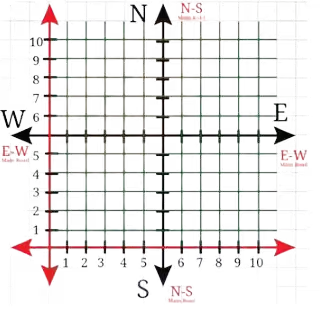
(B) The labelling fixes both the NS street (first coordinate) and the EW street (second coordinate). A single pair of perpendicular streets meet at exactly one point.
(a) ‘(4, 3)’ means the 4th NS street and the 3rd EW street, this is a unique point. So, there is EXACTLY ONE such intersection.
(b) ‘(3, 4)’ means the 3rd NS street and the 4th EW street, again a unique point. Exactly ONE such intersection.
Note: (4, 3) and (3, 4) are different intersections. This is exactly the same idea as ordered pairs (x, y) in the Cartesian plane: (x, y) ≠ (y, x) unless x = y.
14. A computer graphics program displays images on a rectangular screen whose coordinate system has the origin at the bottom-left corner. The screen is 800 pixels wide and 600 pixels high. A circular icon of radius 80 pixels is drawn with its centre at the point A (100, 150). Another circular icon of radius 100 pixels is drawn with its centre at the point B (250, 230). Determine:
(A) whether any part of either circle lies outside the screen.
(B) whether the two circles intersect each other.
Solution:
The visible screen is the rectangle 0 ≤ x ≤ 800, 0 ≤ y ≤ 600.
(A) A circle lies entirely on the screen if its centre is at least r pixels from every edge.
Circle 1: centre A(100, 150), r = 80.
Distance from left edge (x = 0): 100 ≥ 80
Distance from right edge (x = 800): 700 ≥ 80
Distance from bottom edge (y = 0): 150 ≥ 80
Distance from top edge (y = 600): 450 ≥ 80
So, Circle 1 is fully inside the screen.
Circle 2: centre B(250, 230), r = 100.
From left: 250 ≥ 100
From right: 550 ≥ 100
From bottom: 230 ≥ 100
From top: 370 ≥ 100
So, Circle 2 is also fully inside the screen. Hence, neither circle has any part outside the screen.
(B) Two circles intersect if the distance between their centres satisfies |r₁ – r₂| ≤ d ≤ r₁ + r₂.
AB = √((250–100)² + (230–150)²) = √(150² + 80²) = √(22500 + 6400) = √28900 = 170 pixels.
r₁ + r₂ = 80 + 100 = 180.
|r₁ – r₂| = |80 – 100| = 20.
Since
20 < 170 < 180
, the distance between centres lies between the difference and sum of radii, so the circles intersect at two points.
15. Plot the points A (2, 1), B (–1, 2), C (–2, –1), and D (1, –2) in the coordinate plane. Is ABCD a square? Can you explain why? What is the area of this square?
Solution:
Plotting of points A (2, 1), B (–1, 2), C (–2, –1), and D (1, –2) in the coordinate plane is given as:
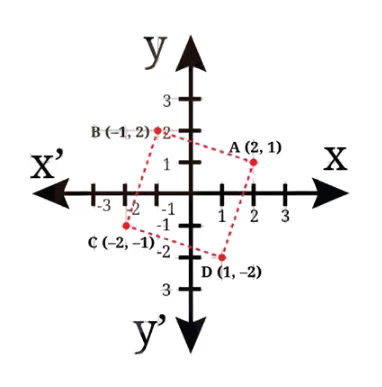
A square is a quadrilateral whose four sides are equal AND whose adjacent sides are perpendicular.
Compute the four side lengths,
AB = √((–1–2)² + (2–1)²) = √(9 + 1) = √10.
BC = √((–2–(–1))² + (–1–2)²) = √(1 + 9) = √10.
CD = √((1–(–2))² + (–2–(–1))²) = √(9 + 1) = √10.
DA = √((2–1)² + (1–(–2))²) = √(1 + 9) = √10.
All four sides equal √10, so ABCD is at least a rhombus.
AC = √((–2–2)² + (–1–1)²) = √(16 + 4) = √20.
BD = √((1–(–1))² + (–2–2)²) = √(4 + 16) = √20.
Since, all sides and diagonals are equal, therefore, it is a square.
Area of square = (side)² = (√10)² = 10 sq. units.
Topics Covered in NCERT Solution Class 9 Maths Chapter 1
1. The Cartesian Coordinate System
The chapter begins with the coordinate plane as a system for finding points with two mutually perpendicular axes. Students become familiar with the x-axis (horizontal), y-axis (vertical), point of origin (where the two axes meet), and the four quadrants that divide the plane.
2. Ordered Pairs and Coordinates
An ordered pair (x, y) will be used to represent a point. The first coordinate tells about the horizontal position of the point, and the second coordinate tells about the vertical position of the point. The chapter also emphasises the importance of the order of the coordinates.
3. Plot points on the coordinate plane
Pupils practise finding points in various quadrants with positive and negative co-ordinates. They also learn how to identify points on the axes and how to understand the special coordinate form of these points.
4. Distance between points
The chapter links horizontal movement to vertical movement through Baudhāyana–Pythagoras Theorem to calculate the distance between two points. This is important for students to learn about the distance formula in a geometric way.
5. Reflection in the Coordinate Plane
In this chapter, students will learn the changes in the position of points or figures through reflection. A reflection across the y-axis will change the sign of the x coordinate, while a reflection across the x-axis will change the sign of the y coordinate.
6. Collinearity and geometric figures
By using the relationship between distance and coordinates, students can determine whether the points are located on the same straight line. Coordinates can also be applied to recognize and verify shapes, such as triangles and squares.
7. Finding the midpoint of a line
Students investigate the relationship between the coordinates of the midpoint and the coordinates of both endpoints of the line segment. This concept is used for coordinate-based problems involving geometric figures and points in the coordinate system.
Key Formulas: Class 9 Maths Ganita Manjari Ch 1
Below are the key formulas and concepts given to help you quickly revise the important ideas from NCERT Solutions Class 9 Maths Ganita Manjari Chapter 1.
1. Coordinates of a point on the y-axis
Every point on the y-axis is: (0, y)
2. Coordinates of a point on the x-axis
Every point on the x-axis is: (x, 0)
3. Distance between two points
For (A(x_1, y_1)) and (B(x_2, y_2)):
AB = √[(x₂ − x₁)² + (y₂ − y₁)²]
It is obtained by the Baudhāyana–Pythagoras Theorem.
4. Find the midpoint of a line segment
If a point (M) is the midpoint of (ST), then
(S(x1, y1)) and (T(x2, y2)), then:
M = ((x1 + x2)/2, ((y1 + y2)/2)
5. Reflection
Reflection in the y-axis: ((x, y) → (−x, y))
Reflection in the x-axis: ((x, y) → (x, −y))
6. Ordered pairs
The order of coordinates is important:
(x, y) ≠ (y, x) unless x = y.
7. Circle with centre at the origin
The distance of the point (x, y) from the origin is:
√(x² + y²)
A point lies on a circle of radius (r) centred at the origin when its distance from the origin is equal to (r).
All the uploaded solutions substantially apply these formulas to questions about points on axes, distance, reflection, midpoint, circles, collinearity, and geometric figures involving points on the coordinate plane.
Things to Remember When Solving Cordinate Questions
- Understand the order of coordinates: In an ordered pair (x, y), x represents the x-coordinate and y represents the y-coordinate.
- Practice signs and quadrants: A frequent mistake is to mix up the signs of coordinates in the quadrants.
- Elaborate method in distance and midpoint questions: In a distance and midpoint problem, write the formula or coordinate relationship before substituting values.
- Explain answers using diagrams where required: A graph with the appropriate labels can clarify reasoning in situations such as plotting and reflection problems and coordinate geometry problems.
- Use additional resources for more practice: Along with studying the NCERT Class 9 Maths textbook, practising questions from a Class 9 Maths Question Bank can add another layer to your preparation.
FAQs on NCERT Solutions Class 9 Maths Chapter 1
1. What’s included in Class 9 Maths Chapter 1 NCERT Solutions 2026-27?
Class 9 Maths Chapter 1 Orienting Yourself: The Use of Coordinates introduces the coordinate plane and how coordinates can be used to find points and describe positions. It includes topics of axes, origin, quadrants, ordered pairs, plotting points, distance, midpoint, reflection, real-life applications of coordinates, and collinearity.
2. What are the main concepts of Chapter 1 of NCERT class 9 Maths?
The main concepts are the Cartesian coordinate system, ordered pairs, plotting points, points on the axes, quadrants, distance between points, midpoint of a line segment, reflection, collinearity, and coordinates to study geometric figures with the origin at their centre.
3. What is the distance formula in NCERT class 9th maths chapter 1?
The distance between two points (A(x₁, y₁)) and (B(x₂, y₂)) is:
AB = √[(x₂ − x₁)² + (y₂ − y₁)²]
It is derived from the Baudhāyana–Pythagoras Theorem, and it will be used in several coordinate-based problems of the chapter.
4. What are the quadrants of a point?
Check the signs of the x and y coordinates of a line to know the quadrant of a point:
- Quadrant I: (+, +)
- Quadrant II: (−, +)
- Quadrant III: (−, −)
- Quadrant IV: (+, −)
For instance, the point (5, −3) lies in Quadrant IV as its x-coordinate is positive and its y-coordinate is negative.
5. How do I download NCERT Solutions for Class 9 Maths Chapter 1 PDF 2026-27 for free?
The Educart NCERT Solutions for Class 9 Maths Chapter 1 Orienting Yourself: The Use of Coordinates PDF download links are present on this page. The chapter-wise solution PDF helps you verify your answers, understand how to solve the questions and edit the chapter accordingly from the new Class 9 Ganita Manjari Mathematics NCERT Textbook for 2026–27.
6. Can I use these NCERT Solutions for school exam preparation in class 9th?
Yes. Educart designs its NCERT Solutions with detailed answers for each question given in the chapter, with quick additional resources for best preparation. The student can try to solve the problems in the book on their own and then verify their approach by referring to the solutions, correct incorrect answers, and comprehend difficult concepts.












.svg)

