The NEET syllabus 2026 PDF is released by National Medical Commission (NMC) and the exam is conducted by NTA. NEET exam includes 3 main subjects - Physics, Chemistry and Biology. The NEET syllabus Chapter wise is based on NCERT Class 11 syllabus and Class 12 syllabus totally.
The official NEET syllabus 2026 PDF was released on 22nd December, 2025. Although, there is not much change from previous years but some topics have been deleted which makes it important for aspirants to go through the detailed NEET syllabus 2026 PDF once.
Download NEET UG Syllabus 2026 Subject-wise
The official NEET syllabus 2026 PDF was released on 22nd December, 2025. Download NEET UG 2026 Syllabus directly from below:
NEET Syllabus 2026 PDF (Official)
Also, you can check subject-wise syllabus from the links given below:
Key Highlights of NEET UG 2026 Syllabus
The important details about NEET Syllabus 2026 are as follows:
| Detail |
Information |
| Prescribed by |
National Medical Commission (NMC) |
| Conducted by |
National Testing Agency (NTA) |
| Subjects |
Physics, Chemistry, Biology (Botany + Zoology) |
| Based on |
NCERT Class 11 and Class 12 |
| Total Chapters |
Approximately 79 |
| Syllabus PDF Released |
22nd December 2025 |
| Expected Exam Date |
3rd May 2026 |
| Total Marks |
720 |
Subjects Included in NEET UG 2026 Syllabus
The NEET UG 2026 syllabus is divided into three subjects:
| Subject |
Sections |
Questions |
Marks |
| NEET Physics syllabus 2026 |
Class 11 + Class 12 |
45 |
180 |
| NEET Chemistry syllabus 2026 |
Physical, Organic, Inorganic
(Class 11 + 12) |
45 |
180 |
| NEET Biology syllabus 2026 |
Botany (Class 11 + 12) + Zoology (Class 11 + 12) |
90 |
360 |
| Total |
180 (out of 200) |
720 |
In summary, total questions in the paper are 200, out of which 180 must be attempted by the students.
NEET Deleted Syllabus
This is the most important part of the NEET syllabus Chapter wise. The following topics were removed officially from the NEET syllabus in 2023 and remain absent in 2026 too:
| Subject |
Class |
NEET Deleted Syllabus |
| Physics |
Class 11 |
Scalar and vector quantities (detailed treatment under Kinematics),
Lubrication (under Laws of Motion), Poisson's ratio,
Reynolds number (under Properties of Solids) |
| Class 12 |
Errors in measurement using significant figures -
detailed treatment removed from Physics and Measurement |
| Chemistry |
Class 11 |
States of Matter (full chapter removed), Hydrogen (full chapter removed),
s-Block Elements, Environmental Chemistry |
| Class 12 |
Solid State, Surface Chemistry, General Principles of
Metallurgy, Polymers, Chemistry in Everyday Life |
| Biology |
Class 11 |
Taxonomic aids (detailed), Secondary growth in angiosperms,
Detailed transport in plants, Vernalisation and seed dormancy,
Digestion and Absorption (detailed sub-topics), Sense organs |
| Class 12 |
Reproduction in Organisms (Chapter 1), Strategies for Enhancement
in Food Production, Environmental Issues, Ecological Succession |
Important: Some chapters might be partially deleted - meaning only sub-topics are removed. Always cross-check with the official NEET 2026 syllabus pdf by NTA.
NEET Physics Syllabus 2026
Physics is the most challenging part of the NEET syllabus for students and hence detailed NEET Physics syllabus Chapter wise analysis is given below for better understanding:
a) Class 11 Physics Topics
These topics given below from NCERT Class 11 Physics form an important part of the NEET UG 2026 Syllabus.
| Unit |
Topics Covered |
| Unit 1 - Physical World and Measurement |
Physics scope and excitement, nature of physical laws, SI units,
fundamental and derived units, dimensional analysis, significant figures,
errors in measurement |
| Unit 2 - Kinematics |
Frame of reference, motion in a straight line, position-time graph,
speed and velocity, uniform and non-uniform motion, equations of motion,
projectile motion, uniform circular motion |
| Unit 3 - Laws of Motion |
Newton's three laws, impulse and momentum, conservation of linear momentum,
static and kinetic friction, dynamics of circular motion, banking of roads |
| Unit 4 - Work, Energy and Power |
Work done by constant and variable forces, kinetic and potential energy,
work-energy theorem, conservation of mechanical energy, power, elastic
and inelastic collisions |
| Unit 5 - Motion of System of Particles and Rigid Body |
Centre of mass, torque, angular momentum, moment of inertia,
theorems of parallel and perpendicular axes, rolling motion |
| Unit 6 - Gravitation |
Universal law of gravitation, Kepler's laws, gravitational potential energy,
escape velocity, orbital velocity, geostationary satellites |
| Unit 7 - Properties of Bulk Matter |
Hooke's law, stress-strain curve, Pascal's law, viscosity, Stokes' law,
Bernoulli's principle, surface tension, capillarity, thermal expansion, calorimetry,
heat transfer |
| Unit 8 - Thermodynamics |
Thermal equilibrium, zeroth law, first law of thermodynamics,
isothermal and adiabatic processes, second law, Carnot engine |
| Unit 9 - Kinetic Theory of Gases |
Ideal gas equation, assumptions of kinetic theory, RMS speed,
degrees of freedom, law of equipartition of energy, mean free path |
| Unit 10 - Oscillations and Waves |
SHM, energy in SHM, damped oscillations, resonance,
longitudinal and transverse waves, Doppler effect |
b) Class 12 Physics Topics
Given below are topics from NCERT Class 12 Physics that plays an important part of the NEET Physics syllabus 2026.
| Unit |
Topics Covered |
| Unit 11 - Electrostatics |
Coulomb's law, electric field and potential, electric dipole,
Gauss's law, capacitors, dielectrics, energy stored in capacitors |
| Unit 12 - Current Electricity |
Electric current, Ohm's law, resistivity, Kirchhoff's laws, Wheatstone
bridge, potentiometer, meter bridge |
| Unit 13 - Magnetic Effects of Current and Magnetism |
Biot-Savart law, Ampere's law, force on a moving charge, cyclotron,
moving coil galvanometer, bar magnet, paramagnetism, diamagnetism,
ferromagnetism |
| Unit 14 - Electromagnetic Induction and Alternating Currents |
Faraday's laws, Lenz's law, eddy currents, self and mutual inductance,
AC circuits, LCR series circuit, resonance, transformer |
| Unit 15 - Electromagnetic Waves |
Displacement current, EM spectrum - radio waves, microwaves, infrared,
UV, X-rays, gamma rays |
| Unit 16 - Optics |
Reflection and refraction, mirror and lens formulas, total internal reflection,
optical instruments, Young's double slit experiment, diffraction, polarisation |
| Unit 17 - Dual Nature of Radiation and Matter |
Photoelectric effect, Einstein's photoelectric equation, wave-particle duality, \
de Broglie wavelength |
| Unit 18 - Atoms and Nuclei |
Rutherford model, Bohr model, hydrogen spectrum, radioactivity, nuclear fission
and fusion, mass-energy relation |
| Unit 19 - Electronic Devices |
Semiconductors, p-n junction diode, Zener diode, LED, photodiode, transistor,
logic gates |
Topics like Current Electricity, Optics, Magnetism, and Semiconductor Electronics are high-scoring in NEET Physics and should be prioritized.
NEET Chemistry Syllabus 2026
Chemistry in NTA NEET syllabus 2026 is about 3 sections - Physical Chemistry, Organic Chemistry, and Inorganic Chemistry. Organic Chemistry has the highest weightage.
a) Physical Chemistry
Physical Chemistry has most appearing questions in NEET MCQs section.
| Class |
Topics Covered |
| Class 11 |
Some Basic Concepts of Chemistry (Mole Concept, Stoichiometry),
Structure of Atom (Bohr model, quantum numbers, orbital shapes, electronic configuration),
Thermodynamics (enthalpy, entropy, Gibbs free energy, Hess's law), Equilibrium (chemical
and ionic, Le Chatelier's principle, buffer solutions, Ksp), Redox Reactions |
| Class 12 |
Solutions (Raoult's law, colligative properties, osmotic pressure), Electrochemistry
(Nernst equation, electrolytic cells, batteries, corrosion), Chemical Kinetics (rate of reaction,
order and molecularity, Arrhenius equation) |
b) Organic Chemistry
Organic Chemistry has the highest weighted topics for NEET UG exam in the Chemistry NEET exam syllabus.
| Class |
Topics Covered |
| Class 11 |
Purification and Characterisation of Organic Compounds,
Some Basic Principles of Organic Chemistry (hybridisation, inductive effect,
resonance, isomerism, IUPAC nomenclature), Hydrocarbons (alkanes, alkenes,
alkynes, aromatic hydrocarbons, electrophilic substitution) |
| Class 12 |
Haloalkanes and Haloarenes, Alcohols, Phenols and Ethers, Aldehydes,
Ketones and Carboxylic Acids, Organic Compounds Containing Nitrogen
(amines, diazonium salts), Biomolecules (carbohydrates, proteins, vitamins, nucleic acids) |
c) Inorganic Chemistry
Inorganic Chemistry is important and gives a conceptual clarity about the entire chemistry syllabus for NEET.
| Class |
Topics Covered |
| Class 11 |
Classification of Elements and Periodicity in Properties,
Chemical Bonding and Molecular Structure (Lewis structures,
VSEPR, hybridisation, MO theory, hydrogen bonding), Some
p-Block Elements (Group 13 and 14) |
| Class 12 |
p-Block Elements (Group 15, 16, 17, 18), d- and f-Block
Elements (transition metals, KMnO4 and K2Cr2O7), Coordination
Compounds (IUPAC nomenclature, Werner's theory, isomerism,
crystal field theory) |
Important topics include Organic reaction mechanisms, Chemical Bonding, Coordination Compounds, and Electrochemistry. Organic Chemistry alone accounts for approximately 34 to 36 percent of Chemistry questions in NEET.
NEET Biology Syllabus 2026
Biology is the most important subject out of the 3, as it contributes 360 marks out of 720. The NEET Bio syllabus splits into Botany and Zoology branches and NCERT Syllabus is non-negotiable as many questions are taken directly from NCERT Textbooks.
a) Class 11 Biology Topics
The topics included from the class 11 in NEET Biology syllabus 2026 are given below:
| Unit |
Topics Covered |
| Unit 1 - Diversity of Living Organisms |
What is living, biodiversity, classification systems, five kingdom classification,
salient features of Monera, Protista, Fungi, Plantae, Animalia, plant and animal kingdom |
| Unit 2 - Structural Organisation in Plants and Animals |
Morphology of flowering plants, anatomy of flowering plants, structural organisation in
animals, cockroach morphology |
| Unit 3 - Cell Structure and Function |
Cell theory, prokaryotic and eukaryotic cells, cell organelles and their functions,
cell division (mitosis and meiosis), cell cycle |
| Unit 4 - Plant Physiology |
Photosynthesis in higher plants (light and dark reactions, C3 and C4 plants, photorespiration),
respiration in plants (glycolysis, Krebs cycle, ETC), plant growth and development |
| Unit 5 - Human Physiology |
Digestion and absorption, breathing and exchange of gases, body fluids and circulation, excretory products
and their elimination, locomotion and movement, neural control and coordination, chemical
coordination and integration |
b) Class 12 Biology Topics
Genetics, Human Physiology, Cell Biology, and Ecology together account for nearly 65 percent of questions in NEET based on recent PYQ analysis. The topics from the class 12 biology in NEET Biology syllabus 2026 are given below:
| Unit |
Topics Covered |
| Unit 6 - Reproduction |
Sexual reproduction in flowering plants, human reproduction, reproductive health |
| Unit 7 - Genetics and Evolution |
Principles of inheritance and variation (Mendel's laws, chromosomal theory, linkage),
molecular basis of inheritance (DNA structure, replication, transcription, translation, gene
regulation), evolution (Darwin's theory, Hardy-Weinberg principle, human evolution) |
| Unit 8 - Biology and Human Welfare |
Human health and disease (pathogens, immunity, AIDS, cancer), microbes in human welfare,
drugs and alcohol abuse |
| Unit 9 - Biotechnology and its Applications |
Principles and processes of biotechnology (recombinant DNA technology, cloning vectors,
PCR), applications (Bt crops, gene therapy, molecular diagnostics, transgenic animals) |
| Unit 10 - Ecology and Environment |
Organisms and populations, ecosystems (energy flow, nutrient cycling, ecological pyramids),
biodiversity and conservation |
NEET 2026 Chapter-wise Weightage
Chapter-wise weightage data helps you understand the topics that yo should prioritize for your preparations. The data below is based on analysis of NEET question papers from 2021 to 2025.
a) Physics Chapter-wise Weightage
Physics last 5 years paper analysis for NEET Physics syllabus 2026:
| Chapter |
5-Year Questions (2021–25) |
Weightage Tier |
| Current Electricity |
22 |
High |
| Electrostatic Potential and Capacitance |
16 |
High |
| Semiconductor Electronics |
15 |
High |
| Ray Optics and Optical Instruments |
14 |
High |
| Units and Measurements |
14 |
High |
| Moving Charges and Magnetism |
13 |
High |
| Rotational Motion |
10 |
Medium |
| Gravitation |
10 |
Medium |
| Thermodynamics |
9 |
Medium |
| Waves |
8 |
Medium |
| Laws of Motion |
7 |
Low |
| Dual Nature of Radiation and Matter |
7 |
Low |
b) Chemistry Chapter-wise Weightage
Chemistry last 5 years paper analysis for NEET 2026 syllabus:
| Chapter |
5-Year Questions (2021–25) |
Weightage Tier |
| Aldehydes, Ketones and Carboxylic Acids |
19 |
High |
| Some Basic Principles of Organic Chemistry |
14 |
High |
| Hydrocarbons |
13 |
High |
| Chemical Bonding and Molecular Structure |
13 |
High |
| Coordination Compounds |
13 |
High |
| Chemical Equilibrium |
12 |
High |
| Chemical Kinetics |
12 |
High |
| d- and f-Block Elements |
12 |
High |
| Haloalkanes and Haloarenes |
10 |
Medium |
| Electrochemistry |
9 |
Medium |
| Atomic Structure |
8 |
Medium |
| Solutions |
8 |
Medium |
c) Biology Chapter-wise Weightage
Biology last 5 years paper analysis for NEET 2026 syllabus:
| Chapter |
5-Year Questions (2021–25) |
Weightage Tier |
| Molecular Basis of Inheritance |
35 |
High |
| Biotechnology: Principles and Processes |
32 |
High |
| Animal Kingdom |
26 |
High |
| Biomolecules |
25 |
High |
| Structural Organisation in Animals |
24 |
High |
| Principles of Inheritance and Variation |
22 |
High |
| Human Reproduction |
21 |
High |
| Biotechnology and its Applications |
20 |
High |
| Cell Cycle and Cell Division |
20 |
High |
| Human Health and Disease |
17 |
High |
| Plant Kingdom |
17 |
High |
| Sexual Reproduction in Flowering Plants |
15 |
Medium |
| Cell: The Unit of Life |
14 |
Medium |
| Plant Growth and Development |
14 |
Medium |
NEET UG 2026 Exam Pattern
NEET UG 2026 is conducted in offline pen-and-paper mode. The exam is 3 hours and 20 minutes long and tests knowledge from Physics, Chemistry, Botany, and Zoology as separate sections.
a) Marking Scheme
- Correct Answer: Four marks are awarded for every correct answer.
- Wrong Answer: One mark is deducted for each incorrect answer.
- Unattempted Question: No marks are awarded or deducted for questions that are not attempted.
b) Subject-wise Questions and Marks Distribution
| Subject |
Section A (Compulsory) |
Section B (Attempt any 10 of 15) |
Total Questions |
Total Marks |
| Physics |
35 |
15 |
50 |
180 |
| Chemistry |
35 |
15 |
50 |
180 |
| Botany |
35 |
15 |
50 |
180 |
| Zoology |
35 |
15 |
50 |
180 |
| Total |
140 |
60 |
200 (attempt 180) |
720 |
How to Use NEET 2026 Syllabus for Preparation?
A clear understanding of the NEET syllabus 2026 is important for further planning your preparation strategy in a proper way.
- Know the official syllabus: visit the official NTA site, download the NEET Syllabus 2026 and go through the updated topics and removed topics.
- Prioritize subjects: Biology carries the highest weightage. Make sure you cover it chapter-wise from NCERT thoroughly. After that, Chemistry and then Physics should be the line.
- Use NCERT as the primary source, as nothing is more important than questions being directly asked from the NCERT book itself.
- Practice ch-wise questions after completing each chapter. Solving previous year questions for NEET is a great way to get started.
- Focus on topics that carry the highest marks and those that appear most in previous year papers. Revise them multiple times.
NEET 2026 Preparation Resources
For better preparation, use these resources alongside:
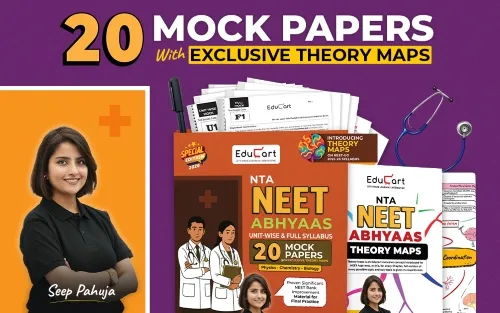
Also, to strengthen biology, many toppers recommend Seep Pahuja's NEET Biology Notes and video lectures, as they simplify even the toughest chapters.
Best Books for NEET 2026 Preparation
Educart's NEET preparation books are specially designed keeping every small and important detail in mind for aspirants like you!
It becomes easier to approach the NEET exam syllabus with the right strategy and consistent practice. Remember, NOTHING is impossible until YOU decide it is. Goodluck!
FAQs
Q1. What is the NEET UG syllabus for 2026?
The NEET UG 2026 syllabus by the National Medical Commission (NMC) includes Physics, Chemistry, and Biology (Botany and Zoology) from NCERT Class 11 and Class 12. The official PDF was released on 22nd December 2025.
Q2. Which subjects are included in the NEET 2026 syllabus?
NEET includes three subjects - Physics, Chemistry, and Biology. Biology is further divided into Botany and Zoology. Each subject is drawn from both Class 11 NCERT and Class 12 NCERT syllabus.
Q3. Is the NEET syllabus based on NCERT books?
Yes. The NEET syllabus is entirely based on NCERT Class 11 and Class 12 textbooks for Physics, Chemistry, and Biology. NCERT is the primary and most sufficient source for NEET preparation, especially for Biology where a majority of questions are lifted directly from NCERT text and diagrams.
Q4. How many chapters are there in the NEET 2026 syllabus?
The NEET 2026 syllabus covers aprox.79 chapters across all 3 subjects. Physics has 20 units, Chemistry covers around 30 chapters across Physical, Organic, and Inorganic sections, and Biology covers around 38 chapters across Botany and Zoology.
Q5. Where can I download the NEET 2026 syllabus PDF?
The official NEET 2026 syllabus PDF can be downloaded from the NTA website or the NMC website.
Q6. Has the NEET syllabus changed for 2026?
The NEET syllabus structure has not changed for 2026. However, several topics were deleted during the 2023 NMC rationalisation and those deletions continue to apply in 2026. Key deleted topics include Solid State, Surface Chemistry, Polymers, Chemistry in Everyday Life, Hydrogen, s- Block Elements from Chemistry; Reproduction in Organisms, Environmental Issues from Biology; and some subtopics in Physics. Refer to the deleted topics section for the complete list.
Q7. What topics are deleted from the NEET 2026 syllabus?
Key deletions include - Chemistry: Solid State, Surface Chemistry, Polymers, Chemistry in Everyday Life, Hydrogen, s-Block Elements, Environmental Chemistry; from Biology: Reproduction in Organisms, Strategies for Enhancement in Food Production, Environmental Issues, Ecological Succession; from Physics: detailed sub- topics under Kinematics and Properties of Solids. The complete list with class and subject details is available in the deleted topics table in this page.
Q8. How is NEET 2026 different from NEET 2025?
The NEET 2026 syllabus is the same as NEET 2025. No new additions have been announced as of the official PDF release in December 2025. The deleted topics from the 2023 rationalisation continue to apply. Aspirants who prepared for NEET 2025 can use the same syllabus framework for 2026 without needing to restructure their preparation plan.

.svg)




.svg)

