
.svg)
Probability is a part of cbse class 12 mathematics syllabus. It helps us measure the likelihood of the occurrence of events.
While in Class 11 we studied basic probability concepts, in Class 12 the focus is on more advanced aspects such as conditional probability, independence of events, Bayes’ theorem and random variables.
These concepts are fundamental in understanding real-life problems involving uncertainty, such as predicting weather, insurance risks, genetics and even games of chance.

Revision of Class 11 Probability
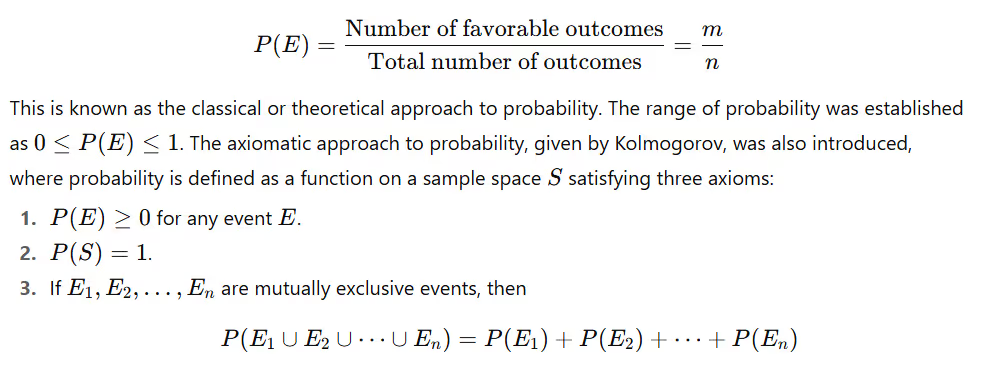
In Class 11, probability was defined using the concept of sample space and equally likely outcomes. If an experiment has n equally likely outcomes and an event E has mm favorable outcomes, then the probability of E was defined as:
Conditional Probability
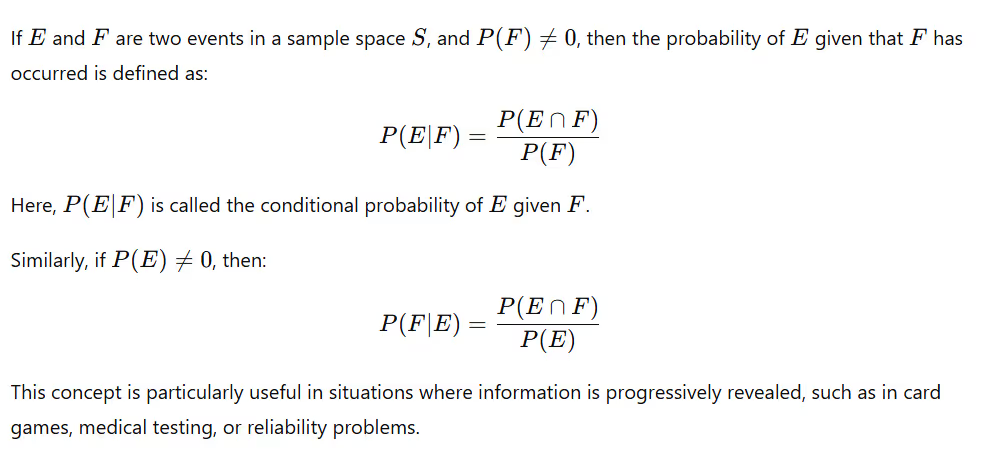
Often, we need to find the probability of an event when it is known that another event has already occurred. This leads to the concept of conditional probability.
Multiplication Theorem on Probability
The multiplication rule connects conditional probability with the probability of the intersection of two events.
For any two events E and F, we have:

This theorem is the foundation of many important results in probability, as it allows us to compute joint probabilities using conditional probabilities.
Independent Events
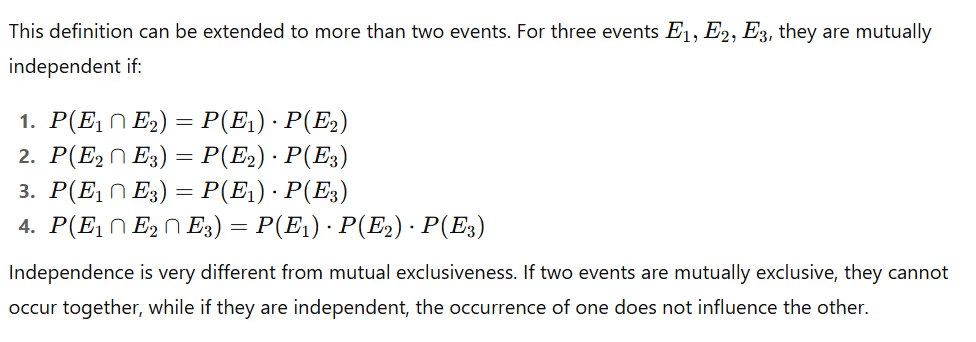
Two events E and F are said to be independent if the occurrence of one does not affect the probability of occurrence of the other. Mathematically, events E and F are independent if:

If this condition is not satisfied, the events are dependent.
Bayes’ Theorem
Bayes’ theorem is a very important result that allows us to compute the probability of a cause when the outcome is known. It is based on the multiplication theorem.

This is known as Bayes’ theorem. It is particularly useful in medical testing, fault diagnosis and decision-making problems where the probability of a hypothesis needs to be updated after new evidence is observed.
Random Variables and Probability Distribution
A random variable is a real-valued function that assigns a numerical value to each outcome of a random experiment. If X denotes a random variable, then for each outcome ss in the sample space S, X(s) is a real number.
Random variables are of two types:
- Discrete random variable takes a finite or countable number of values. Example: Number obtained on throwing a die.
- Continuous random variable takes infinitely many values within a given interval. Example: The height of students in a class.

Mean and Variance of a Random Variable
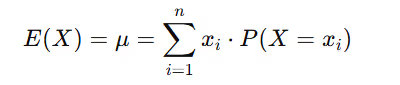
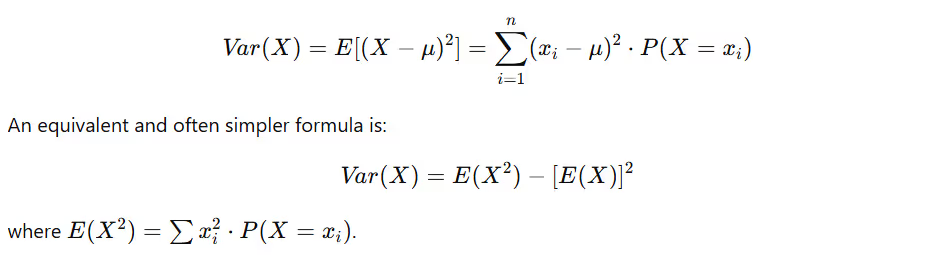
The mean (or expected value) of a discrete random variable X is the average value it takes, weighted by the probabilities. It is defined as:
The variance of a random variable measures the spread of its values around the mean. It is defined as:
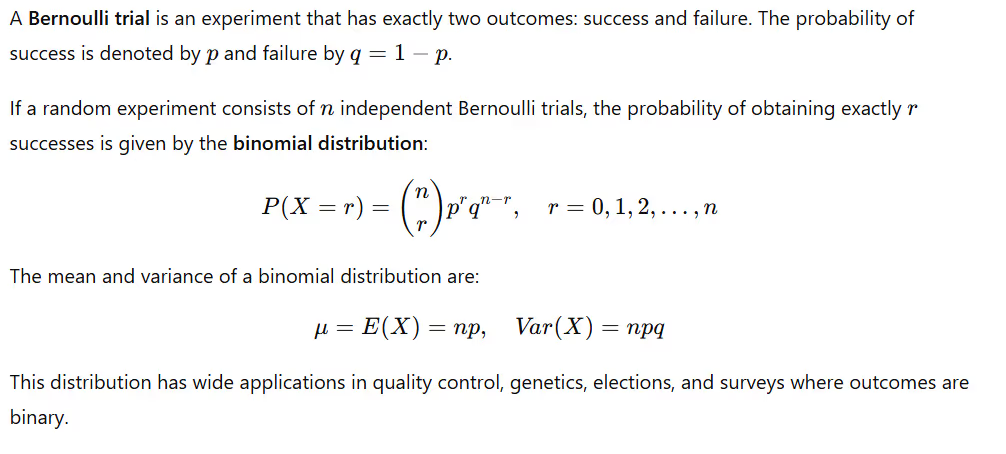
Bernoulli Trials and Binomial Distribution
Conclusion
Now that you have gone through the notes on Probability, you should feel much more confident about handling this chapter. What once seemed stressful will now appear logical and approachable because every concept has been explained in detail with clarity and purpose.
So, instead of worrying, treat these notes as your trusted guide. Stay calm, stay positive and keep practicing because success in probability, like in life, is simply about understanding patterns and applying them correctly. You’ve got this!
FAQs
Q1. What is probability?
Ans. Probability is a measure of how likely an event is to occur, ranging from zero (impossible) to one (certain).
Q2. How is probability calculated?
Ans. It is calculated by dividing the number of favorable outcomes by the total number of possible outcomes.
Q3. What are the types of events?
Ans. Events can be certain, impossible, mutually exclusive, independent, or complementary.
Q4. What is the addition rule of probability?
Ans. The probability of either of two events occurring is equal to the sum of their individual probabilities minus the probability of both occurring together.
Q5. What is the multiplication rule of probability?
Ans. The probability of two independent events occurring together is equal to the product of their individual probabilities.












.svg)

